Yeah, any metric will be bastardized at some point. It's definitely worth considering how this can go wrong.
27.02.2026 21:02 — 👍 1 🔁 0 💬 1 📌 0Yeah, any metric will be bastardized at some point. It's definitely worth considering how this can go wrong.
27.02.2026 21:02 — 👍 1 🔁 0 💬 1 📌 0But maybe I misunderstood your point. If you’re asking whether I would try to replicate work I think is unimportant, then I would say no. There’s already more than enough interesting and important science that I would try to replicate first.
27.02.2026 01:35 — 👍 1 🔁 0 💬 0 📌 0Even if funders reward replication work to some degree, I doubt that most people will be able to get a grant with none of their own publications and only peer replication reports on their CV. So no, I do not anticipate hoards of scientists abandoning research altogether to do only replications.
27.02.2026 01:28 — 👍 0 🔁 0 💬 1 📌 0
Acknowledge that this is a challenge.
But I can’t help but wonder if people made similar arguments when peer review was first proposed.
Sorry, I now see that you said review *article*.
Some people still *do* write review articles, even though they only partially help one’s career. And reading an entire review article is a pretty time-consuming task. If scientists are willing to do that, some may be willing to do small replications.
More bad experiments is worse than fewer good ones.
Bad experiments not only teach trainees to do improper science, but it also pollutes the literature with confusing results. For example, P values calculated on technical replicates instead of independent samples is a waste of everyone’s time.
Editors, partially. But ultimately the replicators themselves. No one will be willing to try to replicate unimportant findings.
Replicators would be further incentivized to tackle splashy findings published in well respected journals, because their report would be published in the same journal.
Part of the reason is that there is no benefit conveyed to the reviewer. A replicator would get a report published in the journal with a DOI, which they could add to their CV.
I acknowledge that this is a small incentive, but funders who appreciate robust science could reward those reports.
The vast majority of papers published, especially at predatory journals and papermills, are crap. Most papers are currently ignored, and would continue to be ignored under peer replication.
Important findings should be replicated.
Fewer papers would probably be published if peer replication took off. But I would argue that the findings that would get published would be more robust, and arguably more *science* would be done, in the end.
The purpose of research is to find truth, not to generate the most PDFs.
What a silly framing. The idea would be to dedicate some small minority of time to a replication.
Scientists spend time writing reviews, which have zero benefit to their career. A published peer replication report could incrementally help.
I appreciate your concerns about replication studies. That is not what we propose.
If most Western blots, IF stainings, or flow cytometry experiments can’t be replicated, even when the original authors supply adequate protocols, guidance, and reagents—then I think that indicates a major problem.
1) So you can just be more skeptical of papers that aren't replicated.
2) We tried to address it, but funding is indeed an issue. Depending on the journal, it might be worth spending a little time and money to get a replication report published and on your CV.
The original manuscript and the replication could still be published, with an explanation to the reader. Or at minimum, the replication report could be published.
I'm not sure that "no one" will try to replicate: if you could get a mini-publication in Science with one gel, might you consider it?
Want to call it garbage to my face? 🤣
We do try to address funding in the piece, but I acknowledge that it's still an issue with the idea. But I would argue that if 10% of current science funding went toward making science more rigorous (at the expense of a few bad papers), that would be OK.
Thanks again, @acharlesorszag.bsky.social, @skruberk.bsky.social, @mullinslab.bsky.social, and Anders!
09.02.2026 19:16 — 👍 3 🔁 0 💬 0 📌 0Update: our #PeerReplication idea is now published in EMBO Reports: doi.org/10.1038/s443...
09.02.2026 19:02 — 👍 4 🔁 1 💬 1 📌 1
#arXiv #April1st PromoPlot: Covering open-access fees by filling wasted space in corner plots https://arxiv.org/abs/2503.24254 a novel technique can allow authors to reduce or eliminate publication charges for journals such as MNRAS and ApJ.
01.04.2025 08:35 — 👍 1 🔁 1 💬 0 📌 0
Here's the reason I ask: I'd like to write up about some basic science researchers who preregistered their plan and how the experience ultimately played out. #OpenScience #Preregistration
blog.everydayscientist.com/the-case-for...
Any cell biologists out there who have preregistered your data collection/analysis plans before starting an experiment? Either on an official depository or unofficially? I'd be curious about your experience.
21.01.2026 23:48 — 👍 2 🔁 1 💬 0 📌 1
Here's my idea for better science funding: blog.everydayscientist.com/end-grant-wr...
Instead of funding grants, just award financial prizes for good papers. Award half the prize upon publication; award the second half upon replication, 25% to the original authors and 25% to the replicators.

Preprint drop! 🚨 Rhobin-tag your proteins and watch Saci glow at high temps! 🔥 Bright, photostable, live-cell imaging made possible with JF dyes. Huge thanks to @samjlord.bsky.social @acharlesorszag.bsky.social @mullinslab.bsky.social and Bo Huang lab at UCSF.😊
www.biorxiv.org/content/10.1...
So grateful to all collaborators on this huge effort!
@mullinslab.bsky.social at UCSF with Natalie Petek, @samjlord.bsky.social, and @skruberk.bsky.social now at Gonzaga with Ethan MacVicar for microscopy & motility analyses

The Incindiamoeba preprint is out and getting great press! (featuring one of Natalie Petek's HOTTT movies) Congratulations to Beryl Rappaport (@hbrappap.bsky.social) and everyone else who made this happen (including @samjlord.bsky.social and @skruberk.bsky.social). Super-fun collaboration!
02.12.2025 17:47 — 👍 6 🔁 1 💬 0 📌 0Preprint alert! I’m publishing my last paper from my postdoc work on archaeal cell biology, with @mullinslab.bsky.social, @archaellum.bsky.social, @samjlord.bsky.social, @marleenvw.bsky.social, @arghya93.bsky.social, and more great folks (thread below with more details)
16.04.2025 18:55 — 👍 57 🔁 19 💬 7 📌 3It’s “Washington’s Birthday,” officially.
17.02.2025 14:22 — 👍 1 🔁 0 💬 0 📌 0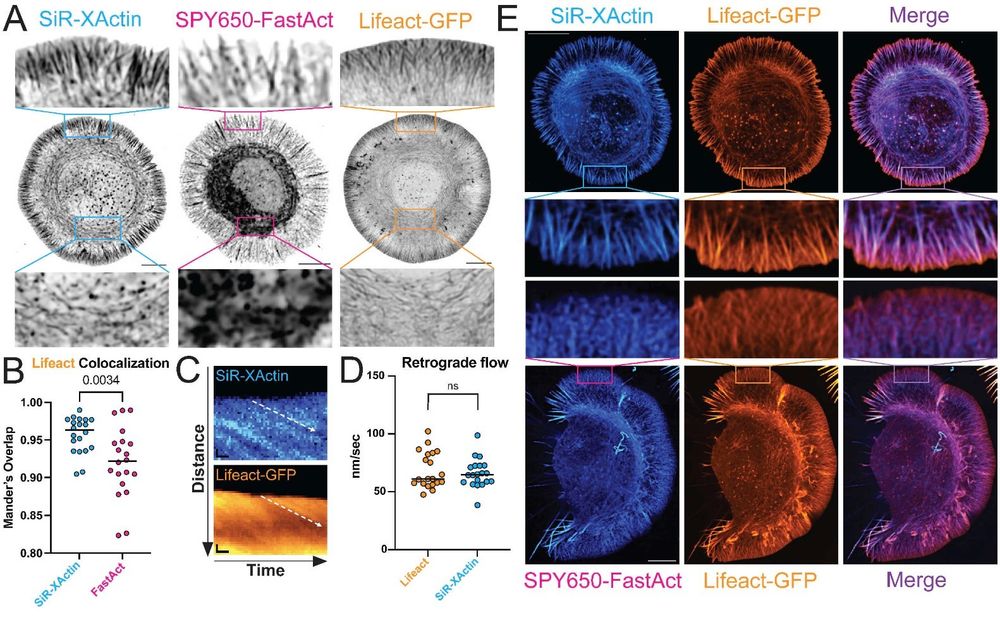
New actin probe from @veselin-nasufovic.bsky.social et al! SiR-XActin and its variants are more photostable and less perturbative than SiR-actin or FastAct. And it's already available from @spirochrome.com! With some beautiful data from @chillinwithpfn1.bsky.social:
www.biorxiv.org/content/10.1...
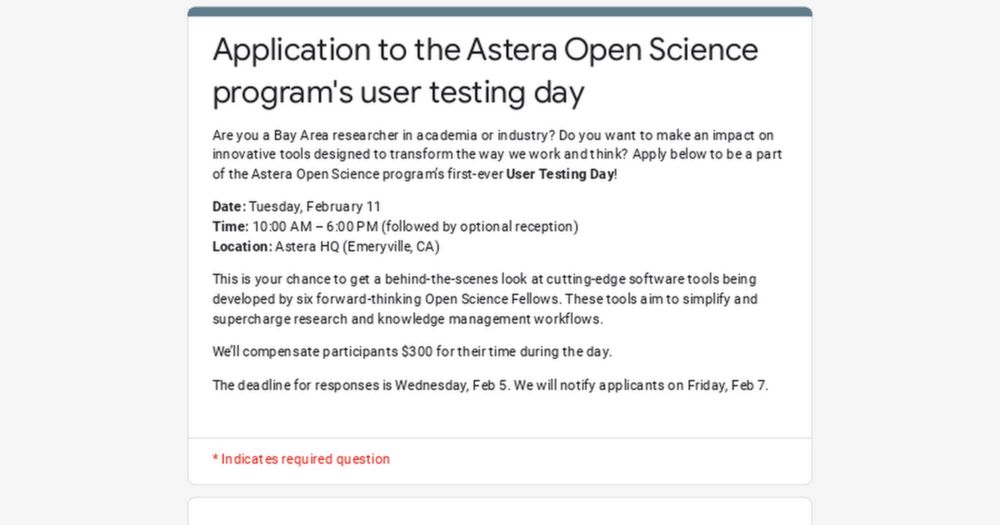
Calling all Bay Area researchers for a paid opportunity: the @asterainstitute.bsky.social Open Science Program’s User Testing Day in Emeryville on Feb 11!
📍 Try cutting-edge research tools
💡 Share feedback
🍷 Network
Apply by Feb 5: forms.gle/1qk4PHjbee35...
#UXTesting #Biotech #OpenScience