This is one of my favorite trees on campus!
14.05.2025 20:52 — 👍 1 🔁 0 💬 1 📌 0
Despite how things ended, I still learned so much from my time at EPA about how applied, interdisciplinary science can drive progress on complex problems like climate change. I look forward to taking these experiences into my next chapter, with more details on that soon! 7/7
06.05.2025 22:02 — 👍 18 🔁 2 💬 2 📌 0
As many of these people might be on the job market soon given the destruction of the EPA’s Office of Research and Development, I cannot emphasize enough how much of an asset they would be to any team. 6/7
06.05.2025 22:02 — 👍 12 🔁 1 💬 1 📌 0
They are a truly special group of brilliant and dedicated scientists, and even with the growing challenges we faced in our work over the past few months it amazed me how they always continued to show up with care and kindness for each other and those that we served. 5/7
06.05.2025 22:02 — 👍 12 🔁 1 💬 1 📌 0
Nevertheless, I’m so grateful to the incredible colleagues I got to work with in the Integrated Climate Sciences Division at EPA and am so proud of the things we were able to accomplish. 4/7
06.05.2025 22:02 — 👍 12 🔁 1 💬 2 📌 0
On a broader level, I’m deeply concerned about the larger trend of dismantling scientific research at EPA, especially after having spent the last several months getting to see firsthand how this vital work supports safer, cleaner, and more resilient communities. 3/7
06.05.2025 22:02 — 👍 22 🔁 5 💬 1 📌 0
On a personal level, I’m heartbroken. I had come to DC in the hopes that I could use my years of scientific training to serve the public. 2/7
06.05.2025 22:02 — 👍 24 🔁 3 💬 2 📌 0
Recently, all the AAAS Science & Tech Policy Fellows at EPA were terminated from our positions with little notice and for no clear reason. This effectively ended a partnership that had been going since 1980 and which had brought hundreds of scientists to the EPA as fellows, many of whom stayed. 1/7
06.05.2025 22:02 — 👍 85 🔁 45 💬 3 📌 5

Took your tip and checked out the Smithsonian Castle magnolias yesterday for my afternoon “desperately in need of some sunlight and fresh air” walk. Truly delightful!
26.03.2025 18:01 — 👍 3 🔁 0 💬 1 📌 0
@msp-lter.bsky.social, UMN St. Anthony Falls Lab (SAFL), and UMN College of Science & Engineering (CSE) researchers @jvwilkening.bsky.social and Xue Feng's new paper impresses the importance of keeping our urban #treecanopy healthy to promote urban #resilience and climate #adaptation
12.03.2025 23:44 — 👍 4 🔁 1 💬 1 📌 0
Haven’t had a chance to pull together a thread on the paper, but so cool to see this highlight on some of my postdoc work! Urban trees can be a great tool for resiliency, but to be effective we also need to think about how the varied urban landscape leads to differences in how trees provide benefits
18.02.2025 14:50 — 👍 15 🔁 1 💬 1 📌 1
Done!
14.02.2025 12:44 — 👍 1 🔁 0 💬 0 📌 0
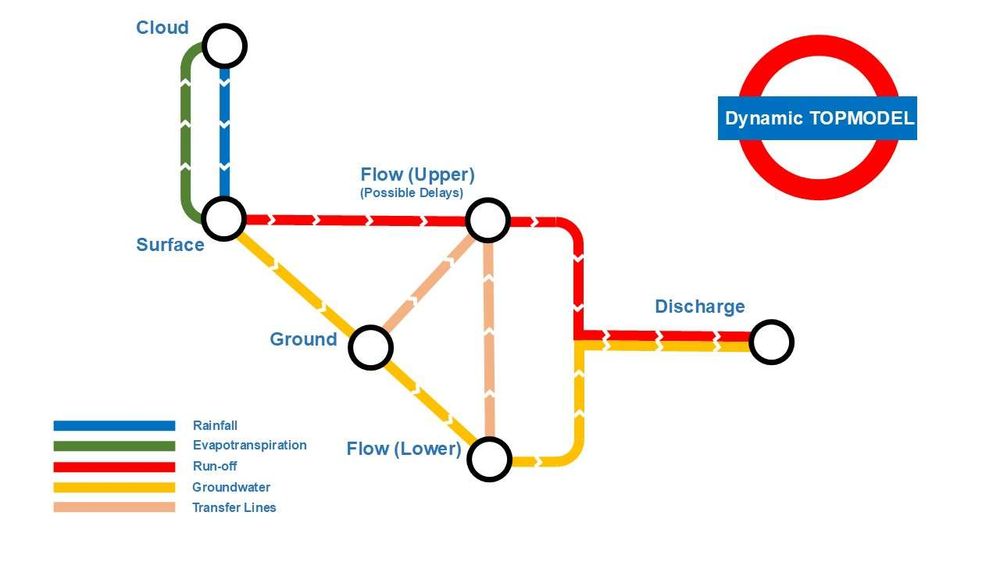
A conceptual model for the Dynamic-TOPMODEL hydrological model in the style of the London Underground Map. Flow transfers are shown as lines and stores as stations.
Conceptual hydrology models in the style of the Tube map?
Going through some old files from a few years ago and found this idea I was toying with. Not sure it is entirely accurate.
30.01.2025 12:58 — 👍 25 🔁 4 💬 2 📌 0
Must also shout out everyone who made this possible, especially @drsallyet.bsky.social & Todd Dawson. This was a beast of a dissertation chapter that took up a lot of my mental, physical, and emotional energy in grad school. And we pulled it off even though a global pandemic got in the way 🫠
24.01.2025 16:28 — 👍 1 🔁 0 💬 0 📌 0
TLDR: Collecting more simultaneous measurements of different parts of this high dimensional system during drought response and recovery is really valuable for identifying drivers and mechanisms, but there are also ways we can be strategic about it in terms of what measurements we take when.
24.01.2025 16:28 — 👍 0 🔁 0 💬 1 📌 0
From that we saw a couple different things: 1) environmental variables are generally valuable as constraints & important things to measure, & 2) dynamics after (vs during) drought are generally harder to constrain, so targeting more intensive data collection after drought could be strategic
24.01.2025 16:28 — 👍 0 🔁 0 💬 1 📌 0
Beyond just trying to understand what happened in this experiment, we also wanted to think about how we might better approach data collection during and after drought. To do this, we used metrics from information theory to characterize the “value” of msmnts as constraints fluxes and water status.
24.01.2025 16:28 — 👍 1 🔁 0 💬 1 📌 0

Figure showing photos of the trees over the course of the experiment. Following rewatering, there is a lot of leaf yellowing and drop.
Through piecing together different types of data that we collected, we hypothesize that this was likely due to a hormonal drought response, where effects can persist even after soil moisture is replenished via stomatal closure and changes in morphology (e.g., leaf area)
24.01.2025 16:28 — 👍 0 🔁 0 💬 1 📌 0

Figure showing six panels of sap flow data, one for each tree. As the drydown progressed, sap flow rates dropped. But even after rewatering, most trees still had much lower sap flow than they did at the beginning of the experiment.
We saw that despite not pushing the trees to a point embolism, they showed a delayed & only partial recovery of water fluxes. We also saw a decoupling between sap flow and leaf water potentials after the trees were rewatered, and there was significant yellowing and leaf drop even after rewatering.
24.01.2025 16:28 — 👍 0 🔁 0 💬 1 📌 0
This is a bit of what this looked like behind the scenes for a couple weeks in Summer 2021. Safe to say I was a very tired PhD student.
24.01.2025 16:28 — 👍 0 🔁 0 💬 1 📌 0
And I mean a LOT of measurements. In addition to installed sensors for sap flux and met, I tallied:
90 soil moisture, 196 leaf water potential, 540 isotope,
122 leaf area, 78 gas exchange, 21 root mass, 2 soil H2O retention curves, 6 vulnerability curves, 3 A/Ci curves & 5 light response curves
24.01.2025 16:28 — 👍 0 🔁 0 💬 1 📌 0

Figure from the manuscript. The experimental setup consisted of six potted Populus trichocarpa trees on which various measurements were made to characterise plant function, environmental conditions and fluxes of water and carbon. Some of these measurements were continual (green), some were done only during select intensive sampling days (red) and others acted as background measurements that were completed before the start or following the conclusion of the experiment (blue). On Day 0, an 18O tracer was applied to the soil surface and a D tracer was injected halfway down the
65 cm soil column. Three intensive sampling days occurred on Days 2, 5 and 8, during the drydown period. The trees were then rewatered on Day 10 and a D tracer was applied to the surface. During the subsequent recovery period, two intensive sampling days occurred on Days 12 and 15. In this and the subsequent result figures, the drydown sampling days are represented with progressively darker shades of red, and the recovery sampling days are represented with progressively darker shades of blue.
In our experiment, we subjected trees to a drydown followed by a recovery period and were interested in exploring what we can do when we have a lot of data about these dynamics. So we took measurements to characterize water fluxes, water status, physiological traits, & environmental conditions.
24.01.2025 16:28 — 👍 1 🔁 0 💬 1 📌 0
hello world! 👋
15.12.2024 23:35 — 👍 15 🔁 4 💬 3 📌 1
If you happen to be one of the approximately 12 people left at #AGU24 this afternoon, come hear me talk about urban trees and machine learning (H53W-03) from 2:34-2:46!
13.12.2024 17:00 — 👍 9 🔁 1 💬 0 📌 0
The AGU Ecohydrology Technical Committee is finally over here: @aguecohydro.bsky.social ! Give them a follow for plenty of ecohydro goodness!
12.12.2024 23:07 — 👍 6 🔁 1 💬 0 📌 0
Amazing, will be making a stop there. Thanks!!
12.12.2024 11:32 — 👍 1 🔁 0 💬 0 📌 0
Wait where are these?!
12.12.2024 11:21 — 👍 0 🔁 0 💬 1 📌 0
postdoc at Oregon State & water enthusiast // headwaters, stream intermittency, and watershed structure // VT and Bama almuna (roll hokies) // she/her #BLM
Assistant Professor, University of Illinois Springfield
PI, WATER Lab
Ecohydrology, water resource management, urban heat and microclimates, remote sensing, STEM education, and JEDI
https://kyleblount.weebly.com/
https://www.uis.edu/directory/kyle-blount
Biologist. Scientific Researcher from CONICET at GEA, San Luis, Argentina.
Ecohydrology, semiarid mountains, catchments, plant-water relations, SPAC, ecosystem ecology.
Asst Prof at Univ. of Nevada, Reno. Ecohydrology and Ecosystem Processes (EEP!) Lab. Amateur Sculptor. He/Him. tinyurl.com/EEPLabAllenUNR
Retired from EPA Office of Research and Development, focused on climate change issues. Active with US Global Change Research Program, interested in climate intervention. University of Arizona, North Carolina State University, mechanical engineer
energy system modeller | head of department at Jülich Systems Analysis (FZJ-ICE-2) https://www.fz-juelich.de/en/ice/ice-2/research-1/integrated-scenarios
Data and Impact Manager at RCAC. MS & BS Hydrology, UC Davis.
Amanda Katz said this was the cool kids table.
Science, analysis, and news around climate change's impacts on the economy, focusing on growth, inflation, investment, companies, consumers #ClimateRisk #ClimateImpacts
plant bio, poet, tap dancer; 🌈 ; #blacklivesmatter
asst. prof: PLACE (PLant physiology, Art and Community Engagement) Lab at Smith College
Environmental researcher-practitioner and educator in water and climate with @luskininnovation.bsky.social and @ucanr.edu. Artist, curator, and wilderness explorer in between.
Background in geography, archaeology, & programming - agent-based evacuation models - high performance computing - geographic information systems - learning Bangla - interested in many things - UIUC CIGI Lab & CyberGIS Center - She/they
Assistant Professor and O.N. Allen Professor of Soil Microbiology at UW-Madison. https://freedmanlab.soils.wisc.edu
UC Davis Center for Watershed Sciences — dedicated to the interdisciplinary study of critical water issues in California. Follow our other accounts at https://linktr.ee/ucdaviswater
President @ucs.org. Previously: USDOT, White House OSTP, @500womensci.bsky.social. Environmental engineer. Mom. Cyclist. Public Transit Enthusiast. Views my own. She/her.
I run HEATED, a weekly-ish newsletter devoted to climate accountability reporting and opinion. Philly-based. She/her.
📧: emorwee@proton.me
Signal: @emorwee.06
Full-Time Federal Campaigns Director @NRDC.org 🌎. Part-Time Westie belly scratcher 🐶. Breast cancer thriver. 🫶🏻 Denver based 🏔️ World bound. ✈️
Alum of:
✔️Kamala Harris
✔️First Descents
✔️Hillary
✔️Planned Parenthood
✔️Wellesley College