Thank you, Marta! 😊
13.02.2026 08:37 — 👍 0 🔁 0 💬 0 📌 0
Very glad that our first DEMNORM paper found such a great home at @thejop.bsky.social. If you’re interested in the role of social desirability in online surveys, check out the thread and paper below ⬇️
13.02.2026 08:32 — 👍 23 🔁 7 💬 1 📌 0
From context to congruence: Immigration salience and voter socialization | European Journal of Political Research | Cambridge Core
From context to congruence: Immigration salience and voter socialization
🚨Happy to finally see this out in the @ejprjournal.bsky.social (with @leonardocarella.bsky.social)
⁉️ Does growing up when immigration is salient make people vote for parties they agree with on immigration *for the rest of their lives*?
doi.org/10.1017/S147...
27.01.2026 08:17 — 👍 73 🔁 38 💬 1 📌 0

📄 New WP version out: revised text, tightened argument, and new analysis.
The Politics of Evidence Selection (w/ @jesperasring.bsky.social)
Grateful for the helpful comments and presentation opportunities. Further feedback welcome!
🔗 osf.io/preprints/so...
20.01.2026 16:01 — 👍 42 🔁 14 💬 1 📌 2

New paper in @ajpseditor.bsky.social. Is descriptive representation good for substantive representation? Why do voters stay loyal to corrupt and poorly governing ethnic parties? I argue that we ought to focus less on patronage and more on dignity concerns. Defiant pride can come at a price. 1/🧵
08.12.2025 22:01 — 👍 112 🔁 39 💬 3 📌 5
Just published in @bjpols.bsky.social: @sergipardos.bsky.social and I show that inter-regional moves in pursuit of employment security reduce individual worries about immigration—a mobility pattern that, in the aggregate, reinforces spatial polarization in anti-immigration sentiment. cup.org/3XiB6yD
10.11.2025 13:20 — 👍 90 🔁 38 💬 1 📌 3
How do contemporary challenges of backsliding and war interact? We show that interstate conflict boosts support for undemocratic candidates, especially among Republicans who *do not prefer democratic Rs over undemocratic Rs* during interstate conflict.
Out in @bjpols.bsky.social with Lasse Laustsen
28.10.2025 09:46 — 👍 20 🔁 12 💬 1 📌 0

Abstract for the article: How does right-wing terrorism affect electoral support for populist radical right parties (PRRPs)? Recent research has produced contrary answers to this question. We argue that only high-intensity attacks, whose motives and targets mirror PRRPs’ nativist agenda, are likely to generate a media backlash that dampens electoral support for PRRPs. We test this argument by combining high-frequency survey and social media data with a natural and survey experimental design. We find that right-wing terror reduced support for the radical right party Alternative für Deutschland after one of the most intense nativist attacks in recent German history. An analysis of all ninety-eight fatal right-wing attacks in Germany between 1990 and 2020 supports our argument. Our findings contribute to an understanding of how political violence triggers partisan detachment and have important implications for media responsibility in the aftermath of terrorist attacks.
🚨 New article out!
“Right-Wing Terror, Media Backlash, and Voting Preferences for the Far Right” in @bjpols.bsky.social
👉 doi.org/10.1017/S000...
We (Alex De Juan, @juvoss.bsky.social & I) examine how right-wing attacks shape support for the far-right in Germany.
Short summary thread below 👇
22.10.2025 15:14 — 👍 118 🔁 49 💬 1 📌 5

Abstract
New paper out with @dasalgon.bsky.social: “Far-Right Agenda Setting: How the Far Right influences the Political Mainstream” doi.org/10.1017/S1475676525100066 #openaccess in @ejprjournal.bsky.social🧵
07.10.2025 07:14 — 👍 474 🔁 206 💬 6 📌 16

🚨 New paper in @thejop.bsky.social
Why do politicians often misperceive what citizens' policy positions are?
@simonotjes.bsky.social and I study ~10,000 estimates of public opinion by politicians in Denmark & the Netherlands to uncover the sources of these (mis)perceptions
Thread 🧵1/10
29.09.2025 07:18 — 👍 168 🔁 66 💬 2 📌 4
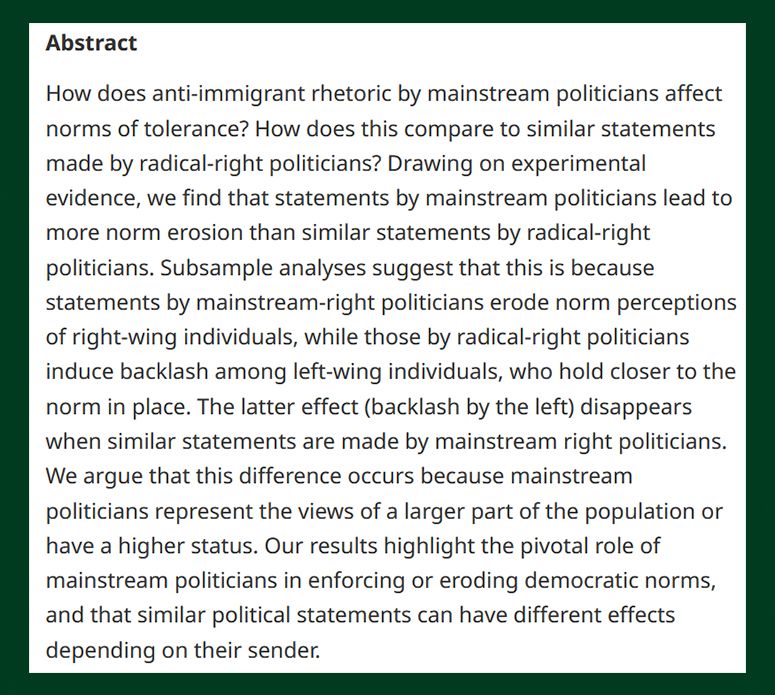
BJPolS abstract discussing the dynamics of mainstream and radical political rhetoric regarding anti-immigrant policies, highlighting differences in societal responses and enforcement norms based on the source of the rhetoric.
NEW -
How Mainstream Politicians Erode Norms - cup.org/4lfeHvD
"we find that statements by mainstream politicians lead to more norm erosion than similar statements by radical-right politicians"
- @valentimvicente.bsky.social, Elias Dinas & @dziblatt.bsky.social
#OpenAccess
11.08.2025 08:45 — 👍 182 🔁 96 💬 4 📌 17
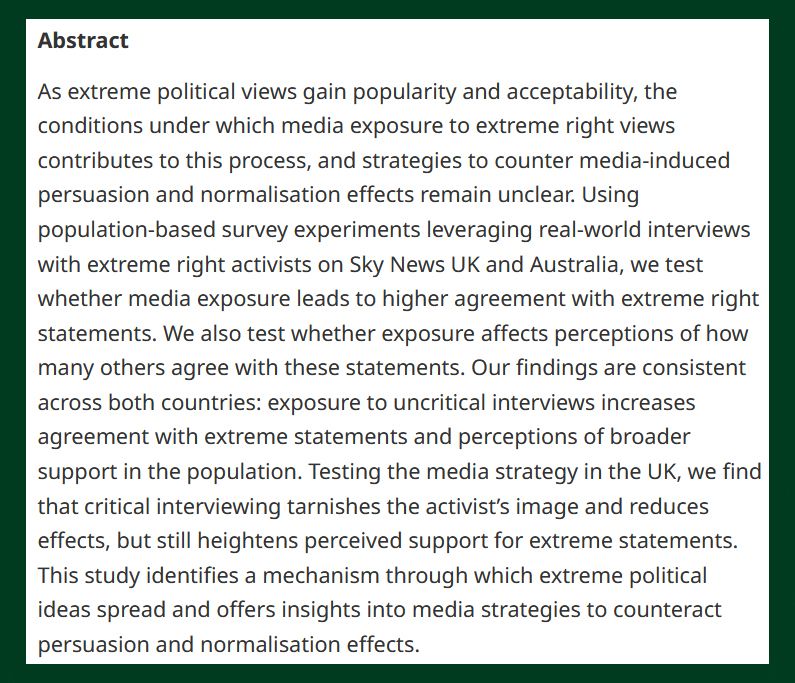
BJPolS abstract discussing the effects of extensive media exposure on public perceptions and normalization. It references specific research surveys conducted on Sky News UK and Australia, analyzing changes in public attitudes and policy effects due to media strategies.
NEW -
Media Platforming and the Normalisation of Extreme Right Views - cup.org/4mmVIAL
"exposure to uncritical interviews increases agreement with extreme statements and perceptions of broader support in the population"
- @dianebolet.bsky.social & @florianfoos.bsky.social
#OpenAccess
12.08.2025 09:05 — 👍 280 🔁 151 💬 5 📌 24
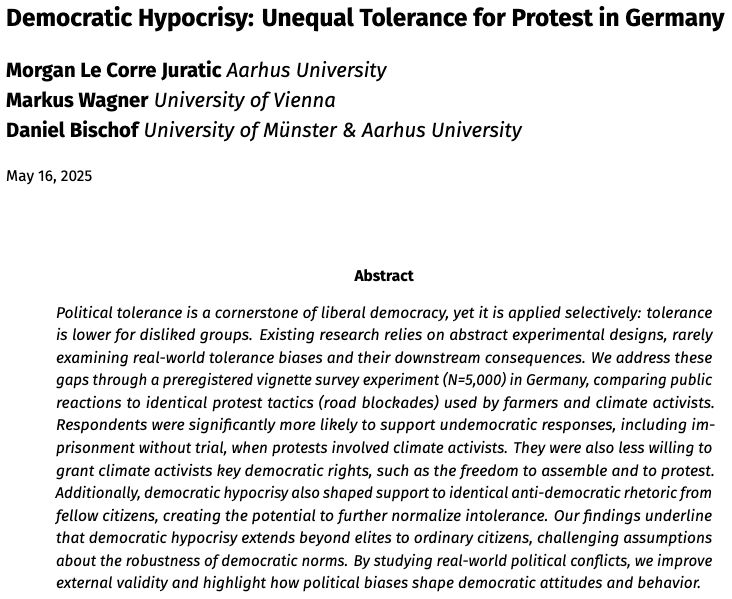
🚨 working paper (w. @morganlcj.bsky.social @markuswagner.bsky.social): Protesters are not judged equally - even if tactics of groups are similar.
We ran an experiment in 🇩🇪 testing how people react to farmers vs. climate activists blocking roads.
What we find is disturbing:
osf.io/preprints/os...
16.05.2025 12:59 — 👍 361 🔁 147 💬 10 📌 23
🚨 My first publication, co-authored with Sylvia Kritzinger & Susanna Bastaroli, is out! In our chapter, we explore how Italians re-elaborate their country’s role in the WWII & the Holocaust.
Available online & in print (EN): www.wallstein-verlag.de/978383535866...
🧵 Some key findings: 👇
15.05.2025 07:00 — 👍 15 🔁 4 💬 3 📌 0
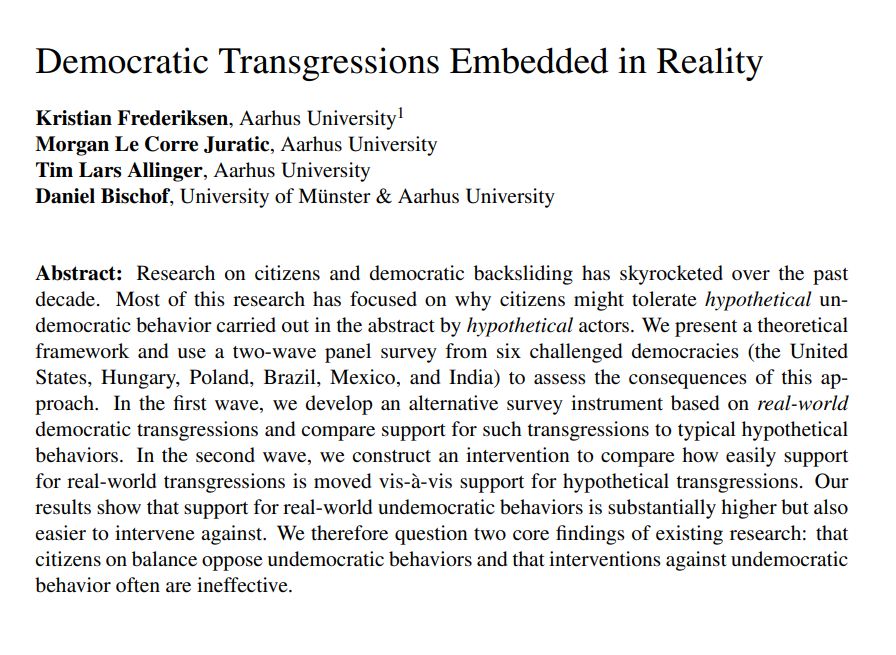
🛎️New WP with @morganlcj.bsky.social @timallinger.bsky.social and @danbischof.bsky.social
Against the surge of conjoints and other hypothetical experiments in relation to democratic backsliding, we study the consequences of using hypotheticals versus real-world scenarios.
osf.io/preprints/os...
14.05.2025 10:06 — 👍 53 🔁 19 💬 1 📌 2
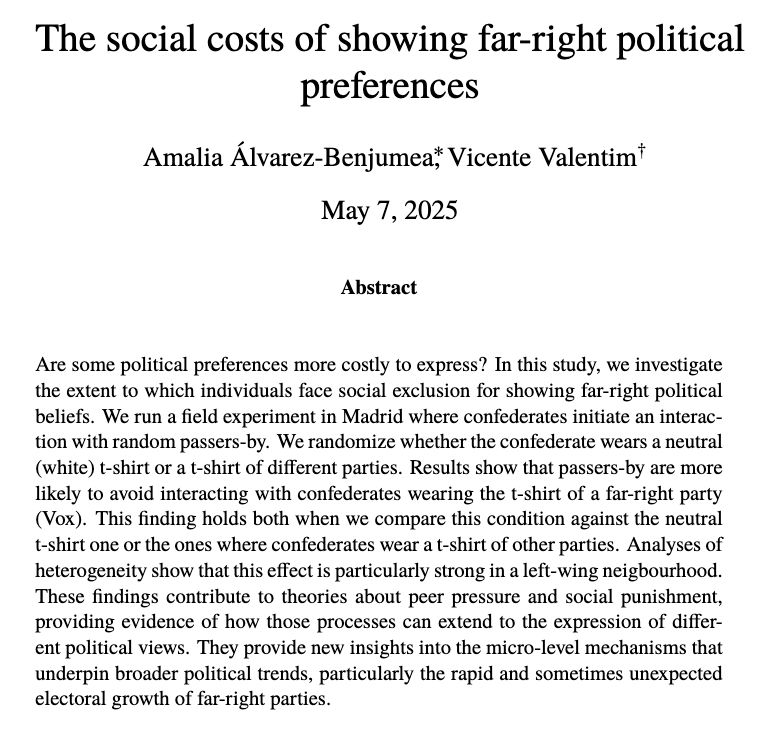
Paper abstract: Are some political preferences more costly to express? In this study, we investigate the extent to which individuals face social exclusion for showing far-right political beliefs. We run a field experiment in Madrid where confederates initiate an interaction with random passers-by. We randomize whether the confederate wears a neutral (white) t-shirt or a t-shirt of different parties. Results show that passers-by are more likely to avoid interacting with confederates wearing the t-shirt of a far-right party (Vox). This finding holds both when we compare this condition against the neutral t-shirt one or the ones where confederates wear a t-shirt of other parties. Analyses of heterogeneity show that this effect is particularly strong in a left-wing neigbourhood. These findings contribute to theories about peer pressure and social punishment, providing evidence of how those processes can extend to the expression of different political views. They provide new insights into the micro-level mechanisms that underpin broader political trends, particularly the rapid and sometimes unexpected electoral growth of far-right parties.
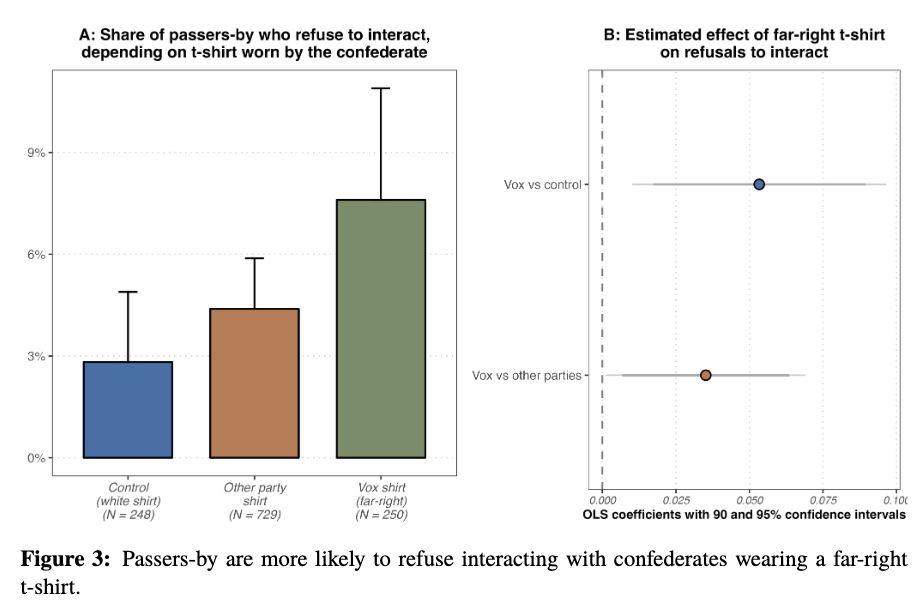
I am very excited to share a new working paper coauthored with @amaliaab.bsky.social.
Using a field experiment, we find that, in the real world, it is more costly to express far-right preferences than other political preferences.
osf.io/preprints/os...
1/8
09.05.2025 15:39 — 👍 102 🔁 23 💬 8 📌 6

Does Mainstream Populism Work❓
I answer this question in a new paper officially out at @psrm.bsky.social❗
Check out the paper here: doi.org/10.1017/psrm...
Key take-aways in the thread below 🧵⬇️:
25.03.2025 12:29 — 👍 157 🔁 55 💬 4 📌 4

Deutscher Bundestag - Unionsgesetz zur Zustrombegrenzung mit knapper Mehrheit abgelehnt
Der Bundestag hat das sogenannte Zustrombegrenzungsgesetz der CDU/CSU-Fraktion (20/12804) mit knapper Mehrheit abgelehnt. Gegen die Initiative votierten am Freitag, 31. Januar 2025,...
You wonder how the CDU/CSU playing with the "Brandmauer" to AfD last week has influenced German voters? @mafaldapratas.bsky.social @jmfernandes86.bsky.social & I have you covered. We surveyed sample of 2,000 German voters. 🧵with first results 👇. Spoiler: It did not go down as well as CDU/CSU hoped.
07.02.2025 08:49 — 👍 163 🔁 79 💬 5 📌 12
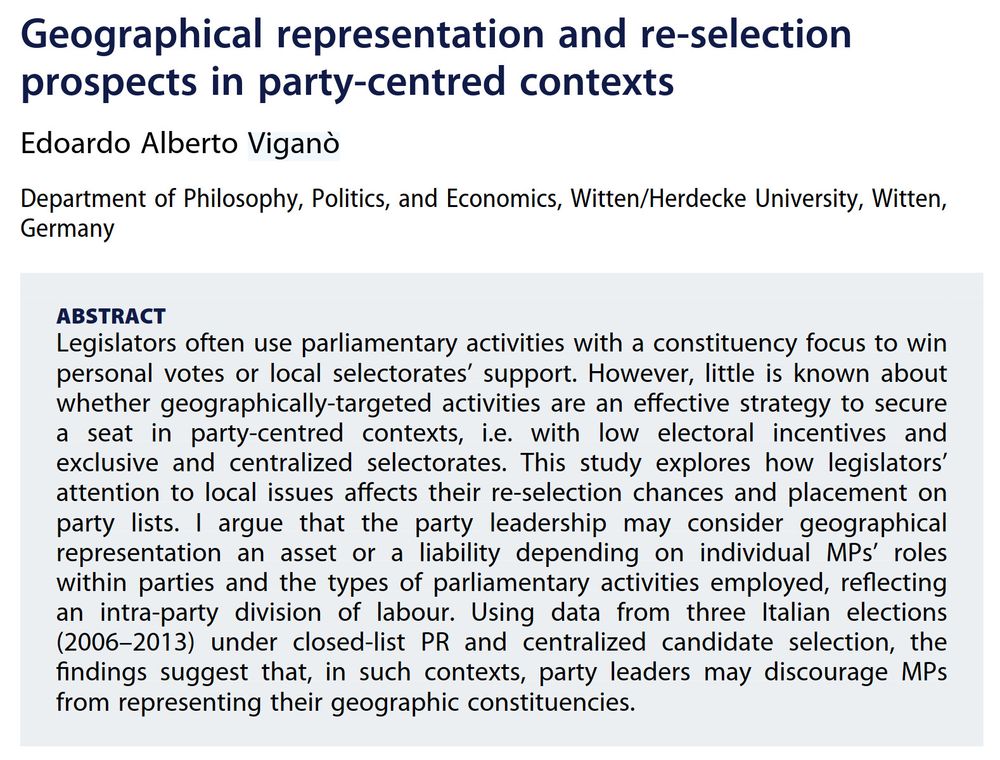
🚨 Happy to see one of my PhD papers out at JEPOP
📚 I examine whether MPs' attention to local issues in parliamentary activities affects their re-election chances in party-centred contexts
www.tandfonline.com/eprint/G2HVG...
Ungated version here: eavigano.github.io/papers/jepop...
04.02.2025 09:53 — 👍 13 🔁 4 💬 0 📌 0
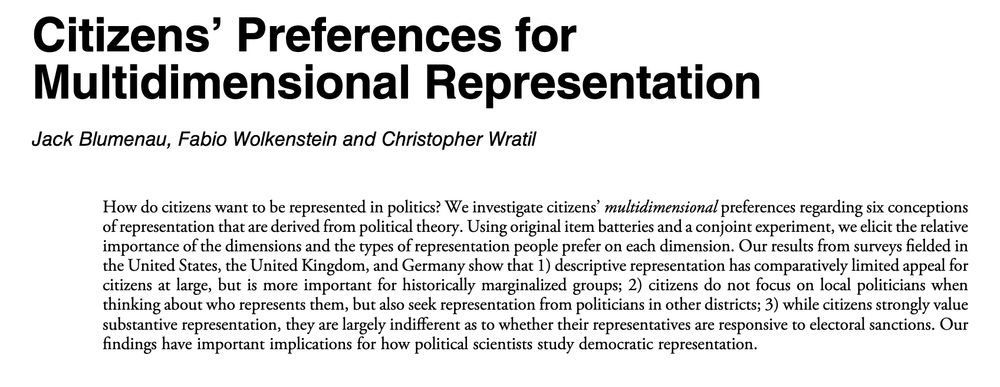
🚨 Out now in @poppublicsphere.bsky.social
: "Citizens' Preferences for Multidimensional Representation". Jack Blumenau, Fabio Wolkenstein & I investigate citizens' preferences regarding 6 dimensions of representation using surveys conducted in 🇬🇧🇺🇸🇩🇪. Short 🧵(1/10) doi.org/10.1017/S15375
10.01.2025 10:20 — 👍 75 🔁 34 💬 2 📌 3
Asymmetric Responsiveness: The Effects of Protesters’ Demographics and Policy Preferences on the Political Agenda
New working paper!
How do protesters' demographics and policy preferences affect politicians' responsiveness to their demands? I find no effects of shared demographics btw. protesters and politicians, but asymmetric responsiveness to left-right policy preferences: gupea.ub.gu.se/handle/2077/...
18.12.2024 07:55 — 👍 30 🔁 11 💬 0 📌 1
🚨 New @apsrjournal.bsky.social Paper! 🚨
In “When Migrants Mobilize against Labor Exploitation: Evidence from the Italian Farmlands,” I study how empowering undocumented migrants can reduce labor exploitation and even weaken organized crime.
Thread : 🧵
11.12.2024 18:04 — 👍 117 🔁 47 💬 2 📌 2

The super election year is ending, with many winners and losers.
Our new @thejop.bsky.social paper, (@henrikseeberg.bsky.social, @martinbaekgaard.bsky.social ) asks: How do winning and losing candidates see elections?
Spoiler: Losers are more concerned about fairness.
Link: doi.org/10.1086/734240
11.12.2024 12:09 — 👍 42 🔁 18 💬 3 📌 1
What Can We Learn about the Effects of Democracy Using Cross-National Data? | American Political Science Review | Cambridge Core
What Can We Learn about the Effects of Democracy Using Cross-National Data?
Thrilled that my article has just been published at @apsrjournal.bsky.social! 🎉 The article argues that low statistical power is a major impediment to acquiring cumulative knowledge on questions concerning cross-national differences: www.cambridge.org/core/journal...
10.12.2024 11:14 — 👍 150 🔁 44 💬 8 📌 10

Postdoctoral positions in Political Science at Aarhus University – Advertising Democracy - Vacancy at Aarhus University
Vacancy at Department of Political Science, Aarhus University
Join our team! 🚨
We are hiring 2 postdocs for the new Advertising Democracy project at Aarhus University.
We are looking for researchers who are passionate about advertisements & citizens’ democratic values in Western democracies.
Feel free to share!👇🏾
bss.au.dk/en/about-aar...
03.12.2024 09:07 — 👍 64 🔁 57 💬 0 📌 4
PhD Student Political Science Aarhus University | Interested in Political Parties & Issue Competition | prev. MA Social Sciences HU Berlin, BA Political Science FU Berlin, student assistant Manifesto Project at WZB Berlin, methods chair FU sociology dept
PhD Researcher & Lecturer @HumboldtUni.
Reactionary Politics | Racism | Polarisation | Political Communication
he/him
PhD Candidate at ETH Zurich | Interested in the implications of climate change for conflict management.
PostDoc in Politics, University of Zurich | Oxford PhD | Interests: Digital Politics, Polarisation, & Computational Social Science.
giulianoformisano.github.io
Doctoral student at University of Cologne. Interested in electoral politics, fiscal policy, (historical) political economy. https://nblossey.github.io/
Postdoc research fellow at Aarhus; PhD from Essex; protest violence; computational social science 🔬
https://www.winniexia.com
Professor of Political Science at University College London
political scientist • how people engage with info, and why this matters for attitudes and policy around the world • Deputy Editor @migrationjrnl.bsky.social • UK Young Academy • all the baking • www.wlallen.com
Political scientist at Harvard. www.mashailmalik.com
PhDing in Political Science @IPZ at University of Zurich | Education | Labor market expectations | Political socialization
PhD student researching social movement organizations and protests targeting UN peace missions at the University of St. Gallen, Switzerland.
Phd student @ipz.bsky.social
Doctoral Researcher @ipz.bsky.social
Researcher in Political Communication with the @rpa-cs-uva.bsky.social at @ascor.bsky.social | PhD in Political Science @sspunil.bsky.social | Elite Incivility, Marginalization, Violence
website: chiaravargiu.com
PhD Candidate in Political Science @ipz.bsky.social, previously @prioresearch.bsky.social | repression, mobilization, autocratic politics, tech, ML/NLP
PhD candidate @ Osnabrück University
https://julian-voss.github.io/
Research Associate & PhD Candidate at @uni-hamburg.de | Political Science, esp. Political Behaviour, Public Opinion, and Political Communication | she/her
CIS at @ethz.ch | I study historical political economy and political behaviour—especially identity, culture, and social norms.
Project researcher in political science @UniTurku | intraparty competition | ideology | voting advice applications | FNES
Professor of Comparative Politics, Queen Mary University of London. Studies populism, radical right, politics of European integration. Staff page: https://www.qmul.ac.uk/politics/staff/profiles/vankesselstijn.html