Children leverage predictive representations for flexible, value-guided choice
By harnessing a mental model of how the world works, learners can make flexible choices in changing environments. However, while children and adolesce…
New paper out in cognition with @arikahn.bsky.social, @nathanieldaw.bsky.social, Cate Hartley, and @katenuss.bsky.social !!
We show that children 👶 use predictive representations (e.g. SR) to guide their choices, providing an account of how they can make flexible choices in a changing world
15.10.2025 10:52 — 👍 37 🔁 11 💬 0 📌 1

Does sleeping on an idea work? Here’s what science says.
Scientists are finding experimental evidence that the transition between wakefulness and sleep is a portal for creative thought.
Does Sleeping on a idea work? Nice to see our work led by the amazing @anikaloewe.bsky.social and @maritpetzka.bsky.social featured together with other studies in the WaPo:
www.washingtonpost.com/wellness/202...
Our preprint www.biorxiv.org/content/10.1...
19.03.2025 16:52 — 👍 26 🔁 8 💬 0 📌 0
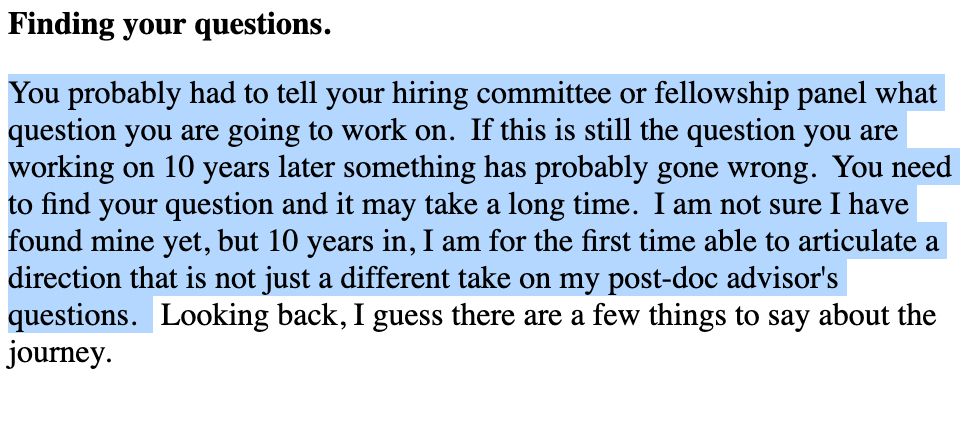
I think about this a lot. Thanks @behrenstimb.bsky.social for the wonderfully 90s-vibe blog full of wisdom!
users.fmrib.ox.ac.uk/~behrens/Sta...
17.03.2025 20:10 — 👍 92 🔁 13 💬 3 📌 2
In the chess example, the player might have learned from past experience that sacrificing one's queen is generally a bad choice. They would then be less likely to consider solutions involving this move, and less likely to make the 'aha' discovery that it is indeed optimal to do so in this case.
14.03.2025 15:21 — 👍 1 🔁 0 💬 0 📌 0
This strategy enables efficient decision-making, but can also lead us astray when our past experience isn't informative for the current context.
14.03.2025 15:21 — 👍 1 🔁 0 💬 1 📌 0
We suggest that humans and AI often fail on these problems because they both rely on a planning architecture where possible options are generated based on what was successful in the past and these options are then evaluated based on knowledge of the task at hand.
14.03.2025 15:21 — 👍 1 🔁 0 💬 1 📌 0
An example of such a problem is a chess puzzle where sacrificing one's queen is necessary to ensure victory a few steps down the line. A novice chess player who understands the rules of chess might never consider this solution, though they would certainly select it if it were proposed to them
14.03.2025 15:21 — 👍 1 🔁 0 💬 1 📌 0

Similar failures of consideration arise in human and machine planning
Humans are remarkably efficient at decision making, even in “open-ended” problems where the set of possible actions is too large for exhaustive evalua…
my paper with max, @maxkw.bsky.social, tuomas, and @fierycushman.bsky.social out in cognition at long last www.sciencedirect.com/science/arti...
We explain why humans and successful AI planners both fail on a certain kind of problem that we might describe as requiring insight or creativity
14.03.2025 15:21 — 👍 33 🔁 8 💬 1 📌 1
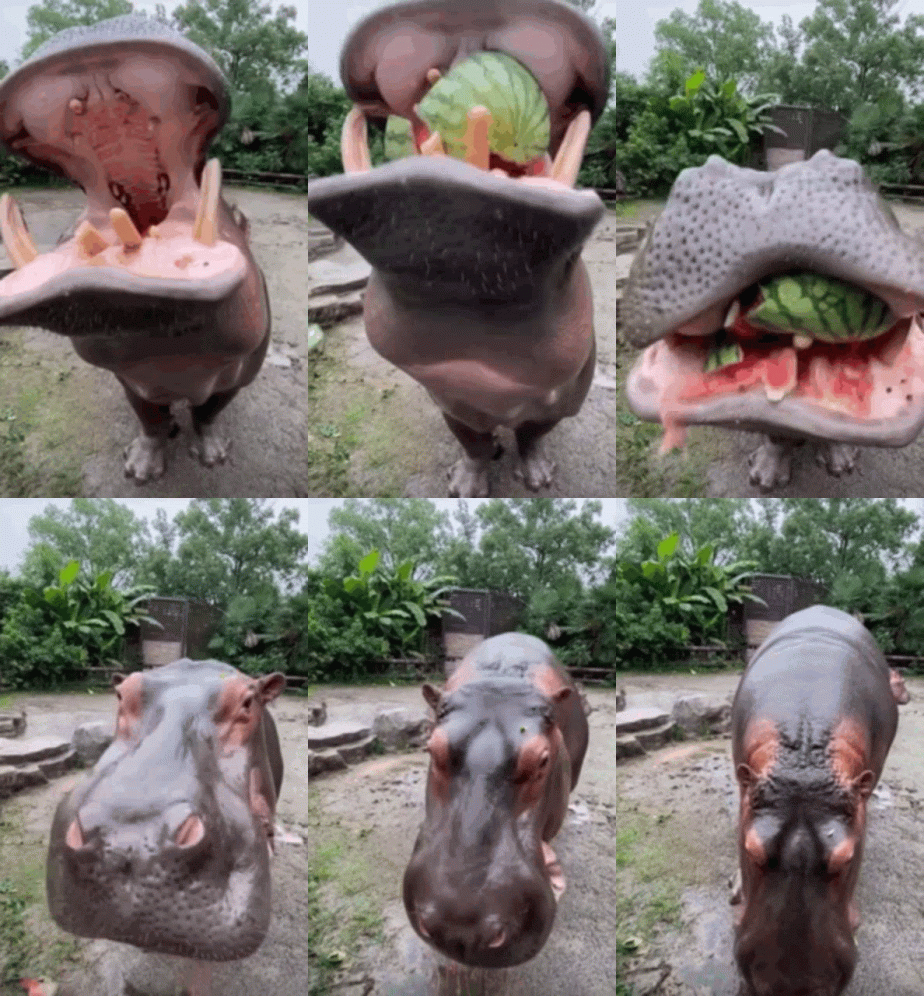
a statue of a hippopotamus with its mouth open and teeth showing .
Alt: A hippo being tossed a watermelon, which it crushes in its massive jaws.
I have been doing entirely too much earnest posting about deep things recently, I need to do a proper thread about hippo testicles or something just to keep myself sane.
Oh by the way hippos have migratory testicles.
12.03.2025 05:33 — 👍 3730 🔁 1222 💬 150 📌 1032
OSF
New preprint 📝 - another fun collaboration with @arikahn.bsky.social, @licezhang.bsky.social, @nathanieldaw.bsky.social, @hartleylabnyu.bsky.social
We ask: Why do children and adults often derive different representations of their environments from the same experiences? 🧠👶🔎
osf.io/preprints/ps...
06.03.2025 12:54 — 👍 45 🔁 13 💬 1 📌 0
TLDR: kids are smart
20.01.2025 22:17 — 👍 2 🔁 0 💬 0 📌 0
Our results provide an account of how children and adolescents make flexible choices in a changing world, and suggest a need to better understand how diverse learning strategies influence choices across development.
20.01.2025 22:16 — 👍 2 🔁 0 💬 1 📌 0
Here, we ask if children can rely on alternative strategies to use structured knowledge in their choices. We show that children use simplified predictive representations like the Successor Representation to efficiently predict the likely outcomes of their choices without multi-step simulation.
20.01.2025 22:16 — 👍 0 🔁 0 💬 1 📌 0
One possible reason for this is that using structured knowledge to make decisions often involves mentally simulating multi-step actions and their outcomes, which can be computationally costly and depend on still-developing cognitive processes
20.01.2025 22:16 — 👍 0 🔁 0 💬 1 📌 0
OSF
psyarxiv.com/y3dzn preprint from the time i spent at @hartleylabnyu.bsky.social 💜 - we were puzzled by past findings suggesting that children learn about the structure of the world, but don't use this knowledge to flexibly guide their decision-making as much as adults do.
20.01.2025 22:16 — 👍 18 🔁 3 💬 1 📌 1
Postdoc @harvard.edu @kempnerinstitute.bsky.social
Homepage: http://satpreetsingh.github.io
Twitter: https://x.com/tweetsatpreet
Postdoc at Brown University. Social neuroscientist researching how we make memories of networks; cognitive neuroscientist researching how we make networks of memories.
Misadventurer; reluctant optimist; amor fati.
https://jaeyoungson.com/
Psych PhD student in Dynamic Cognition Lab @WUSTL🧠
Assistant Professor at UCLA | Alum @MIT @Princeton @UC Berkeley | AI+Cognitive Science+Climate Policy | https://ucla-cocopol.github.io/
Postdoc @ Center for Adaptive Rationality | Max Planck Institute for Human Development | learning, decision making, development
I post mainly about Neuroscience, Machine Learning, Complex Systems, or Stats papers.
Working on neural learning /w @auksz.bsky.social CCNB/BCCN/Free University Berlin.
I also play bass in a pop punk band:
https://linktr.ee/goodviewsbadnews
research associate, NYU
https://www.hartleylab.org/
https://s-michelmann.github.io/Join
🇹🇭 phd candidate w/ @lukejchang.bsky.social in the computational social affective neuroscience lab (cosanlab.com) at @DartmouthPBS.bsky.social
i study social interactions & communication
wasita.space
"If one does not expect it, one will not find out the unexpected;
It is not to be tracked down and no path leads us to it."
slimemoldtimemold.com
patreon.com/slimemoldtimemold
PhD student doing cool computational neuroscience work at NYU
PhD student @Oxford. Interested in learning and simplicity biases in humans and machines.
Post-doctoral research fellow in cognitive neuroscience (Oxford), interested in complex systems and in simple systems who believe they are complex systems
DPhil(PhD) student @ox.ac.uk, @oxexppsy.bsky.social studying #CognitiveNeuroscience | B.S. from @pku1898.bsky.social.
Website: https://www.psy.ox.ac.uk/people/deng-pan
Twitter: https://x.com/DengPan18
PhD student at TAU. Trainee Clinical Psychologist.
Mathematics/Music Composition Undergrad at Soochow Univ. in Taiwan
Computational Neuroscience RA at Academia Sinica, Oxford & Harvard (3jobs simultaneously)
Interested in the interplay between memory and mental simulation and NN/DeepRL!!
AGI safety researcher at Google DeepMind, leading causalincentives.com
Personal website: tomeveritt.se
Postdoc @ UCL studying causal judgment, counterfactual thinking, and metacognition
https://kevingoneill.github.io
PhD student at Cornell studying intergroup cognition | NSF GRFP fellow | baking enthusiast | she/her
kirstanbrodie.github.io
PhD student @dukemedschool.bsky.social | semantic & episodic memory
Previously a lab manager with @alexatompary.bsky.social at Drexel
MA psych at NYU with @davidpoeppel.bsky.social
BA psych/stats at UW-Madison with Dr. Heather Kirkorian
professor at university of washington and founder at csm.ai. computational cognitive scientist. working on social and artificial intelligence and alignment.
http://faculty.washington.edu/maxkw/