We’re pleased to announce a $10 million gift from the James M. and Cathleen D. Stone Foundation, which supports the work of @stone-lis.bsky.social www.gc.cuny.edu/news/10-mill... @cuny.edu
24.02.2026 14:30 — 👍 18 🔁 10 💬 1 📌 3
"[T]he rich man holds the Law in his purse." -- Rousseau, Letters Written from the Mountain (#9).
12.02.2026 15:03 — 👍 11 🔁 6 💬 1 📌 0
Thanks a lot Sehyun!!
29.01.2026 19:40 — 👍 0 🔁 0 💬 0 📌 0
2025 highlights:
✨ Inequality placed on the agenda of the 𝗚𝟮𝟬 𝘀𝘂𝗺𝗺𝗶𝘁
✨2025 𝗖𝗹𝗶𝗺𝗮𝘁𝗲 𝗜𝗻𝗲𝗾𝘂𝗮𝗹𝗶𝘁𝘆 𝗥𝗲𝗽𝗼𝗿𝘁 published in October
✨2026 𝗪𝗼𝗿𝗹𝗱 𝗜𝗻𝗲𝗾𝘂𝗮𝗹𝗶𝘁𝘆 𝗥𝗲𝗽𝗼𝗿𝘁 published in December
✨27 Working Papers authored by 78 researchers
...and more!
📖 Flip through our report heyzine.com/flip-book/22...
29.01.2026 09:38 — 👍 23 🔁 17 💬 2 📌 0

📢now forthcoming in ECMA!
The Class Gap in Career Progression: Evidence from US Academia
Class is rarely a focus of research or DEI in elite US occupations.
Evidence suggests it should be: we find a large class gap in at least one occupation - tenure-track academia...🧵
27.01.2026 22:34 — 👍 140 🔁 55 💬 5 📌 14
Now another R&R at one of my favorite journals (JEH) - 2026 is blessed 😀
28.01.2026 02:02 — 👍 2 🔁 0 💬 1 📌 0
To make the most of the World Inequality Database, consult the DINA Guidelines and other resources: wid.world/methodology/
This 3rd edition includes improved or new:
🔹macro aggregates
🔹income and wealth definitions
🔹data-quality flags
🔹sections on wealth distribution and gender inequality
22.01.2026 08:10 — 👍 23 🔁 13 💬 0 📌 0
whce.world | about
World Human Capital Expenditure database
The data underlying the paper and replication package are publicly available at the World Human Capital Expenditure Database: whce.world
17.01.2026 15:25 — 👍 1 🔁 0 💬 0 📌 0
Published version coming soon! Link to old WP: wid.world/document/hum....
17.01.2026 15:19 — 👍 0 🔁 0 💬 1 📌 0
We build a new global historical database on education and health expenditures since 1800 and study how unequal opportunities shape long-run productivity convergence.
Joint work with @nitin-k-bharti.bsky.social, Amory Gethin, @thomaspiketty.bsky.social, @markjenmana.bsky.social and Li Yang.
17.01.2026 15:17 — 👍 1 🔁 0 💬 1 📌 0

✨ Good news to start 2026! ✨ 🥳
Our paper “Human Capital, Unequal Opportunities and Productivity Convergence: A Global Historical Perspective, 1800–2100” has been accepted at the Journal of Public Economics.
17.01.2026 15:16 — 👍 7 🔁 0 💬 1 📌 1

I am so very sorry to hear about the passing about my friend and colleague Professor Kimuli Kasara. She was a brilliant scholar and a bright, funny, warm person. I remember first meeting her as the only other Black woman/faculty at the Columbia political econ seminar and feeling relief/happiness
12.01.2026 19:07 — 👍 5716 🔁 656 💬 130 📌 22
🚨 We're hiring an Assistant Professor (Lecturer) in Economics
Only 5 days left to apply. See details 👇
30.12.2025 13:13 — 👍 19 🔁 27 💬 0 📌 0
Also, "contributed by" articles should probably be entirely done away with at PNAS.
This dirty little secret is that this provides a way for NAS members to get questionable work in at a high profile outlet with less stringent peer review.
It's corrupt and it's anti science.
29.12.2025 02:02 — 👍 58 🔁 10 💬 2 📌 3
YouTube video by World Inequality Lab
World Inequality Report 2026
Today, we are publishing our World Inequality Report, which reviews the most recent #inequalitydata and exposes the magnitude of #inequality across time, space and all its dimensions.
👇Share this thread, share the report!
www.youtube.com/watch?v=R67u...
10.12.2025 10:24 — 👍 177 🔁 130 💬 3 📌 12
This is a very cool paper with a clever identification strategy to test the causal impact of the opioid epidemic on various political outcomes.
A key point that’s not in the abstract —causal mechanism is voters agreed with GOP tough on crime rhetoric and policy.
24.11.2025 00:17 — 👍 28 🔁 5 💬 3 📌 1
OSF
Full paper link here: osf.io/preprints/so...
22.11.2025 02:40 — 👍 0 🔁 0 💬 0 📌 0
🎯 Conclusion:
Light-touch information corrects misperceptions but does not shift deeper identity-based or geopolitical attitudes toward Chinese FDI.
As Germany and the EU adjust their China strategies, public opinion—not just economic fundamentals—will shape the policy space ahead.
22.11.2025 02:39 — 👍 1 🔁 0 💬 2 📌 0

📌 Heterogeneity:
Quantile regressions on WTA measures show that fact-checking and positive narratives reduce the penalty only among respondents already at the favorable end.
Heavy baseline bias → no treatment response
Low baseline bias → clear treatment effect to information and narratives
22.11.2025 02:37 — 👍 1 🔁 0 💬 1 📌 0

📉 More on Willingness-To-Accept (WTA):
To consider a Chinese investor equivalent to an EU/US investor, respondents require more job preservation:
• EU/US investor baseline: 250 jobs saved
• Chinese investor: ~350 jobs saved
This implies a ~50% China-origin penalty built into public preferences.
22.11.2025 02:34 — 👍 0 🔁 0 💬 1 📌 0
However:
❌ deeper geopolitical or autonomy-related attitudes remain unchanged
❌ support for a Germany–China FDI agreement does not shift
❌ no detectable effects on either conjoint choices or WTA measures
In short, belief updating does not translate into substantive preference updating.
22.11.2025 02:33 — 👍 1 🔁 0 💬 1 📌 0
📣 Narratives:
🔵 Positive narrative → modest improvements in economic perceptions
🔴 Negative narrative → little effect on China-specific concerns, but notably increases favorable evaluations of US FDI, consistent with a substitution logic
22.11.2025 02:30 — 👍 0 🔁 0 💬 1 📌 0
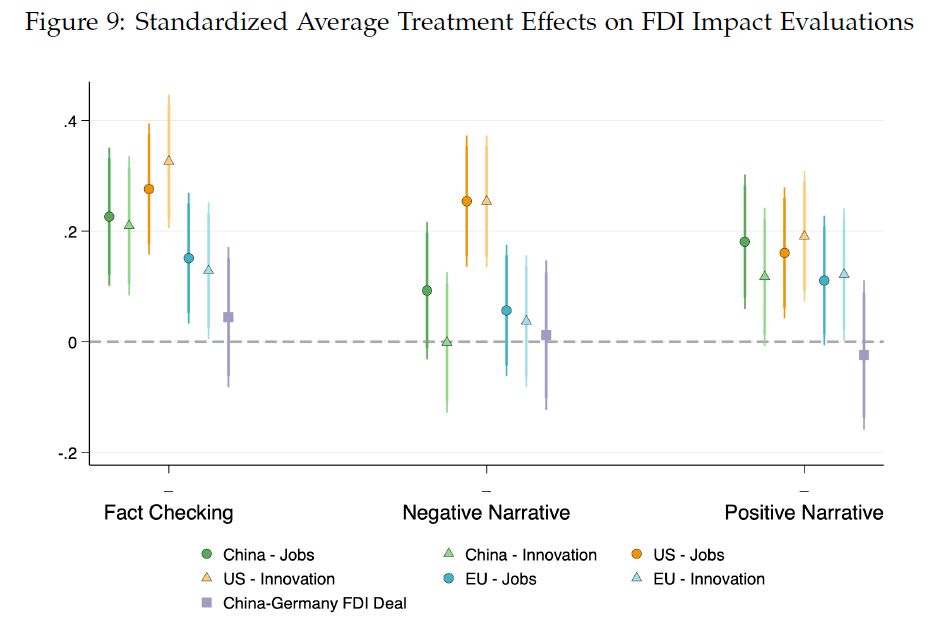
📈 Fact-checking effects:
Providing accurate information significantly improves perceived economic benefits of FDI (across the board regardless of the country of origin) — by roughly 0.2–0.3 standard deviations
22.11.2025 02:30 — 👍 0 🔁 0 💬 1 📌 0
🧪 Experimental interventions:
We implemented three randomized treatments interventions w.r.t. Chinese FDI in Germany:
1️⃣ Fact-checking: true FDI shares
2️⃣ Negative narrative: economic/political risks, dependency, IP
3️⃣ Positive narrative: market access, diversification, competitiveness
22.11.2025 02:29 — 👍 0 🔁 0 💬 1 📌 0

🇨🇳➡️🇩🇪 Meanwhile in China:
Chinese respondents express overwhelmingly positive evaluations of German FDI, rating it highly on:
✔️ job creation
✔️ technological upgrading
✔️ national economic development
Roughly 80% provide strongly favorable assessments.
The asymmetry in mutual perceptions is striking.
22.11.2025 02:28 — 👍 0 🔁 0 💬 1 📌 0
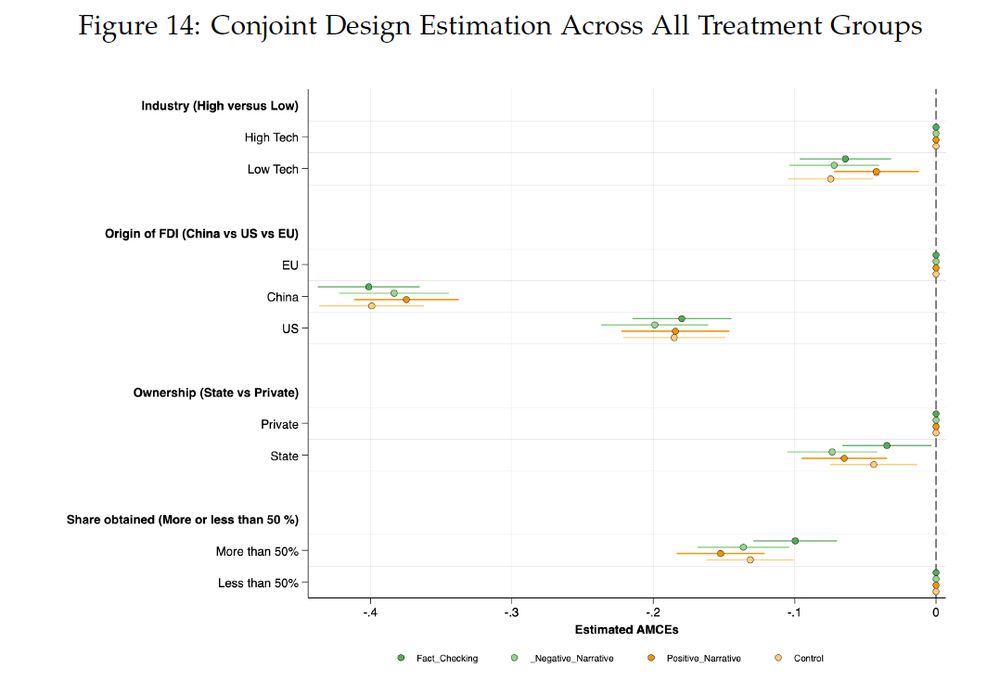
🧩 Conjoint experiment:
Holding all attributes constant, changing the investor from EU → China reduces selection likelihood by:
➡️ −40 percentage points
Compared with the US:
➡️ −20 points
A substantial origin penalty, independent of project characteristics.
22.11.2025 02:26 — 👍 0 🔁 0 💬 1 📌 0

🟦 EU FDI
🟧 US FDI
🟥 Chinese FDI
Across every domain we measure —
💼 economic prospects
🏭 employment
🧪 innovation
🏛 political autonomy
a remarkably stable preference hierarchy emerges:
EU > US > China
This structure is consistent and highly robust.
22.11.2025 02:25 — 👍 1 🔁 0 💬 1 📌 0

📊 The perception gap:
On average, Germans believe that Chinese firms account for 33% of inward FDI.
The actual figure?
👉 ~1% — a roughly 30-fold overestimation. 😬
By contrast:
• EU FDI is systematically underestimated
• US FDI is perceived relatively accurately
22.11.2025 02:23 — 👍 0 🔁 0 💬 1 📌 0
🔥 Key finding:
German respondents substantially overestimate the scale of Chinese FDI in Germany and evaluate it far more negatively than FDI from the EU or the United States.
Attempts to correct these misperceptions produce only modest and fragile shifts in attitudes.
22.11.2025 02:22 — 👍 0 🔁 0 💬 1 📌 0
Traducteur littéraire, auteur ("Traduire Hitler", "Coulée brune" et prochainement "Retour aux souches", éd. Héloise d'Ormesson), Fondateur de l'Ecole de Traduction Littéraire. Dans les hauteurs pyrénéennes.
Compte officiel de l'Université Laval.
Première université francophone d'Amérique, animée par un esprit d’innovation et par la recherche de l’excellence.
Prof de français en collège. J’aime la mer, les romans, la poésie et l’estampe, gravure et lithographie. Le cinéma aussi. Politique, justice sociale et solidarité.
Economist: Labo(u)r, Macro, Inequality || Ass't Prof @MITSloan @MIT_IWER || Nonres fellow @piie
European Political Science Review (EPSR) is an #OpenAccess journal of the European Consortium for Political Research (ECPR).
Environmental economist working at the intersection of economic growth, inequality, and environmental policy. Veteran. LSE, Yale, UC Davis.
Ph.D. candidate in Political Economy & Government @Harvard | political economy + development + public finance. From 🇵🇾
https://rduarte.scholars.harvard.edu/
Our work sits at the intersection of research, public policy, and efforts to reduce inequality
Email: info@theeconomicmisfit.com
https://theeconomicmisfit.com/
Economics Professor at Brown, studying discrimination, education, healthcare, and applied econometrics. I like IV
https://sites.google.com/site/aboutpeterhull/home
Econometrics professor and author. Dogs = 2, cats >= 10.
Economist, tax policy/inequality. Professional skeptic. Anti-illiberal.
http://www.columbia.edu/~wk2110/index.html
@wwwojtekk at various other websites
Professor at USC. Previously MIT, Wharton, WashU, LSE.
Economics and Ethics, UMass Amherst
Econ prof at Harvard. (Mechanism design, market design, behavioral theory.) www.shengwu.li
MIT Robert M. Solow Professor of Economics | Macro, International, Public, Monetary, Taxes, Finance | v = u + β v | Beatles | Boston | Argentina | Patagonia
Papa. Journaliste. Animateur. Zone info, Zone économie, Question d'intérêt.
A network of economists focused on connecting researchers and promoting global collaboration in development economics.
https://dev-connect.org/
Sociologist of inequality.
Economics research to revitalize labor market opportunities for workers without a college degree. Led by @dacemoglumit.bsky.social,
@simonhrjohnson.bsky.social, and @davidautor.bsky.social.
The academic home of the best economics programs and researchers in North America.