Robert Bixby (CPLEX, Gurobi) also talks about bound perturbations in these amazing talks on the dual simplex: youtu.be/uccbVoamiUM?...
27.10.2025 10:16 — 👍 2 🔁 0 💬 0 📌 0
@mwien.bsky.social
Postdoc working on causality
Robert Bixby (CPLEX, Gurobi) also talks about bound perturbations in these amazing talks on the dual simplex: youtu.be/uccbVoamiUM?...
27.10.2025 10:16 — 👍 2 🔁 0 💬 0 📌 0In the paper, we also develop novel algorithms for conditional instrumental sets directly with CIfly. Furthermore, we discuss the computational complexity of other (algorithmic) primitives, namely moralization and latent projection, showing that both are more expensive than CIfly-based algorithms.
30.07.2025 12:16 — 👍 0 🔁 0 💬 0 📌 0Of course, CIfly is not limited to simple d-separation checks. The CIfly website contains many additional examples and applications. A good starting point is this article introducing the main ideas and features of CIfly. Also, feel free to contact us in case of questions. cifly.dev/docs/introdu...
30.07.2025 12:16 — 👍 0 🔁 0 💬 1 📌 0

To put this idea into practice, we provide a software framework named CIfly, that is build directly on top of such rule tables. The 'reach' function returns all nodes found by the graph search specified with the rule table. Thus, a d-separation check takes just a few lines of Python or R code.
30.07.2025 12:16 — 👍 0 🔁 0 💬 1 📌 0
CIfly rule table for d-connectivity.
We introduce a framework for expressing such tasks through rule tables. A rule table encodes a graph search, such as the one for d-connectivity below. As familiar, the rules prescribes walking along colliders, if they are in the conditioning set Z, and for non-colliders, in case they are not in Z.
30.07.2025 12:16 — 👍 0 🔁 0 💬 1 📌 0There are loads of tasks in graphical causal inference that need to be tackled with very specific types of algorithms. Think of checking d-separation or finding adjustment sets in DAGs, ADMGs or CPDAGs. Writing causal inference software for such problems has a high barrier of entry.
30.07.2025 12:16 — 👍 1 🔁 0 💬 1 📌 0
Excited to share a recent preprint (with an accompanying softare package named CIfly) that introduces a unifying framework for algorithm development in graphical causal inference! Joint work with Sebastian Weichwald and Leonard Henckel 🧵 arxiv.org/abs/2506.15758
30.07.2025 12:16 — 👍 2 🔁 0 💬 1 📌 0
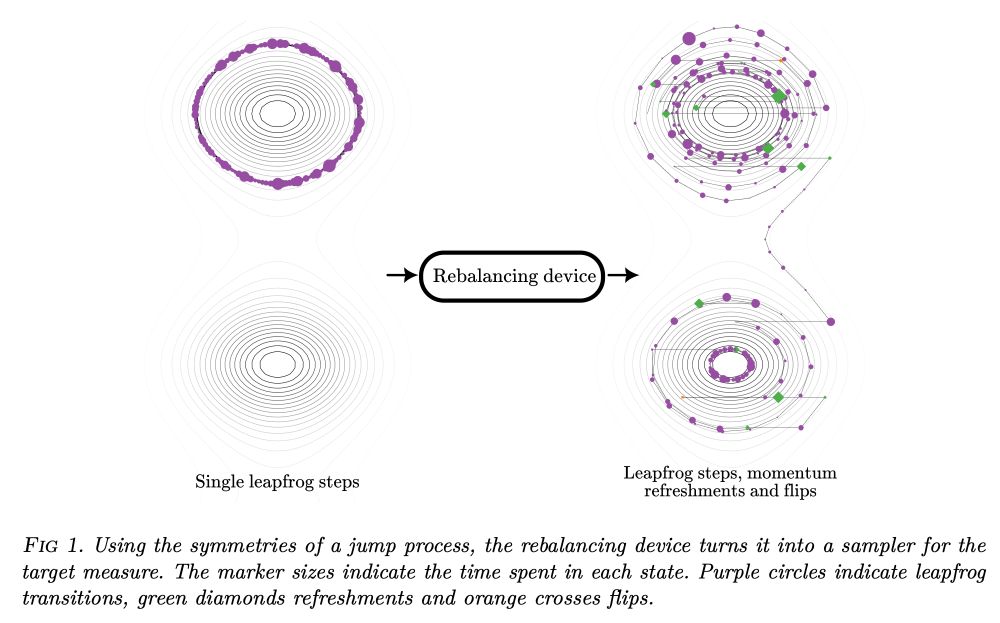
keen to read this one!
arxiv.org/abs/2504.12190
'Creating non-reversible rejection-free samplers by rebalancing skew-balanced Markov jump processes'
- Erik Jansson, Moritz Schauer, Ruben Seyer, Akash Sharma

⭐Small milestone: 200 Github stars for github.com/mschauer/Cau...
22.02.2025 16:51 — 👍 15 🔁 2 💬 1 📌 0