Over-impute the entire dataset with {mice}?
`mice(dat, m = 1, maxit = 1, where = matrix(TRUE, dim(dat)) method = "sample")`
@amices.bsky.social
amices.org/mice/referen...

@oberman.bsky.social
PhD candidate in Utrecht @utrechtuniversity.bsky.social | they/them | rstats | missing data | dataviz | open science @opensciutrecht.bsky.social | @rainbowr.org 🌈 | hanneoberman.github.io
Over-impute the entire dataset with {mice}?
`mice(dat, m = 1, maxit = 1, where = matrix(TRUE, dim(dat)) method = "sample")`
@amices.bsky.social
amices.org/mice/referen...

Screen shot of a youtube video titled "AI.FILL Function Explained: 10X Productivity in Excel with AI" with the caption "Let ChatGPT fill your missing data"
Don't you f**king dare.
03.02.2026 14:56 — 👍 305 🔁 66 💬 28 📌 39
📣 registration for the rainbowR conference is now live 🎉
The conference is for anyone interested in R and/or analysing data to understand LGBTQ+ issues. The majority of speakers and workshop leaders are LGBTQ+, but you do not have to be LGBTQ+ to attend.
pretix.eu/rainbowr/con...
#RStats #LGBTQ
"However, my case reveals a fundamental weakness: these tools were not developed with academic standards of reliability and accountability in mind."
Erm, no. We already knew that. It is a hyped black box built on plagiarised content + labour exploitation. The arrogance & lack of reflection 🙄

Zoom meet-up and AGM Weds Jan 28th, 4:30pm UTC - vote on constitution - elect leadership committee - connect with community members - R chat and informal 'show and tell' More info and sign-up details at rainbowr.org/meetups 12m
🌈 rainbowR meet-up & AGM*: Wednesday Jan 28th, 4:30pm UTC 🌈
- vote on constitution*
- elect leadership committee*
- connect with other LGBTQ+ people who code in #RStats 🏳️🌈 🏳️⚧️
➡️ Registration via rainbowr.org/meetups
![R code:
> library(devtools)
Loading required package: usethis
> load_all()
ℹ Loading sessioncheck
> sessioncheck()
Warning message:
Session check results:
- Objects in global environment: [no issues]
- Attached packages: sessioncheck, testthat, devtools, usethis
- Attached environments: devtools_shims](https://cdn.bsky.app/img/feed_thumbnail/plain/did:plc:kugxzv2vbv6xkjwjorepgzm4/bafkreigufofquol7dpzae32nvavdnodrpnld7vmrb4ghspoz2fctnf4cde@jpeg)
R code: > library(devtools) Loading required package: usethis > load_all() ℹ Loading sessioncheck > sessioncheck() Warning message: Session check results: - Objects in global environment: [no issues] - Attached packages: sessioncheck, testthat, devtools, usethis - Attached environments: devtools_shims
love it! not sure if this is also true for others, but intuitively, i would expect the 'no issues' not to be shown in yellow, but that would maybe require separating the 3 components of the session check (objects, packages, envs), or adding a dependency on {cli}?
06.01.2026 11:49 — 👍 1 🔁 0 💬 0 📌 1happy ‘i will reply to your email on my return’ day to all who celebrate
05.01.2026 07:00 — 👍 115 🔁 28 💬 4 📌 0Philosophers: Imagine yourself behind the veil of ignorance, not knowing what life you might be born into
Giving What We Can: But what if we unveiled it
Think of AI instead of cigarettes here. Nothing is inevitable.
20.12.2025 06:18 — 👍 517 🔁 118 💬 10 📌 7I don't know how many times this needs to be said, but apparently a lot: If you are not in a position to verify the accuracy of some synthetic text, the synthetic text is not useful/has a high potential to be misleading.
This is one of those cases.

Screenshot of a paper entry: Fictional Failures and Real-World Lessons: Ethical Speculation Through Design Fiction on Emotional Support Conversational AI Authors: Faye Kollig, Jessica Pater, Fayika Farhat Nova, Casey Fiesler (There are tabs with "abstract" and "summary" and "summary" is selected.)
The ACM Digital Library, where a LOT of computing-related research is published (I'd say at least 75% of my own publications), is now not only providing (without consent of the authors and without opt-in by readers) AI-generated summaries of papers, but they appear as the *default* over abstracts.
16.12.2025 23:31 — 👍 647 🔁 336 💬 30 📌 94here’s a free version:
neat_research_panel <- data.frame(
id = 1:100,
treatment = sample(c(TRUE, FALSE), 100, replace = TRUE),
outcome = rnorm(100, mean = 50, sd = 5)
)

Text reads: About synthetic panels Recruiting the right participants for a study can be difficult. You may not get the exact demographics you need, and the shorter the deadline, the less sure you can be that everyone will answer on time. One possible solution can be to use synthetic panels. Synthetic panels are powered by a first party proprietary AI model developed here at Qualtrics. Our synthetic panel is trained on thousands of responses from a variety of demographic backgrounds in order to more accurately predict how certain populations would respond to a survey. Our synthetic panel is based on the United States General Population, and is only available in English. This panel comes with ready-made quotas and target breakouts in order to represent your chosen population and make it easy to launch your survey right away.

Text reads: Question-writing best practices To get the most reliable and actionable results from synthetic audiences, consider these question-writing best practices: Ask forward-looking and attitudinal questions. Synthetic panels perform best with perceptions, preferences, and intent-based questions. For example, “How likely are you to try…?” Synthetic panels are less applicable for studies on past behaviors, detailed recall, brand recall, or awareness questions. For example, “When did you last visit…?”

Text reads: Discussion The current study aimed to conduct a meta-analysis of the TPB when applied to health behaviours which addressed the limitations of previous reviews by including only prospective tests of behaviour, applying RE meta-analytic procedures, correcting correlations for sampling and measurement error, and hierarchically analysing the effect of behaviour type and sample and methodological moderators. Some 237 tests were identified which examined relations amongst model components. Overall the analysis indicated that the TPB could explain 19.3% of the variance in behaviour and 44.3% of the variance in intention across studies. This level of prediction of behaviour is slightly lower than that of previous meta-analytic reviews which have found between 27% (Armitage & Conner, 2001; Hagger et al., 2002) and 36% (Trafimow et al., 2002) of the variance in behaviour to be explained by intention and PBC.
Did you know that from tomorrow, Qualtrics is offering synthetic panels (AI-generated participants)?
Follow me down a rabbit hole I'm calling "doing science is tough and I'm so busy, can't we just make up participants?"

screenshot of my post
Big new blogpost!
My guide to data visualization, which includes a very long table of contents, tons of charts, and more.
--> Why data visualization matters and how to make charts more effective, clear, transparent, and sometimes, beautiful.
www.scientificdiscovery.dev/p/salonis-gu...
contributing to base R is fun and surprisingly easy!
🧵 by the amazing @ellakaye.co.uk #RStats

Event flyer, info via https://us02web.zoom.us/webinar/register/WN_bShkkgF3SUyb8zUL1pd0BA#/registration
'How Open Science Bridges Cultures and Promotes Best Practices' webinar tonight at 20:00 NL time. Organized by @utrechtuniversity.bsky.social Master's student Antonios Kagialis, and featuring Flavio Azevedo among the amazing speakers! Registration via us02web.zoom.us/webinar/regi...
13.11.2025 15:22 — 👍 3 🔁 3 💬 0 📌 0
Presentation by Ionica Smeets: communication goals
Scientists often don't think about communication goals: "I want to make a podcast", and then make a podcast. But what is the goal of your #SciComm? - @ionica.mathstodon.xyz.ap.brid.gy
07.10.2025 06:23 — 👍 2 🔁 0 💬 0 📌 0
Abstract: Under the banner of progress, products have been uncritically adopted or even imposed on users — in past centuries with tobacco and combustion engines, and in the 21st with social media. For these collective blunders, we now regret our involvement or apathy as scientists, and society struggles to put the genie back in the bottle. Currently, we are similarly entangled with artificial intelligence (AI) technology. For example, software updates are rolled out seamlessly and non-consensually, Microsoft Office is bundled with chatbots, and we, our students, and our employers have had no say, as it is not considered a valid position to reject AI technologies in our teaching and research. This is why in June 2025, we co-authored an Open Letter calling on our employers to reverse and rethink their stance on uncritically adopting AI technologies. In this position piece, we expound on why universities must take their role seriously toa) counter the technology industry’s marketing, hype, and harm; and to b) safeguard higher education, critical thinking, expertise, academic freedom, and scientific integrity. We include pointers to relevant work to further inform our colleagues.

Figure 1. A cartoon set theoretic view on various terms (see Table 1) used when discussing the superset AI (black outline, hatched background): LLMs are in orange; ANNs are in magenta; generative models are in blue; and finally, chatbots are in green. Where these intersect, the colours reflect that, e.g. generative adversarial network (GAN) and Boltzmann machine (BM) models are in the purple subset because they are both generative and ANNs. In the case of proprietary closed source models, e.g. OpenAI’s ChatGPT and Apple’s Siri, we cannot verify their implementation and so academics can only make educated guesses (cf. Dingemanse 2025). Undefined terms used above: BERT (Devlin et al. 2019); AlexNet (Krizhevsky et al. 2017); A.L.I.C.E. (Wallace 2009); ELIZA (Weizenbaum 1966); Jabberwacky (Twist 2003); linear discriminant analysis (LDA); quadratic discriminant analysis (QDA).

Table 1. Below some of the typical terminological disarray is untangled. Importantly, none of these terms are orthogonal nor do they exclusively pick out the types of products we may wish to critique or proscribe.

Protecting the Ecosystem of Human Knowledge: Five Principles
Finally! 🤩 Our position piece: Against the Uncritical Adoption of 'AI' Technologies in Academia:
doi.org/10.5281/zeno...
We unpick the tech industry’s marketing, hype, & harm; and we argue for safeguarding higher education, critical
thinking, expertise, academic freedom, & scientific integrity.
1/n
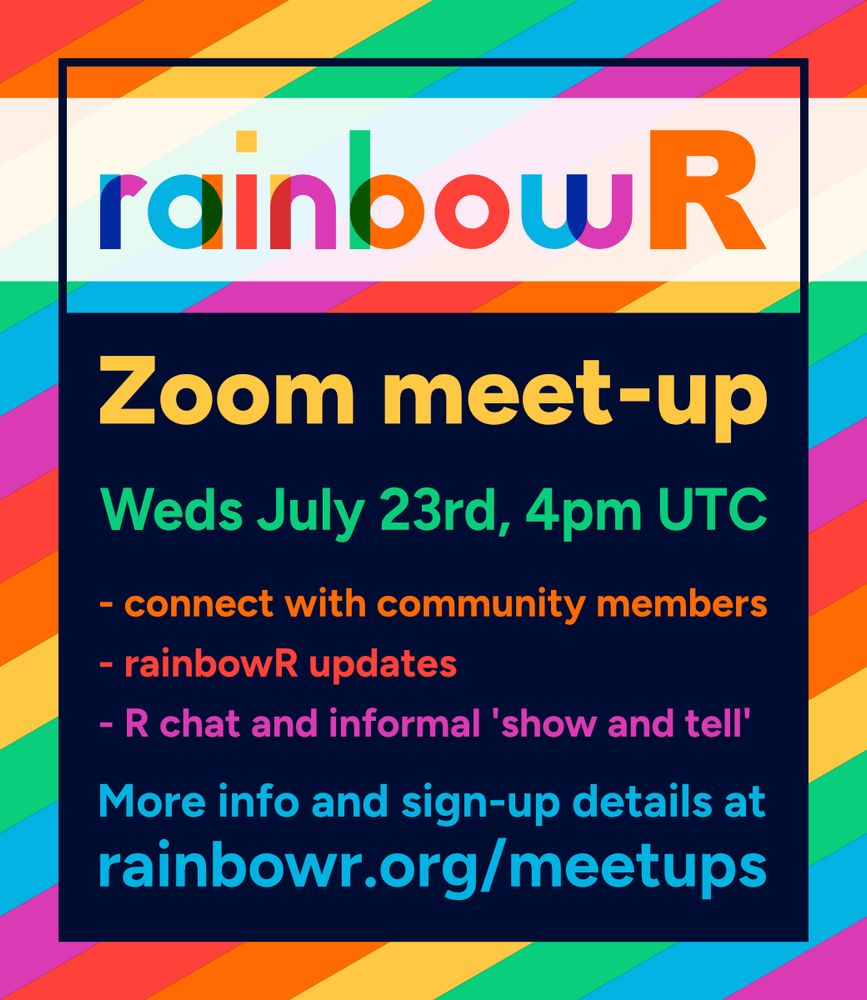
rainbowR zoom meet-up: Wednesday July 23rd, 4 pm UTC. Sign up via rainbowR.org/meetups
🌈 rainbowR meet-up: Wednesday July 23rd, 4pm UTC 🌈
- connect with other LGBTQ+ people who code in #RStats 🏳️🌈
- ask questions about R 🙋
- tell us about an R package you like 📦
- show us something R-related you’ve been working on 💻
➡️ Registration via rainbowr.org/meetups
my supervisors whenever they get a draft from me:
21.07.2025 08:57 — 👍 13 🔁 2 💬 1 📌 0We are Nowhere Lab 👋
nowherelab.com
Anyone from any field is welcome to join who doesn't have a lab but would like the lab meeting experience!
🍃 July-September meetings
📆 Every week on WEDNESDAY
⏰ 3.30-4.30pm (UK)
🌐 Remote (email priyasilverstein at gmail dot com to join)

🌈 🌐 rainbowR conference: online, early 2026 🌐 🌈
Are you LGBTQIA+, do you code in R, and would you like to get involved in rainbowR’s first-ever conference? We are looking for people to join our conference organising committee!
➡️ rainbowr.org/conference
🗓️ 1st meeting: July 9, 4pm UTC
🙌🏻
03.07.2025 12:08 — 👍 1 🔁 0 💬 0 📌 0
Thank you! It's an edited version of this template: www.uu.nl/en/organisat.... My version is here: github.com/hanneoberman...
02.07.2025 16:07 — 👍 1 🔁 0 💬 0 📌 0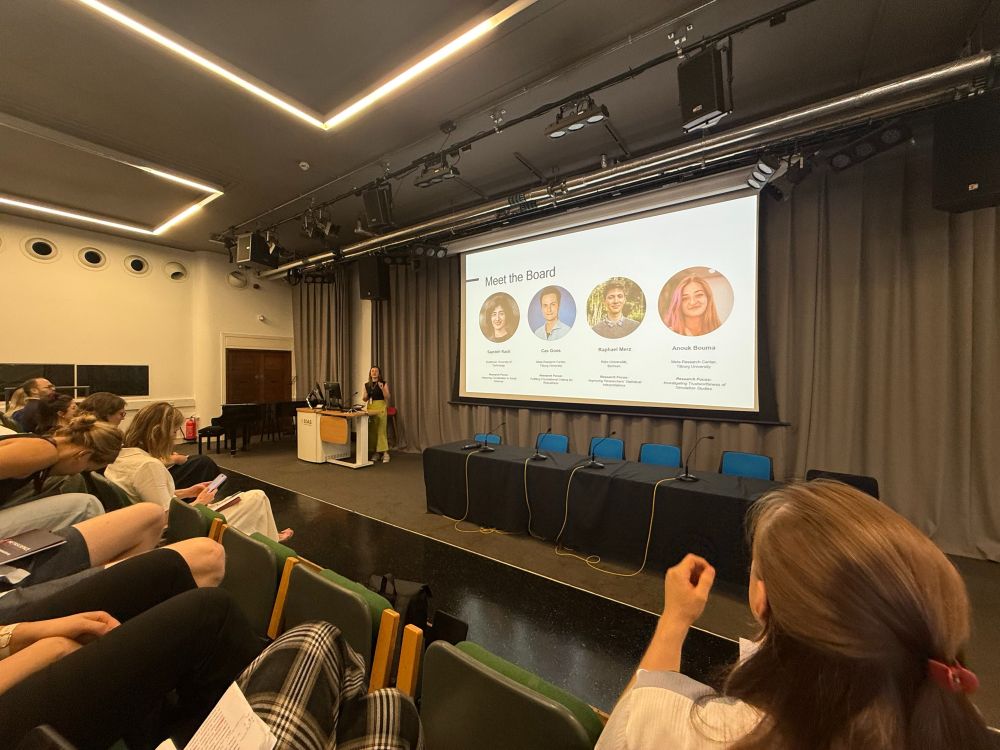
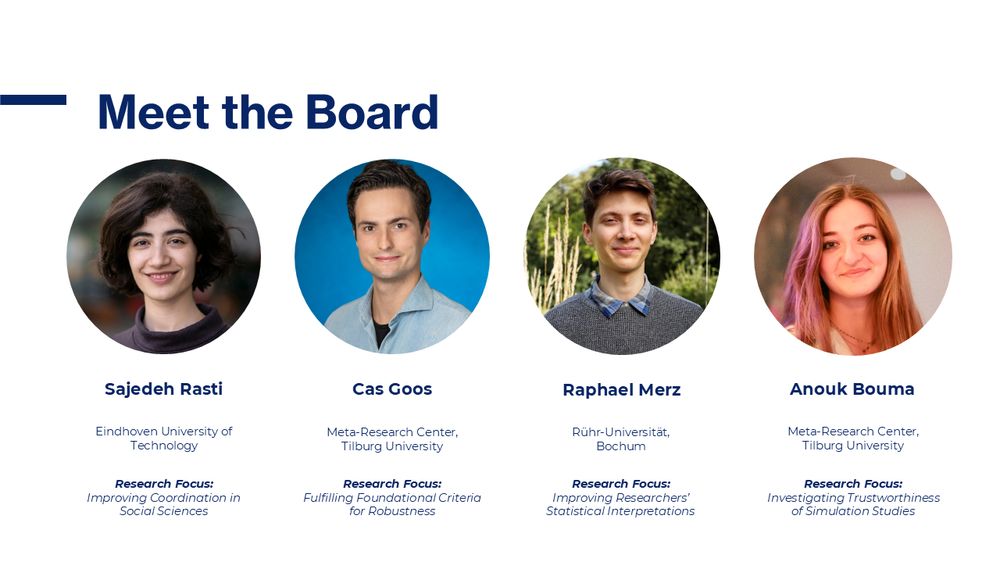
We had a great time at our session at #metascience2025 on Monday! We got a lot of new members and connections that joined our community over the last days.
Missed our talk, and want to join PYMS or learn more? Find one of our board members at the last day of the conference!
If it weren't for Andy Sterling and @sabinaleonelli.bsky.social, today's #metascience2025 plenaries would have centred on Ioannidis' zombie numbers and Google's PR (which when challenged was protected by one of the most elitist voices on stage). Thanks you bringing something worth thinking about.
01.07.2025 22:10 — 👍 37 🔁 8 💬 4 📌 1
A panel with John Ioannides speaking in fromt of a slide that reads: "Is science currently overall more beneficial or harmful to humans?" In 2005 "Undoubtedly yes!" In 2025 "I hope so, but I am not so sure" See conflicts of interest (?), SARS-CoV-2 from a lab (?), lockdowns (?), loss of trust, challenge to Mertonian values (disinterestedness, communality, universalism, organized skepticism)
It was all just vibes! But what shocked me even more was promoting the lab leak theory 🤯
(The podcast “If Books Could Kill” has a recent very good discussion of the evidence around this theory and the political forces pushing it)
I'm sorry but you can't come to a #metascience2025 conference and do slide after slide comparing 2005 and 2025 without a single source.
Also, I can think of positive reasons for some of the things he's promoting as bad e.g. retractions.
Is it just me that's sitting here spectacularly unimpressed?