Congratulations Lauren
09.01.2026 15:18 — 👍 3 🔁 0 💬 0 📌 0

Sleep-dependent infraslow rhythms are evolutionarily conserved across reptiles and mammals
Nature Neuroscience - Bergel et al. show that an infraslow rhythm connecting the brain and body during sleep is shared by lizards, mammals and birds, revealing an ancestral process and reshaping...
⚠️ New paper alert and what a way to end 2025! 🎉
Happy to share our story “Sleep-dependent infraslow rhythms are evolutionarily conserved across reptiles and mammals.” published today in Nature Neuroscience.
Sleeping dragons 🦎 and functional ultrasound!
Read the full paper here: rdcu.be/eWJHb 1/8
29.12.2025 16:17 — 👍 101 🔁 37 💬 3 📌 2
Congrats, well deserve
10.12.2025 16:17 — 👍 1 🔁 0 💬 0 📌 0
Portail Emploi CNRS - Offre d'emploi - Postdoc position (M/F) in Neuroscience, stress modulation of learning (H/F)
You just finished your PhD and you are looking for a postdoc to study stress-dependent modulation of learning. We are using the powerful fly model to understand the underlying circuits and mechanisms. You can apply here:
emploi.cnrs.fr/Offres/CDD/U...
15.09.2025 10:25 — 👍 11 🔁 18 💬 0 📌 2

Lauren Reynolds
Big news for @laurenmac.bsky.social !
2025 is quite a year: CNRS position + ERC Starting Grant
Her project DeMARRe will study how adolescent exploration & risk-taking shape neural circuits and resilience in adulthood.
@cnrs.fr @espciparispsl.bsky.social
www.insb.cnrs.fr/fr/personne/...
17.09.2025 08:44 — 👍 6 🔁 1 💬 0 📌 1
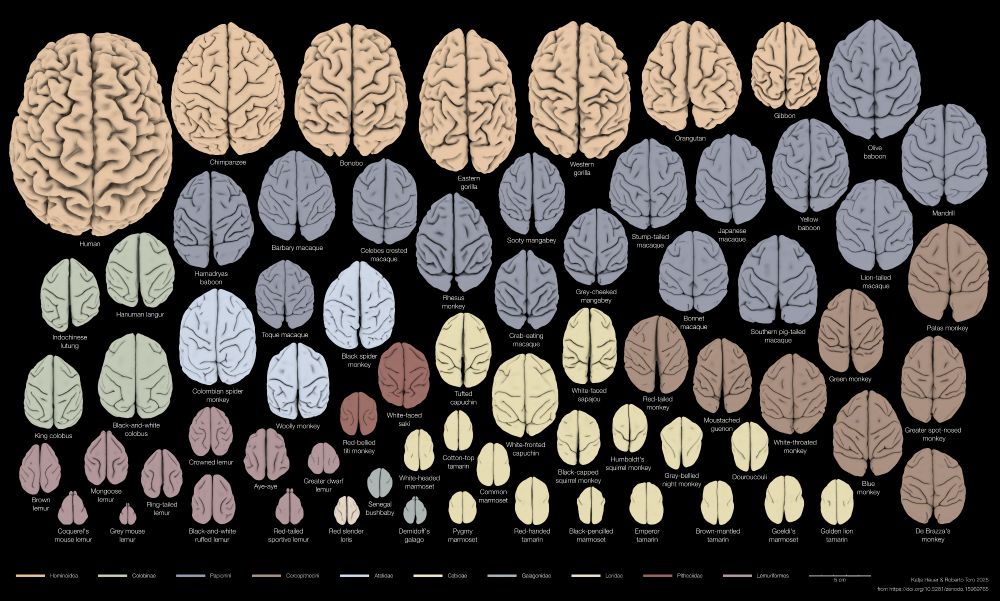
Brain Surfaces of 70 primate species
1
To predict the behaviour of a primate, would you rather base your guess on a closely related species or one with a similar brain shape? We looked at brains & behaviours of 70 species, you’ll be surprised!
🧵Thread on our new preprint with @r3rt0.bsky.social , doi.org/10.1101/2025...
27.07.2025 17:26 — 👍 512 🔁 233 💬 16 📌 26
Alcool et nicotine : un même circuit cérébral à l’origine de la récompense et de l’anxiété
👋 @cnrs-paris.bsky.social @espciparispsl.bsky.social
✍️ @faurelab.bsky.social & Fabio Marti
👉 Lire l'article dans buff.ly/vE1j6LP
buff.ly/fD5DOxu
10.07.2025 05:00 — 👍 5 🔁 4 💬 0 📌 1
Congratulations to first author Tinaïg Le Borgne for her outstanding work and Fabio marti for leading this project. Many thanks as well to our collaborators across @espciparispsl.bsky.social , @cnrsbiologie.bsky.social, @sorbonne-universite.fr and beyond!
05.07.2025 13:18 — 👍 2 🔁 0 💬 0 📌 0
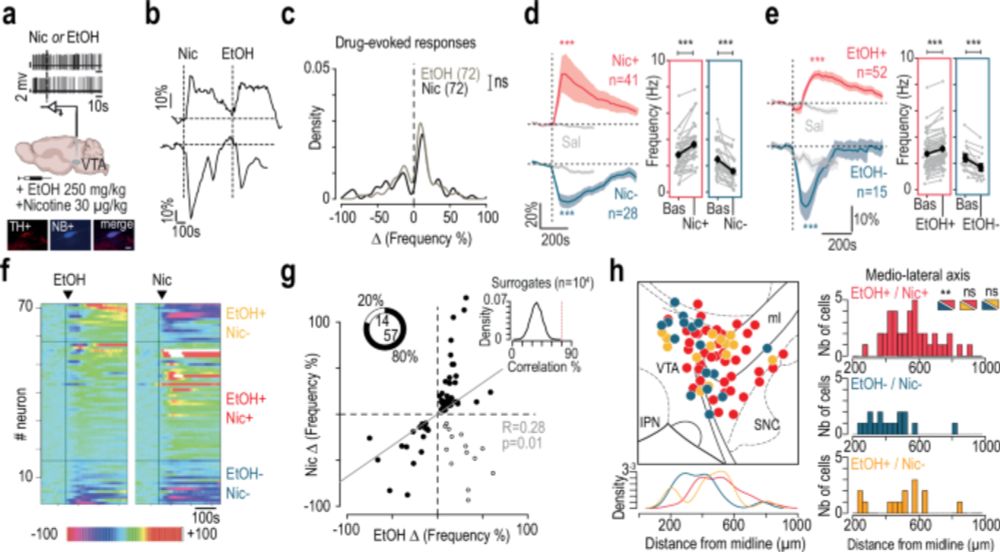
Nicotine and alcohol seem very different, but they converge on the same circuit. Both activate NAc-projecting dopamine neurons and inhibit those projecting to the amygdala. We show that this shared loop shapes reward and emotion, helping explain their high co-use.
05.07.2025 13:18 — 👍 1 🔁 0 💬 1 📌 0
A circuit-level explanation for nicotine’s dual impact: Nicotine activates VTA→NAc dopamine neurons (reward), but this comes at a cost: It triggers a GABAergic feedback loop that inhibits VTA→amygdala neurons (emotion).
One drug, the dopaminergic circuits, 2 effects: reinforcement + negative affect.
05.07.2025 13:18 — 👍 1 🔁 0 💬 1 📌 0
Yesss! So happy to see this, totally deserved!
13.06.2025 16:18 — 👍 2 🔁 0 💬 0 📌 0
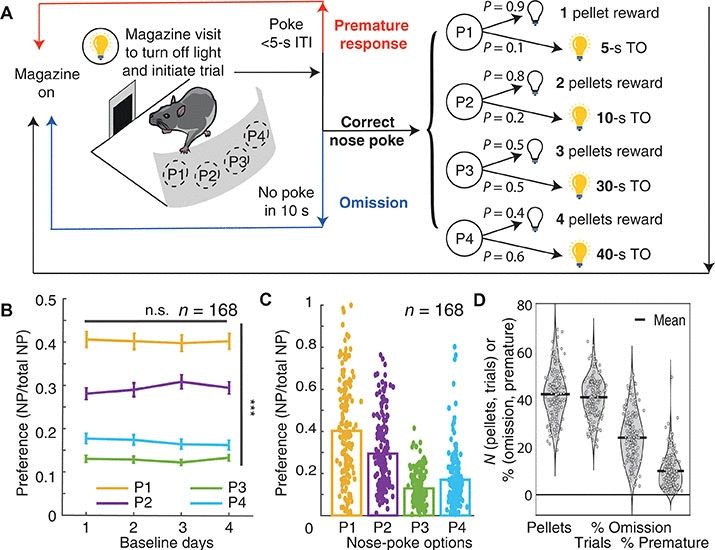
Direct and indirect striatal projecting neurons exert strategy-dependent effects on decision-making
In the dorsomedial striatum, d-SPNs increase risk seeking, while iSPNs amplify the value of large gains in decision making.
Nouvel article avec mes ami-es belges E. Chaves et A. de Kerchove où on décrit l'effet de l'activation de populations de neurones du striatum sur les stratégies de décision. On a essayé de sortir d'une définition "par l'expérimentateur" de la performance des souris.
www.science.org/doi/10.1126/...
28.05.2025 19:20 — 👍 12 🔁 4 💬 1 📌 0
I have an opening in my lab for a postdoctoral fellow to work on projects that relate to the mechanisms of neurotransmitter release by dopamine neurons and/or on how inflammatory signals infuence the functionning of these neurons. Please share.
24.04.2025 21:34 — 👍 13 🔁 13 💬 1 📌 0
free access here authors.elsevier.com/c/1kzRE3BtfH...
21.04.2025 17:01 — 👍 0 🔁 0 💬 0 📌 0
Congrat J. Jehl, M. Ciscato, E. Vicq & @nicolasguyon.bsky.social . Thanks to our amazing team, and collaborators! @cnrsbiologie.bsky.social , @inserm.fr , @sorbonne-universite.fr , @espciparispsl.bsky.social , @institutpasteur.bsky.social, @frm-officiel.bsky.social
21.04.2025 17:01 — 👍 2 🔁 0 💬 1 📌 0
This was made possible by a new chemogenetic method: a covalently tethered suicide antagonist for β4* nAChRs. Sustained, subtype-specific silencing in vivo, with single-site precision. A method developed by Alexandre Mourot in the lab @faurelab.bsky.social
21.04.2025 17:01 — 👍 0 🔁 0 💬 1 📌 0
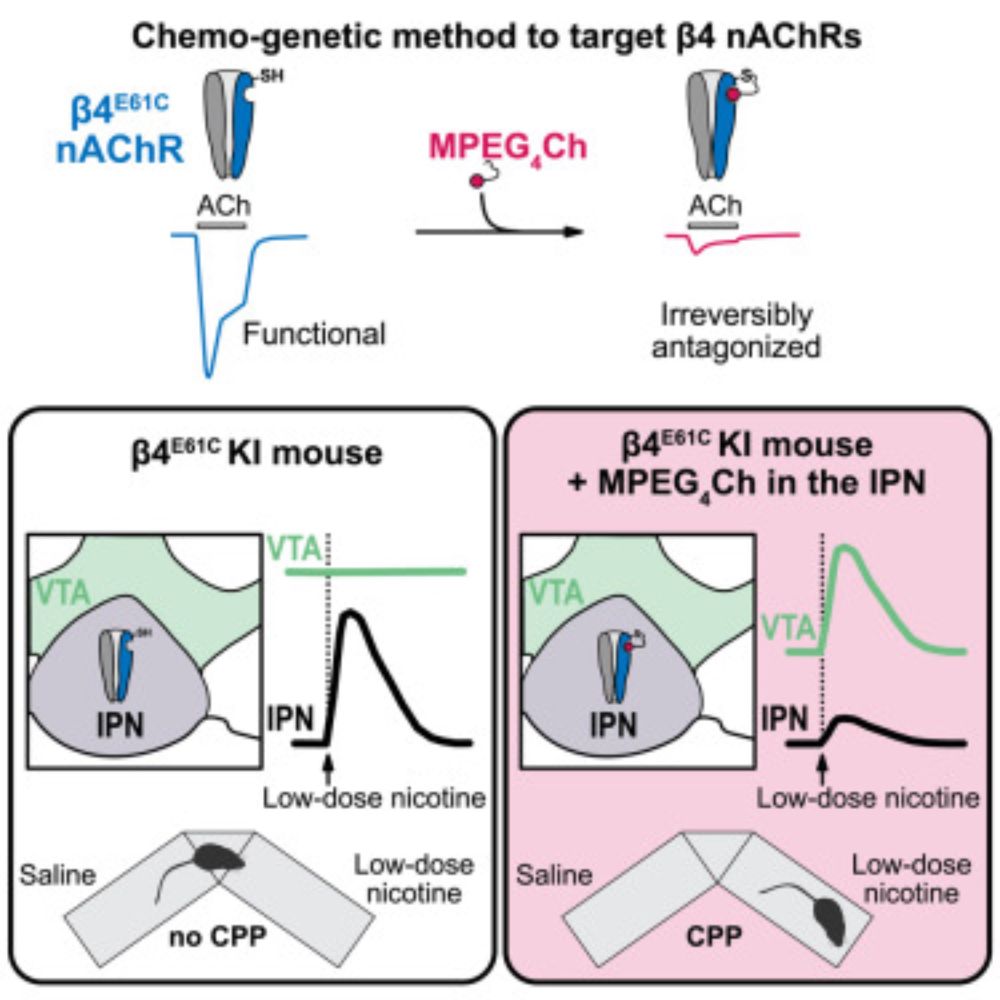
The interpeduncular nucleus blunts the rewarding effect of nicotine
Nicotine activates the dopamine reward system to promote consumption and addiction,
but the brain has a natural brake to counteract it. Jehl, Ciscato, Vicq, Guyon, et al.
identified the interpeduncula...
The interpeduncular nucleus (IPN) dampens nicotine reward via β4* nAChRs and IPN→LDTg projections. Blocking this pathway enhances VTA responses and CPP: A nicotine-specific brake embedded in the mesolimbic system.
New paper from the lab out in @cp-neuron.bsky.social www.cell.com/neuron/abstr...
21.04.2025 17:01 — 👍 3 🔁 2 💬 1 📌 0
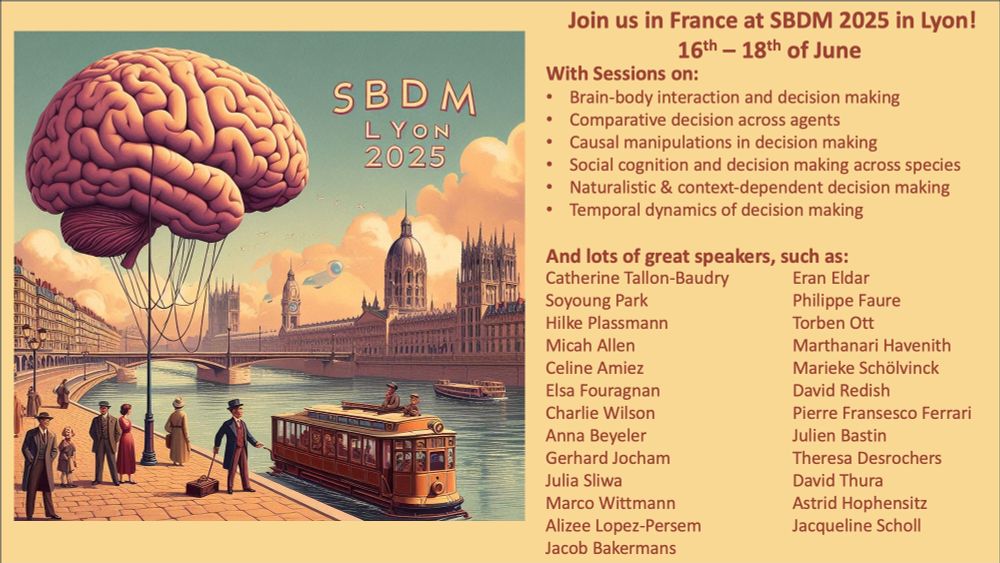
Registrations for the Symposium for the Biology of decision making (SBDM) in Lyon 2025 are finally open! sbdm2025.github.io Please spread the message!
08.04.2025 18:18 — 👍 23 🔁 10 💬 0 📌 1
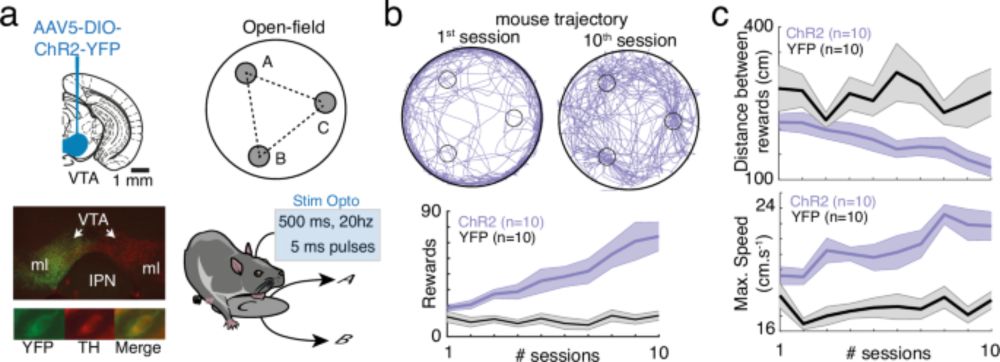
Social structures are dynamic: manipulating dopamine activity reshapes role distribution, confirming a feedback loop where social context modulates neural states, which in turn reinforce specialization.
11.02.2025 12:47 — 👍 1 🔁 0 💬 0 📌 0
A reinforcement learning model reveals how competition for ressources drives behavioral specialization, with varying degrees of exploitation shaping social roles development and driving sex differences.
11.02.2025 12:47 — 👍 1 🔁 0 💬 1 📌 0
Neural and computational analyses during the task reveal that dopaminergic activity in the ventral tegmental area (VTA) plays a key role in stabilizing social roles.
11.02.2025 12:47 — 👍 1 🔁 0 💬 1 📌 0
Males exhibit clear divisions of labor, where worker-scrounger equilibria emerge from competitive dynamics. In contrast, females adopt more uniform & cooperative behaviors. These sex-specific differences arise only in group contexts—when tested alone, males and females show only subtle differences!
11.02.2025 12:47 — 👍 3 🔁 0 💬 1 📌 0
How do animals self-organize into structured societies? Using behavioral tracking, neural recordings, and reinforcement learning models, we show that small groups of isogenic mice spontaneously develop specialized roles.
11.02.2025 12:47 — 👍 3 🔁 0 💬 1 📌 0
Evolution; animal behaviour; animal culture; human cognitive evolution; niche construction; anti-racism. Editor-in-Chief of Biological Theory
#evolution #evodevo #philbio #philsci #animalculture #animalbehavior
CNRS Researcher at CRNL. Research Specialist at Karolinska Institutet, Stockholm. Studying the prefrontal cortex and cognition in rodents. Electronic musician.
lab : https://www.lab.pierrelemerre.com/
personal webpage: https://www.pierrelemerre.com/
Behavioral Neuroscientist, Prof, ICAN co-Director, Ivan Pavlov fan.
Interested in rats, drugs, motivation circuits, orexin, VP, DREADDs, psychedelics, neurodevelopment, etc
https://faculty.sites.uci.edu/mahlerlab/
http://www.youtube.com/@stephenvmahler56
neuroscientist @INSERM @FemmesSciences #memoryresearch
https://www.igf.cnrs.fr/equipes/equipe-trouche/
Comp. Cog. Neuro, Imaging & Neurphysiology, Epilepsy | MNI, McGill U.
Neuroscience, Sleep, Imaging - Teacher @ LPI - Researcher @ CNRS and Atip-Avenir Emerging Group Leader @ Paris Brain Insitute
Veille et recherche sur les politiques publiques de l'éducation, de l'enseignement supérieur et de la recherche
#ESR #DataESR #VeilleESR
Maître de conférences à l'Université de Strasbourg, laboratoire SAGE.
Membre de la CPESR.
Crowmunity manager des corneilles baguées parisiennes, biodiversité ordinaire, culture libre et collaborative.
Signaler des corneilles baguées :
http://corneilles-paris.fr/
Assistant Professor | Neuroscientist trained as a developmental neuroscientist + in vivo electrophysiologist | Sex, stress, development, dopamine, reward, motherhood | NYU PhD/ Pitt PD/ UTD PI
UK based in 🏴 Entomologist 🇵🇷
Former ITAP.gov Invert chair
Former US Labor Union Leader
Film Ent: imdb.com/name/nm13959020/
Editorial admin at: https://www.sswento.org/
Board Member: circulodepr.org
Views are personal.
Postdoc at the Institute of Philosophy, Zagreb | PhD, King’s College London | Primarily working on mind and metaphysics 💭
Historien (guerres, histoire publique), prof (CPGE, ScPo, ENS), auteur (Nathan, Monde des Livres), podcasteur (Paroles d’histoire, Le fil de l’épée)
👩🏼, rider 🐎 and postdoc at @PittPsychiatry
PhD from Sorbonne University 🇫🇷🧠 into heteromers, addiction and depression
neuroscientist at Karolinska Institutet
The goal of our research is to understand how brain states shape decision-making, and how this process goes awry in certain neurological & psychiatric disorders
| tobiasdonner.net | University Medical Center Hamburg-Eppendorf, Germany
Professor specializing in bird social behavior. Interested in developmental systems thought, ontogenetic niches, organismal agency, and ייִדיש. PI: Animal Social Interaction lab, kohnlab.wordpress.com
CNRS Researcher at the University of Poitiers, Inserm, Neuroscience of Addiction, Brain
Neuroscientist at the Paris Brain Institute / www.dejuansanzlab.org / ERC / FENS-Kavli Scholar / Young Academy of Spain / CNRS
World citizen, Time and Variation in Brain Development, football, cheese, wine, single malt!