NEW Highlight of @nature.com paper by @peeperlab.bsky.social showing that T cell-containing heterotypic clusters can be isolated from clinical tumour samples, providing insights into phenotype and function
#immunosky #cancersky
@peeperlab.bsky.social
Cancer researcher @NKI_nl and @oncodeinstitute, Cofounder of Flindr Tx; developing rational cancer & immune cell combination treatments using functional genomics
NEW Highlight of @nature.com paper by @peeperlab.bsky.social showing that T cell-containing heterotypic clusters can be isolated from clinical tumour samples, providing insights into phenotype and function
#immunosky #cancersky
🙏 Huge thanks to everyone involved - postdocs, PhD students, bioinformaticians, technicians, internship students and collaborators.
👏 I’m incredibly proud that this long-term team effort led to a discovery that may help us better harness the immune system to fight cancer.
🚀 What’s next?
We aim to:
• Develop a clinical-proof procedure to specifically isolate T cell clusters from tumors
• Test them in clinical trials to improve TIL therapy
• Explore how the unique features of these clusters can inspire new immunotherapy strategies.
👊 Why this may help patients:
TIL therapy takes T cells from a patient’s tumor, expands them, and reinfuses them. It can help a subset of melanoma patients and is being explored for other cancers.
Our work suggests we can purify the most potent TILs by selecting T cell clusters.
😲 Why wasn’t this seen before?
Immune cell clusters have been observed before- but because most analyses focus on single cells, clusters were usually filtered out.
We did the opposite: we asked whether the clusters themselves might be where highly active T cells live.
They do.
⚙️ What we show:
By isolating these T cell-tumor clusters from patient material, we enrich for highly tumor-reactive T cells fast and easy.
In lab models and patient-derived tumors, these T cells were up to 9× more effective at killing cancer cells.
🧠 This led to a key question:
👉 Could we use these clusters to directly find the best tumor-killing T cells in patient tumors?
The breakthrough: the interactions between active T cells and cancer cells are so strong that the clusters can be isolated straight from a tumor.
🧪 In our lab at the @nkinl.bsky.social and
@oncodeinstitute.bsky.social, we noticed something striking:
T cells that truly “see” the tumor stick to cancer cells and form tight clusters. These clustered T cells were far better at killing tumor cells than lone T cells.
🧩 The challenge:
To improve cancer immunotherapy, we need to isolate the T cells that actually kill tumor cells.
We know CD8 T cells can do this — but picking out the most powerful tumor-killing cells from patient samples has been very hard.

Our new paper is out in Nature - online today!
Huge congrats to shared first authors Sofía Ibáñez-Molero & Johanna Veldman, the whole team & all collaborators.
📄 Open-access paper: www.nature.com/articles/s41...
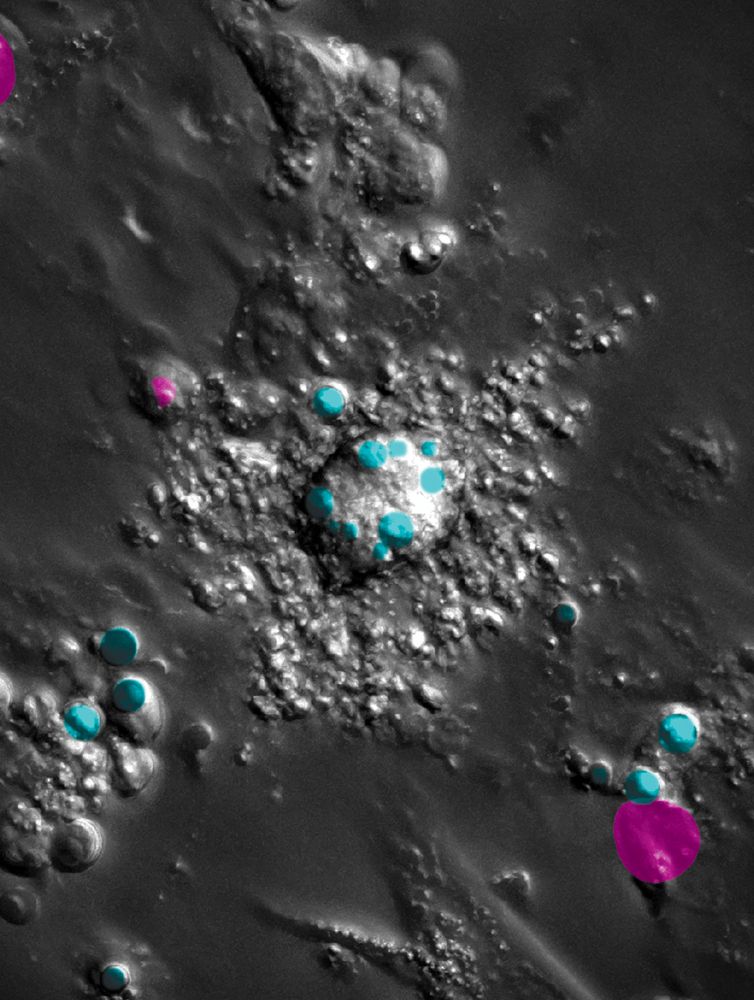
High-resolution microscopy of a mesenchymal cancer cell that has been killed by inactivating the CDS2 gene. Prior to cell death, tiny lipid droplets accumulated, which are still visible as cyan-colored dots, visualized using fluorescence microscopy. The DNA of the dead cancer cells (magenta) is dispersed throughout the surrounding area. Processed image by Tim Arnoldus, Gemma Driessen and Marjolein Mertz. Legend: magenta = DNA from dead cancer, cyan = lipid droplets
In a new Nature Genetics paper our researchers identified a synthetic lethal interaction in 50% of cancers. Tumors lacking CDS1 depend entirely on CDS2. Blocking CDS2 kills cancer cells while sparing healthy tissue ➡️ www.nki.nl/news-events/...
07.07.2025 09:29 — 👍 8 🔁 1 💬 0 📌 0
The SMR 2025 Annual Congress (Amsterdam Oct 25-28) covers basic, preclinical & translational melanoma research of international top investigators. It is a very enjoyable conference with top faculty and now improved with ample opportunity for young investigators to network. Join us! smrcongress.org
04.07.2025 12:23 — 👍 8 🔁 5 💬 1 📌 4Major congratulations to my PhD student Tim Arnoldus @nkinl.bsky.social @oncodeinstitute.bsky.social on publishing his exciting discovery today in Nature Genetics! 🎉
By computational mining Tim found a synthetic lethal target that may impact future treatment of half of all cancers.👏
t.co/cQdeYQinsX

Congrats to Sofía Ibáñez Molero @NKI_nl and
@oncodeinstitute for excellently defending her PhD thesis, on functional interactions between cancer and the immune system, with several interesting papers already published and under review. Great work Sofía and best of luck with your postdoc!
📢 Applications for the NKI PhD program now open till Feb 28. Several exciting positions available, including one in my lab on discovering new biology and therapeutic opportunities of a population of enriched tumor-reactive T cells we recently identified.
www.nki.nl/careers-stud...
More knowledge about immunotherapy, advanced diagnostics, and reducing overtreatment. Thanks to financial support from KWF Dutch Cancer Society, 13 research teams from the Netherlands Cancer Institute are launching new projects ➡️ www.nki.nl/news-events/...
13.12.2024 13:59 — 👍 21 🔁 3 💬 0 📌 0
📢 Applications for the NKI PhD program open from Jan 1 - Feb 28. Join our international research community in Amsterdam, working in cancer biology, AI research & life sciences with leading scientists and top facilities #PhD #CancerResearch More info: bit.ly/3O4bOjq
29.11.2024 08:36 — 👍 26 🔁 16 💬 0 📌 6My first post here: Congrats to David Vredevoogd from my lab @NKI_nl
@oncodeinstitute + collaborators for reporting on TMED, a new regulator of both immune checkpoints PD-1 and CTLA-4, which is amenable to therapeutic intervention. Read the paper here jitc.bmj.com/content/12/1...