Science Needs to Embrace the Idea of Style
How do individual scientists approach their work? These stylistic differences can influence the process of discovery.
Some chemists build molecules incrementally. Others make risky moves to discover new chemistry. Both succeed. We call it methodology. But it's style. And we act like acknowledging different approaches threatens scientific rigor.
10.12.2025 17:03 — 👍 2 🔁 3 💬 0 📌 0

Did you know sand grains record their transport history?
New research in Geology shows zircon grains reveal their journey through microscopic abrasion “microtextures”—even in billion-year-old rocks!
Read more: geosociety.co/4oHG2J6
#Geology #GSAPubs
01.11.2025 12:32 — 👍 16 🔁 5 💬 0 📌 1
take a sec to check out our paper on zircon micro-abrasion features and what they can tell us about Earth’s surface billions of years ago (hot of the proverbial press in @geosociety.bsky.social)!
01.11.2025 16:21 — 👍 1 🔁 0 💬 0 📌 0
Yooo how about those Mariners??!!!
18.10.2025 01:02 — 👍 0 🔁 1 💬 0 📌 0
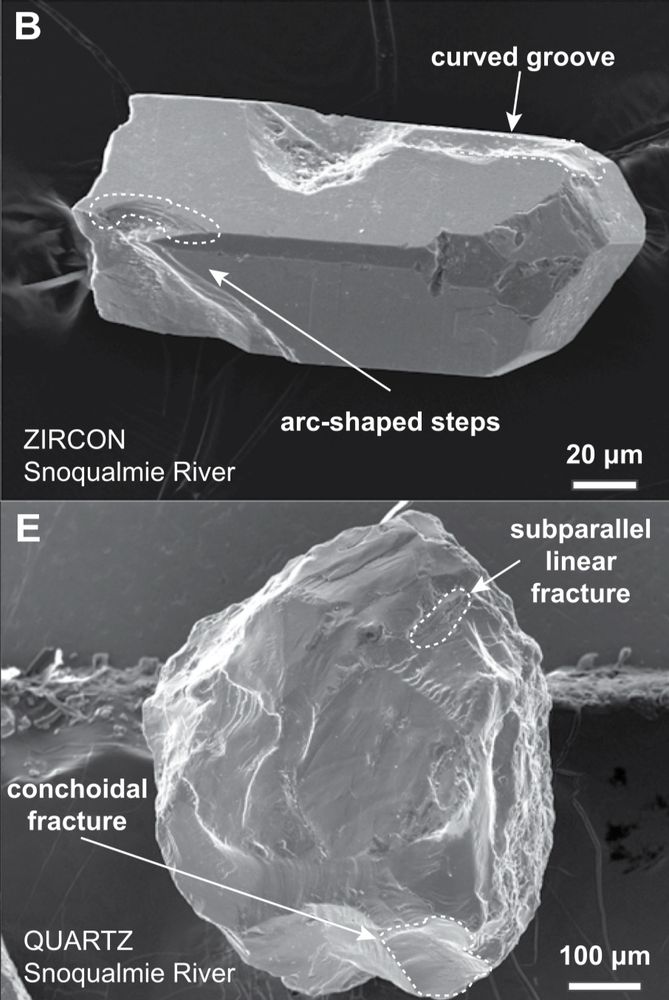

Just out: PhD candidate @mcolinmarvin.bsky.social shows that like in quartz, #zircon grains preserve microscopic archives of their transport history. But unlike in quartz, those archives remain decipherable for billions of years, unlocking first 90% of #Earth ’s history
@stanforddoerr.bsky.social
16.10.2025 16:39 — 👍 5 🔁 2 💬 1 📌 0
with Michael Hasson, Vittorio Colicci, Raisha Abubo, and @marslogander.bsky.social, all at @stanforddoerr.bsky.social
16.10.2025 06:45 — 👍 4 🔁 0 💬 0 📌 0


Did you know that sand records its transport history as it moves across Earth's surface? We developed a new tool to investigate billion-year-old rocks by looking at microscopic features on zircon sand grains. Check out our new paper in @geosociety.bsky.social to see how!
doi.org/10.1130/G537...
16.10.2025 06:43 — 👍 69 🔁 10 💬 2 📌 0
^^ a classic. “Puyallup” as a close second
09.10.2025 05:16 — 👍 1 🔁 0 💬 0 📌 0
Instant classic!
02.10.2025 14:24 — 👍 1 🔁 0 💬 0 📌 0
02.10.2025 04:05 — 👍 1 🔁 0 💬 0 📌 0
I also like to use some of their examples from previous underwater experiments (Reffet et al., 2010; doi.org/10.1130/G308...) to show how acute and obtuse diverging winds result in different dune types (inspired by @agunn.bsky.social 's Sharp Lecture last year):
02.10.2025 04:04 — 👍 2 🔁 2 💬 2 📌 0
Their results totally line up with the Rubin and Hunter model too! "As defined, the resulting dune orientation yields to the maximum gross transport normal to the bedform trend, as proposed by Rubin and Hunter"
02.10.2025 03:58 — 👍 0 🔁 0 💬 1 📌 0

Their underwater experiments and model comparison with modern aeolian dunes shows that the orientation relative to the RDD is the one that maximizes the growth rate. Also explains how dunes of different morphologies can exist under the same wind regime:
02.10.2025 03:58 — 👍 1 🔁 0 💬 1 📌 0
cool stuff! Courrech du Pont et al. (2014) took this a step further by showing that the dune type (elongating vs migrating) is dependent on sediment supply. doi.org/10.1130/G356...
02.10.2025 03:55 — 👍 1 🔁 0 💬 1 📌 0
eBook Preview
Statistical Physics of Rarefied Sediment Particle Motions and Transport: Applications to Hillslopes and Rivers
Posting this preview of material from my next (unfinished) book might be a mistake. But eh… what the hell.
1/n
cdn.vanderbilt.edu/t2-my/my-prd...
01.09.2025 21:15 — 👍 6 🔁 3 💬 1 📌 2

The rise of plant life changed how rivers move, study shows
Research reveals that unvegetated meandering rivers can geologically masquerade as braided rivers, suggesting they were much more common in the first 90 percent of Earth’s history than previously thou...
Findings from a recent study could upend the conventional view of how rivers have shaped continents over time.
It’s “a significant revision to our understanding of the history of the Earth,” said lead author Michael Hasson.
@marslogander.bsky.social
25.08.2025 16:08 — 👍 3 🔁 3 💬 0 📌 0
So proud of Michael!! 😎
This work was a collaboration with @alvitello.bsky.social at @unipd.bsky.social and A. Ielpi and @ubcokanagan.bsky.social
Check also:
- Perspective by J. Pizzuto: doi.org/10.1126/scie...
- Stanford’s press release: sustainability.stanford.edu/news/rise-pl...
22.08.2025 19:17 — 👍 2 🔁 2 💬 0 📌 0

Vegetation changes the trajectory of river bends
A primary axiom in geoscience is that the evolution of plants drove global changes in river dynamics. Notably, the apparent sinuosity of rivers, derived from the variance of sediment accretion directi...
Plants change how river bends move - paper by PhD student Michael Hasson out as First Release in #Science!!
Paper: doi.org/10.1126/scie...
Before #plants, #meanders did not grow laterally as much but translated downstream, making them look like braided rivers in rocks.
@stanforddoerr.bsky.social
22.08.2025 19:17 — 👍 7 🔁 4 💬 1 📌 0

A few semi-transparent grains of sand on a black background, with a frosted texture characteristic of wind abrasion

A lot of semi-transparent grains of sand on a black background

A few semi-transparent grains of sand on a black background, with a frosted texture characteristic of wind abrasion

The microscope and camera setup I used to take the photos
Sand grains from Coral Pink Sand Dunes State Park, Utah 🧪⚒️
16.05.2025 00:31 — 👍 39 🔁 6 💬 1 📌 0

Tonight is the 250th anniversary of Paul Revere’s midnight ride. May his memory remind us all to resist the tyranny forming in our government.
19.04.2025 00:00 — 👍 23391 🔁 7537 💬 329 📌 285
we ❤️ dunes
09.04.2025 01:24 — 👍 1 🔁 0 💬 0 📌 0
New paper by PhD student @mcolinmarvin.bsky.social uses #patterns formed by #dunes to better understand sources, pathways, and sinks of #sand on #Titan. Spoiler: #Xanadu has outsized influence on #eolian sediments, and sand travels far!!
@stanforddoerr.bsky.social
05.03.2025 00:29 — 👍 8 🔁 1 💬 0 📌 0
with @marslogander.bsky.social, Jani Radebaugh, and Wen Bo
04.03.2025 18:17 — 👍 1 🔁 0 💬 0 📌 0

Check out our paper in @agu.org where we provide evidence for a continuous transport pathway around Titan’s equatorial dune fields, only interrupted by the Xanadu region (with implications for the nature of Titan’s sand grains!) agupubs.onlinelibrary.wiley.com/doi/full/10....
04.03.2025 18:16 — 👍 8 🔁 3 💬 1 📌 1

8th International Planetary Dunes Workshop is held in Sassari/Alghero, Italy, from 19–22 May:
www.hou.usra.edu/meetings/dun...
🔔 Important Deadlines:
📌 Abstract submission: 12 March
📌 Registration: 31 March
04.03.2025 16:18 — 👍 1 🔁 3 💬 0 📌 0

Enhanced color cutout shows a closeup of a thick sand sheet draped over bedrock in Melas Chasma on Mars. The dark-blue and purple colors indicate coarse-grained sands that are comprised of basalt. The scene is less than 1 km across. (NASA/JPL-Caltech/University of Arizona)
Mars Wore Blue Velvet
The dark-blue and purple colors indicate coarse-grained sands that are comprised of basalt, an iron and magnesium-rich volcanic rock that formed from cooled lava millions of years ago.
uahirise.org/hipod/ESP_05...
NASA/JPL-Caltech/University of Arizona
#Mars #NASA #science
05.02.2025 13:45 — 👍 120 🔁 32 💬 1 📌 0
Had a wonderful time today! It was really great meeting you and thank for the invite to visit your fantastic department (and beautiful campus!)
23.01.2025 05:55 — 👍 1 🔁 0 💬 0 📌 0
Astrobiologist and Staff Scientist at JHU Applied Physics Laboratory. Project Scientist on Dragonfly. Rampant foodie. My opinions are my own.
Hydrologist and satellite enthusiast. Associate Professor at Virginia Tech
Associate Professor @UTKnoxville | Amazon Scholar | Creator of #geemap & #leafmap | Talk about #Geospatial #GeoPython #DataViz #GIS #FOSS #EarthEngine
International, community-run Research & Academic faculty & post-doc positions in the Earth & Environmental Sciences.
Access the list here: https://tinyurl.com/EarthJobs25
Maps—Rivers—Terrain
dancoecarto.com
ISAR was created to promote contacts among scientists undertaking research in aeolian processes and landforms, stimulate scientific research in aeolian topics and related fields, and to further the application of the results of such research into practice.
Loves rocks (especially rocks on Mars)
Cinephile
PhD candidate at Imperial College London researching the red planet 🪐
Space nerd, rock nerd, ed nerd, dog nerd, fiber nerd
granddad and emeritus professor studying statistical physics of sediment transport & science philosophy
essays on these topics: https://my.vanderbilt.edu/davidjonfurbish/
author of Fluid Physics in Geology: https://academic.oup.com/book/40895?login=false
Advancing the understanding of Earth and space systems through innovative research and education. Stay up to date with our latest news and events ⬇️
Associate Professor in the School of Earth and Space Exploration at Arizona State University. Barnes & Noble Premium Member.
Puertorriqueña. Planetary Science phd student at Brown. Purdue BS
Planetary geophysicist | PhD candidate @ Baylor | Research: potential fields, geodynamics, ML, & chaos on mostly icy worlds but some dabbling on Venus | John Mather Nobel Scholar | x8 NASA intern | Clipper G/RS graduate affiliate
Every week during our Spring and Fall series, we host a presentation by a geoscientist on their work in and around geomorphology. Part of EGU GM family.
Homepage: https://www.landscapeslive.org/
Youtube page: https://www.youtube.com/@landscapeslive1326
Geomorphology 🏔️ Landscape evolution 🗻 Tectonics ⛰️ Assistant Professor @ Queens College - CUNY 🌋 Opinions/posts my own 🏔️ he/him
Geologist @ Michigan Geological Survey | Clastic Sedimentology, Glacial Geology, & Geologic Mapping on Earth & Mars | she/her/hers | views are my own | glacierseds.com
Planetary scientist and paleomagnetist.
🇨🇦 Geologist, Canadian Arctic | Critical minerals in volcanic 🌋 environments | Mackenzie LIP | Arctic Ocean & Ridges | elle, she, her | Views are my own.
Assistant Professor, Stanford University | coastal dynamics & engineering | wave enthusiast | she/her