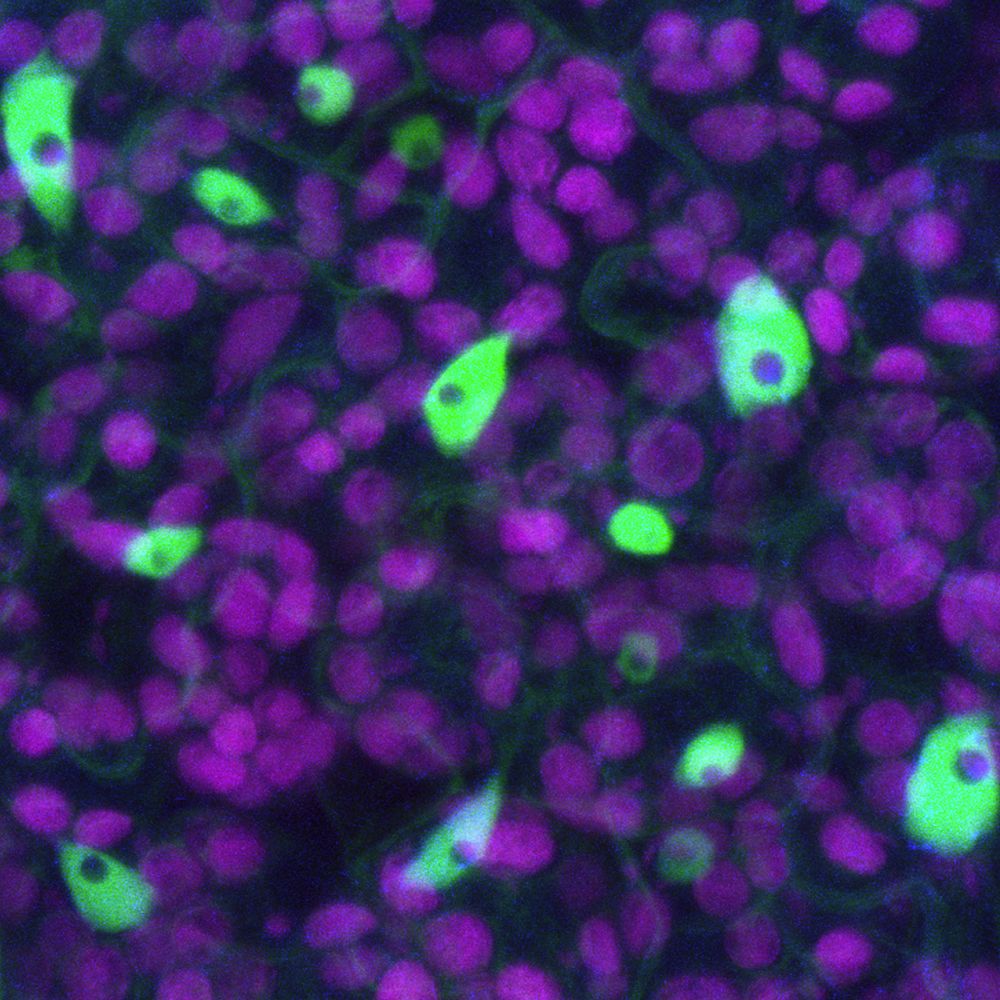
We also collected genes based on expression dynamics across the day and mapped these communities back to snRNAseq, finding enrichment in specific cell states and types.
01.02.2026 06:58 — 👍 0 🔁 0 💬 0 📌 0
This allows retention of genes that are expressed at a low level, but with consistent measurements. Many transcription factors are among the genes that are recovered using this method, and they map to specific cell populations in single-nucleus RNAseq data.
01.02.2026 06:51 — 👍 1 🔁 0 💬 1 📌 0
This is the most generalizable work I think I have every done. RNAseq is everywhere these days, and most analysis pipelines have a step for filtering out genes that are expected to be too noisy to interpret. We came up with a strategy to filter based on variance, rather than expression level.
01.02.2026 06:48 — 👍 3 🔁 1 💬 1 📌 0
Precision-Based Filtering Facilitates Integration of Conventional and Single-Nucleus Transcriptomes to Identify Time- and Temperature-Sensitive Cell Populations https://www.biorxiv.org/content/10.64898/2026.01.28.702137v1
01.02.2026 04:47 — 👍 0 🔁 1 💬 0 📌 1
JupyterLab is my Winamp visualizer.
Professor of Plant Molecular Biology at the University of Geneva interested in how plants detect, signal, and respond to environmental cues, with a main research focus on UV-B perception & signalling
https://www.ulm-lab.ch/
Publishing the best of biotech science and business. Find us on Twitter, Facebook & Instagram. Part of @natureportfolio.nature.com.
Publishing reviews and commentaries across the fields of genetics and genomics. Part of Springer Nature and Nature Portfolio.
https://www.nature.com/nrg/
An independent research institute renowned for world-leading fundamental discoveries in molecular plant-microbe interactions to reduce crop losses
Professor, plant biology, molecular biologist, fruit grower, science communicator, cancellation survivor. Good Trouble. Strategic communication coach, Talking Biotech podcast host. Old new dad. Farmer's husband. Best booth at farmers market.
A museum of plants 🌱, a center for learning 📚, and a plant science leader in the Bronx 🔬
John Yates studies proteins using the coolest method on the planet, mass spectrometry. Thoughts and musings are my own. EIC of the Journal of Proteome Research. https://www.scripps.edu/yates/
Global coalition of plant/crop science societies seeking to develop #plantscience. Curated by @isabelmyp.bsky.social
https://globalplantcouncil.org
Writing & Editing @ www.thesustainableprofessor.com 🌱Co-host, The Taproot Podcast 🌱Former midwestern biology professor finding her way as a writer and bon vivant in the PNW 🌱Check out what I'm up to or contact me: https://elizabethhaswell.carrd.co
Engineer/scientist, Nobel Prize in Chemistry 2018
I love evolution, enzymes, protein engineering, AI
Linus Pauling Professor at Caltech
Dog Lover, Scientist studying biological rhythms, Professor. Views are my own.
Growing Knowledge for the Future
The LPI unites all plant research
@kuleuvenuniversity.bsky.social
.
#PlantSci #biodiversity #SustainableFoodSystems #GreenSpace
🌱 Discussion of all plant-related research and concepts.
UC Davis supports academic and research programs in plant sciences, plant biology, plant pathology, viticulture and agricultural engineering.
https://instagram.com/ucdavisplants
News, research and updates from the Department of Plant Sciences at the University of Cambridge.🌱🔬 🌾
https://www.plantsci.cam.ac.uk/
The international job board for scientists, by scientists | https://jobRxiv.org
Are you hiring? ➡️ https://jobrxiv.org/post-a-job
Get all new jobs in your inbox ➡️ https://jobrxiv.org/job-alert-subscription/
The Bio-Analytic Resource encompasses more than 200 databases of plant genomic data (for transcriptome data, protein-protein and protein-DNA interactions, protein 3D structures, variation and more) with numerous tools for data visualization, e.g. ePlants!
Plant roots are the best! We study diverse and crazy cell type developmental programs at cellular resolution in plant roots. We have a special focus on those that make the plant more resilient in extreme stresses.
Doudna Lab at UC Berkeley, Innovative Genomics Institute founder, CRISPR co-inventor and Nobel laureate innovativegenomics.org/
News from Jennifer Doudna's lab at UC Berkeley, Innovative Genomics Institute. Tweets from lab members and not Jennifer Doudna unless signed JD. Tweets represent personal views only.
doudnalab.org