Thank you for inviting us! Very much looking forward to reading the other contributions, and seeing the book in print.
12.07.2025 16:30 — 👍 1 🔁 0 💬 0 📌 0
Forgot to tag @bringmannlaura.bsky.social and #PhilSci
12.07.2025 13:40 — 👍 3 🔁 0 💬 0 📌 0
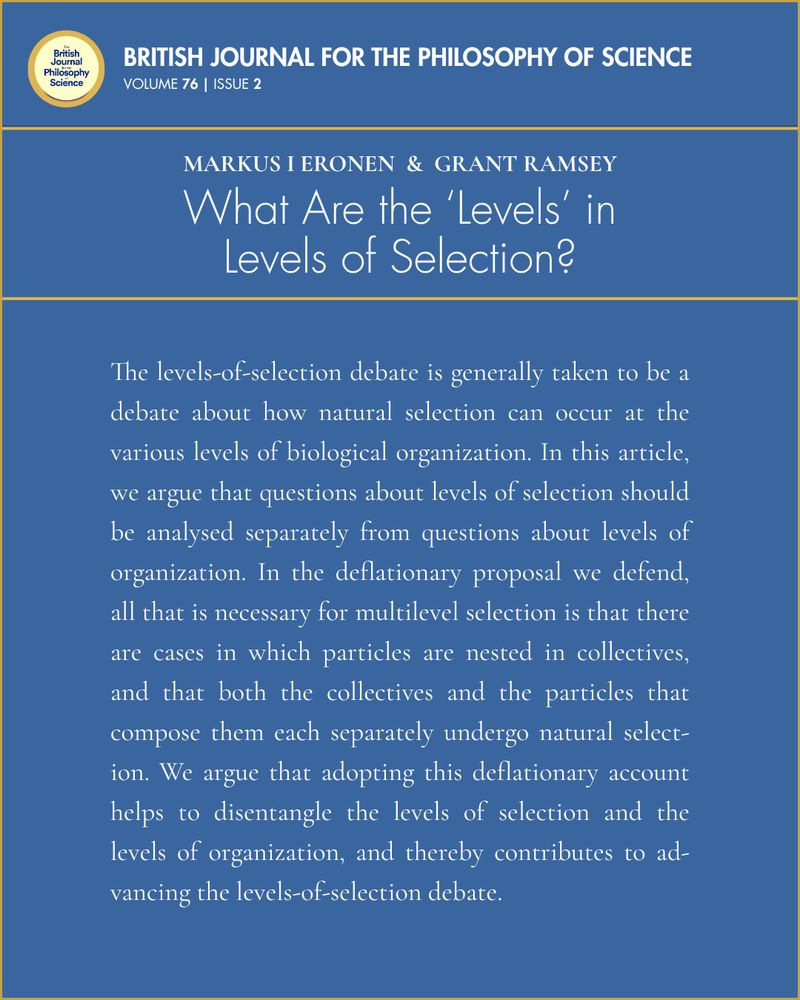
ABSTRACT. The levels-of-selection debate is generally taken to be a debate about how natural selection can occur at the various levels of biological organization. In this article, we argue that questions about levels of selection should be analysed separately from questions about levels of organization. In the deflationary proposal we defend, all that is necessary for multilevel selection is that there are cases in which particles are nested in collectives, and that both the collectives and the particles that compose them each separately undergo natural selection. We argue that adopting this deflationary account helps to disentangle the levels of selection and the levels of organization, and thereby contributes to advancing the levels-of-selection debate.
From the new issue:
Markus Eronen & Grant Ramsey
‘What Are the "Levels" in Levels of Selection?'
Read it here: www.journals.uchicago.edu/doi/10.1086/...
#philsci #philsky #hps #hpbio
03.07.2025 09:15 — 👍 27 🔁 5 💬 1 📌 1
🚨Preprint alert! 🚨
In this one, @mieronen.bsky.social and I argue that using network psychometrics, DAGs or BNs to study predictions of the network theory of psychopathology (NT) is conceptually incoherent.
Why? NT either directly contradicts or cannot support causal sufficiency!
1/11
23.01.2025 17:55 — 👍 19 🔁 8 💬 2 📌 1

A researcher
Latest papers: Markus Ilkka Eronen presents a new causal perspective to psychological measurement and argues that psychological measurement is fundamentally different from measurement in the physical sciences in this open access article buff.ly/3HrrqtS
21.01.2024 09:58 — 👍 8 🔁 4 💬 0 📌 0
Workshop announcement: We organize a workshop on the interaction between conceptualization and measurement across all scientific disciplines for early-career researchers located in Europe. More info and application here ias.uva.nl/content/even... Thanks for sharing!
27.03.2024 16:28 — 👍 24 🔁 10 💬 0 📌 2
That is another possibility (I also refer to Uher in my paper). I decided to stick to the terminology of soft "measurement" because "measurement" is the established and deeply rooted term for what psychologists are doing. However, there is surely also a case to be made for calling it something else.
11.01.2024 21:05 — 👍 3 🔁 0 💬 0 📌 0
I am big fan of causal inference, and I would love to have causal psychological measurements! I just think we (mostly) can't have them, in practice.
11.01.2024 20:59 — 👍 1 🔁 0 💬 0 📌 0
Many thanks for the kind words and for posting the paper, happy that you liked it!
11.01.2024 15:26 — 👍 1 🔁 0 💬 0 📌 0
Thank you for the very helpful review, I don't know which was by you, but they were both very nice and constructive! 😄
11.01.2024 15:16 — 👍 2 🔁 0 💬 1 📌 0

Excellent new paper by @mieronen.bsky.social on whether psychologists actually measure anything at all. Lays out a minimal causal condition for measurement, argues that psych vars do not satisfy it & distinguishes between "hard" and "soft measurement.">
www.tandfonline.com/doi/full/10....
10.01.2024 09:34 — 👍 90 🔁 35 💬 11 📌 2
One of my all-time favorite papers. It IS vague, but also full of great ideas. I have probably read it at least 20 times over the years, but still keep discovering new things in it.
27.11.2023 15:51 — 👍 2 🔁 0 💬 0 📌 0
Levels of Organization in Biology (Stanford Encyclopedia of Philosophy)
A thoroughly revised version of the Stanford Encyclopedia of Philosophy entry on Levels of Organization in Biology, written by me and Dan Brooks, has now been published! Very happy to see this online, writing it was a nice but long process. plato.stanford.edu/entries/leve...
10.11.2023 13:58 — 👍 18 🔁 2 💬 0 📌 0

Supporters of the autonomy of higher-level causation (or explanation) often appeal to proportionality, arguing that higher-level causes are more proportional than their lower-level realizers. Recently, measures based on information theory and causal modelling have been proposed that allow one to shed new light on proportionality and the related notion of specificity. In this article we apply ideas from this literature to the issue of higher- versus lower-level causation (and explanation). Surprisingly, proportionality turns out to be irrelevant for the question of whether higher-level causes (or explanations) can be autonomous; specificity is a much more informative notion for this purpose.
More from the new issue (and open access!):
Quantifying Proportionality and the Limits of Higher-Level Causation and Explanation
—Alexander Gebharter & Markus Eronen
www.journals.uchicago.edu/doi/10.1086/...
#philsci #philsky
06.10.2023 12:49 — 👍 7 🔁 1 💬 0 📌 1

BJPS, volume 74, issue 3
Table of Contents
Peter Carruthers — On Valence
Augustin Baas & Baptiste Le Bihan — What Does the World Look Like according to Superdeterminism?
Alexander Gebharter & Markus I Eronen — Quantifying Proportionality and the Limits of Higher-Level Causation and Explanation
Miloud Belkoniene — Grasping in Understanding
Manolo Martínez & Marc Artiga — Neural Oscillations as Representations
Alfonso García-Lapeña — Truthlikeness for Quantitative Deterministic Laws
Cameron Buckner — Black Boxes, or Unflattering Mirrors?
Uwe Peters — Science Communication and the Problematic Impact of Descriptive Norms
Corey J Maley — Analogue Computation and Representation
James DiFrisco — Toward a Theory of Homology
Adam Bradley & Quinn Hiroshi Gibson — Monothematic Delusions and the Limits of Rationality
New issue out now, full to the brim of crunchy and nutritious* philosophy of science
www.journals.uchicago.edu/toc/bjps/cur...
*Contains science communication & superdeterminism, machine behaviour & monothematic delusions, neural oscillations & analogue computation, & much more...
#philsky #philsci
26.09.2023 17:02 — 👍 7 🔁 2 💬 0 📌 1
Artist, naturalist and social scientist
East Anglia
Senior Lecturer in Philosophy at the University of Lancashire.
Avid writer and reader (#crimefiction); guitarist; snooker nut; nature lover (especially cats).
An International Journal for Theory, History and Foundations of Science is a non-profit editorial venture. It is a diamond open-access journal.
🔗: https://ojs.ehu.eus/index.php/THEORIA/index
Dutch Light: Christiaan Huygens and the Making of Science in Europe, Tide, The Adventures of Sir Thomas Browne in the 21st Century, Periodic Tales and other things.
Psychologist PhD - Professor Université Paris Nanterre / Associate researcher Inserm CESP - Clinical FSEF & St-Anne Hospital - SHU - C3RP
art & architectural historian / visual, material & religious culture
🔥 Blog by Dariusz Majgier. AI, fun facts, science & brilliant ideas:
👉 https://patreon.com/go4know
🔥 Get prompts, art styles & tutorials. Learn how to create ChatGPT & Midjourney images!
👉 Join me: https://patreon.com/ai_art_tutorials
The DEI Caucus aims to support networking among and raise the visibility of traditionally marginalized groups in the Philosophy of Science Association.
Ecology, conservation, statistics, reproducibility https://camargue.unibas.ch Retire statistical significance https://nature.com/articles/d41586-019-00857-9
Philosopher. Interested in: Philosophy, Psychology, Evolution, Artificial Intelligence, Social Science, Politics.
#Logician, #Onomast, #Medievalist, #AcademicMama, #Author, #Immigrant, founder of SFFReviews.com and @EllipsisImprint. Co-president of @ducu. Own views. Robot.
The Centre for Logic and Philosophy of Science (CLPS) at the Institute of Philosophy (@kuleuvenuniversity.bsky.social) focuses on #logic and #philsci, with a concentration on the philosophies of the special sciences • https://hiw.kuleuven.be/clps #philsky
Assistant Prof. in Philosophy of Technology Maastricht University, fascinated by #synbio, #experimentation, #historicalepistemology, #HOPOS, #HOPOT, #sciencefiction and #conspiracytheory - he/him
Research Fellow, University of Oxford
Theology, philosophy, ethics, politics, environmental humanities
Associate Director @LSRIOxford
Anglican Priest
https://www.theology.ox.ac.uk/people/revd-dr-timothy-howles
Yhteiskunta, tiede, työ(terveys)elämä, kulttuurihistoria... PsT, työterveyspsykologi
Ulkoilmaelämää, metallimusiikkia ja tekniikkajuttuja rakastava keski-ikäistyvä pohjoisen kasvatti.
Phd student (social epistemology) at university of Helsinki, sound guy, punk and metal music enjoyer, gamer.
Semiotican, writer, guerrilla artist, blue collar logistic worker (Philip J. Fry voice: "I'm a delivery boy!")
Interested in popular culture, arts, equality, martial arts.
Runs on caffeine and alcohol.
He/him.
A philosopher @ Tampere University. He/they. Philosophy, ethics, metaethics, music (currently on heavy rotation: Sibelius, death metal), politics (on the side of the good against the bad), football (FGR), green tea. Antifascist. Sometimes in Finnish.