Can a portable device measure the full thickness of sea-ice pressure ridges? New preprint led by Polona Itkin @oceanseaicenpi.bsky.social tests ground-based electromagnetic induction (GEM) across all seasons.
doi.org/10.5194/egus...

@salganik.bsky.social
ice researcher and architecture photographer Alfred Wegener Institute @awi.de
Can a portable device measure the full thickness of sea-ice pressure ridges? New preprint led by Polona Itkin @oceanseaicenpi.bsky.social tests ground-based electromagnetic induction (GEM) across all seasons.
doi.org/10.5194/egus...

A blog post from Megan Lenss about our new paper on Antarctic sea-ice algae: ic3.uit.no/news/hidden-...
04.12.2025 14:37 — 👍 1 🔁 0 💬 0 📌 0
New nice preprint led by Dmitry Divine (@oceanseaicenpi.bsky.social) on #Arctic sea ice ridge volume in the Fram Strait, derived from moored sonar observations from 2012–2019: doi.org/10.5194/egus...
19.11.2025 11:07 — 👍 1 🔁 0 💬 0 📌 0
A new thesis about the inclusion of air bubbles into the mushy layer model of sea ice by Joseph Fishlock from the University of Oxford @ox.ac.uk: ora.ox.ac.uk/objects/uuid...
29.09.2025 09:41 — 👍 0 🔁 0 💬 0 📌 0
Back from the CONTRASTS expedition (July–Sept)!
We studied 3 types of Arctic sea ice, revisiting each site 4 times.
I wrote a short overview here: en.wikipedia.org/wiki/CONTRAS...

Unique concept for observing Arctic sea ice successfully implemented: AWI scientists were able to study different types of sea ice in parallel during the Polarstern expedition “CONTRASTS.” 🧊
www.awi.de/en/about-us/...
Photo: Evgenii Salganik

It also features exciting sea ice draft data from mooring observations in the northwestern Barents Sea (2018–2021):
28.06.2025 12:12 — 👍 0 🔁 0 💬 0 📌 0
The Nansen Legacy data paper also includes ice and snow thickness measurements from both on-ice and helicopter-borne electromagnetic surveys:
28.06.2025 12:06 — 👍 0 🔁 0 💬 1 📌 0
Sea ice density data from Nansen Legacy show seasonality and temperature dependence very similar to the MOSAiC observations we recently analyzed: doi.org/10.5194/tc-19-1259-2025
28.06.2025 12:02 — 👍 0 🔁 0 💬 1 📌 0
Great to see a data paper from the Nansen Legacy cruises (2018–2022), led by Dmitry Divine (@oceanseaicenpi.bsky.social), including sea ice density measurements that clearly show strong seasonality: doi.org/10.1002/gdj3.70001
28.06.2025 12:02 — 👍 2 🔁 0 💬 1 📌 0
Sea ice density data from Nansen Legacy show seasonality and temperature dependence very similar to the MOSAiC observations we recently analyzed: doi.org/10.5194/tc-1...
28.06.2025 12:00 — 👍 0 🔁 0 💬 0 📌 0
An example of how data from ROV-based multibeam sonar was used to quantify ridge-enhanced melt rates can be found here: doi.org/10.5194/tc-1...
06.06.2025 09:01 — 👍 0 🔁 0 💬 0 📌 0
The study includes an overview of >80 surveys including measurements of ice draft from sonar, solar irradiance and radiance (see below), hyperspectral images, physical, chemical (pH, nitrate, oxygen), and bio-optical (fluorometry, ultra-violet and visible absorbance spectroscopy) water properties.
06.06.2025 08:54 — 👍 0 🔁 0 💬 1 📌 0
Our new data paper about under-ice observations from a remotely operated vehicle (ROV) during MOSAiC led by Philipp Anhaus from @awi.de: www.nature.com/articles/s41...
06.06.2025 08:50 — 👍 8 🔁 2 💬 1 📌 0
A new study led by Niels Fuchs uses hydrological models to predict the locations of melt ponds: doi.org/10.1029/2025GL115033
08.05.2025 20:06 — 👍 2 🔁 1 💬 0 📌 0
Our new study is out:
The Arctic Beaufort Gyre is projected to weaken or vanish in most CMIP6 models under future climate change.
The gyre would thus stop storing freshwater in its centre, with possibly large impacts on the Arctic and beyond.
Read: agupubs.onlinelibrary.wiley.com/doi/full/10....

Temporal evolution of temperature from Ice Mass Balance Buoy with identified interfaces of air, melt pond, first-year ice, seawater, and meltwater layer.
Ice Mass Balance (IMB) buoys are unique in their ability to distinguish between ice surface and bottom melt, which relates to the way solar energy is distributed. Models still do a poor job of capturing this. You can find the updated Wiki article here: en.wikipedia.org/wiki/Ice_mass_balance_buoy
29.03.2025 10:16 — 👍 2 🔁 1 💬 0 📌 0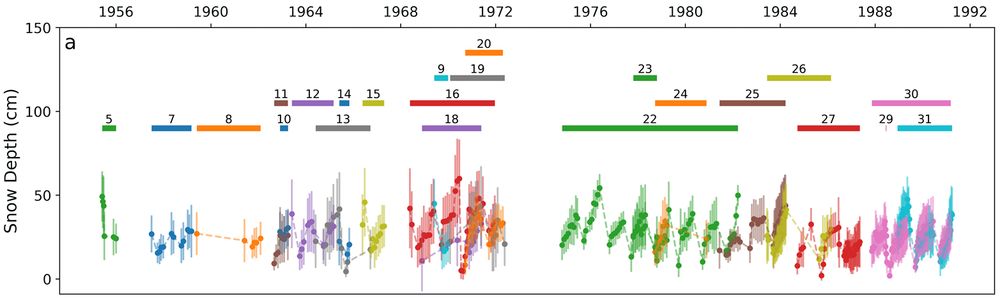
And if you are interested in longer observations of snow thickness from drifting stations in 1937–1991, I can recommend a wonderful PhD thesis by @robbiemallett.bsky.social: discovery.ucl.ac.uk/id/eprint/10161766
28.03.2025 14:04 — 👍 1 🔁 0 💬 1 📌 0
Huge thanks to Don Perovich, Chris Polashenski, Cameron Planck, and others for leading and maintaining CRREL, Dartmouth @dartmouthears.bsky.social, and Cryosphere Innovation www.cryosphereinnovation.com ice mass balance buoy programs.
28.03.2025 09:02 — 👍 2 🔁 1 💬 1 📌 0
Map showing the location of digital thermistor chains (DTCs) within MOSAiC Central Observatory (CO) ice floe.
And if you are working with the data from the MOSAiC expedition, here are an additional 24 Digital Thermistor Chain (DTC) datasets led by Mario Hoppmann from @awi.de and processed by me: doi.org/10.1594/PANGAEA.964023
28.03.2025 08:47 — 👍 0 🔁 0 💬 1 📌 0A similar but even larger dataset with 96 SIMBA ice mass balance buoys was published by Andreas Preußer @ando-puru.bsky.social for both Arctic and Antarctic ice during 2012–2023: doi.org/10.1594/PANGAEA.973193
28.03.2025 08:38 — 👍 1 🔁 0 💬 1 📌 0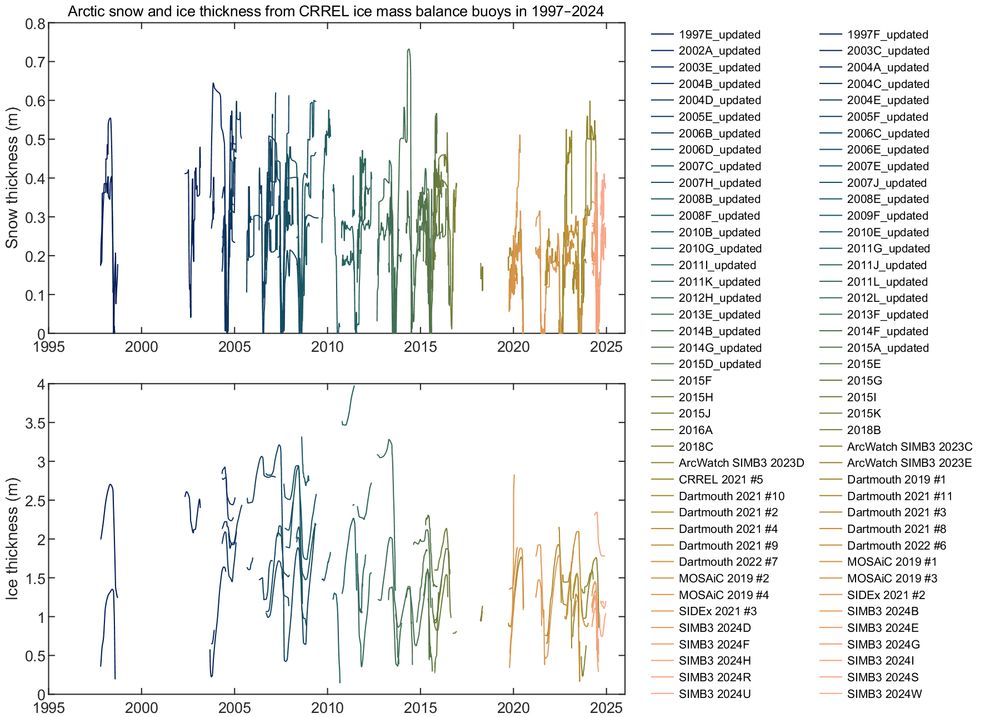
Two panels show the temporal evolution of snow (top) and sea ice (bottom) thickness from various ice mass balance buoys listed in the legend (right).
If you are into Arctic sea ice thermodynamics, here is our new dataset of 82 CRREL ice mass balance buoys deployed in 1997–2024 with estimates of snow and ice thickness and their interface evolution: doi.org/10.5281/zenodo.15096485
28.03.2025 08:30 — 👍 21 🔁 9 💬 1 📌 0The raw discrete data of sea ice physical properties, isotopes, and nutrients is available for first-year ice doi.org/10.1594/PANGAEA.959830, second-year ice doi.org/10.1594/PANGAEA.971385 for October 2019-July 2020, and doi.org/10.1594/PANGAEA.971266 for August-September 2020.
21.03.2025 11:09 — 👍 0 🔁 0 💬 0 📌 0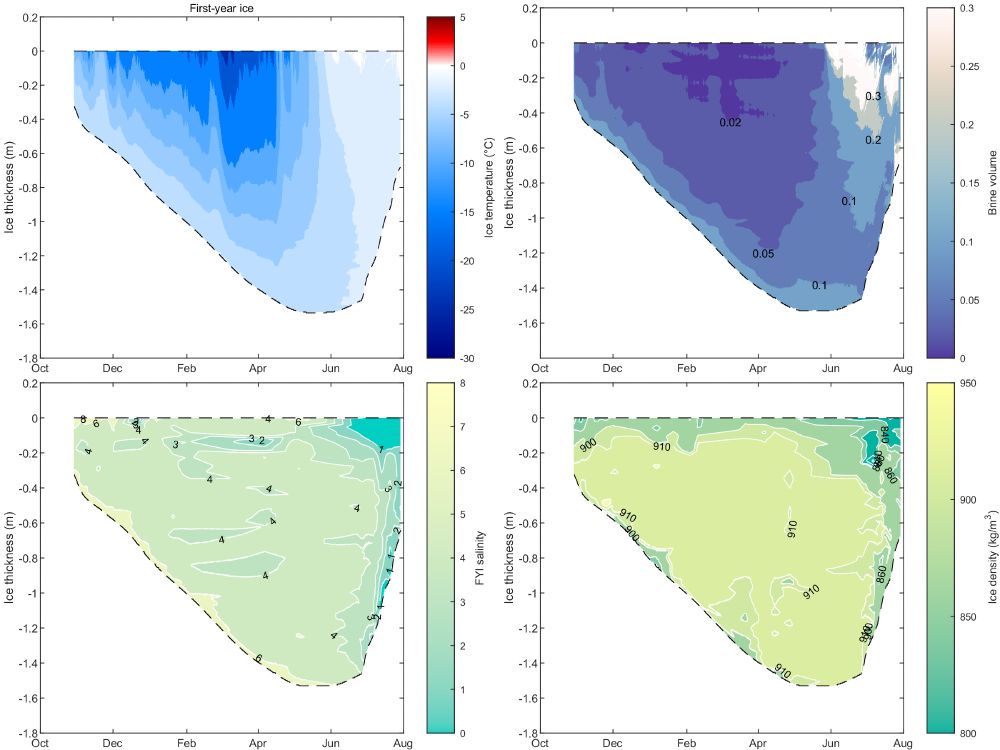
If you are into modeling of sea ice physical properties (salinity, brine volume, or density), we combined coring datasets to have a seasonal evolution for first- and second-year level ice: doi.org/10.5281/zeno...
The coring datasets have many more parameters, including isotopes and nutrients.

Finally, I wanted to thank my co-authors Odile Crabeck @universitedeliege.bsky.social, Niels Fuchs @cenunihh.bsky.social, Nils Hutter @awi.de
@geomarkiel.bsky.social, Philipp Anhaus @dlr-spaceagency.bsky.social, and Jack Christopher Landy (UiT), and Norwegian Polar Institute, where I made the study

The left panel shows seasonal evolution of historical and MOSAiC density measurements of first-year ice. The right panels hows the same data plotted against ice temperature.
What about historical observations? We measure sea ice density since 1927 by Malmgren. Seasonal evolution is complicated due to differences in melt onset timing in the Arctic Ocean. But the same data looks much tidier when plotted against ice temperature, with MOSAiC values fitting previous values:
18.03.2025 10:40 — 👍 2 🔁 0 💬 1 📌 0
The left panels show spatial variability of the total freeboard. The central panels show estimates of ice density assuming hydrostatic balance. The right panels show a histogram of ice density estimates from hydrostatic balance (grey) and from weighing (blue dots).
The densities were similar from all used methods. This means that weighing is the most affordable and accurate way with minor errors from brine loss. Here we show that ice is typically not in hydrostatic balance on scales of 10 meters, which leads to artificially large spreads of density estimates:
18.03.2025 10:33 — 👍 2 🔁 0 💬 1 📌 0
But why does ice get lighter upon warming? We linked the increase in air volume to two factors: (1) internal melt, which creates voids, enlarges bubbles, and nucleates new bubbles, and (2) the replacement of liquid brine by air in drained inclusions. Air occupies much more than 10% of brine:
18.03.2025 10:26 — 👍 2 🔁 0 💬 1 📌 0
When do these density changes happen? When it is getting warmer (d), its air volume fraction increases (h). The strongest changes were observed in first-year ice, but weaker effects were also observed in second-year ice and pressure ridges (g). So, after all, air bubbles matter even for altimetry:
18.03.2025 10:14 — 👍 2 🔁 0 💬 1 📌 0
Colors matter too. Here are measurements of snow freeboard (fb) from an airborne laser scanner, snow thickness (sn) from transects, and ice draft (d) from underwater sonar with a colormap from @fabiocrameri.ch. Ice just doesn't want to go down.
18.03.2025 10:08 — 👍 3 🔁 0 💬 2 📌 0