Gianmarco Ingrosso's Avatar

Gianmarco Ingrosso

@gianingro.bsky.social

Marine biogeochemist | landโ€“ocean carbon cycle, oceanography, polar sciences, arctic greening ๐ŸŒŠ๐ŸŒโ„๏ธ๐ŸŒฟ๐Ÿ”๏ธ

179 Followers  |  476 Following  |  11 Posts  |  Joined: 02.02.2025  |  1.8223

Latest posts by gianingro.bsky.social on Bluesky

Preview
Glacier biogeochemical cycling and downstream impacts - Nature Reviews Earth & Environment Far from frozen and sterile environments, glaciers are biogeochemical reactors and regulators. This Review outlines key biogeochemical and associated physical processes occurring in glacierized enviro...

How do glaciers drive and interact with Earth's regional and global biogeochemical cycles? โ„๏ธ๐Ÿ”๏ธ๐Ÿฆ ๐Ÿชจ๐ŸŒŠ๐ŸŒŽ๐Ÿงชโš’๏ธ

@natrevearthenviron.nature.com

Expertly led by Jon Hawkings & many collaborators

@mioceanologie.bsky.social @cnrs.fr @cnrs-dr12.bsky.social @cnrs-insu.bsky.social

www.nature.com/articles/s43...

10.02.2026 07:04 โ€” ๐Ÿ‘ 17    ๐Ÿ” 6    ๐Ÿ’ฌ 0    ๐Ÿ“Œ 0

New paper out! ๐Ÿšจ
โ€œAssessing the adoption of the FAIR principles in Italian environmental research infrastructuresโ€
We explore how 14 RIs are putting #FAIRdata into practice โ€” key to building more open, reusable, and connected environmental science.
๐Ÿงช ๐ŸŒŠ ๐Ÿงฌ ๐Ÿชจ

12.11.2025 17:32 โ€” ๐Ÿ‘ 1    ๐Ÿ” 1    ๐Ÿ’ฌ 0    ๐Ÿ“Œ 0
Preview
Ocean stratification in a warming climate Nature Reviews Earth & Environment, Published online: 30 September 2025; doi:10.1038/s43017-025-00715-5Ocean stratification โ€” density-related layering of seawater โ€” influences oceanographic and climatic processes. This Review outlines observed and projected changes in stratification, noting a 0.8%โ€‰decโˆ’1 increase in 0โ€“2,000โ€‰m stratification from 1960โ€“2024, and a further 1.4%โ€‰decโˆ’1 increase by 2100 under SSP2-4.5.

New online! Ocean stratification in a warming climate

30.09.2025 23:49 โ€” ๐Ÿ‘ 7    ๐Ÿ” 3    ๐Ÿ’ฌ 0    ๐Ÿ“Œ 0
Preview
Weather and climate extremes in a changing Arctic Nature Reviews Earth & Environment, Published online: 21 October 2025; doi:10.1038/s43017-025-00724-4Rare and extreme climate events have increasingly occurred in the Arctic since ~2000. This Review outlines the observed and projected changes in atmospheric, oceanic and cryospheric extremes and explains their increasing occurrence through a โ€˜pushing and triggeringโ€™ framework.

New online! Weather and climate extremes in a changing Arctic

21.10.2025 12:04 โ€” ๐Ÿ‘ 4    ๐Ÿ” 3    ๐Ÿ’ฌ 0    ๐Ÿ“Œ 0
Preview
Atlantification drives recent strengthening of the Arctic overturning circulation A less ice-covered Arctic shifts dense water formation northward, strengthening the Arctic Ocean overturning circulation.

Deep water formation decreased in the Nordic Sea during 1993-2020. This decrease was countered by an increase in deep water formation near the Arctic Mid-Ocean Ridge. Thus, the transport of dense overflow waters to the AMOC's lower limb remained unchanged: ๐ŸŒŠ www.science.org/doi/10.1126/...

15.07.2025 22:33 โ€” ๐Ÿ‘ 22    ๐Ÿ” 5    ๐Ÿ’ฌ 1    ๐Ÿ“Œ 1
aโ€“f, Multidecadal time series of water temperature, salinity and oxygen saturation concentration in the Atlantic water layer from repeated observations at different stations (Svinรธy (a), Gimsรธy (b), Northern Norwegian Sea (c), Fram Strait (d), Barents Sea Opening (e) and Eastern Barents Sea (f)), covering the pathway from the Atlantic-origin Nordic Seas to the Atlantic gateways. The station numbers aโ€“f correspond to locations indicated in g. Linear regression trends are shown for two distinct periods: thick dashed lines represent the period from 1980 to 2006, corresponding to the inflow of Atlantic water into the Canada Basin (1994โ€“2021); thin dashed lines represent the period from 2007 to 2020, projecting potential changes in the Canada Basin from 2022 onwards; grey dashed lines represent the overall trend from 1980 to 2020. rT, rS and rO2 denote the trends in water temperature, salinity and O2 saturation, respectively. g, Schematic circulation of the Atlantic and Pacific waters of the Arctic Ocean. Three Arctic gateways are indicated by black lines. Red and pink arrows denote the circulation of Atlantic water, dashed pink arrows denote the circulation of Pacific water, blue arrows denote the circulation of surface waters51. Yellow arrows represent the locations of six observational sites corresponding to aโ€“f.

aโ€“f, Multidecadal time series of water temperature, salinity and oxygen saturation concentration in the Atlantic water layer from repeated observations at different stations (Svinรธy (a), Gimsรธy (b), Northern Norwegian Sea (c), Fram Strait (d), Barents Sea Opening (e) and Eastern Barents Sea (f)), covering the pathway from the Atlantic-origin Nordic Seas to the Atlantic gateways. The station numbers aโ€“f correspond to locations indicated in g. Linear regression trends are shown for two distinct periods: thick dashed lines represent the period from 1980 to 2006, corresponding to the inflow of Atlantic water into the Canada Basin (1994โ€“2021); thin dashed lines represent the period from 2007 to 2020, projecting potential changes in the Canada Basin from 2022 onwards; grey dashed lines represent the overall trend from 1980 to 2020. rT, rS and rO2 denote the trends in water temperature, salinity and O2 saturation, respectively. g, Schematic circulation of the Atlantic and Pacific waters of the Arctic Ocean. Three Arctic gateways are indicated by black lines. Red and pink arrows denote the circulation of Atlantic water, dashed pink arrows denote the circulation of Pacific water, blue arrows denote the circulation of surface waters51. Yellow arrows represent the locations of six observational sites corresponding to aโ€“f.

Let's say it all together again: "A warmer ocean is an oxygen-poor ocean". Yet more evidence of that, this time from the Arctic Ocean, which is getting way warmer faster than you'd like to imagine. ๐Ÿงช๐ŸŒŠ

Link: www.nature.com/articles/s41...

10.07.2025 14:24 โ€” ๐Ÿ‘ 34    ๐Ÿ” 13    ๐Ÿ’ฌ 1    ๐Ÿ“Œ 0
The Mackenzie Trough in the Beaufort Sea

The Mackenzie Trough in the Beaufort Sea

Increased permafrost thaw is an unfortunate effect of rapid Arctic warming. Kim et al., investigate how permafrost thaw has affected the sources of organic carbon in sediments from the Mackenzie Trough in the Canadian Beaufort Sea ๐ŸŒŠ ๐Ÿปโ€โ„๏ธ

agupubs.onlinelibrary.wiley.com/doi/10.1029/...

11.07.2025 06:02 โ€” ๐Ÿ‘ 1    ๐Ÿ” 1    ๐Ÿ’ฌ 0    ๐Ÿ“Œ 0

๐ŸŒŠ ๐Ÿ‘ ๐Ÿ’ช

26.06.2025 05:15 โ€” ๐Ÿ‘ 2    ๐Ÿ” 0    ๐Ÿ’ฌ 0    ๐Ÿ“Œ 0
Preview
Large live biomass carbon losses from droughts in the northern temperate ecosystems during 2016-2022 - Nature Communications Drought, fires, and human activities have reversed the accumulation of live biomass carbon in the Northern Hemisphere, with total biomass shifting from a positive to a negative trend around 2016.

๐ŸŒฟ๐ŸŒŠ๐Ÿงช
www.nature.com/articles/s41...

03.06.2025 04:56 โ€” ๐Ÿ‘ 6    ๐Ÿ” 2    ๐Ÿ’ฌ 0    ๐Ÿ“Œ 0
Preview
Synthesis of data products for ocean carbonate chemistry Abstract. As the largest active carbon reservoir on Earth, the ocean is a cornerstone of the global carbon cycle, playing a pivotal role in modulating ocean health and regulating climate. Understandin...

โ€ผ๏ธ Check out our new discussion paper "Synthesis of data products for ocean carbonate chemistry" led by Liqing Jiang.
๐ŸŒŠ

essd.copernicus.org/preprints/es...

15.05.2025 04:31 โ€” ๐Ÿ‘ 16    ๐Ÿ” 10    ๐Ÿ’ฌ 1    ๐Ÿ“Œ 1
Preview
Plant diversity dynamics over space and time in a warming Arctic Nature - Warming temperatures and interactions between plants are the main drivers of changes in Arctic plant communities in response to climate change, and there is no evidence of overall biotic...

๐ŸŒฟโ„๏ธ๐Ÿ”๏ธ๐Ÿงช rdcu.be/ekf3M

01.05.2025 13:45 โ€” ๐Ÿ‘ 7    ๐Ÿ” 0    ๐Ÿ’ฌ 0    ๐Ÿ“Œ 0
Preview
Arctic fjord ecosystem adaptation to cryosphere meltdown over the past 14,000 years Communications Earth & Environment - In the Arctic cryosphere, phytoplankton communities changed abruptly with variable sea ice cover and glacial ice loss in the last 14,000 years, according to...

๐ŸŒŠ rdcu.be/ejJu1

28.04.2025 16:17 โ€” ๐Ÿ‘ 4    ๐Ÿ” 1    ๐Ÿ’ฌ 0    ๐Ÿ“Œ 0
Preview
Recent intensified riverine CO2 emission across the Northern Hemisphere permafrost region Nature Communications - Climate warming causes riverine CO2 emissions increasing at 0.42โ€‰ยฑโ€‰0.16 Tg C yrโป1 in the Northern Hemisphere permafrost regions during 2000โ€“2020.

Easter paper ๐ŸŒŠ rdcu.be/eire1

20.04.2025 05:37 โ€” ๐Ÿ‘ 4    ๐Ÿ” 2    ๐Ÿ’ฌ 0    ๐Ÿ“Œ 0
The upper halocline layer of the Arctic

https://agupubs.onlinelibrary.wiley.com/doi/full/10.1029/2024GB008342

The upper halocline layer of the Arctic https://agupubs.onlinelibrary.wiley.com/doi/full/10.1029/2024GB008342

Enjoyed reading this in Global Biogeochemical Cycles this morning, an epic @geotraces.bsky.social summary of how elements move from the Pacific into the Arctic ๐ŸŒŠ ๐Ÿปโ€โ„๏ธ

agupubs.onlinelibrary.wiley.com/doi/full/10....

09.04.2025 01:38 โ€” ๐Ÿ‘ 16    ๐Ÿ” 3    ๐Ÿ’ฌ 0    ๐Ÿ“Œ 0
Preview
Job Vacancies - Universitรคt Bremen Offene Stellen

๐ŸšจPermanent job alert๐Ÿšจ At @marumunibremen.bsky.social @unibremen.bsky.social, we are looking for a new professor in the field of Marine Geology. Check out the job description and how to apply here ๐Ÿ‘‡
www.uni-bremen.de/en/universit...

15.03.2025 18:10 โ€” ๐Ÿ‘ 25    ๐Ÿ” 19    ๐Ÿ’ฌ 1    ๐Ÿ“Œ 2
First page of the paper including the abstract

First page of the paper including the abstract

Locations of new AT and CT data (2005โ€“2023) in the global ocean and the western Mediterranean Sea (white box, inset) in the SNAPO-CO2-v2 dataset. Color code is for year. Figure produced with ODV (Schlitzer, 2018).

Locations of new AT and CT data (2005โ€“2023) in the global ocean and the western Mediterranean Sea (white box, inset) in the SNAPO-CO2-v2 dataset. Color code is for year. Figure produced with ODV (Schlitzer, 2018).

โ€ผ๏ธ Check out our new paper led by Nicolas Metzl on "An updated synthesis of ocean total alkalinity and dissolved inorganic carbon measurements from 1993 to 2023: the SNAPO-CO2-v2 dataset". ๐ŸŒŠ

14.03.2025 11:22 โ€” ๐Ÿ‘ 29    ๐Ÿ” 7    ๐Ÿ’ฌ 2    ๐Ÿ“Œ 0
Preview
Postdoctoral Fellow in Marine Carbon Cycle Science (275511) | University of Bergen Job title: Postdoctoral Fellow in Marine Carbon Cycle Science (275511), Employer: University of Bergen, Deadline: Thursday, March 6, 2025

Exciting job opportunity to work with ICOS-Norway in Bergen ๐ŸŒŠ
www.jobbnorge.no/en/available...

20.02.2025 10:52 โ€” ๐Ÿ‘ 7    ๐Ÿ” 4    ๐Ÿ’ฌ 0    ๐Ÿ“Œ 1
Preview
Autonomous Sensor for In Situ Measurements of Total Alkalinity in the Ocean Total alkalinity (TA) is one of the measurable parameters that characterize the oceanic carbonate system. A high temporal and spatial frequency in TA data can lead to better measurements, modeling, and understanding of the carbon cycle in aquatic systems, providing insights into problems from global climate change to ecosystem functioning. However, there are very few autonomous technologies for in situ TA measurements, and none with field demonstrations below 2 m depth. To meet this need in marine observing capabilities, we present a submersible sensor for autonomous in situ TA measurements to full ocean depths. This sensor uses lab-on-a-chip technology to sample seawater and perform single-point open-cell titration with an optical measurement. It can carry multiple calibration materials on board, allowing for routine recalibration and quality checks in the field. The sensor was characterized in the laboratory and in a pressure testing facility to 600 bar (equivalent to 6 km depth) and deployed in a shallow estuary, on a lander at 120 m depth, and on an autonomous underwater vehicle. With a demonstrated precision and accuracy regularly better than 5 ฮผmol kgโ€“1 in field deployments, this sensor has the potential to dramatically expand our ability to perform long-term autonomous measurements of the marine carbonate system.

๐ŸŒŠI would have one of these for my PhD thesisโ€ฆ
pubs.acs.org/doi/full/10....

18.02.2025 13:37 โ€” ๐Ÿ‘ 1    ๐Ÿ” 0    ๐Ÿ’ฌ 0    ๐Ÿ“Œ 0
Preview
2 year Postdoc in Biomarker Paleoclimatology - Vacancy at Aarhus University Vacancy at Department of Geoscience, Aarhus University

๐Ÿ“ฃ As part of my DFF-funded project, WARMEST, I'm hiring a biomarker-loving postdoc to join my group and examine terrestrial climate + environment of the western Sahel during the Eocene.

Applications are due Feb 15th - contact me with any questions!

RT plz :)

international.au.dk/about/profil...

12.01.2024 11:54 โ€” ๐Ÿ‘ 8    ๐Ÿ” 13    ๐Ÿ’ฌ 0    ๐Ÿ“Œ 1
Preview
Combined CH4, N2O, and CO2 Fluxes Reveal a Net Carbon Sink Across a Glacierโ€Ocean Continuum A rapidly-retreating marine-terminating glacier exported CH4 to nearshore waters N2O was undersaturated near the glacier front The regional CO2 sink greatly outweighs CH4 and N2O emissions

๐ŸŒŠ agupubs.onlinelibrary.wiley.com/doi/10.1029/...

10.02.2025 22:10 โ€” ๐Ÿ‘ 0    ๐Ÿ” 0    ๐Ÿ’ฌ 0    ๐Ÿ“Œ 0
Preview
Gianmarco Ingrosso โ€ชIRET - CNRโ€ฌ - โ€ชโ€ช722 citazioniโ€ฌโ€ฌ - โ€ชoceanographyโ€ฌ - โ€ชbiogeochemistryโ€ฌ - โ€ชclimate changeโ€ฌ - โ€ชocean acidificationโ€ฌ - โ€ชmarine chemistryโ€ฌ

Hi, could you please add me to the science feed? Here's my Google Scholar scholar.google.it/citations?us...

09.02.2025 15:01 โ€” ๐Ÿ‘ 1    ๐Ÿ” 0    ๐Ÿ’ฌ 1    ๐Ÿ“Œ 0
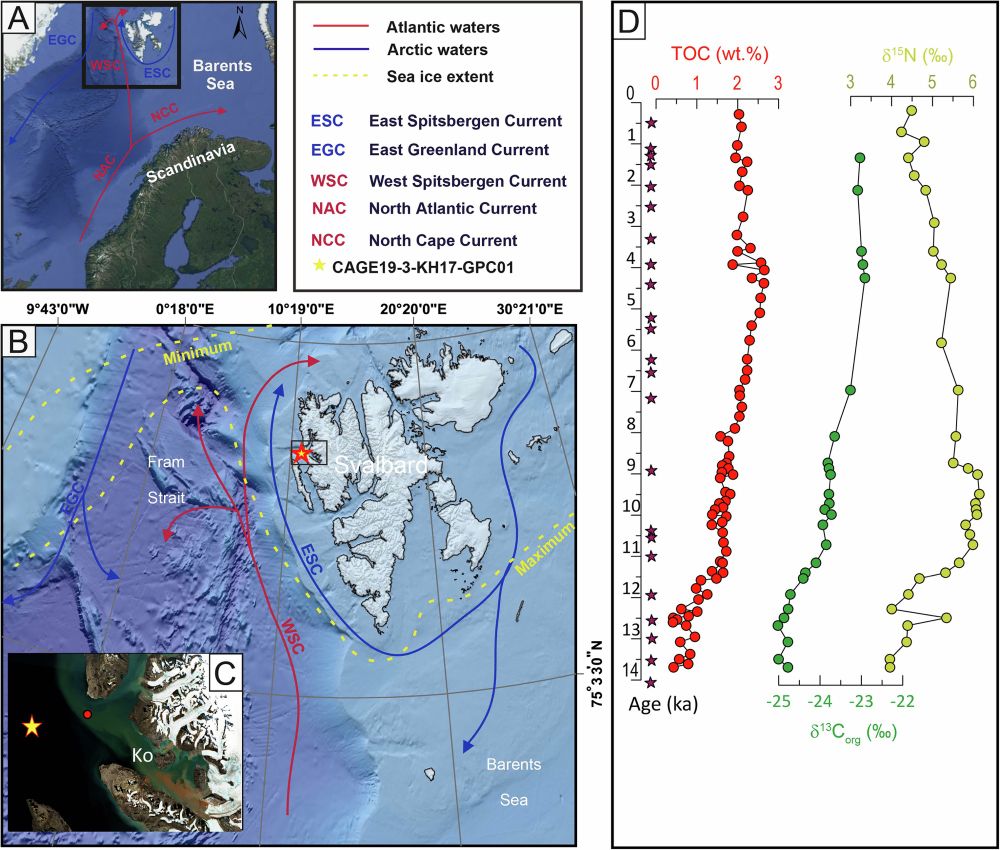
Post image

Excited to share our latest paper on the greening of Svalbard! ๐ŸŒŠ๐Ÿงช๐Ÿฅผโ„๏ธ๐Ÿชจโš’๏ธ

We use a marine sediment core to reconstruct how climate change is reshaping this Arctic landscape, revealing fascinating insights into vegetation dynamics ๐ŸŒฑ๐ŸŒ๐Ÿ๐ŸŒฟ

Read here: rdcu.be/d6uJR

09.02.2025 07:14 โ€” ๐Ÿ‘ 13    ๐Ÿ” 1    ๐Ÿ’ฌ 1    ๐Ÿ“Œ 0

Hi @davidho.bsky.social, I would like to be added as a contributor. Thank you!

07.02.2025 10:24 โ€” ๐Ÿ‘ 0    ๐Ÿ” 0    ๐Ÿ’ฌ 1    ๐Ÿ“Œ 0

@gianingro is following 20 prominent accounts