We will still consider applications submitted today and tomorrow!
02.12.2025 20:38 — 👍 15 🔁 9 💬 0 📌 0
0/10 Thanks for the interest in our preprint. Some takes say it negates or fully supports the “manifold hypothesis”, neither quite right. Our results show that if you only focus on the manifold capturing most of task-related variance, you could miss important dynamics that actually drive behavior.
02.12.2025 07:48 — 👍 48 🔁 22 💬 1 📌 1

Neural dynamics outside task-coding dimensions drive decision trajectories through transient amplification
Most behaviors involve neural dynamics in high-dimensional activity spaces. A common approach is to extract dimensions that capture task-related variability, such as those separating stimuli or choice...
“Our findings challenge the conventional focus on low-dimensional coding subspaces as a sufficient framework for understanding neural computations, demonstrating that dimensions previously considered task-irrelevant and accounting for little variance can have a critical role in driving behavior.”
23.11.2025 13:38 — 👍 144 🔁 41 💬 8 📌 9

We’ve come a full circle
27.11.2025 20:04 — 👍 2 🔁 0 💬 0 📌 0

microcentrifuge tube racks with Rack names
I was lucky enough to inherit a bunch of racks where a graduate student had labelled all of them with Rack jokes 😂, perfect. I am dead at Racksputin.
26.11.2025 17:37 — 👍 44 🔁 9 💬 1 📌 1

The Neuro Latine community invites you!
Sunday, November 16
7–9 p.m.
Marriott Marquis San Diego Marina – Grand Blrm 5
#NeuroLatine #SfN2025
12.11.2025 19:51 — 👍 3 🔁 3 💬 0 📌 2
Application Process ::
Center on Alcohol, Substance use, And Addictions (CASAA) | The University of New Mexico
We have at least TWO postdoctoral fellowship openings on our @unm.edu @casaa.bsky.social T32 NIAAA Training Grant, best consideration date for applications is Nov 15 2025. Join our phenomenal community and enjoy incredible quality of life in beautiful New Mexico. casaa.unm.edu/training/ins...
05.11.2025 22:30 — 👍 26 🔁 28 💬 0 📌 2

a woman with gray hair is sitting in front of a sign that says por 10 on it
ALT: a woman with gray hair is sitting in front of a sign that says por 10 on it
When you happily start the day with not a single meeting scheduled but only manage to write one paragraph of your manuscript because of all the little things that came up during the day
23.10.2025 21:28 — 👍 7 🔁 1 💬 1 📌 0
Long post ahead! I am very excited to be recruiting 1 to 2 #PhD students during this upcoming application cycle for Fall 2026 admission! The Clinical Psychology PhD program at The University of New Mexico (UNM) is absolutely stellar and accredited by both #APA and #PCSAS (Clinical Science model). 1/
30.09.2025 17:14 — 👍 18 🔁 10 💬 11 📌 1
So basically all the science that helps humanity…. 🤦♂️
27.09.2025 01:09 — 👍 1 🔁 0 💬 0 📌 0

A diagram showing dozens of brain regions densely interconnected by complicated loops
I think about this diagram a lot. This is a *simplified* schematic of *some of* the brain regions and circuits involved in behavioral control. (From: www.sciencedirect.com/science/arti...)
15.09.2025 07:53 — 👍 98 🔁 20 💬 5 📌 2

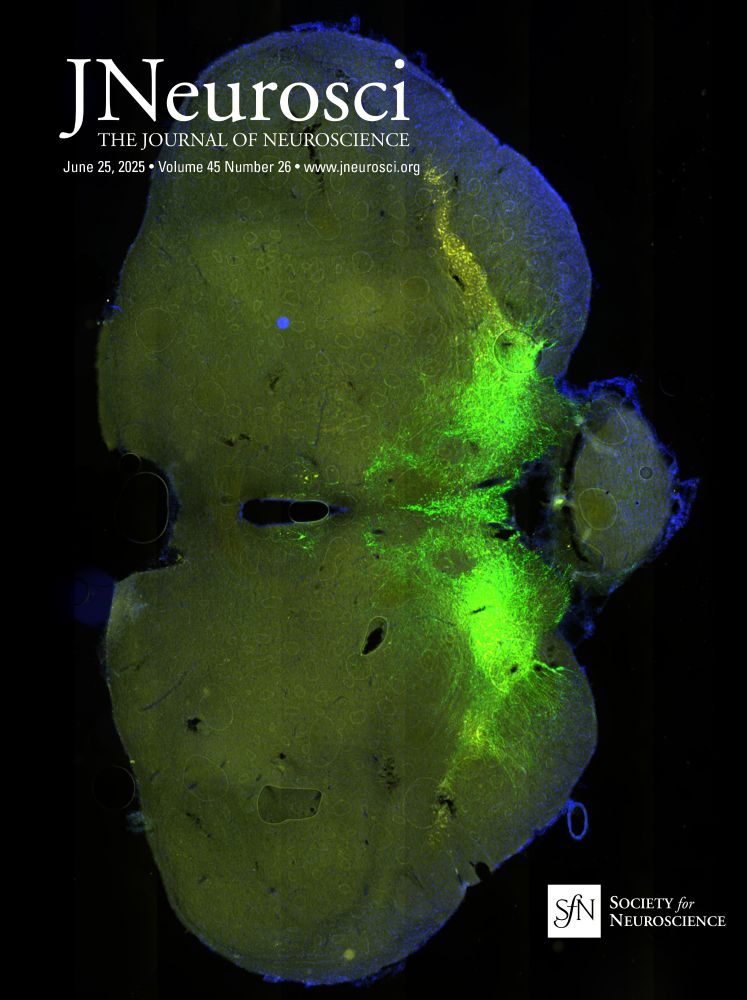
#eNeuro: @mattjwanat.bsky.social et al. show that the cue-evoked dopamine response in rats signals the duration of the trace period between cue and reward, and relates to the response latency.
https://doi.org/10.1523/ENEURO.0016-25.2025
27.08.2025 11:32 — 👍 8 🔁 2 💬 0 📌 0

Models as Prediction Machines: How to Convert Confusing Coefficients into Clear Quantities
Abstract
Psychological researchers usually make sense of regression models by interpreting coefficient estimates directly. This works well enough for simple linear models, but is more challenging for more complex models with, for example, categorical variables, interactions, non-linearities, and hierarchical structures. Here, we introduce an alternative approach to making sense of statistical models. The central idea is to abstract away from the mechanics of estimation, and to treat models as “counterfactual prediction machines,” which are subsequently queried to estimate quantities and conduct tests that matter substantively. This workflow is model-agnostic; it can be applied in a consistent fashion to draw causal or descriptive inference from a wide range of models. We illustrate how to implement this workflow with the marginaleffects package, which supports over 100 different classes of models in R and Python, and present two worked examples. These examples show how the workflow can be applied across designs (e.g., observational study, randomized experiment) to answer different research questions (e.g., associations, causal effects, effect heterogeneity) while facing various challenges (e.g., controlling for confounders in a flexible manner, modelling ordinal outcomes, and interpreting non-linear models).

Figure illustrating model predictions. On the X-axis the predictor, annual gross income in Euro. On the Y-axis the outcome, predicted life satisfaction. A solid line marks the curve of predictions on which individual data points are marked as model-implied outcomes at incomes of interest. Comparing two such predictions gives us a comparison. We can also fit a tangent to the line of predictions, which illustrates the slope at any given point of the curve.

A figure illustrating various ways to include age as a predictor in a model. On the x-axis age (predictor), on the y-axis the outcome (model-implied importance of friends, including confidence intervals).
Illustrated are
1. age as a categorical predictor, resultings in the predictions bouncing around a lot with wide confidence intervals
2. age as a linear predictor, which forces a straight line through the data points that has a very tight confidence band and
3. age splines, which lies somewhere in between as it smoothly follows the data but has more uncertainty than the straight line.
Ever stared at a table of regression coefficients & wondered what you're doing with your life?
Very excited to share this gentle introduction to another way of making sense of statistical models (w @vincentab.bsky.social)
Preprint: doi.org/10.31234/osf...
Website: j-rohrer.github.io/marginal-psy...
25.08.2025 11:49 — 👍 978 🔁 286 💬 47 📌 20
Very excited to share this major update to our paper delineating VTA GABA neuron encoding of valence and decision conflict. Studies led by the amazing @margestelzner.bsky.social. We leaned in here, taking the opportunity to add a lot of cool new data. www.biorxiv.org/content/10.1...
21.08.2025 15:23 — 👍 50 🔁 16 💬 2 📌 2

Congrats to Sven Bervoets and co-authors for our paper on fly Arc now out in @currentbiology.bsky.social !! This was an awesome collaboration with @thecaronlab.bsky.social’s lab @utah.edu
authors.elsevier.com/c/1lZlk3QW8S...
08.08.2025 23:01 — 👍 45 🔁 10 💬 2 📌 2
The field of neuroscience views the goal of human genetics as "finding genes". This is an outdated view. In whole genome studies of rare variants, finding genes is the easy part. The more interesting and important goal is to map out the causal pathway from genes to brain function to cognitive traits
16.07.2025 14:47 — 👍 95 🔁 30 💬 2 📌 3
Good stuff from Alex. I touch on some of these themes here as well, from the perspective of an applied statistician (plus a few more refs on the topic).
statsepi.substack.com/p/statistica... (ICYMI)
16.07.2025 07:17 — 👍 31 🔁 7 💬 2 📌 2

Dr. Sudie Back - Prolonged Exposure for Substance Use Disorder and PTSD
Podcast Episode · The Addiction Psychologist · 07/14/2025 · 1h 17m
Newest episode of The Addiction Psychologist (@addpsychpodcast.bsky.social) just dropped. In this episode, Dr. Sudie Back discusses Prolonged Exposure for Co-Occurring Substance Use Disorder and PTSD (COPE).
podcasts.apple.com/us/podcast/t...
15.07.2025 01:09 — 👍 23 🔁 12 💬 2 📌 0
Long-Term Effects of Adolescent 5F-MDMB-PICA Intravenous self-administration: Neurobehavioral Consequences and medial Prefrontal Cortex Dysfunction in Adult Mice https://www.biorxiv.org/content/10.1101/2025.06.26.661592v1
30.06.2025 01:16 — 👍 1 🔁 1 💬 0 📌 0

Winter Conference on Brain Research January 24th to 29th 2026 Big Sky Montana!
Submissions for #WCBR2026 open today! Please go to www.winterbrain.org Big Sky is my absolute favorite venue for this meeting. The science is top notch, the people are great, the meaning is inclusive, and I learned to ski as a 35 year old! Please repost!
01.07.2025 13:14 — 👍 33 🔁 16 💬 2 📌 0
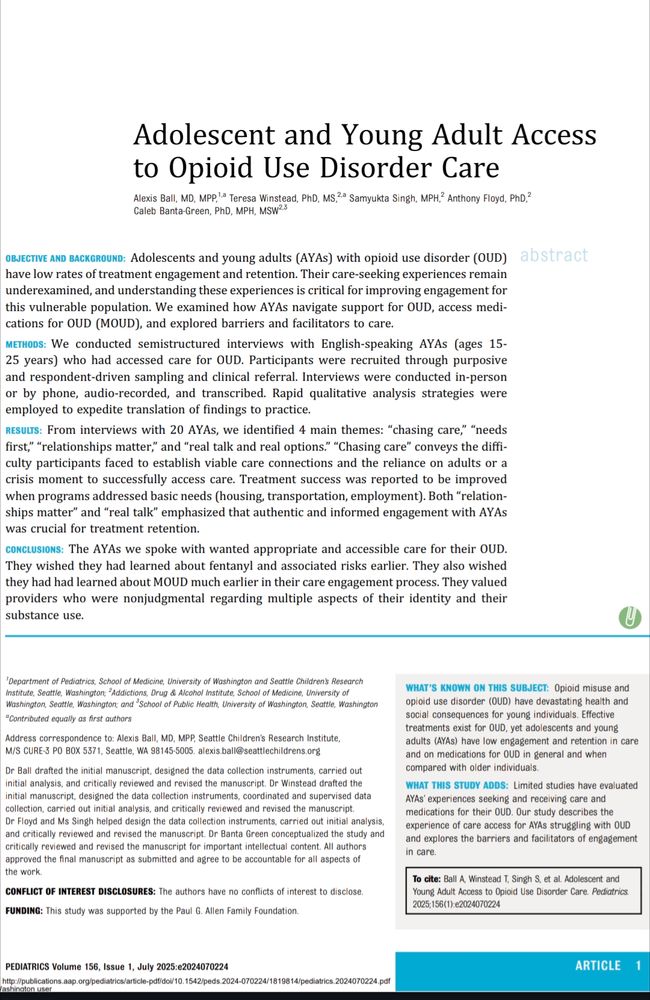
Pict of article titled Adolescent and young adult access to opioid use disorder care
📣New paper out in Pediatrics about Adolescent & Young Adult OUD Care Access, by part of our UW team💕, & co-first-author, Dr. Alexis Ball!
📝Documenting part of what we already know in practice:
real care options & honest conversations @ drug use matter a lot.
publications.aap.org/pediatrics/a...
16.06.2025 21:34 — 👍 7 🔁 3 💬 0 📌 0
So are they going to reinstate those that were cut? 👀
16.06.2025 22:31 — 👍 0 🔁 0 💬 0 📌 0
Today, my NIH colleagues and I did something scary but really important. We spoke up about egregious harms we are seeing happen to research participants and public health through thoughtless and politicized policies at NIH. 🧵1/3
apnews.com/article/nih-...
10.06.2025 04:10 — 👍 1044 🔁 255 💬 36 📌 20
Behavioral Neuroscience PhD candidate in the Root Lab at the University of Colorado Boulder. Cellular heterogeneity in motivational systems. Expected graduation spring 2026. Gardener, skier, dog mom, and backyard chicken farmer. she/her
Assistant Professor @ Penn | Dept Psychiatry + Dept Neuroscience + Dept Anesthesiology | Pain • Placebo • Poppies • Psychedelics
https://corderlab.com/
Scientist. Addiction neuroscience, molecular biology, & bioinformatics | NIDA K99 Postdoc @ National Institute on Drug Abuse Intramural Research Program, Hope Lab | Leading Edge Fellow | PhD UAB, Day Lab. Personal account
🧠🧬🐀 linktr.ee/katherinesavell
Proud 🇨🇦 Maritimer | Assistant Professor @ uCalgary Obs/Gyn | She/her | Epidemiologist | 💃 #WomensHealth #CardioObstetrics🫀🤰| Mom 👪 | #WomenInSTEM | #EDIA proponent & ally | Insta: aware_research | Views are mine
Postdoc at Lieber Institute for Brain Development. Brain molecular regul° and gene express° in health, mood disorders, and neurodegen (and sex diffs therein)
He/him. Neuroscientist. Dad of 2. Follows science, music, art. Views are mine.
Neuro PhD Candidate in the Corder Lab studying pain & opioids | she/her 🇨🇲 | #DSPAN F99/K00 Fellow | #BlackinNeuro #scicomm
📩neuromelody1@gmail.com
Assistant Professor of Psychology at Carnegie Mellon University | Studying how we acquire, adapt, and retain skilled movements | Physical Intelligence Lab: www.tsaylab.com
Director, Translational Neuroscience at Lieber Institute and Professor, Johns Hopkins School of Medicine studying molecular regulation across species in circuits impacted in complex brain disorders. Native plants/flowers/wetland habitats. Own opinions.
Clinical Psychologist and Postdoctoral Fellow at VA San Diego | Addiction researcher and clinician | BostonU and Georgia Tech Alum | she/her | Views are my own
@ericgross.bsky.social
Stanford research lab studying how aldehydes (alcohol flushing) impact anesthesiology (organ injury, pain, & anesthetics), and public health.
Neuroscientist, following circuits in neurodegeneration 🐭🔬
she/her/ella|ASERT/IRACDA Postdoctoral Fellow at the University of New Mexico|Research interests include behavioral neuroscience, genetics, addiction, and reward 🐭🥃
A project highlighting the stories and careers of women in neuroscience 👩🏾🔬👩🔬👩🏿🔬👩🏻🔬
Podcast here http://linktr.ee/storiesofwin
Nerding out to neuroscience since 2002. Studying the neurobiology of motivated behavior by day. Running, hiking, eating, and camping by night.
www.wanatlab.org
Psychiatric genetics, complex trait genetics, genome sequencing, rare variants are my jam
Clinical Psychologist & Substance Use Research
ESM & Cannabis 🧘♀️☕️ 📚✈️🧠🔂🐈🎗️
Waitress turned Congresswoman for the Bronx and Queens. Grassroots elected, small-dollar supported. A better world is possible.
ocasiocortez.com