Publishing flows (no domestic)
A Flourish data visualization by cody
When we published international bestseller data with @post45data.bsky.social all I wanted was to make a Sankey diagram but never managed, now someone has. And it looks beautiful. Check it out!
Source: substack.com/home/post/p-...
public.flourish.studio/visualisatio...
11.02.2026 22:18 — 👍 6 🔁 4 💬 0 📌 0
Excited to see the dataset being used!!
11.02.2026 21:23 — 👍 4 🔁 2 💬 0 📌 0

Literary Nationalism
Why don't Americans read more European fiction? Why don't Europeans?
Cool new essay that analyzes data from @post45data.bsky.social to argue for the rise of literary nationalism in parallel with political nationalism substack.com/home/post/p-...
11.02.2026 21:19 — 👍 20 🔁 9 💬 2 📌 1
Used Claude Code to analyze three datasets from @post45data.bsky.social together: NEA literature winners; NYT bestsellers; major prize winners. Made a power list of the 51 writers (out of ~7000) who hit all three open.substack.com/pub/sinykin/...
07.02.2026 19:44 — 👍 14 🔁 2 💬 0 📌 1

The NEA is a Zombie
What Was the NEA?
Started mucking around with data this morning. Made a couple interesting charts from data about all the writers who ever got an NEA grant, with data from Xander Manshel + team. Decided I’d write it up for my first post.
substack.com/home/post/p-...
05.02.2026 18:13 — 👍 15 🔁 7 💬 2 📌 0
This project has been supported by the @post45data.bsky.social.
It was initially funded by an NEH grant led by @dan-sinnamon.bsky.social and me. Then our NEH got cancelled. But we persisted!
Matt, Dan, and I have been working on this project for years at this point.
17.12.2025 21:37 — 👍 10 🔁 2 💬 1 📌 0

Diagram illustrating the BookReconciler workflow. On the left, a book cover of The Book of Salt by Monique Truong appears alongside “Minimal Metadata,” listing Author: Truong, Monique and Title: The Book of Salt. An arrow points to a box labeled “BookReconciler” with book and diamond icons. A downward arrow leads to “Enriched + Clustered Metadata,” showing multiple editions of the book cover and expanded metadata, including several ISBNs, subject headings (e.g., Vietnamese–France fiction, women authors, household employees, gay men, cooking), and an author VIAF identifier.
Very happy to introduce a new tool, BookReconciler!
You can take spreadsheets with book data and add subject headings, descriptions, ISBNs, HathiTrust IDs, & more. You can also cluster editions & variations of the same "Work."
Led by @thisismattmiller.com and supported by @post45data.bsky.social.
17.12.2025 21:37 — 👍 123 🔁 56 💬 7 📌 1
Are you a grad student working on post-1945 culture? Could your research benefit from incorporating some data, even minimally? Want feedback from journal editors?
This Post45 Data Collective virtual workshop may be for you!
Applications are due DECEMBER 1: data.post45.org/news/grad-wo...
26.11.2025 18:09 — 👍 15 🔁 25 💬 1 📌 1

The Post45 Data Collective invites graduate students in the humanities or adjacent fields to explore cultural data reflexively and collaboratively in a mini-workshop hosted virtually on Friday, March 13. Details here: data.post45.org/news/grad-wo...
12.11.2025 16:11 — 👍 8 🔁 10 💬 0 📌 1

A heatmap showing gender and ethnic representation in UK literary prizes, split into two panels for shortlisted authors and winners. The visualization displays counts across ethnicity categories (African, Asian, Black British, Caribbean, Irish, Jewish, Non-UK White, Non-White American, and White British) on the y-axis and gender categories (Man, Non-binary, Transman, and Woman) on the x-axis. Each cell shows the count with white text on a colored background, where darker colors indicate higher counts. White British men show the highest counts in both panels (120 shortlisted, 149 winners), followed by White British women (123 shortlisted, 105 winners). Non-UK White authors also show substantial representation (39 men and 87 women shortlisted; 40 men and 32 women winners). Most other ethnic groups show single-digit counts, with several cells having zero representation. The data reveals that White British authors increase from 46% of shortlisted to 61% of winners, while women decrease from 54% of shortlisted to 43% of winners.
I created a heatmap for this week's #TidyTuesday showing UK literary prize demographics with data from @post45data.bsky.social. White British authors account for 61% of winners vs. 46% shortlisted. Men win 56% vs. 46% shortlisted.
Code: github.com/gkaramanis/t...
#RStats #dataviz
02.11.2025 17:11 — 👍 12 🔁 2 💬 0 📌 0

This week's #TidyTuesday data was interesting. I decided to look into the Costa Book Awards and the gender distribution of their winners.
Data: github.com/stats33100/t...
29.10.2025 09:35 — 👍 8 🔁 2 💬 0 📌 0

Looked at the percentage of Oxbridge educated people who have won various British Literary Prizes for #TidyTuesday. I used ggbrick and, as the bricks of look like books, tried to make it look like they were in bookshelves with meh results.
Code here: tinyurl.com/bddsuuc3
#rstats | #dataviz
30.10.2025 09:09 — 👍 4 🔁 1 💬 0 📌 0
TWO great opportunities for graduate students in post45 literary studies in 2026! The Post45 Graduate Symposium @ Duke and @post45data.bsky.social’s virtual workshop for research with their data sets.
28.10.2025 15:45 — 👍 5 🔁 4 💬 0 📌 0
Excited to get to sit in on this workshop! Hopefully, @post45.bsky.social will get the opportunity to publish some articles that emerge from this P45DC event 🤩
27.10.2025 19:21 — 👍 6 🔁 4 💬 1 📌 0
We're excited to host a virtual workshop where graduate students can present work-in-progress that engages with data from the Post45 Data Collective in some way.
Editors from the P45DC, Public Books, Post45, and the 19th Century DC will be there to offer feedback.
Proposals are due December 1!
27.10.2025 17:17 — 👍 14 🔁 8 💬 0 📌 2


Catching up with hashtag#TidyTuesday.
week 39 - Crane Observations at Lake Hornborgasjön, Sweden (1994–2024)
week 43 - Selected British Literary Prizes (1990-2022)
Both charts created in Observable
Notebooks: observablehq.com/user/@deepal...
#DataViz #JavaScript #Figma
25.10.2025 06:04 — 👍 24 🔁 1 💬 0 📌 0

This week's #TidyTuesday is all about who has won or been shortlisted for a British literary prize 📖
I focused on the gender balance of authors awarded prizes for fiction 📊 The changing names of awards made the data wrangling a little bit more tricky!
#RStats #ggplot2 #DataViz
27.10.2025 08:57 — 👍 30 🔁 4 💬 1 📌 0

Abstract submission form QR code for the Post45 graduate symposium at Duke, February 20-21, 2026. The form is also accessible at https://tinyurl.com/2e2dr4wv.
The 11th annual Post45 Graduate Symposium will be hosted by Duke University's Department of English, February 20-21, 2026! Check out the CFP (post45.org/graduate/202...) and please share with anyone who might be interested.
Abstracts are due November 14.
09.10.2025 00:46 — 👍 19 🔁 15 💬 1 📌 1
oh look the best graduate conference is back 👀
09.10.2025 00:48 — 👍 5 🔁 2 💬 0 📌 0
Logo for the #TidyTuesday Project. The words TidyTuesday, A weekly data project from the Data Science Learning Community (dslc.io) overlaying a black paint splash.
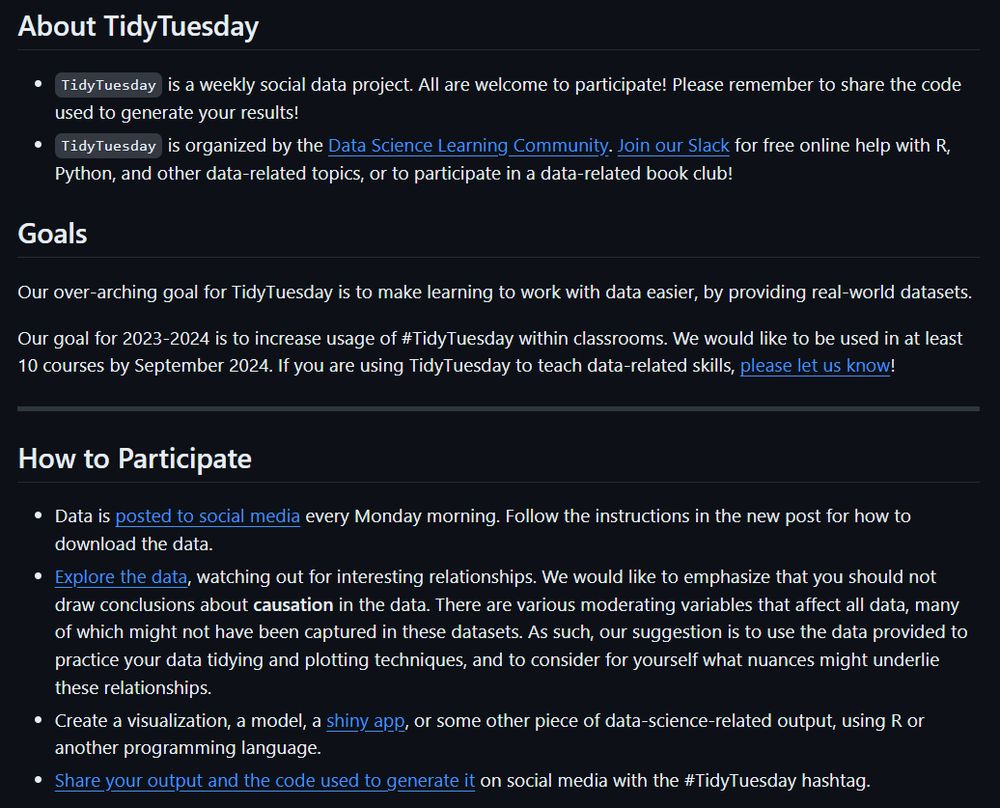
TidyTuesday is a weekly social data project. All are welcome to participate! Please remember to share the code used to generate your results!
TidyTuesday is organized by the Data Science Learning Community. Join our Slack for free online help with R and other data-related topics, or to participate in a data-related book club!
How to Participate
Data is posted to social media every Monday morning. Follow the instructions in the new post for how to download the data.
Explore the data, watching out for interesting relationships. We would like to emphasize that you should not draw conclusions about causation in the data.
Create a visualization, a model, a shiny app, or some other piece of data-science-related output, using R or another programming language.
Share your output and the code used to generate it on social media with the #TidyTuesday hashtag.

This horizontal bar chart shows gender distribution of winners across British literary awards. Each bar displays the percentage and count of women (blue), men (green), and non-binary (yellow) winners. The Women's Prize for Fiction is 100% women by design. Other awards show varying gender representation, with women most represented in children's literature (Costa Children's Book Award at 71%) and poetry (Ted Hughes Award at 50%). Most other prizes show male majorities, ranging from slight (Costa awards around 52% men) to substantial (BSFA Award at 79% men). The data reveals significant gender imbalances across most literary prizes, with men winning the majority of awards except in women-specific and children's categories.
@dslc.io welcomes you to week 43 of #TidyTuesday! We're exploring Selected British Literary Prizes (1990-2022)!
📁 https://tidytues.day/2025/2025-10-28
🗞️ https://theconversation.com/why-we-still-need-a-womens-prize-for-fiction-257494
#RStats #PyData #JuliaLang #DataViz #tidyverse #r4ds
27.10.2025 13:52 — 👍 9 🔁 5 💬 0 📌 1
For highest degree, I believe none means no college degree (for example, Patricia Lockwood and Jonathan Lethem do not have college degrees.) But you could also reach out and talk to the authors of the dataset.
26.10.2025 20:46 — 👍 1 🔁 0 💬 1 📌 0
So cool that the British Literary Prize dataset is the focus of this week’s #TidyTuesday — a weekly community project where people visualize and explore data.
This shelf viz is fantastic! Looking forward to seeing more explorations throughout the week.
TidyTuesday: github.com/rfordatascie...
26.10.2025 15:42 — 👍 9 🔁 1 💬 1 📌 0

A two-panel visualization analyzing gender equity in British literary prizes from 1990 to 2022. The top panel shows a line chart of women's share of winners, which increased from 35% to 50% and showed significant year-to-year variation. The bottom panel displays a horizontal pyramid chart comparing 13 major prizes, revealing that only four achieved gender balance (40-60% women). Seven prizes remain male-dominant, and two are female-dominant, showing persistent disparities despite overall progress.
📊 #TidyTuesday – 2025 W43 | Selected British Literary Prizes (1990-2022)
.
🔗: stevenponce.netlify.app/data_visuali...
.
#rstats | #r4ds | #dataviz | #ggplot2
26.10.2025 11:21 — 👍 15 🔁 1 💬 0 📌 0

A plot with the title "British Literary Prizes (1991-2022): Proportion of women & non-binary authors among literary prize recipients over time". The plot is designed to resemble a bookcase, with each 5-year time period from 1991 to 2022 featured as a single shelf, and books representing individual prize recipients. Women and non-binary winners are color coded pink-ish and light blue-ish, respectively. Women and non-binary authors were in the minority until 2010–2014 and have constituted about half of the winners since then. Data: Post45 Data Collective via TidyTuesday; Packages: {tidyverse, marquee}; Visualization: C. Börstell.
Friday night early #TidyTuesday of British Literary Prizes.
Wanted it as a bookshelf, made it into a bookshelf 📚
Code: github.com/borstell/tid...
#R4DS #DataViz
24.10.2025 22:28 — 👍 40 🔁 10 💬 6 📌 2
#publishing #xl8 #translation
20.09.2025 14:02 — 👍 2 🔁 1 💬 0 📌 0
Info sci prof @ Drexel, trying to keep the machines (esp. RecSys & IR) from learning bigotry and discrimination. ADHDS9. Usually self-propelled. Opinions those of the Vulcan Science Academy. 🐰x2.
🏡 https://md.ekstrandom.net
🧪 https://inertial.science
the contemporary and its curiosities
https://mid-theory.com
The Price Lab for Digital Humanities @ The University of Pennsylvania
Final Year Medical Biochemistry Student @ University of Huddersfield | Intern @ Cambridge Experience Postgraduate Life Sciences
Aspiring Computational Biologist & Bioinformatician
Bug Enthusiast - Virtual & Biological 🐛💻
Yorkshire Born and Bred
ex-academic, co-founder RLadiesSydney, developer #RYouWithMe, sharer of #rstats learning https://jenrichmond.github.io/
🗣️#RStats #DataScience #Dogs
@dslc.io Executive Director
#TidyTuesday poster
🔗http://linkedin.com/in/jonthegeek
🔗http://github.com/jonthegeek
Our mission: To provide tools and resources to foster a diverse, friendly, and inclusive community of data science learners and practitioners. Join us at https://dslc.io
Dataviz designer, psychiatrist, PhD
https://karaman.is
Linguist at the University of Bergen 🇳🇴
#SignLanguages, #linguistics, #RStats & #dataviz
✍🏾 Jacqueline Nyathi, librocubicularist, friendly neighbourhood "You *Must* Read This" person.
https://hararereview.com
📝📚 @thecontinent.org, @strangehorizons.bsky.social etc
(Incidentally, also @shonatiger.hararereview.com)
PhD English. SSHRC Postdoc @ Duke. Interested in contemp and digital literary culture! Lover of emojis in emails. Learn more about me at tanjagrubnic.com.
Reader.
Bilingual (Spanish/English) author & literary translator. Kidlit. Poetry. SF/F/H. Comics. 🌈
He/él
I’ve translated: Maggie Nelson, Danez Smith, George Takei, Juan Villoro, Carmen Boullosa, Trifonia Melibea Obono, Koleka Putuma, etc.
English PhD turned Machine Learning Researcher. I medicate my imposter syndrome with cold brews.
Current:
Foundation Models @ Apple
Prev:
LLMs/World Models @ Riot Games
RecSys @ Apple
Seattle -> NYC 🏳️🌈
Award-winning Diamond Open Access journals of digital methods for the humanities.
https://programminghistorian.org • https://tinyurl.com/support-PH • https://linkedin.com/company/prog-hist
Univ. HH.Am.Studies.The long 19th c;author of “Producing Mass Entertainment:The Serial Life of the Yellow Kid” (OSUP 2019).Eisner Award nominee.President of ComFor e.V. Gardening.she/her
https://www.slm.uni-hamburg.de/iaa/personen/meyer-christina.html
https://linktr.ee/roxanegay
Writer, editor, publisher, professor. Some people call me a bad feminist and by some people I mean me.
Historian: White Flight; New Suburban History; Fog of War; One Nation Under God; Fault Lines; Voter Suppression; Myth America. CAMPAIGN TRAILS: campaign-trails.ghost.io
Bronx boy. Cubs fan. Dad, husband, writer, podcaster and cable news host.
The Sirens’ Call: How Attention Became the World’s Most Endangered Resource out now.
https://sirenscallbook.com/
detroit native. deputy editor at huffpost. WABJ president. check out my free newsletter! --> https://www.whatimreading.net/
The real jbouie. Columnist for the New York Times Opinion section. Co-host of the Unclear and Present Danger podcast. b-boy-bouiebaisse on TikTok. jbouienyt on Twitch. National program director of the CHUM Group.
Send me your mutual aid requests.