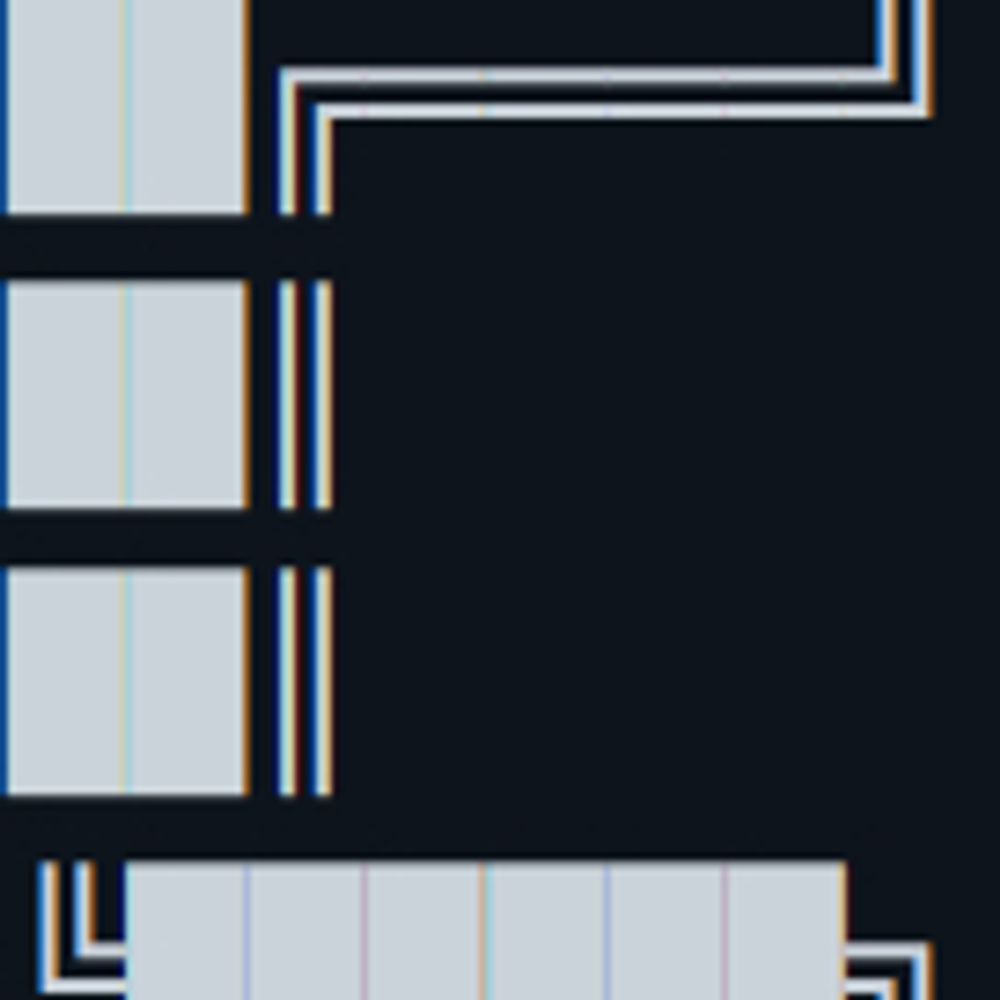
Fly through video for ROM-less Cordic Engine design.
This design is on TTSKY25A shuttle by @tinytapeout.com
Made easy with BlenderGDS plugin - github.com/aesc-silicon...
@mattvenn.net @urishaked.bsky.social @aksharvastarpara.bsky.social
21.01.2026 18:17 — 👍 8 🔁 3 💬 0 📌 0
Fly through video for ROM-less Cordic Engine design.
This design is on TTSKY25A shuttle by @tinytapeout.com
Made easy with BlenderGDS plugin - github.com/aesc-silicon...
@mattvenn.net @urishaked.bsky.social @aksharvastarpara.bsky.social
21.01.2026 18:17 — 👍 8 🔁 3 💬 0 📌 0
How well do SP10 probes perform when used with high-frequency oscilloscope measurements?
20.01.2026 21:25 — 👍 1 🔁 0 💬 1 📌 0

welcome to our cordic city!!
15.01.2026 20:23 — 👍 1 🔁 1 💬 0 📌 0
welcome to our cordic city!!
15.01.2026 20:23 — 👍 1 🔁 1 💬 0 📌 0
yes! it's from that same blender plugin.
15.01.2026 16:28 — 👍 1 🔁 0 💬 0 📌 0

Yes, that’s a GDSII render.
Yes, it’s inside Blender.
Yes, it’s our design on TTSKY25A chip.
@tinytapeout.com @mattvenn.net @urishaked.bsky.social
15.01.2026 16:25 — 👍 5 🔁 1 💬 2 📌 0
oh! got it.
15.01.2026 16:19 — 👍 0 🔁 0 💬 0 📌 0
can you post the "GPU running on FPGA"?
15.01.2026 16:11 — 👍 0 🔁 0 💬 1 📌 0
....while CSIS sponsers terrorism on Indian soil.
28.12.2025 08:46 — 👍 4 🔁 0 💬 0 📌 0
Innovation in ZMOS process node led to development of modern CMOS and BiCMOS process node where we have 20 metal layers.
For instance, Sky130A 130nm process node have upto 5 metal layers.
bsky.app/profile/roha...
28.10.2025 05:12 — 👍 0 🔁 0 💬 0 📌 0
Back in the day, NMOS chips used only one metal layer, so designers had to squeeze all the wiring onto a single surface.
Metal 1: used for local interconnects, this allowed short and dense wiring.
Metal 2: used for global signals like buses, clocks, power.
28.10.2025 05:11 — 👍 0 🔁 0 💬 1 📌 0

This is the DCJ11 PDP-11 processor, built using the old-school ZMOS tech, a 3 μm NMOS process with two interconnect layers.
It was one of the first NMOS processes to use separate metal layers for local connections and global signals.
28.10.2025 05:10 — 👍 1 🔁 0 💬 1 📌 0
🤩🤩
Another mike bell project to fab!
28.10.2025 05:09 — 👍 1 🔁 0 💬 0 📌 0
Fomu fpga?
27.10.2025 04:22 — 👍 1 🔁 0 💬 0 📌 0

chinese semiconductor industry is creative for sure.
Nice idea for analog tapeout for some day.
26.10.2025 14:50 — 👍 0 🔁 0 💬 0 📌 0

This looks like a matrix.
Each one has 128 analog switches.
We can do 8x16 analog array with one.
So this is actually a analog matrix.
26.10.2025 14:49 — 👍 0 🔁 0 💬 1 📌 0
And guess what whole hdl for this is written in both system verilog and chisel/scala.
16.10.2025 20:38 — 👍 0 🔁 0 💬 0 📌 0
Note that Zve32x extension works only on integers, it needs Zicsr and Zvl32b base profiles to be implemented first.
Although the element size is capped at 32 bits, the wide vector registers (256 bits) still allow multiple elements to be processed simultaneously.
16.10.2025 20:37 — 👍 0 🔁 0 💬 1 📌 0

Google has open sourced its Coral NPU, which uses a 32 bit RISC V core with the Zve32x extension. It supports vector arithmetic on data ≤ 32 bits, making it great for DSP applications.
It has been prototyped on a Xilinx Ultrascale Plus FPGA platform.
github.com/google-coral...
16.10.2025 20:36 — 👍 3 🔁 1 💬 1 📌 0
YouTube video by Crowd Supply
Teardown Session 56: wafer.space with Tim Ansell
Leo Moser and myself will be on @crowdsupply.bsky.social 's Teardown Session talking with @helenleigh.bsky.social about
@wafer.space this Thursday (3rd October) - youtu.be/tEOmnN8IAjs
30.09.2025 06:00 — 👍 12 🔁 6 💬 1 📌 0
We already have chisel for this right? or it lacks on something that only Haskell can provide?
30.09.2025 06:53 — 👍 0 🔁 0 💬 1 📌 0
FYI : Original electronic diary was invented by a Indian guy known as Satyan Pitroda, alias Sam Pitroda.
He may be a tad racist, but a great guy. I mean all Indians are racist to each other, who cares.
www.computerhistory.org/revolution/m...
28.09.2025 10:44 — 👍 0 🔁 0 💬 0 📌 0
It was awesome to be on @chrisgammell.bsky.social 's Amp Hour podcast again. Find out more about my latest endeavor to make custom silicon manufacturing accessible and follow @wafer.space and bookmark wafer.space to keep up to date!
25.09.2025 21:22 — 👍 5 🔁 3 💬 1 📌 0
It can be powered directly from a Pi USB port
with 60% brightness. It needs a external supply for 100% brightness.
25.09.2025 08:26 — 👍 0 🔁 0 💬 0 📌 0
it's ROM generated from ROM compiler.
*This is the one for storing TV codes for that IR LED project
*and not the atari one
16.09.2025 11:49 — 👍 2 🔁 0 💬 1 📌 0
yeah, openroad STA gives you a rough estimate for power.
It's a static power estimation obviously. Also it's a digital tapeout, so I don't expect it to be a very power hungry design (assuming SKY130A cells are optimized).
06.09.2025 14:55 — 👍 0 🔁 0 💬 1 📌 0
Low power math within few clock cycles.
Imagine it, then put it into silicon.
Made by Vicharak aka @aksharvastarpara.bsky.social 's team and two FPGA freaks.
Check - t.co/vBGGA2i0uX
Thanks @mattvenn.net and @urishaked.bsky.social and whole @tinytapeout.com team for making this possible.
06.09.2025 08:18 — 👍 13 🔁 5 💬 1 📌 1
Only hardware makes it possible!
FPGA, RISC-V, 68K, OS, graphics, demos, permacomputing
http://projectf.io | http://systemtalk.org
Maker ◆ Voiding warranties at @wokwi.com ◆ Keepin' it Chippin' at
@TinyTapeout.com ◆ What I'm doing now? http://urish.org/now
Tiny Tapeout makes it easier and cheaper than ever to get your designs manufactured on a real chip!
https://tinytapeout.com
Best maker in the village
Hacker Neko Vtuber | xGoogle & 💍 with @lina.yt | https://cyan.yt/magic
Hello everyone, Hoshino Lina here! I'm a developer VTuber!
▶️ lina.yt/magic
EN/日本語|she/her|🎨 #HoshinoLinArt
My gf: @cyan.yt 🩵|We are @thgirls.yt
PFP x.com/7783__
🐘 @lina@vt.social
📨 lina@lina.yt
💲 lina.yt/sponsor | lina.yt/kofi
Big nerd. Building things
Trump voters: History won’t be kind to you. Neither will I
Progress isn’t about making you comfortable
The home for the team maintaining Yosys and related Open Source EDA projects.
https://www.yosyshq.com/
Sign up to our newsletter! https://yosyshq.com/newsletter
Electronics tinkerer, narrowboater, puzzle hunter, board gamer and occasional geocacher.
Also on fedi @rebelmike@hachyderm.io
Co-Founder @VoltronData, @condaforge.bsky.social core. Previously @NVIDIA @RAPIDSAI. My thoughts are my own.
bit shuffler and theorem prover
not affiliated with Y Combinator, running on a pi in my basement
PipelineC Hardware Description Language
An easy to understand hardware description language with a powerful autopipelining compiler and growing set of real life design inspired features.
github.com/JulianKemmerer/PipelineC
https://discord.gg/Aupm3DDrK2
Electronics engineer. RISC-V ASICs at IQonIC Works 🧙♂️ (He/Him)
I also take macro photos of electronics