@zombievols.bsky.social (thanks man)
20.02.2026 00:23 — 👍 0 🔁 0 💬 0 📌 0
Wait a second.
20.02.2026 00:03 — 👍 1 🔁 0 💬 1 📌 0
The Onion never misses.
20.02.2026 00:02 — 👍 3 🔁 0 💬 1 📌 0
![Aaron Rupar
@atrupar.com
Trump: "They have the ballots. That should be no problem, right? FBI came in and raided. They found plenty of stuff. Now they have the ballots. And Democrats are fighting like hell to not let anybody see the ballots. Why don't they want them to see the ballots? Because they cheated like dogs."
[sweaty Trump in front of the mic]
zombievols.bsky.social
@zombievols.bsky.social
Interesting....so fighting to keep something hidden makes someone guilty you say?](https://cdn.bsky.app/img/feed_thumbnail/plain/did:plc:avejgmemtiysrg5woizxmuzz/bafkreidqzqcgg5poqox5jjic3ou5pbkxdcikpvenfyd5nuli3bzqhymaru@jpeg)
Aaron Rupar
@atrupar.com
Trump: "They have the ballots. That should be no problem, right? FBI came in and raided. They found plenty of stuff. Now they have the ballots. And Democrats are fighting like hell to not let anybody see the ballots. Why don't they want them to see the ballots? Because they cheated like dogs."
[sweaty Trump in front of the mic]
zombievols.bsky.social
@zombievols.bsky.social
Interesting....so fighting to keep something hidden makes someone guilty you say?
20.02.2026 00:01 — 👍 13 🔁 5 💬 6 📌 0
10/10, no notes.
19.02.2026 23:59 — 👍 0 🔁 0 💬 0 📌 0

"sad" blobfish
19.02.2026 23:46 — 👍 4 🔁 0 💬 1 📌 0
Alysa Liu
That's the skeet.
19.02.2026 22:27 — 👍 0 🔁 0 💬 0 📌 0

Remember when Prince Harry doing an interview with Oprah was the "worst royal crisis in 85 years"?
Good times.
19.02.2026 22:23 — 👍 1 🔁 0 💬 0 📌 0
Why isn't every answer just "Fifth"?
19.02.2026 22:21 — 👍 16 🔁 0 💬 1 📌 0

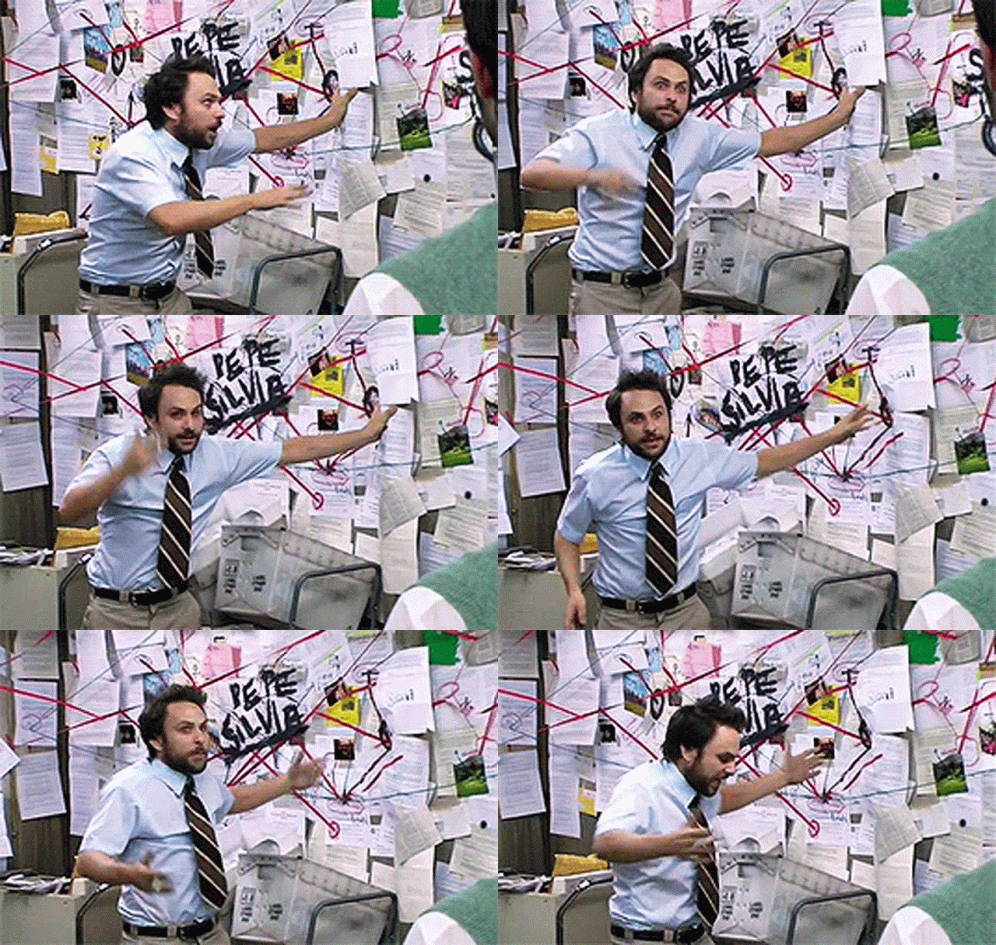
Left: former Prince Andrew is arrested
Right: surprised cat meme
Knew I'd seen this somewhere before.
19.02.2026 22:18 — 👍 15 🔁 3 💬 1 📌 0
🤔🤔🤔
19.02.2026 22:15 — 👍 1 🔁 0 💬 0 📌 0
AHAHAHAHAHAHAHA!
19.02.2026 22:14 — 👍 0 🔁 0 💬 0 📌 0
My dog when I turn on the lights and find him trying to open the treats cupboard.
19.02.2026 20:57 — 👍 0 🔁 0 💬 0 📌 0
Wasn't it in Pam Bondi's first letter to the agency? Something about advancing Trump's agenda?
19.02.2026 20:55 — 👍 0 🔁 0 💬 0 📌 0
Does…does he think you can *pass* legislation via a filibuster?
19.02.2026 20:46 — 👍 1365 🔁 192 💬 83 📌 10
 19.02.2026 19:42 — 👍 28705 🔁 11557 💬 385 📌 541
Trump famously doesn't read, and I think his advisor all told him the Epstein Files made him look great, and he believed them.
19.02.2026 20:13 — 👍 0 🔁 0 💬 0 📌 0
"Oh shiiiiiiiiit"
19.02.2026 20:11 — 👍 1 🔁 0 💬 0 📌 0
YouTube video by Lower East Side Records
Technohead - I Wanna Be A Hippy (Flamman & Abraxas Radio Mix)
I've done a terrible job of remembering to post, but this is from this week's UK chart from 30 years ago.
youtu.be/nmYi5u9BhtI
19.02.2026 20:05 — 👍 0 🔁 0 💬 0 📌 0
![E.
Rule 11 Considerations
Finally, Petitioners reiterate concerns raised at the Status Conference
regarding misrepresentations or frivolous arguments made by Respondents in this
matter. [See Transcript at 13–14]. As Respondents indicate, no Rule 11 motion
has been properly filed nor presented such that Respondents may benefit from the
mandatory 21-day period. [Opp. at 11]. No further discussion is necessary as to
this issue.](https://cdn.bsky.app/img/feed_thumbnail/plain/did:plc:avejgmemtiysrg5woizxmuzz/bafkreicsn5bffpi5duzb2s53leeu5duzc6l3uudov2bpltthtgrbblvsxy@jpeg)
E.
Rule 11 Considerations
Finally, Petitioners reiterate concerns raised at the Status Conference
regarding misrepresentations or frivolous arguments made by Respondents in this
matter. [See Transcript at 13–14]. As Respondents indicate, no Rule 11 motion
has been properly filed nor presented such that Respondents may benefit from the
mandatory 21-day period. [Opp. at 11]. No further discussion is necessary as to
this issue.
Finally, as what follows is the conclusion, the court highlights that no Rule 11 motion has been filed, in what looks like a massive invitation for plaintiffs to do it.
(Rule 11 is the sanctions one, BTW)
19.02.2026 19:59 — 👍 0 🔁 0 💬 0 📌 0
![As a preliminary matter, necessity and propriety are not the standards by
which the Court may issue orders requiring notice to a certified class. See Fed. R.
Civ. P. 23(d)(1)(B). Rather, Rule 23(d) permits a court to issue orders on
“procedural matters” to “protect class members and fairly conduct the action.”
Fed. R. Civ. P. 23(d)(1)(B), (E). This includes entering orders “giving appropriate
notice to some or all class members” of “any step in the action[.]” Fed. R. Civ.
P. 23(d)(1)(B)(i); see also Fed. R. Civ. P. 23 advisory committee’s note to 1966
amendment (“Notice is available fundamentally for the protection of the members
of the class or otherwise for the fair conduct of the action[.]”); id. (“Subdivision
(d)(2) does not require notice at any stage, but rather calls attention to its
availability and invokes the court’s discretion.”).](https://cdn.bsky.app/img/feed_thumbnail/plain/did:plc:avejgmemtiysrg5woizxmuzz/bafkreihpfi2mhoquhrs7jdv2mvhixgcf2blogjz5y6qh2bexltypr466i4@jpeg)
As a preliminary matter, necessity and propriety are not the standards by
which the Court may issue orders requiring notice to a certified class. See Fed. R.
Civ. P. 23(d)(1)(B). Rather, Rule 23(d) permits a court to issue orders on
“procedural matters” to “protect class members and fairly conduct the action.”
Fed. R. Civ. P. 23(d)(1)(B), (E). This includes entering orders “giving appropriate
notice to some or all class members” of “any step in the action[.]” Fed. R. Civ.
P. 23(d)(1)(B)(i); see also Fed. R. Civ. P. 23 advisory committee’s note to 1966
amendment (“Notice is available fundamentally for the protection of the members
of the class or otherwise for the fair conduct of the action[.]”); id. (“Subdivision
(d)(2) does not require notice at any stage, but rather calls attention to its
availability and invokes the court’s discretion.”).
For those who care about such procedural matters.
19.02.2026 19:57 — 👍 0 🔁 0 💬 1 📌 0

The Court’s initial decision to deny Petitioners’ request to vacate Yajure
Hurtado under the APA was an act of judicial restraint: a formality. However,
based on the representations Respondents have made to the Court, it is evident that
further relief is both necessary and proper. The Court VACATES Yajure Hurtado
under the APA.
I think the court felt it was unnecessary to actually vacate it, as it's not the case the court is reviewing.
But the executive branch is claiming the case is binding on immigration judges, so she is vacating it.
19.02.2026 19:56 — 👍 0 🔁 0 💬 1 📌 0

It is “emphatically the province and duty of the judicial department to say
what the law is.” Marbury v. Madison, 5 U.S. 137, 177 (1803). It is not the
executive department’s province and duty to say what the law is. The role of the
*DING DING DING DING DING*
19.02.2026 19:55 — 👍 0 🔁 0 💬 1 📌 0
![Respondents engage in a deliberately dense three-step maneuver to reach
their core absurd conclusion that no further relief is warranted.
Step 1: Identify an immaterial difference between two things that are
functionally the same. [Opp. at 9; Dkt. No. 103 at 3].
Step 2: Insist that the immaterial difference is so consequential that it
can violate separation of powers. [Opp. at 12; Dkt. No. 103 at 3].
Finally, and most importantly,
Step 3: Make sure to never mention the Constitution with the hope
that a federal court will not notice. [See generally Opp.; Dkt. No. 103
at 3].](https://cdn.bsky.app/img/feed_thumbnail/plain/did:plc:avejgmemtiysrg5woizxmuzz/bafkreicjehhgzc3ehyenledoeisxnx6rmcifzqjdehekfcbu2eiiwqclcy@jpeg)
Respondents engage in a deliberately dense three-step maneuver to reach
their core absurd conclusion that no further relief is warranted.
Step 1: Identify an immaterial difference between two things that are
functionally the same. [Opp. at 9; Dkt. No. 103 at 3].
Step 2: Insist that the immaterial difference is so consequential that it
can violate separation of powers. [Opp. at 12; Dkt. No. 103 at 3].
Finally, and most importantly,
Step 3: Make sure to never mention the Constitution with the hope
that a federal court will not notice. [See generally Opp.; Dkt. No. 103
at 3].
19.02.2026 19:54 — 👍 0 🔁 0 💬 1 📌 0
![C.
Form of Further Relief
Respondents have violated and continue to violate the law by detaining
Bond Eligible Class members in contravention of the Final Judgment. Worse,
Respondents proffer frivolous arguments that aim to insulate unlawful policies
from judicial review while taking positions that seek to bludgeon separation of
powers into oblivion. [See generally Opp.; see also Dkt. No. 103].
Respondents’ fixation on the “coercive” nature of the declaratory judgment
issued by the Court ignores the other form of relief expressly granted by the Court:
vacatur under the APA. Thus, the only relevant argument raised in the Opposition
is Respondents’ suggestion that Yajure Hurtado is not the DHS Policy that was
previously vacated, and that Yajure Hurtado remains binding upon IJs because the
BIA issued it.](https://cdn.bsky.app/img/feed_thumbnail/plain/did:plc:avejgmemtiysrg5woizxmuzz/bafkreicujuow7u2c4o6eokoa3nbz3olesqmzmmvqj6mj2of5cejq5i22ve@jpeg)
C.
Form of Further Relief
Respondents have violated and continue to violate the law by detaining
Bond Eligible Class members in contravention of the Final Judgment. Worse,
Respondents proffer frivolous arguments that aim to insulate unlawful policies
from judicial review while taking positions that seek to bludgeon separation of
powers into oblivion. [See generally Opp.; see also Dkt. No. 103].
Respondents’ fixation on the “coercive” nature of the declaratory judgment
issued by the Court ignores the other form of relief expressly granted by the Court:
vacatur under the APA. Thus, the only relevant argument raised in the Opposition
is Respondents’ suggestion that Yajure Hurtado is not the DHS Policy that was
previously vacated, and that Yajure Hurtado remains binding upon IJs because the
BIA issued it.
Bludgeon!
19.02.2026 19:53 — 👍 0 🔁 0 💬 1 📌 0
![When considering one branch’s aggrandizement of power, Chief Justice
John Marshall confirmed that the Constitution “establish[ed] certain limits not to
be transcended.” Marbury v. Madison, 5 U.S. 137, 176 (1803).
Respondents engage in unlawful practices under the guise of “immigration
enforcement” and fidelity to agency regulations. Those practices were found
unlawful by way of statutory interpretation by this Court.
“[I]nterpretation of the laws” is “the proper and peculiar province of the
courts.” The Federalist No. 78, at 525 (A. Hamilton) (J. Cooke ed. 1961). The
Supreme Court observed recently that “the Framers structured the Constitution to
allow judges to exercise that judgment independent of influence from the political
branches.” Loper Bright Enters. v. Raimondo, 603 U.S. 369, 385 (2024) (citations
omitted).](https://cdn.bsky.app/img/feed_thumbnail/plain/did:plc:avejgmemtiysrg5woizxmuzz/bafkreiazmay6fro7gqsorjnpaw5f2k55do5q6b6khoxvs7bwcgg4h52sdm@jpeg)
When considering one branch’s aggrandizement of power, Chief Justice
John Marshall confirmed that the Constitution “establish[ed] certain limits not to
be transcended.” Marbury v. Madison, 5 U.S. 137, 176 (1803).
Respondents engage in unlawful practices under the guise of “immigration
enforcement” and fidelity to agency regulations. Those practices were found
unlawful by way of statutory interpretation by this Court.
“[I]nterpretation of the laws” is “the proper and peculiar province of the
courts.” The Federalist No. 78, at 525 (A. Hamilton) (J. Cooke ed. 1961). The
Supreme Court observed recently that “the Framers structured the Constitution to
allow judges to exercise that judgment independent of influence from the political
branches.” Loper Bright Enters. v. Raimondo, 603 U.S. 369, 385 (2024) (citations
omitted).
Yeah,
They can't hide behind "but the BIA says" when they've been told by dozens of courts that they've got the law wrong.
19.02.2026 19:52 — 👍 0 🔁 0 💬 1 📌 0
![Ordinarily, the Court would not state basic principles of law to avoid
pontification. Yet separation of powers concerns is at the heart of this case, this
Court’s exercise of authority, and this country’s foundational principles imbued in
the Constitution. Respondents appear to have little regard for such fundamental
tenets; thus, a brief lesson in legal history is apt.
Separation of powers as well as checks and balances are essential
components to this country’s founding. The Constitution is evidence of that
fundamental premise. The words and structure of the Constitution anticipate that
the three branches of government would be in tension with one another. See
Redish, supra, at 3 (describing the Framers’ design of the constitutional system “to
protect against the risk of a dominant faction abusing its power”). There is nothing
“awkward” or “confusing” about that, as Respondents and IJs suggest. [See Opp.
at 6; Dkt. No. 107-3 at 3].
The current reality that two branches of government are at odds with one
another is not an anomaly. It is the very nature of the government put into place by
the Framers. “[T]he great security against a gradual concentration of the several
powers in the same department, consists in giving to those who administer each
department the necessary constitutional means and personal motives to resist
encroachments of the others.” The Federalist No. 51 (J. Madison). James Madison
posited that “[a]mbition must be made to counteract ambition,” and “such devices
should be necessary to control the abuses of government.” Id.](https://cdn.bsky.app/img/feed_thumbnail/plain/did:plc:avejgmemtiysrg5woizxmuzz/bafkreiferuzs3uetv4ry6l4affbk3zidgn4eyxoy6bub2xx74pzu3s2ylm@jpeg)
Ordinarily, the Court would not state basic principles of law to avoid
pontification. Yet separation of powers concerns is at the heart of this case, this
Court’s exercise of authority, and this country’s foundational principles imbued in
the Constitution. Respondents appear to have little regard for such fundamental
tenets; thus, a brief lesson in legal history is apt.
Separation of powers as well as checks and balances are essential
components to this country’s founding. The Constitution is evidence of that
fundamental premise. The words and structure of the Constitution anticipate that
the three branches of government would be in tension with one another. See
Redish, supra, at 3 (describing the Framers’ design of the constitutional system “to
protect against the risk of a dominant faction abusing its power”). There is nothing
“awkward” or “confusing” about that, as Respondents and IJs suggest. [See Opp.
at 6; Dkt. No. 107-3 at 3].
The current reality that two branches of government are at odds with one
another is not an anomaly. It is the very nature of the government put into place by
the Framers. “[T]he great security against a gradual concentration of the several
powers in the same department, consists in giving to those who administer each
department the necessary constitutional means and personal motives to resist
encroachments of the others.” The Federalist No. 51 (J. Madison). James Madison
posited that “[a]mbition must be made to counteract ambition,” and “such devices
should be necessary to control the abuses of government.” Id.
19.02.2026 19:50 — 👍 1 🔁 0 💬 1 📌 0

Respondents can only do so in a world where the Constitution does not exist.
The Constitution makes no apology in condemning Respondents. With no other
option but to uphold its constitutional duty, the Court GRANTS Petitioners’
Motion.
19.02.2026 19:49 — 👍 0 🔁 0 💬 1 📌 0
Former DOJ Pardon Attorney. Forever a public defender. Hardwired to stand up to bullies.
Labour Member of Parliament for Bolsover
Skeptic. Pedantic, stubborn, nerd, maker of lists. MSc Computing, BSc Psychology. British. Immigrant parents from 🇮🇹Italy & 🇮🇳India.
@PootDibou on Twitter and YouTube
#factsmatter #rightmatters
Extraordinary claims require extraordinary evidence, I will track down sources "Skeptical Asshole"
twitXter [@r5Philly until stolen 7/8/2024, then @r5_to_philly (now deleted, no more traffic on that hellscape)]
#NoKings
Attorney for the people, for hire. danielsuitor.com Landlords do not @ me.
New England then, Minneapolis now, housing and economic justice forever.
Political scientist, co-host of Words Matter podcast, contributor to The Contrarian
Words at ballsandstrikes.org, and even more words in The Originalism Trap: How Extremists Stole the Constitution and How We the People Can Take It Back
Out now at tinyurl.com/originalismtrap !
Fighting every day to deliver a city that working New Yorkers can actually afford. Mayor of New York City.
This is the bot for TrumpActionTracker.info - a website that documents the actions, statements, and plans of President Trump and his administration that echo those of authoritarian regimes.
This bot automatically posts the latest actions.
Police & crime reporter at The Spokesman-Review, covering both Eastern Washington and Northern Idaho — formerly both TV & print in Boise, ID. Reach me on Signal: aduggan.58
Law & politics. The stuff that matters. https://t.co/MkL7VivzSU
Law prof at Chicago-Kent College of Law; co-director of CK Institute on the Supreme Court; Of Counsel, Schnapper-Casteras, PLLC; former IL Solicitor General.
Professor of political science. Willing expat becoming an unwilling emigre. Essentially millennial, analytically millenarian. https://musgrave.substack.com
4 dogs. 2 kitchens. Zero chill. | Lawyer | Journalist | co-host of Boom! Lawyered podcast | Host of B*tch, Listen podcast | abortion rights are, like, 80% of my personality | skeets are the opinion of your employer. | Colorado, America🏳️🌈
Executive Editor at Lawfare. Lawyer who believes in the rule of law.
Prof of Public Engagement in Science, Uni of Birmingham; anatomist, author, broadcaster; vice President of Humanists UK. All views my own.
Law Prof @AkronLaw | Computer Scientist | bot psychologist 🤖 | 1A 💬 / tech expert
Priors: Google, Twitter (no, not X), Chamber of Progress
jmiers@uakron.edu | Signal: j230.95
Currently writing about chatbots, speech, and suicide.
hi i'm @annierau.bsky.social i love wikipedia! dm submissions if you want :-)
Professor of Political Science & Director of the Saltzman Institute of War & Peace Studies, Columbia. New Book: The Insiders' Game: How Elites Make War and Peace https://press.princeton.edu/books/paperback/9780691215808/the-insiders-game