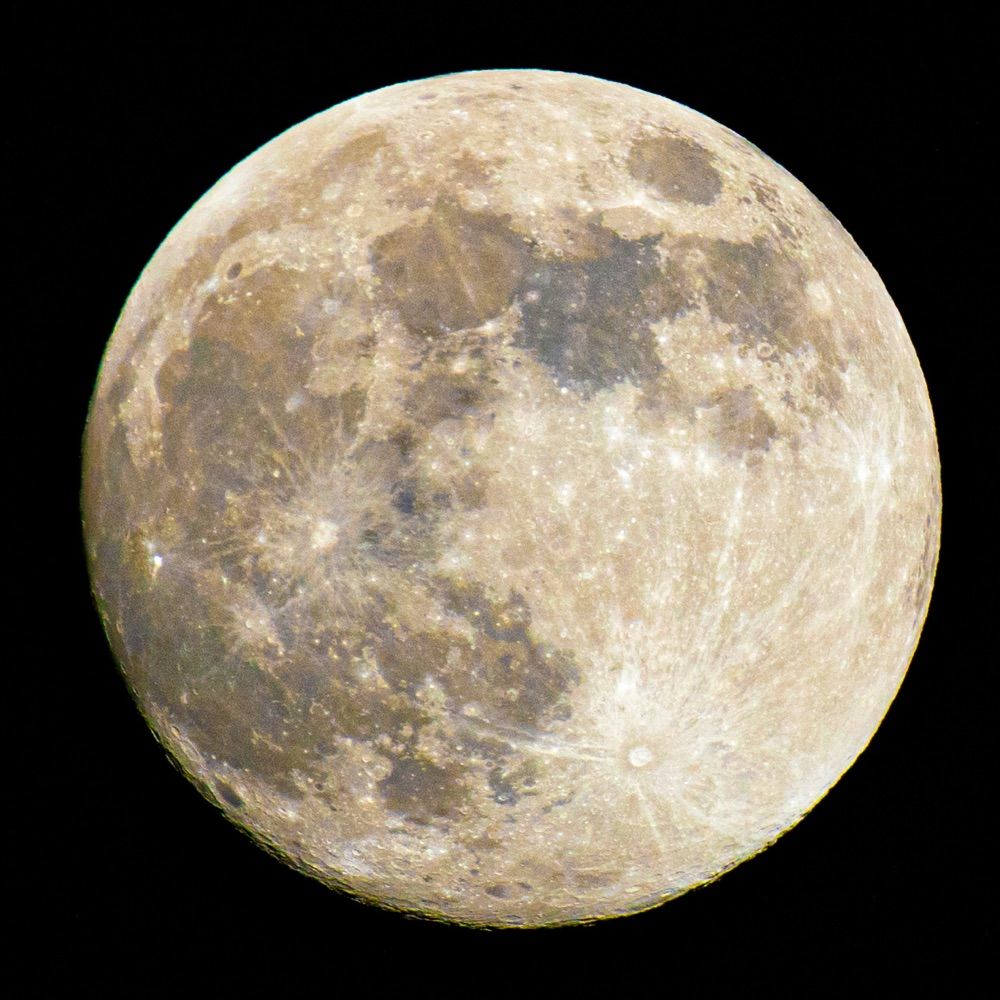
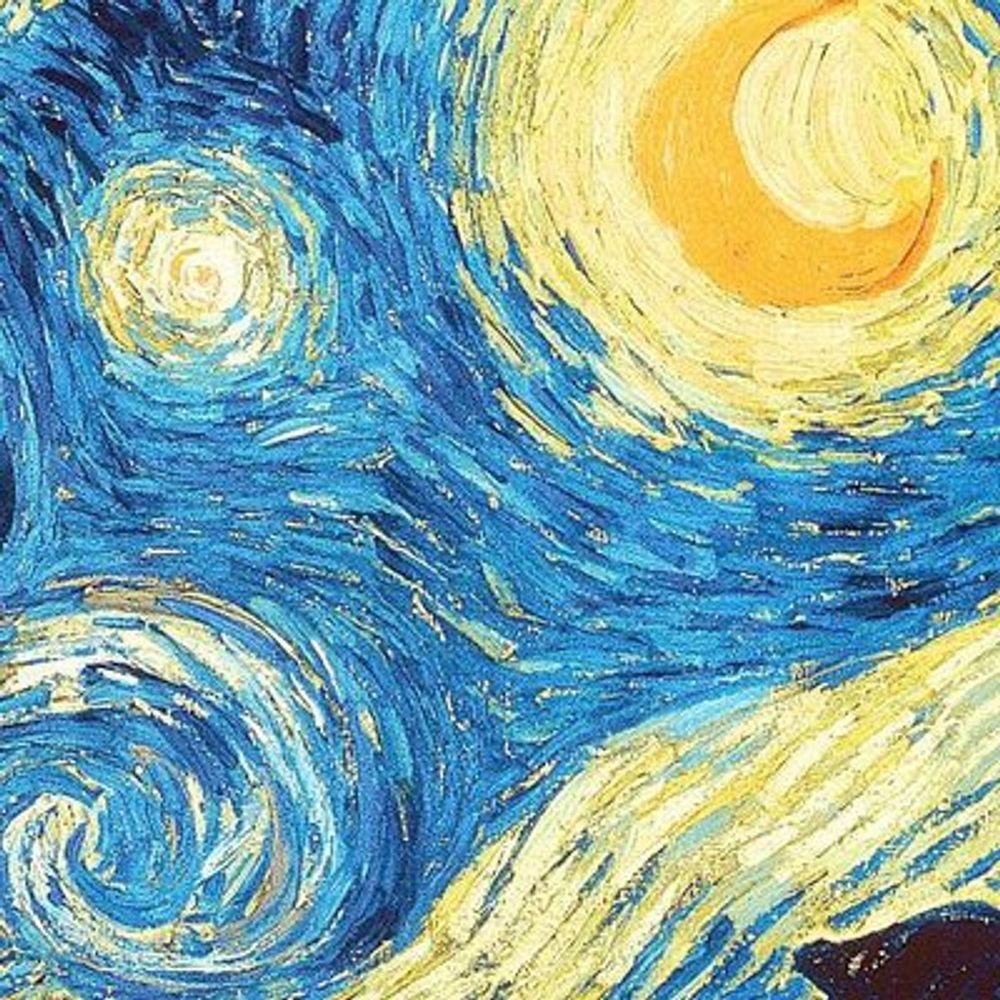
See Explanation. Clicking on the picture will download the highest resolution version available.
🔭 NGC 147 and NGC 185
Image Credit & Copyright: Chuck Ayoub
apod.nasa.gov/apod/ap26021...

@bslinkin.bsky.social
Laugh/learn/like/lounge/lurk 😻🏳️🌈
See Explanation. Clicking on the picture will download the highest resolution version available.
🔭 NGC 147 and NGC 185
Image Credit & Copyright: Chuck Ayoub
apod.nasa.gov/apod/ap26021...

A person with the arms raised stands atop of a rock peak covered in snow. Snow covered mountains are all around. Green aurora swirl overhead and reflect off the snow. Please see the explanation for more detailed information.
🔭 In Green Company: Aurora over Norway
Image Credit & Copyright: Max Rive
apod.nasa.gov/apod/ap26021...

See Explanation. Clicking on the picture will download the highest resolution version available.
🔭 Roses are Red
Image Credit & Copyright: Raffaele Calcagno
Text: Keighley Rockcliffe (NASA GSFC, UMBC CSST, CRESST II)
apod.nasa.gov/apod/ap26021...

NGC6888(Crescent Nebula) #Celestron 8/AVX, #Starizona Night Owl 0.4X FR, #ASI294MC Pro, exposure not recorded,
#Autostakkert!, #GraXpert, #Corel Paintshop Pro
Imaged: 11/3/2021. To be revisited in the future. #Astrophotography

New Yorkers, Come to this event at the American Museum of Natural History Feb 24 and find out how you can help NASA make scientific discoveries! www.amnh.org/calendar/cit... #citizenscience #astrophotography
13.02.2026 20:25 — 👍 15 🔁 3 💬 0 📌 0#astrophotography
14.02.2026 01:26 — 👍 14 🔁 7 💬 1 📌 0
Happy Valentine's Day, Bluesky.💘
Hope yours is an Astronomical one.
High-resolution: app.astrobin.com/i/gzac6b
#astrophotography #astronomy #naturephotography #nature #longexposure #nebula #valentinesday #eastcoastkin #photography

Jupiter from Whittier, CA
#astronomy #astrophotography #jupiter #LAAS #whittier

The Heart Nebula (officially designated IC 1805) is a massive emission nebula located approximately 7,500 light-years away in the constellation Cassiopeia. Spanning nearly 200 to 300 light-years across, it is one of the most iconic deep-sky targets for astronomers due to its striking resemblance to a human heart.
The Heart Nebula!
On Valentine's Day, any excuse or opportunity to share the #astronomy version of a human heart! Such an iconic part of our visible universe ❤️
#astrophotography @stormhour.com @photohour.bsky.social

Oye, Beltalowda! - Orion's Belt
AstroBin's Image of the Day: "Oye, Beltalowda! - Orion's Belt" by Timothy Martin
www.astrobin.com/7vliv5/
#astrophotography

This is NGC 2359 in Canis Major, also called Thor's Helmet or the Duck Nebula. Why the Duck Nebula, I will never know. I see no duck here. #Astronomy #Astrophotography
14.02.2026 15:10 — 👍 65 🔁 12 💬 1 📌 2
This is IC 1805, the Heart Nebula, and IC 1848, the Soul Nebula, and if that doesn't put a song in your heart then you just don't have a musical heart. #Astronomy #Astrophotography
14.02.2026 18:29 — 👍 44 🔁 3 💬 1 📌 0
Image of the Heart and Soul nebulae in Cassiopeia from Dec 4th taken with the SV545 telescope and SC571CC astrocam.
The heart and the soul nebulae in Cassiopeia. Taken on Dec 4th with the Svbony SV545 and the Svbony SC571CC astrocam.
Happy Valentine's day!
#astronomy #astrophotography #space #nebulae

An image of the Sun is surrounded by 12 smaller Sun images. Each surrounding image has some spots on it, but the large central image has the most dark spots. Please see the explanation for more detailed information.
🔭 A Year of Sunspots
Image Credit: NASA, SDO; Processing & Copyright: Şenol Şanli & Uğur İkizler; Text: Cecilia Chirenti (NASA GSFC, UMCP, CRESST II)
apod.nasa.gov/apod/ap26021...

An unusual gray body looks like a more jaggged version of the Earth's moon, but close up. Craters and stripes run across much of the surface. Please see the explanation for more detailed information.
🔭 Miranda Revisited
Image Credit: NASA, JPL, Voyager 2; Processing & License: Flickr: zelario12; Text: Keighley Rockcliffe (NASA GSFC, UMBC CSST, CRESST II)
apod.nasa.gov/apod/ap26020...
After this talk by Ruth Boreham, I went looking among my lunar images for any craters named after women that I'd captured. Here are 6. #astronomy #astrophotography
10.02.2026 12:53 — 👍 35 🔁 5 💬 1 📌 1
AR4336 on the western edge

Today's Sun captured in white light with a false colour.

NASA/SDO image

Graphic showing the spot numbering.
Super Sunspot AR4336 is about to disappear from view. One of the most potent of the entire Solar Cycle 2025, it has fired off many X class flares #astronomy #astrophotography @stormhour.com @photohour.bsky.social
10.02.2026 13:35 — 👍 36 🔁 4 💬 0 📌 1
Stellar region in the constellation Cassiopeia. This photo is my wide field exploratory shot of an area that contains reflection and dark nebulae, open star clusters, and HII regions. If weather cooperated I was planning to investigate some areas further with my narrow field of view scope. - The weather never did cooperate, maybe this summer I will shoot some of the interesting areas with a narrow field higher res scope. Set up: Telescope: SVBony SV555 Petzval Astrograph Camera: ASI2600mc pro Mount: ZWO AM3 mount Filter: SVBony UV/IR cut Controller: Mini PC running NINA and PHd2 acquisition and guiding software.
Stellar region in the Cassiopeia. This is my wide field exploratory photo of an area that contains reflection and dark nebulae, open star clusters, and HII regions. If weather was good the plan was to shoot some areas in higher res
-Weather was poor, maybe this summer
#astronomy #astrophotography

A deep-space photograph of the Horsehead Nebula shows a dark, horse-shaped silhouette rising from a glowing band of red and pink gas that stretches diagonally across the image. Wispy clouds of illuminated hydrogen surround the dark dust, with a bright bluish star nearby and countless small white stars scattered across a black background, creating a dramatic contrast between glowing gas and shadowed space.
This image of the Horsehead Nebula marks the start of my sixth year as an astrophotographer, and I am filled with immense pride. It serves as a reminder of the progress I have made and the vast expanse of knowledge that still awaits me.
#astrophotography #astronomy #space
www.justinthedark.com

A photograph of the Orion Constellation. The Orion Nebula is visible in the sword and the Flame nebula is visible near the left hand star of the belt, Alnitak. Now for the technical information. This was taken with a Nikon Z5 using a Sigma 105 mm, f/5.6 ISO 1600 30 sec. It is a stack of 25 images in PixInsight. The image was tracked with a MoveShootMove Nomad Tracker.
I do love the night sky! Orion! #love #SensoryArt #EastCoastKin #astrophotography #Orion #OrionNebula #FlameNebula #MoveShootMoveNomad More info on taking the photo in alt
10.02.2026 17:24 — 👍 50 🔁 8 💬 2 📌 0
Thin Moon at waning crescent right of centre. Bird below flying towards it.
On this day in 2016 a bird was flying to the Moon. 🔭 🧪 🎨 #astrophotography #SciArt #photography #StormHour #ThePhotoHour
10.02.2026 20:15 — 👍 117 🔁 14 💬 5 📌 0Seagull Nebula (IC 2177)*
Acquisition details and full resolution: app.astrobin.com/i/log8xo
#Astrophotography
*Updated with additional curves adjustment.

M35 is a young open star cluster in the constellation on Gemini. Blue looking stars mean they are young. Hope you enjoy! It is about 2800 light years away! #astrophotography #astronomy Processed in Siril, Lightroom and Topaz for manual denoise. @kat-astro-bot.bsky.social
11.02.2026 03:21 — 👍 29 🔁 6 💬 2 📌 0
The Great Andromeda Galaxy. It covers the centre of the frame running from bottom-left to top-right. Companion galaxies M110 and M32 are seen to the right and left of the main galaxy respectively. 2 hours of RGB (unfiltered OSC) and 2 hours of Ha, with an Esprit 80 telescope and a ZWO 2600mc camera.
M31 from Latitude 30 degrees South!
Opportunities to image the Andromeda Galaxy from my part of Australia are extremely rare. Late last year I travelled nearly 4 degrees north to dark skies. I captured this over 2 nights when it was highest (14 to 18 degrees above the horizon) 🔭 #astrophotography

NGC 2014 Region of the LMC (Cosmic Reef and Dragon's Head Nebulae)
AstroBin's Image of the Day: "NGC 2014 Region of the LMC (Cosmic Reef and Dragon's Head Nebulae)" by Glenn Baxter
www.astrobin.com/51oqzy/
#astrophotography

The Eastern Veil Nebula is the eastern portion of a supernova remnant known as the Veil Complex, aka the Cygnus Loop.
High-resolution: app.astrobin.com/i/brkpo6
#astrophotography #astronomy #naturephotography #nature #longexposurephotography #longexposure #nebula #eastcoastkin #photography

The Dolphin Head nebula in Canis Major constellation, photographed from my terrace
1/ The Dolphin Head (Sh2-308) is an emission nebula in the Canis Major region: a huge bubble created by material expelled by the star WR6, swept by its powerful stellar wind.
It’s also a target that drove me crazy for four years before I finally started to get a grip on it. ➡️
🔭
#Astrophotography

a bright comet with two distinct tails. One tail is longer than the other. The nucleus of the comet glows green. The comet is positioned on the right of the image. The background is a sea of stars. To the left, is a near-edge on spiral galaxy, residing in the distance.
I really *love* when we get these conjunctions!
Depth is hard to perceive when looking into the cosmos, but images like this give us an idea.
Comet - our Solar System
Stars - further out, but our Galaxy
Galaxy - very far away with a void between
Looking across space & time!
📸 Daniele Gasparri

Most of the Sun is pictured peeking over a hill. On the surface of the Sun are several sunspots including a very large sunspot region toward the center-right. Please see the explanation for more detailed information.
🔭 Active Sunspot Region 4366 Crosses the Sun
Image Credit & Copyright: Daniel Korona
apod.nasa.gov/apod/ap26020...
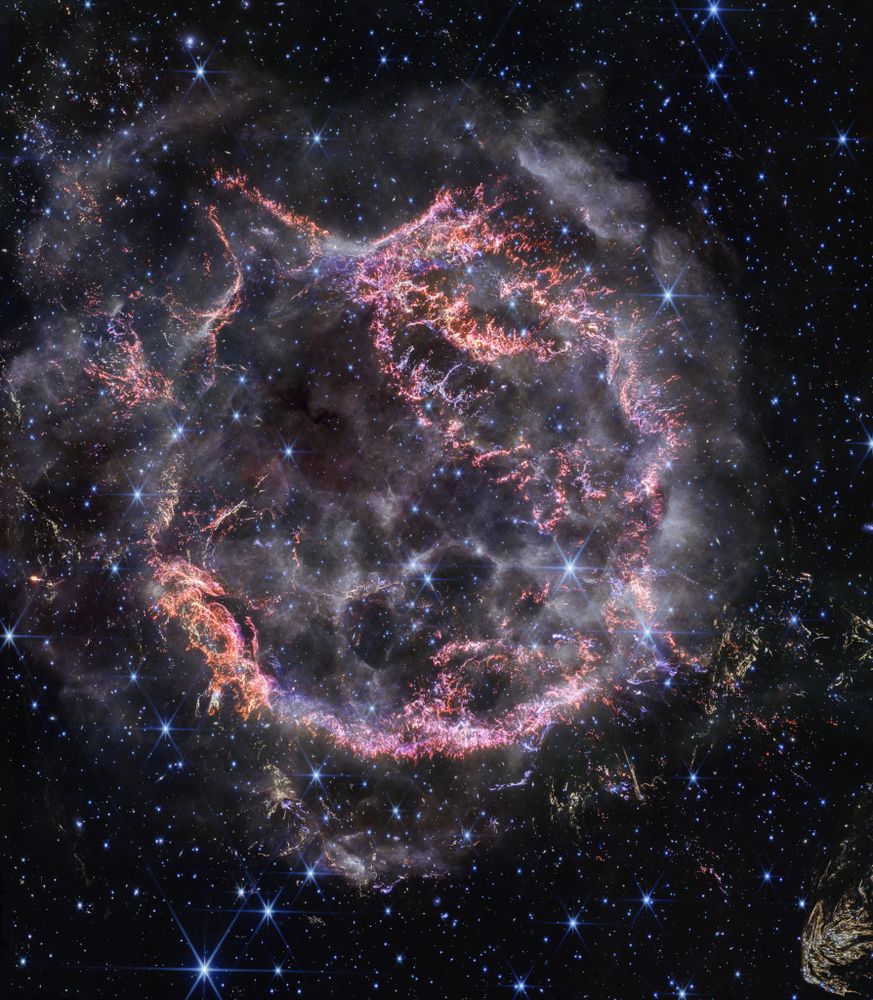
Massive stars in our Milky Way Galaxy live spectacular lives. Collapsing from vast cosmic clouds, their nuclear furnaces ignite and create heavy elements in their cores. After only a few million years for the most massive stars, the enriched material is blasted back into interstellar space where star formation can begin anew. The expanding debris cloud known as Cassiopeia A is an example of this final phase of the stellar life cycle. Light from the supernova explosion that created this remnant would have been first seen in planet Earth's sky about 350 years ago, although it took that light 11,000 years to reach us. This sharp NIRCam image from the James Webb Space Telescope shows the still-hot filaments and knots in the supernova remnant. The whitish, smoke-like outer shell of the expanding blast wave is about 20 light-years across. A series of light echoes from the massive star's cataclysmic explosion are also identified in Webb's detailed images of the surrounding interstellar medium.
🔭 Supernova Remnant Cassiopeia A
Image Credit: NASA, ESA, CSA, STScI; D. Milisavljevic (Purdue University), T. Temim (Princeton University), I. De Looze (University of Gent)
apod.nasa.gov/apod/ap26020...