I seriously doubt you would have even run across that old commentary, but just made me happy to see that I'm not the only one that starts channeling Jackson 5 when I see "APC"... as I said, great post!
13.02.2026 16:14 — 👍 3 🔁 0 💬 1 📌 0

Job opening for postdoctoral researchers at the Max Planck Institute for Demographic-Epidemiology.

The Medical Demography research group explains its goals for studying disease progression and its effects on health and the population.

We are looking for a PhD in demography, sociology, epidemiology, or related fields with experience in quantitative health data analysis.

Apply now: The application deadline is March 22, 2026. For more information, visit www.demogr.mpg.de/go/jobs.
📢Job Offer‼️New Max Planck Research Group on Medical Demography
Marcus Ebeling will lead the team starting on 1 July 2026. The research group will be based at the MPIDR in Rostock. Read an interview with Marcus on his future research here: www.demogr.mpg.de/go/rgmd (including link to job) #postdoc
09.02.2026 08:30 — 👍 19 🔁 20 💬 0 📌 0
Nurses' Health Study. The gift that keeps on giving...
22.01.2026 13:54 — 👍 1 🔁 0 💬 0 📌 0
The full report is posted here www.healtheffects.org/system/files...
along with commentary from HEI's Research Committee and Appendix material here: www.healtheffects.org/publication/...
14.01.2026 19:39 — 👍 0 🔁 0 💬 0 📌 0
A new @mcgill.ca study led by me and Jill Baumgartner released by @heiresearch.bsky.social reports that China’s Clean Heating Policy, one of the largest #CleanEnergy policies yet implemented, reduced household coal use, improved air quality, and reduced blood pressure in rural Beijing.
14.01.2026 19:39 — 👍 0 🔁 0 💬 1 📌 0
Yes, I believe the technical term for this is enshittification.
12.01.2026 19:49 — 👍 26 🔁 0 💬 0 📌 0
Lived in Copenhagen last year and New Year's Eve was 100% the worst time to be there. I just do not understand it.
31.12.2025 20:57 — 👍 3 🔁 0 💬 0 📌 0
Overshoot (again I've only read the first few chapters) is extensively documented but written in a much more polemical and frustrated style that I think KT are keen to avoid. Maybe that's what appealed to the NYRB reviewer. Hope to see your take soon!
30.12.2025 20:17 — 👍 1 🔁 0 💬 1 📌 0
Yes, that rings true. I've only read the "Invent" chapter of Abundance, which is all about the stifling effects of risk aversion and excess paperwork on scientific innovation [likely true], but pays little attention to the role of perverse incentives (counting up pubs and grant dollars, etc.).
30.12.2025 20:17 — 👍 2 🔁 0 💬 1 📌 0
It's not a particularly deep critique of Abundance, but I did enjoy this review essay by economic historian Trevor Jackson, which simultaneously reviewed "Overshoot" by Malm and Carton. Happy to send you the full text if you don't have access. www.nybooks.com/articles/202...
30.12.2025 16:42 — 👍 2 🔁 0 💬 1 📌 0
The Government of Canada introduces new programs for international researchers - Canada.ca
It's happening! Canada launched two programs to recruit international researchers.
Canada Impact+ Research Chairs (1 million/yr for 8 yrs +)
Canada Impact+ Emerging Leaders.
I will do my best to facilitate the process for those interested. Hit me up.
www.canada.ca/en/impact-pl...
09.12.2025 18:06 — 👍 198 🔁 115 💬 4 📌 20
I think the answer is no. I recall an interesting short overview in Mutz’s ‘Population-Based Survey Experiments’ but perhaps dated now (2011).
03.12.2025 11:44 — 👍 0 🔁 0 💬 0 📌 0

A table showing profit margins of major publishers. A snippet of text related to this table is below.
1. The four-fold drain
1.1 Money
Currently, academic publishing is dominated by profit-oriented, multinational companies for
whom scientific knowledge is a commodity to be sold back to the academic community who
created it. The dominant four are Elsevier, Springer Nature, Wiley and Taylor & Francis,
which collectively generated over US$7.1 billion in revenue from journal publishing in 2024
alone, and over US$12 billion in profits between 2019 and 2024 (Table 1A). Their profit
margins have always been over 30% in the last five years, and for the largest publisher
(Elsevier) always over 37%.
Against many comparators, across many sectors, scientific publishing is one of the most
consistently profitable industries (Table S1). These financial arrangements make a substantial
difference to science budgets. In 2024, 46% of Elsevier revenues and 53% of Taylor &
Francis revenues were generated in North America, meaning that North American
researchers were charged over US$2.27 billion by just two for-profit publishers. The
Canadian research councils and the US National Science Foundation were allocated US$9.3
billion in that year.

A figure detailing the drain on researcher time.
1. The four-fold drain
1.2 Time
The number of papers published each year is growing faster than the scientific workforce,
with the number of papers per researcher almost doubling between 1996 and 2022 (Figure
1A). This reflects the fact that publishers’ commercial desire to publish (sell) more material
has aligned well with the competitive prestige culture in which publications help secure jobs,
grants, promotions, and awards. To the extent that this growth is driven by a pressure for
profit, rather than scholarly imperatives, it distorts the way researchers spend their time.
The publishing system depends on unpaid reviewer labour, estimated to be over 130 million
unpaid hours annually in 2020 alone (9). Researchers have complained about the demands of
peer-review for decades, but the scale of the problem is now worse, with editors reporting
widespread difficulties recruiting reviewers. The growth in publications involves not only the
authors’ time, but that of academic editors and reviewers who are dealing with so many
review demands.
Even more seriously, the imperative to produce ever more articles reshapes the nature of
scientific inquiry. Evidence across multiple fields shows that more papers result in
‘ossification’, not new ideas (10). It may seem paradoxical that more papers can slow
progress until one considers how it affects researchers’ time. While rewards remain tied to
volume, prestige, and impact of publications, researchers will be nudged away from riskier,
local, interdisciplinary, and long-term work. The result is a treadmill of constant activity with
limited progress whereas core scholarly practices – such as reading, reflecting and engaging
with others’ contributions – is de-prioritized. What looks like productivity often masks
intellectual exhaustion built on a demoralizing, narrowing scientific vision.

A table of profit margins across industries. The section of text related to this table is below:
1. The four-fold drain
1.1 Money
Currently, academic publishing is dominated by profit-oriented, multinational companies for
whom scientific knowledge is a commodity to be sold back to the academic community who
created it. The dominant four are Elsevier, Springer Nature, Wiley and Taylor & Francis,
which collectively generated over US$7.1 billion in revenue from journal publishing in 2024
alone, and over US$12 billion in profits between 2019 and 2024 (Table 1A). Their profit
margins have always been over 30% in the last five years, and for the largest publisher
(Elsevier) always over 37%.
Against many comparators, across many sectors, scientific publishing is one of the most
consistently profitable industries (Table S1). These financial arrangements make a substantial
difference to science budgets. In 2024, 46% of Elsevier revenues and 53% of Taylor &
Francis revenues were generated in North America, meaning that North American
researchers were charged over US$2.27 billion by just two for-profit publishers. The
Canadian research councils and the US National Science Foundation were allocated US$9.3
billion in that year.

The costs of inaction are plain: wasted public funds, lost researcher time, compromised
scientific integrity and eroded public trust. Today, the system rewards commercial publishers
first, and science second. Without bold action from the funders we risk continuing to pour
resources into a system that prioritizes profit over the advancement of scientific knowledge.
We wrote the Strain on scientific publishing to highlight the problems of time & trust. With a fantastic group of co-authors, we present The Drain of Scientific Publishing:
a 🧵 1/n
Drain: arxiv.org/abs/2511.04820
Strain: direct.mit.edu/qss/article/...
Oligopoly: direct.mit.edu/qss/article/...
11.11.2025 11:52 — 👍 641 🔁 453 💬 8 📌 66

Chaos is coming for scholarly publishing - Research Professional News
Buckling of commercial models alongside maturing of community-led efforts promises major shifts, says Caroline Edwards
Opinion: Chaos is coming for scholarly publishing.
Buckling of commercial models alongside maturing of community-led efforts promises major shifts, says Caroline Edwards (@theblochian.bsky.social).
www.researchprofessionalnews.com/rr-news-uk-v...
12.11.2025 10:17 — 👍 35 🔁 31 💬 0 📌 5
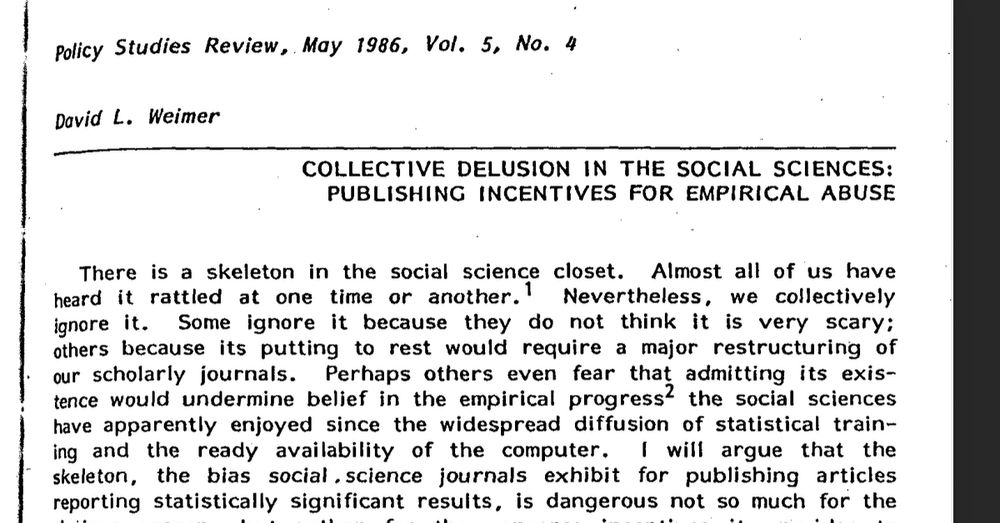
title page of article:
There is a skeleton in the social science closet. Almost all of us have heard it rattled at one time or another.! Nevertheless, we collectively ignore it. Some ignore it because they do not think it is very scary: others because its putting to rest would require a major restructuring of our scholarly journals. Perhaps others even fear that admitting its existence would undermine belief in the empirical progress? the social sciences have apparently enjoyed since the widespread diffusion of statistical training and the ready availability of the computer.
I will argue that the
skeleton, the bias social science journals exhibit for publishing articles reporting statistically significant results, is dangerous

The results of statistical tests should not be submitted to or als until after articles have been accepted for publica-
tion..
would base their decisions on
theory under
discussions of the theory under consideration, the specific hypotheses to be tested, and the data sample to be used.?
This would divert attention from the final result to the a priori specification of hypotheses and the appropriateness of data and statistical technique for testing them. Unfortunate-ly, this approach would not work unless adopted by all the relevant journals. If a single journal adopted it, researchers

Any journal that publishes an article with statistical models should be required (by the disciplines?) to provide a page of space to anyone who wants to report the results of applying the authors' models to different sets of data. This approach would provide a less biased sampling of research results. It would also allow us to better gauge the robustness of our theories.8 Some journals now provide some space for veri-fications; doing so should be standard editorial practice.
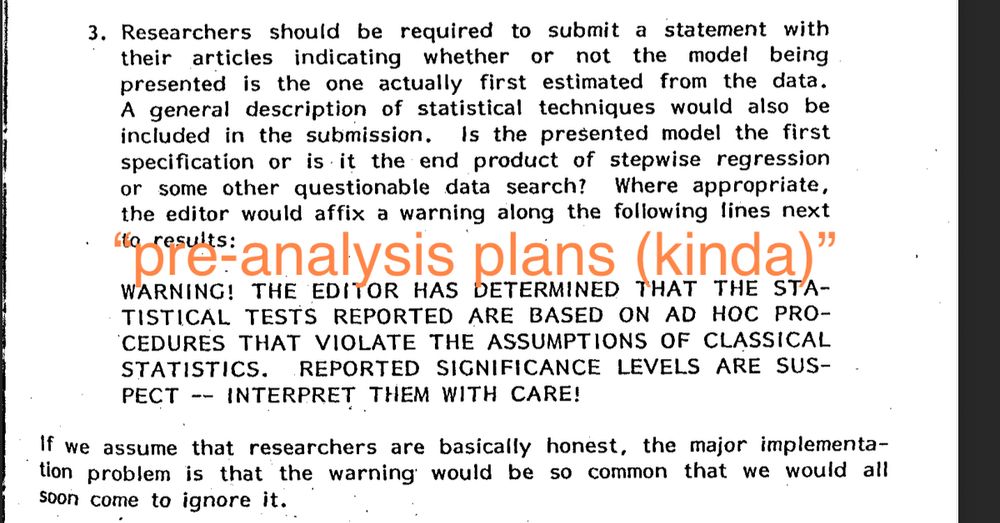
Researchers should be required to submit a statement with
indicating
their articles indicating whether or not the model being presented is the one actually first estimated from the data.
A general description of statistical techniques would also be included in the submission. Is the presented model the first specification or is it the end product of stepwise regression or some other questionable data search? Where appropriate, the editor would affix a warning along the following lines next to results:
encountered this article by David Weimer from 1986 (cited by 7) with three good ideas for improving science that just a few short decades later, we've started to implement.
Collective Delusion In The Social Sciences: Publishing Incentives For Empirical Abuse
doi.org/10.1111/j.15...
27.10.2025 12:28 — 👍 13 🔁 5 💬 1 📌 0

Does One Size Fit All? | Los Angeles Review of Books
In the 10th essay in the Legacies of Eugenics series, Jay S. Kaufman shows how the science of human body size is suffused with cultural assumptions.
McGill's @healthsciences.mcgill.ca Jay Kaufman critiquing public health guidance that "promote the powerful ideological message that being normal or abnormal ultimately depends on one’s race. That premise should be regarded as the truly malignant pathology"
lareviewofbooks.org/article/does...
29.09.2025 13:47 — 👍 1 🔁 0 💬 0 📌 0
Horrors of Trump detention centre: Lisburn man tells his story after arrest for 'looking like a Mexican'
Lee Stinton was lifted by US immigration police on an American street — in an incident he compared to a kidnapping.
Here, he tells us his story.
10.09.2025 07:27 — 👍 2280 🔁 1451 💬 68 📌 289
"Credit card perks for educated, usually urban professionals are being subsidized by people who have less. In other words, when you book a hotel room or enjoy entry to an airport lounge at no cost, poor consumers are ultimately footing the bill." www.nytimes.com/2023/03/04/o...
12.08.2025 13:28 — 👍 1 🔁 0 💬 0 📌 0

A do-or-die moment for the scientific enterprise
Reflecting on our paper “The entities enabling scientific fraud at scale are large, resilient, and growing rapidly”
Today, our article "The entities enabling scientific fraud at scale are large, resilient, and growing rapidly" is finally published in PNAS. I hope that it proves to be a wake-up-call for the whole scientific community.
reeserichardson.blog/2025/08/04/a...
04.08.2025 20:46 — 👍 337 🔁 205 💬 9 📌 44

A Zoo in Denmark Wants to Feed Your Pets to Its Predators
What is going on here?
Why does Aalborg (or Copenhagen, Montreal, San Diego, etc.) even need a zoo?
www.nytimes.com/2025/08/04/s...
05.08.2025 01:11 — 👍 5 🔁 1 💬 0 📌 0
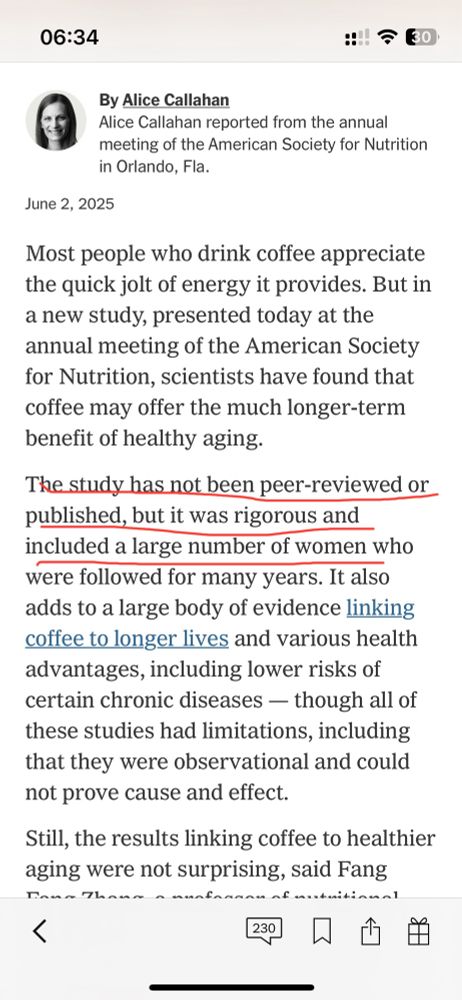
Fully agree. In exactly the same way that making all of the material (protocol, data, code) available for reproducing research also is no guarantee of "better" research. Transparency is (largely) good, but can't delude ourselves that improved transparency equals improved quality.
19.06.2025 09:39 — 👍 1 🔁 0 💬 0 📌 0
 03.06.2025 04:37 — 👍 3 🔁 0 💬 0 📌 0
Raising kids & bread & grant money. Cleaning data & diapers & fish. EA (bed nets, not light cone). Social scientist. typos. twitter.com/ryancbriggs
U.S. Representative, IL-06. Personal account. Dad. Husband. Trained as an engineer, 16 years as a clean energy CEO, now in middle management. For official stuff see @casten.house.gov
High-quality, trusted science for cleaner air and better health.
Associate professor in statistics and sociology at the University of Toronto. Demographer from Australia.
https://www.monicaalexander.com/
https://formaldemography.github.io/working_group/
@tpn-uoft.bsky.social
I spend too much money on books. And too much time writing them. 🇦🇺🇨🇦.
https://rohanalexander.com
http://tellingstorieswithdata.com
The UK Reproducibility Network (UKRN) is a national peer-led consortium that aims to promote and enable rigorous, robust, transparent, and reproducible research in the UK.
https://www.ukrn.org/ #AcademicSky #OpenResearch #Research
Bestselling author of THEY KNEW, HIDING IN PLAIN SIGHT, THE VIEW FROM FLYOVER COUNTRY and THE LAST AMERICAN ROAD TRIP.
https://sarahkendzior.substack.com/
Husband, dad, veteran, writer, and proud Midwesterner. 19th US Secretary of Transportation and former Mayor of South Bend.
Historian. Author. Professor. Budding Curmudgeon. I study the contrast between image and reality in America, especially in politics.
Love for Montreal culture. cultmtl.com
Associate Professor of Political Science at Northwestern University
alexandercoppock.com
Persuasion in Parallel: https://alexandercoppock.com/coppock_2022.html
Research Design: Declaration, Diagnosis, and Redesign: book.declaredesign.org
Time expired epidemiologist
Significance is a magazine + website showcasing statistics stories from around the globe. Brought to you by the Royal Statistical Society, American Statistical Association + the Statistical Society of Australia
Data geek.
Here for demography, public health, social justice, evidence-based policymaking, and math jokes.
Professor. Co-Chief-Editor Environmental & Resource Economics. Behavioural, Environmental, Experimental, Development. Mostly Ibaraki. バーコードなし. Sky Blue.
PoliSci PhD student @ Harvard / 🇬🇧🏳️🌈 / Creator of MyLittleCrony.com
Signal: @sehill.11
Epidemiologist. Professor Emerita. Workplace Wrecker. Blue in Arizona, forged in the Burgh.
Banner quote by @amandagorman
1elizabethtjacobs1@gmail.com
@defendpublichealth.bsky.social
https://www.defendpublichealth.org
No longer in good standing with the New York State bar
My newsletter: StringinaMaze.net
Epidemiologist - www.taylormclinden.ca 🇨🇦