
At least 148 dead after reported strike on school, Iran says
Iran has blamed the US and Israel for the strike; the US is looking into reports of the incident, while the IDF says it is
The mass murder of civilians in Gaza, the brazen attacks on hospitals and schools, without any accountability has created a new kind of warfare that should terrify and enrage all of us.
Every child lost is someone’s whole world. Every life lost matters www.bbc.co.uk/news/article...
01.03.2026 12:28 —
👍 397
🔁 153
💬 9
📌 10

A display of the grave goods, featuring a he chainmail shirt, a helmet on a stand, a long sword, small gold ornaments, and various metal, glass, and ceramic objects, all arranged against a dark background.
The early medieval burial from Gammertingen, 6th century AD.
The high-ranking warrior died in his early 30s and was buried with a Byzantine helmet (a so-called Spangenhelm), his weapons, and his mail armour, which consisted of about 45,000 iron rings!
📷Landesmuseum Württemberg
🏺
01.03.2026 08:10 —
👍 415
🔁 96
💬 12
📌 2
Islam is the USA’s target. DT is supporting Netenyahu in his quest for a Greater Israel.
It’s ghastly watching two warmongers cause this destruction & civilian deaths.
28.02.2026 19:08 —
👍 5
🔁 2
💬 0
📌 0
Down with the Great Satan.
28.02.2026 14:11 —
👍 2
🔁 0
💬 0
📌 0
Israel killing children as usual because that’s what they do
28.02.2026 12:44 —
👍 15
🔁 4
💬 1
📌 0

My photo shows the front of a warm-yellow coloured Minoan clay flask, hand painted in black with a frontally depicted octopus. The flask measures 27 cm (about 10.5 inches) in height. It has a short spout at the top with a small loop handle at either side. The octopus is swimming diagonally with its eight writhing, sucker-lined arms covering the whole surface of the flask. It stares out at the viewer with wide, almost cartoon-like eyes. Additional motifs include sea urchins, tritons, small rocks and seaweed. Minoan decoration depicting sea motifs is known by scholars as the ‘Marine Style’. The flask was excavated in 1903 at a Bronze Age settlement site at Palaikastro. The Palaikastro excavations, carried out between 1902 and 1906, were run by R. Bosanquet and R.M. Dawkins from the British School of Athens. The flask is part of the collections at Heraklion Archaeological Museum, Heraklion, Crete.
Marvellous 3,500 year-old Minoan clay flask decorated with a wide-eyed octopus 🐙❤️
Excavated in 1903 from a Bronze Age settlement site at Palaikastro, Crete.
Heraklion Archaeological Museum 📷 by me
#Archaeology
28.02.2026 13:49 —
👍 968
🔁 233
💬 21
📌 19
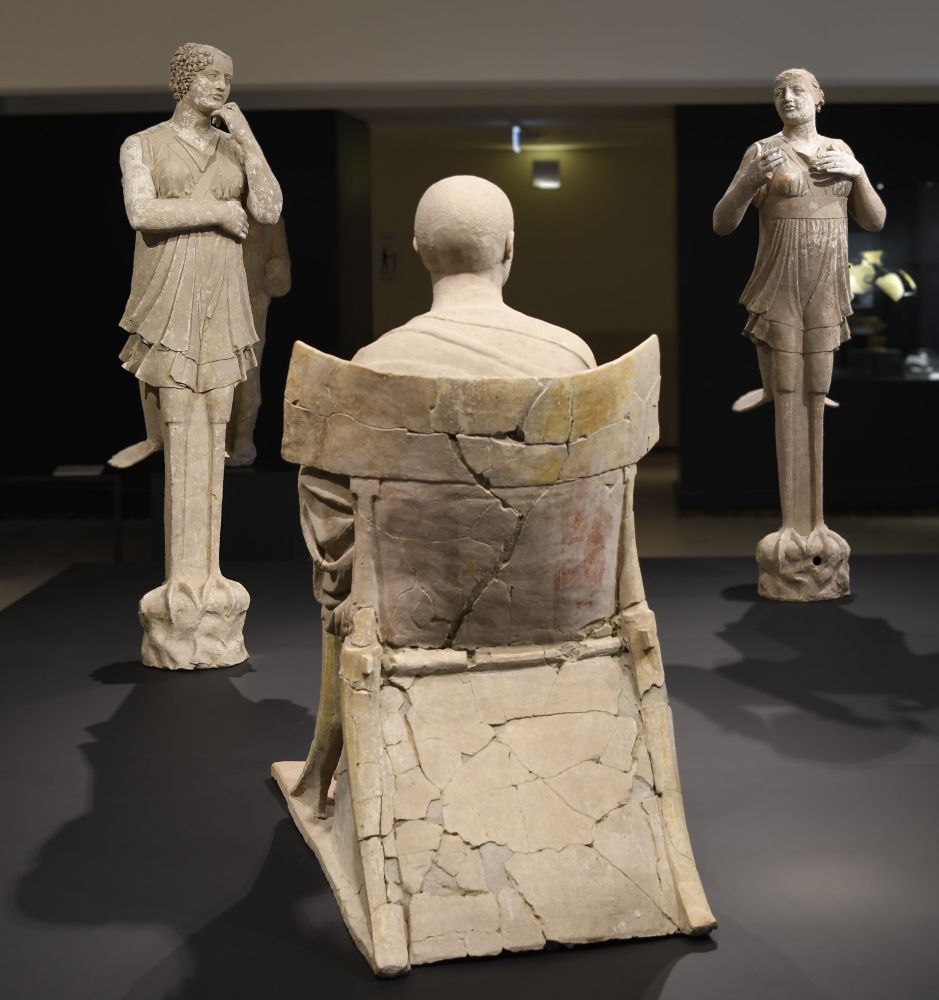
Three terracotta statues of Orpheus, sitting on a stool and playing his instrument, and two sirens, half human and half bird, standing in front of him.
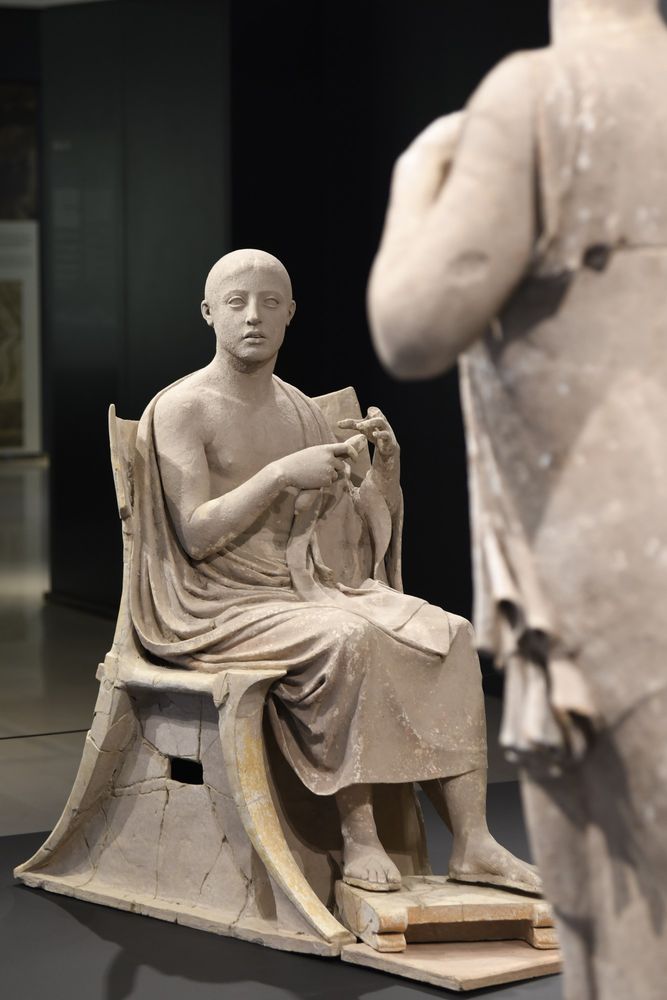
Three terracotta statues of Orpheus, sitting on a stool and playing his instrument, and two sirens, half human and half bird, standing in front of him.
A highlight of early Hellenistic Taranto is the stunning terracotta group of Orpheus and the Sirens, recently returned from the Getty to Italy. While striking, their original setting, possibly on a funerary monument, remains a mystery.
Taranto, late 4th c. BCE, 📷 by me #Archaeology 🏺
10.05.2025 12:42 —
👍 111
🔁 33
💬 4
📌 2
Down with the Great Satan, dude.
28.02.2026 09:23 —
👍 1
🔁 0
💬 0
📌 0

A close-up of a small horse figurine carved from mammoth ivory with a weathered surface. The figure features a bowed head and arched neck, and all four legs are broken off. It's displayed on a dark, speckled platform against a black background, with soft lighting highlighting its contours.
As I'm attending a conference in Tübingen today, for #findsfriday an #IceAge masterpiece that is on display at the University museum: a tiny but most splendid figurine from the Swabian Jura - a #horse carved in mammoth ivory some 40,000 years ago - the oldest known sculpture of a horse.
📷me
🏺
27.02.2026 09:09 —
👍 556
🔁 128
💬 14
📌 19

#FrescoFriday
Fresco from #Pompeii, Italy - Wall painting with Hercules fighting a lion.
#Archaeology #History #art
27.02.2026 10:32 —
👍 12
🔁 2
💬 2
📌 0
keir Starmer, wes streeting, margaret thatcher, francisco franco, rangers football club, hermann goering, ally mccoist.... your boys just took one helluva beating
27.02.2026 05:31 —
👍 71
🔁 11
💬 0
📌 1
✊🏼
27.02.2026 10:27 —
👍 0
🔁 0
💬 0
📌 0
 27.02.2026 07:19 —
👍 1448
🔁 422
💬 31
📌 20
27.02.2026 07:19 —
👍 1448
🔁 422
💬 31
📌 20

Early 10th century Byzantine ivory casket depicting mythological scenes.
This Byzantine ivory casket was my favourite thing in the Musée de Cluny.
One of the best museums in Paris and less busy than the Louvre and d'Orsay.
25.02.2026 12:08 —
👍 6
🔁 1
💬 0
📌 1

A translucent, finely crafted arrowhead made of rock crystal, standing upright on a sandy surface.
A stunning #Neolithic rock crystal arrowhead found in the pile-dwelling settlement of Neuchâtel, Switzerland, dating from around 3500 BC. The raw material was not available in the immediate area, but came from the Alps. Rock crystal has been mined in the Swiss Alps since the early Mesolithic.🧵1/3
🏺
21.02.2026 08:12 —
👍 658
🔁 157
💬 13
📌 11

Book number 5 of 2026. #BookSky
21.02.2026 18:20 —
👍 3
🔁 0
💬 0
📌 0

Met Museum photo of an Ancient Egyptian artist’s painting of a swallow on a flake of limestone, dated to the New Kingdom, Dynasty 18, joint reign of Hatshepsut and Thutmose III, c. 1479-1458 BC.
The sparrow stands in profile with head to the right. It is delicately painted with a pinkish body. The outline and details are highlighted in a reddish/brown pigment. Its legs, eye, and beak are painted black. Limestone flake dimensions Height 6.6 cm x Width 10.6 cm.
This may have been a practice drawing of the sparrow hieroglyph which was used for words meaning ‘small’, ‘poor’, or ‘bad’.
Egyptian artisans who decorated tombs and temples made practice sketches on flakes of limestone which are known by egyptologists as ostraca (singular: ostracon). Sometimes the drawings were used as a template when transferring an image to the wall of a tomb or a temple. Limestone flakes were readily available for this purpose as by-products of the construction of temples and rock-cut tombs. A number of ostraca were recovered at Deir el-Bahri during the 1922-23 MMA excavations.
Artists have always loved to sketch!
Sketch of a sparrow from Egypt dated c. 1479–1458 BC.
Some 3,500 years ago in Egypt, artists used flakes of limestone as sketchpads!
MMA excavations 1922-23, Deir el-Bahri. 📷 The Met www.metmuseum.org/art/collecti...
#Archaeology
03.02.2026 10:58 —
👍 897
🔁 235
💬 10
📌 16
 01.02.2026 01:45 —
👍 0
🔁 0
💬 0
📌 0
01.02.2026 01:45 —
👍 0
🔁 0
💬 0
📌 0

A golden mask of a face of a man with a moustache
#findsfriday - the ‘Face of Agamemnon’. A gold funerary mask from Mycenae - probably 16th C BCE. Sadly not the face of the king though. One of those wow moments when you finally see the object that has become incredibly familiar to you from books & stories #archaeology #greekmyths #trojanwar #gold
30.01.2026 12:55 —
👍 62
🔁 13
💬 4
📌 0

A copper alloy dodecahedron on a dark background, shown from above: a hollow twelve sided object with circular holes in each pentagonal face and small spherical knobs at every vertex.
A complete Roman dodecahedron from Stuttgart-Bad Cannstatt – one of about 130 known examples found across the northwestern provinces of the Roman Empire.
We don’t really know what these mysterious objects were used for. Over the years, countless (and sometimes rather absurd) theories ...🧵1/3
📷me
30.01.2026 08:05 —
👍 338
🔁 88
💬 20
📌 16

An image of an ancient Egyptian wooden box with a separate flat lid placed on top slightly ajar. Dimensions 29.5 cm x 22 cm x 49 cm. The inside of the box is divided into compartments (obscured in the image by the lid). The exterior of the box is decorated with a painted checkerboard pattern, with lotus bud and blossom border. The box’s contents are displayed next it. Small jars and containers made of alabaster, faience, and blue glass decorated with yellow and white festoons. Some still contain traces of original unguents and fat based creams. A blue glass eye-makeup tube decorated with white and yellow festoons, contains an applicator stick for applying kohl, a black eye cosmetic ‘made from soot and antimony that was applied to the eyelids and eyelashes as a protective filter against the rays of the sun and as a disinfectant’.
This beauty box belonged to a woman named Merit. It was discovered in 1906 by Italian archaeologist Ernesto Schiaparelli inside Theban tomb (TT8) which belonged to Merit and her husband Kha. Kha was a high ranking official responsible for the design and construction of three 18th-Dynasty royal tombs in the Valley of the Kings. An inscription on the beauty box, possibly added just before burial, states that the box is a funerary offering for Merit’s spirit. Dated New Kingdom, Eighteenth Dynasty, 1425–1353 BC.
A 3,400 year-old ancient Egyptian beauty box with original containers for makeup and beauty products! 🤩
📷 Museo Egizio, Turin
#Archaeology
27.01.2026 17:26 —
👍 492
🔁 116
💬 9
📌 8

A round Ancient Greek gold coin with irregular edges, in the centre is a figure of a crab and some Greek lettering
This wonderful Ancient Greek gold coin dates from late 5th-century BCE.
It was issued by the city of Akragas, today’s Agrigento, in Sicily.
The coin features a crab on the reverse, and an eagle standing on a rock, devouring a snake.These symbols were common designs on the coinage of Akragas.
29.11.2025 08:01 —
👍 186
🔁 37
💬 4
📌 2

Assyrian relief from the South-West Palace at Nineveh in Iraq depicting the Assyrian victory over the Elamites at the Battle of Til-Tuba. Dating to around 653 BC, the relief is part of the collections at the British Museum. 📸 My own. #ReliefWednesday #Nineveh #Assyria
05.11.2025 06:43 —
👍 33
🔁 8
💬 0
📌 0
Great. Dead paedophile.
12.10.2025 13:48 —
👍 0
🔁 0
💬 0
📌 0

Met Museum photo of an Ancient Egyptian gold head ornament viewed from the front against a grey background. The headband is made of hammered sheet gold, the ends of which have been tapered to a narrower width and rolled to form loops. A string would have threaded through the loops to fasten the band around the head at the back. The front of the band is decorated with a central head of an antlered stag, identified as the Persian fallow deer (Dama mesopotamica). The stag has two large antlers, large ears and a triangular-shaped head. It is flanked on either side by two gazelle heads. The gazelle heads have long ears and long curved horns which point outwards at the tip. Between the animal heads are four 8-pointed flowers or stars. Dimensions: height of central stag 8.9, length of headband 49.5 cm.
Dated to the Second Intermediate period (c. 1648-1540 BC) when northern Egypt was ruled by the Hyksos from the ancient Near East. Said to be part of a group of objects found in the Eastern Delta near Avaris, the Hyksos capital. The headband shows a mix of ancient Near Eastern and Egyptian artistic styles.
Something lovely for the weekend!
Ancient Egyptian gold headband decorated with heads of gazelles and a stag between stars or flowers. Second Intermediate (Hyksos) period, Dynasty 15, c. 1648–1540 BC. 📷 The Met www.metmuseum.org/art/collecti...
#Archaeology
04.10.2025 09:21 —
👍 702
🔁 170
💬 19
📌 14

Grand Roman ruins with a series of arches still standing, above a wide mosaic floor with a pattern of concentric circles, under a cloudy sky
#RomanSiteSaturday The great baths of Mactaris, a old Phoenician town in Tunisia that eventually became a Roman colony
These baths are some of the best preserved in all of North Africa. Walls rise to 15m and #mosaics still line the floors!
📸 Mine
#archaeology #romanempire #photooftheday 🏺
13.09.2025 06:56 —
👍 108
🔁 19
💬 2
📌 0

A photo of a gold object depicting two intricately carved duck heads facing opposite directions, joined at the center with a face of Hathor above and geometric elements connecting the forms, set against a black background
These stunning golden #duck heads flanking the head of Hathor were found in the royal tomb at Qatna/#Syria, dating 15th/14th century BC. The unique object may have been part of a cosmetic container.
National Museum Damascus
#archaeology 🏺 🦆
31.08.2025 07:13 —
👍 319
🔁 76
💬 2
📌 4

Bronze shield boss depicting Virtus. The central relief shows a youthful, helmeted face with flowing curls. Around the figure are engraved motifs, including a bird on the left and a winged figure on the right, with additional ornamental designs. Displayed against a dark background.
The richly decorated umbo (shield boss) from the parade shield of a Roman cavalryman shows Virtus, the personification of valour.
Parade armours were not worn in battle, but during parades and tournaments.
Found in Welzheim, dating 3rd century AD
📷 me
🏺 #archaeology
28.08.2025 08:24 —
👍 176
🔁 35
💬 2
📌 0


