1/7 Can infants recognise the world around them? 👶🧠 As part of the FOUNDCOG project, we scanned 134 awake infants using fMRI. Published today in Nature Neuroscience, our research reveals 2-month-old infants already possess complex visual representations in VVC that align with DNNs.
02.02.2026 16:00 — 👍 142 🔁 65 💬 4 📌 8

How does metabolic learning shape human behaviour? In our recent study www.sciencedirect.com/science/arti..., we found that it shapes flavour preferences but, surprisingly, not action. Thread 🧵
29.01.2026 13:55 — 👍 22 🔁 13 💬 2 📌 1

What is the brain for? Active inference is widely discussed as a unifying framework for understanding brain function, yet its empirical status remains debated. Our review identifies core predictions across the action-perception cycle and evaluates their empirical support: osf.io/preprints/ps...
29.01.2026 08:28 — 👍 83 🔁 32 💬 2 📌 1
Someone read this + noted a coding error to determine the 3-day mean correlations. Now updated with the new code + submitted a revision to bioRxiv.
On one hand, induced a moderate shame spiral.
On the other, super appreciative to see how I hope these open-science practices will work in action!
22.01.2026 20:57 — 👍 20 🔁 2 💬 0 📌 1
New preprint with Nicolai Wolpert and Catherine Tallon-Baudry !
Reaction times across three distinct perceptual tasks (total N = 90) varied with the electrical rhythm of the stomach.
#neuroskyence
22.01.2026 08:44 — 👍 14 🔁 7 💬 0 📌 1
Thanks to everyone who was there!
It really is fantastic to know that 70(!) people are interested in storytelling to explain science! 💙 😱
Missed the talk? Don't worry, I recorded it (in German): youtu.be/hUY098T9p-k
Thanks to @psycomm.bsky.social for allowing me to be one of the first talks! ✨
18.01.2026 08:26 — 👍 11 🔁 5 💬 0 📌 0
I’m very happy to share the latest from my lab published in @Nature
Hippocampal neurons that initially encode reward shift their tuning over the course of days to precede or predict reward.
Full text here:
rdcu.be/eY5nh
14.01.2026 21:32 — 👍 103 🔁 32 💬 2 📌 2
What makes a good ESM / EMA survey item?
We’re launching a bi-weekly m-Path blog on #ESM / #EMA measurement, new papers & showcases.
🗓️ Every 2 weeks (Wed).
First up: item quality.
A paper by @gudruneisele.bsky.social introduces ESM-Q: a consensus checklist for good momentary items.
👉 Read the blog: blog.m-path.io/blog/our-blo...
14.01.2026 08:46 — 👍 28 🔁 8 💬 0 📌 3

WARN-D machine learning competition is live » Eiko Fried
If you share one single thing of our team in 2026—on social media or per email with your colleagues—please let it be this machine learning competition. It was half a decade of work to get here, especi...
After 5 years of data collection, our WARN-D machine learning competition to forecast depression onset is now LIVE! We hope many of you will participate—we have incredibly rich data.
If you share a single thing of my lab this year, please make it this competition.
eiko-fried.com/warn-d-machi...
07.01.2026 19:39 — 👍 186 🔁 161 💬 5 📌 4
EMA-CleanR: Ecological Momentary Assessment (EMA) Data Processing in R
🚨My trainee Victoria Murphy, data architect Gabriel Mongefranco, and I are pleased to share 🌟EMA-CleanR: R code to pre-process, clean, and visualize ecological momentary assessment (EMA) data!
Documentation: teamdynamix.umich.edu/TDClient/210...
Code: github.com/DepressionCe...
07.01.2026 14:54 — 👍 51 🔁 17 💬 2 📌 0
🚀 Excited to announce that I'm looking for people (PhD/Postdoc) to join my Cognitive Modelling group @uniosnabrueck.bsky.social.
If you want to join a genuinely curious, welcoming and inclusive community of Coxis, apply here:
tinyurl.com/coxijobs
Please RT - deadline is Jan 4‼️
18.12.2025 14:52 — 👍 76 🔁 54 💬 1 📌 5
It’s a great study, and I’m excited to see this entering public awareness! But there’s still much more to cover, as BOLD coincides with other metabolic changes, including anaerobic metabolism and lactic acid production. In fact, others have proposed ↑CBF may help regulate local pH homeostasis.
29.12.2025 15:08 — 👍 15 🔁 5 💬 3 📌 2
Horrifying glimpse into a possible future of the scientific information ecosystem.
Fake papers cited dozens of times in real journals, and indexed in our most commonly used databases -- As this grows, it could become a corruption of the literature impossible to undo.
1/2
#academicsky 🧠🟦
20.12.2025 13:40 — 👍 21 🔁 10 💬 3 📌 1
One initial line of defense could be to require transparency statements regarding how instruments have been vetted to combat malicious users, based on best practices (like a STAR editor check). In a recent workshop, we aimed to create such a compendium (see @andreaaaaa.bsky.social for access)!
19.12.2025 19:53 — 👍 3 🔁 2 💬 0 📌 0

Image illustrating sensor placement. The reference sensor is placed on the xiphoid process (just under the sternum), the ground is placed on the left costal margin (just under the bottom rib), and sensors one through four are place over where the stomach would be. Sensor 3 is midway through the umbilicus (navel) and the reference sensor. Sensor 4 is roughly three centimetres from sensor 3 to participant-right. Sensors 2 is also roughly three centimetres away from sensor 3, but along a 45 degree angle upwards and to participant-left. Sensor 1 lies 3 centimetres further from sensor 2, along the same 45 degree line.

Two-panel image showing a processed electrogastrogram. The left panel shows five minutes of raw data from four different leads (measured from the four sensors in the previous image and their common reference). The right panel shows the same signal in frequency space, illustrating the typical normogastric peak at 3 cycles per minute.
Are you curious about electrogastrography, but keep getting chicken-related results when googling "EGG"? We have the preprint for you!
In this tutorial, we describe how to acquire and analyse gastric data from human participants. Plus FREE software! Read it here: arxiv.org/abs/2509.17260
18.12.2025 14:49 — 👍 35 🔁 16 💬 5 📌 2

A figure showing that non-invasive transcutaneous vagus nerve stimulation (tVNS) modulates Pavlovian bias in a state-dependent manner. A milkshake vs. water load reduces hunger and these changes are associated with the effects of tVNS on Pavlovian bias.
Last preprint 🎶(of the year).
If vagus nerve stimulation alters motivation by amplifying internal signals, then bodily states should matter. Using milkshake vs. water loads, we show that tVNS-induced changes in Pavlovian bias are dependent on hunger. #neuroskyence 🩺
www.biorxiv.org/content/10.6...
17.12.2025 07:24 — 👍 42 🔁 15 💬 1 📌 0

BOLD signal changes can oppose oxygen metabolism across the human cortex, Nature Neuroscience
fMRI signals “up,” but neural metabolism might be going “down.”
In our @natneuro.nature.com paper, we demonstrate that about 40% of voxels with robust BOLD responses exhibit opposite oxygen metabolism, revealing two distinct hemodynamic modes.
rdcu.be/eUPO8
funds @erc.europa.eu
#neuroskyence 🧵:
16.12.2025 15:43 — 👍 176 🔁 80 💬 4 📌 8

Graphical visualization of the research question
Your stomach called – your striatum picked up!
But does this actually happen in humans?
Using simultaneous dopamine PET/fMRI, we show that the gut hormone ghrelin helps the brain adjust motivation to current metabolic need.
Here’s what we found👇
Preprint: shorturl.at/pq4A3
#neuroskyence #🩺
09.12.2025 19:27 — 👍 52 🔁 22 💬 2 📌 3
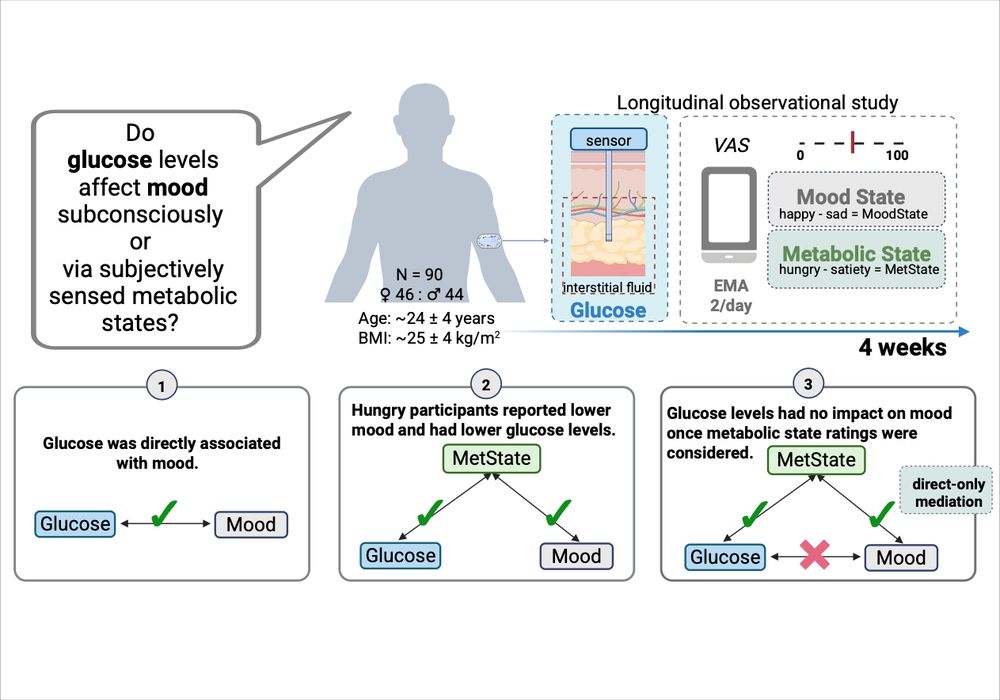
A graphical abstract showing the research question and the operationalization of the study.
Out now in @ebiomedicine.bsky.social 🚨.
Hunger often affects our mood, but is this a conscious or a subconscious process? Using continuous glucose monitoring, we show that differences in mood are driven by hunger ratings, not just glucose. #neuroskyence 🩺
www.thelancet.com/journals/EBI...
08.12.2025 13:32 — 👍 67 🔁 21 💬 1 📌 1

An obviously AI-generated figure with AI slop and fake text all over it, recently published in Scientific Reports.
Since AI slop is again all over Scientific Reports, a thread on the economics of grey-zone publishing.
Why does slop keep getting published? What does it mean for science? How can we stop this?
Background readings:
Understand the strain: tinyurl.com/2b6wxx5r
Stop the drain: tinyurl.com/3jfscscy
30.11.2025 11:09 — 👍 109 🔁 72 💬 4 📌 11

Exemplary analysis pipeline for respiratory data
'Robust circular cluster-based statistics
for respiration-brain coupling'
New preprint, and what a way to welcome @teresaberther.bsky.social to the #neuroskyence community. With @eliobalestrieri.bsky.social, she developed CBPT for circular #bodybrain analyses.
Paper: osf.io/preprints/ps...
🧵🔽
26.11.2025 15:15 — 👍 49 🔁 16 💬 2 📌 2
** Recruiting a postdoc ** We are looking for a postdoc to work on emotion, mental health, and interoception, based in London at @ucl.ac.uk in my lab (Clinical and Affective Neuroscience). Part of a large Wellcome Grant (co-led with the brilliant @camillanord.bsky.social)
24.11.2025 12:22 — 👍 86 🔁 88 💬 1 📌 1
OSF
🚨 Preprint alert: Do 1) smartphone event log data access and 2) the Experience Sampling Method cause reactivity effects in studies? @dougaparry.bsky.social, @klingelhoefer.bsky.social, and I investigated this very question using data from 815 German Android users.
doi.org/10.31235/osf...
17.11.2025 10:09 — 👍 17 🔁 5 💬 1 📌 0

Top: Experimental set up. Single pulses of TMS were applied to the hand area of the right primary motor cortex with an inter-pulse interval randomized between 6 and 10 s. Simultaneously, the neuronavigated coil position (yellow), electrocardiogram (red), respiratory signal (blue), electrogastrogram (green), and electromyography from the left hand (gray) were recorded. The figure shows traces of a 20-s time segment from one participant of the cardiac (raw), respiratory (filtered), gastric (filtered), and EMG (raw) signals. The experimental measure was the Motor Evoked Potential amplitude measured on a hand muscle (first dorsal interosseous), analyzed against the phase of the cardiac, respiratory, and gastric rhythms. Note that the three rhythms have very different periods (~1 s for the heart, ~ 5 s for respiration, and ~20 s for the gastric rhythm). Bottom: Artwork illustrating how rhythms of the internal organs interact with the moment-to-moment fluctuations observed in corticospinal motor excitability. Image depicts an outline of a brain with representations of the three rhythmic organs influencing the motor system: the heart, lungs, and stomach. Image credit: Tahnée Engelen.
How do internal bodily rhythms influence #brain activity & motor function? @tahnee-engelen.bsky.social &co show that #cardiac, #respiratory & #gastric rhythms independently modulate motor excitability, revealing distinct #interoceptive profiles across individuals @plosbiology.org 🧪 plos.io/4nMtpLT
13.11.2025 10:17 — 👍 36 🔁 21 💬 3 📌 2
The German Society for Neurogastroenterology & Motility is a scientific society dedicated to advancing research and knowledge in the fields of neurogastroenterology and gastrointestinal motility. #neurogastro
🌐 www.neurogastro.de
Postdoc & Clinical Psychologist @unimarburg.bsky.social & @SFB-TRR-289.bsky.social
Coordinator of the German Addiction Association - ECR network.
Interested in placebo effects, drugs & clinical psychology. All views my own.
Arguing is a game that two can play at. But it is a strange game in that neither opponent ever wins. Identfies as a two-headed penguin. 🐧 🐧
@gruene.de
#Paderborn
Softwareentwickler
Data Science, Chemie, Meteorologie, Physik
Zahlen, Daten, Fakten.
https://montags-gedanken.jimdofree.com/
Mit Hund und Kindern, KJP
Neuroscientist @hhu.bsky.social
MEG❤️ EEG🧠 DBS👍NIBS 🇩🇪🇨🇳🇬🇧🇪🇺
https://scholar.google.cl/citations?user=lDcTaeEAAAAJ&hl=en
Juan C. Castro-Alonso. Rewarded hubby & daddy. Educational psychology, multimedia, STEM, biochemistry, spatial working memory. Asst. Professor at University of Birmingham (UK), Author, Speaker, Editor, Consultant
Professor Vrije Universiteit Amsterdam, Director Institute Brain and Behavior Amsterdam, human brain and mind, attention, predictive processing, action, consciousness, meditation
www.heleenslagter.com
📍FutureNeuro MSCA Researcher at RCSI, Dublin
Formely Penn Medicine 🇺🇸 ☘️, University of Limerick 🇮🇪
Corkonian📍
Researching #circadianrhythms, #bipolardisorder, #aging, #metabolism #cardiometabolicdisease, #nutrition & #exercise
@pintofscienceie Co-Director 🍻
computational cognitive scientist @tuebingen
lenarddome.github.io
Postdoctoral researcher at UGent ~ metacognition & decision-making, interoception, brain-body interaction, health and sports 🧠🫀🏃♀️
2nd year computational neuro PhD student at Boston University (advisors Cynthia Bradham & Gabe Ocker)
Mathematically modeling embryonic neurodevelopment
I write trippy scifi & mathfiction.
Ignyte Award Finalist 2025
6 stories in Clarkesworld
RA @Yalepsychology @Miamiuniversity | intern @iitroorkee | Interested in Affective Psychopathology, Stress and Cross-Culture🧠
https://sahooabhigyan291.wixsite.com/my-site-1
Neuroscience PhD candidate at the University of Pennsylvania and sci-comm enthusiast interested in brains 🧠 and models of them 💻.
Website: catrinahacker.com
Gender Scholar
Interests: (a)sexualities, health communication, masculinities, contraception/safer sex, repro health, climate crisis, IR, peace/conflict studies, utopias/dystopias, mental health, media, history,...
https://orcid.org/0009-0009-7802-2721
Hi there! We are an EU H2020 project (945263) aimed at implementing ESM/EMA tools into mental health care
https://www.immerse-project.eu/
Postdoc in social and decision neuroscience @Caltech, interested in habits, decision making, associative learning and mood
🧠 PhD cand @ Vandy | Raising visibility of femme and diversity in STEM/Academia | Views=Own | Winder Lab @ UMass Med | IG: femme_in_stem #teaminsula 🏳️🌈
linktr.ee/danielleadank