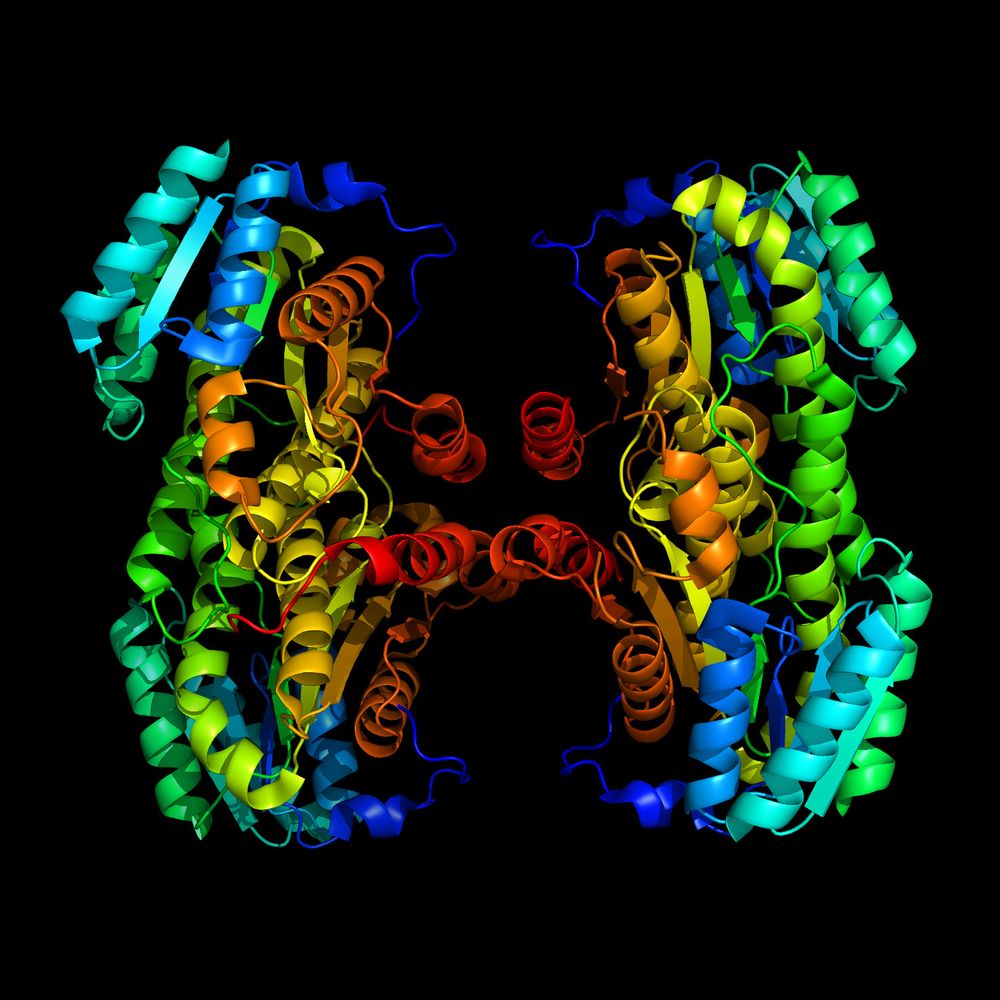
A particular shout-out once more to @atsocf.bsky.social from the @alexbateman1.bsky.social lab at @ebi.embl.org - this paper wouldn't be possible without his significant computational work. If you want to use Francesco's isopeptide-scanning tool, #Isopeptor , check it out here:
bit.ly/4rebh0r
22.11.2025 05:40 — 👍 2 🔁 0 💬 0 📌 0
Overjoyed to finally have our isopeptide bond paper out! If you're interested in the types of proteins and organisms that use a cool intramolecular covalent bond, check it out:
bit.ly/4od3ux8
Plenty of future SynBio/EngBio applications planned! Thanks to all involved (character limits suck).
22.11.2025 05:33 — 👍 4 🔁 2 💬 1 📌 0
... and also former colleagues (and now collaborators!), Delhi Kalwan, Jennifer de Jong, Fabio Parmeggiani and Paul Race.
29.04.2025 14:02 — 👍 0 🔁 0 💬 0 📌 0
I should thank my @ebi.embl.org collaborators @atsocf.bsky.social, Ioannis Riziotis (Crick), Antonina Andreeva, and @alexbateman1.bsky.social for their help with this project! Thanks also to my colleagues at @bristoluni.bsky.social, Phil Hinchliffe and Steve Burston...
29.04.2025 14:00 — 👍 1 🔁 0 💬 1 📌 0
13. At any rate if you're interested in the stalks of fibrillar adhesins/pili, give it a read. If you like covalent bonds that aren't your usual disulphide bridge, you might also get a kick out of it.
29.04.2025 13:44 — 👍 0 🔁 0 💬 0 📌 0
12. It's unclear whether the aromatic caps are there because they're important for domain stability, or whether they might play a role in bond formation. We think the waters may represent a water channel that enables the escape of byproducts of bond formation, as noted by other researchers.
29.04.2025 13:42 — 👍 0 🔁 0 💬 1 📌 0
11. We (painstakingly) collated a list of all known PDB depositions containing intramolecular isopeptide bonds and characterised the environment surrounding the bonds. The nearby aromatic residue (which we term the aromatic cap) appears to be a common feature, as does the proximal water.
29.04.2025 13:39 — 👍 0 🔁 0 💬 1 📌 0
10. We also wanted to see if we can tease out notable features of the environment around the bonds. Previous researchers have noted that these bonds like to form in hydrophobic cores, sometimes nearby an aromatic and a water molecule deep within the cores of globular domains.
29.04.2025 13:36 — 👍 0 🔁 0 💬 1 📌 0
8. We also collated a list of domain families containing intramolecular isopeptide bonds, and even managed to expand the list of families known to contain these bonds (shoutout to Antonina Andreeva). They're found in three superfamilies, representing two types of fold, CnaA-like and CnaB-like.
29.04.2025 13:31 — 👍 0 🔁 0 💬 1 📌 0
7. We rename it CLIPPER (Cross-Linked IsoPeptide Protein of the Extracellular Region). It's found in the stalks of loads of adhesins used by bacteria and archaea. We think it helps microbes adhere under harsh conditions, which is what others have suggested in previous work.
29.04.2025 13:27 — 👍 0 🔁 0 💬 1 📌 0
6. One domain containing these bonds is super widely distributed, it's called DUF11 (domain of unknown function 11). We thought it was worth structurally resolving it, and characterising it in the lab. It's got an isopeptide bond, and also a cool CTTC tetrapeptide disulphide motif.
29.04.2025 13:25 — 👍 0 🔁 0 💬 1 📌 0
5. Turns out, they're REALLY widely utilised by microbes, including Gram-positive bacteria, Gram-negative bacteria, and archaea. They're mainly in cell-surface proteins that enable binding to hosts (notably fibrillar adhesins and pili). Load of these organisms are pretty notable pathogens too.
29.04.2025 13:22 — 👍 0 🔁 0 💬 1 📌 0
4. Fortunately some great people at @ebi.embl.org agreed to help me survey these bonds, to identify key features of the domains that house them, and mapped their distribution in Nature. @atsocf.bsky.social created a really neat tool that can search for isopeptide bonds, and applied it to the AFDB.
29.04.2025 13:20 — 👍 0 🔁 0 💬 1 📌 0
3. One type of domain that utilises intramolecular isopeptide bonds even acts as a mini shock-absorber, which dissipates mechanical energy when tugged, and is thought to be a way to resist mechanical unfolding. It's a neat class of covalent bond, but it's unclear how distributed they are in nature.
29.04.2025 13:17 — 👍 0 🔁 0 💬 1 📌 0
2. If you're interested, intramolecular isopeptide bonds are a subclass of covalent bonds that cross-link two different parts of the same polypeptide chain. Interestingly, domains that contain them typically very thermostable and are exceptionally resistant to proteolysis.
29.04.2025 13:13 — 👍 1 🔁 0 💬 1 📌 0

A global survey of intramolecular isopeptide bonds
Many protein domains harbour covalent intramolecular bonds that enhance their stability and resistance to thermal, mechanical and proteolytic insults. Intramolecular isopeptide bonds represent one suc...
Happy to say that I have a preprint out! This one is a big step as it's my first last author paper. It focusses on assessing the distribution and key characteristics of intramolecular isopeptide bonds in nature, thanks to a really great collaborative effort:
www.biorxiv.org/content/10.1...
29.04.2025 13:10 — 👍 6 🔁 2 💬 2 📌 1
A great opportunity with two great people!
01.02.2025 20:46 — 👍 1 🔁 0 💬 0 📌 0
Professor of Oral Microbiology at Newcastle University, UK and Editor-in-Chief of the Journal of Dental Research
Mark Howarth research group at University of Cambridge Department of Pharmacology: Innovating Protein Technologies for Therapeutics and Vaccine Design. www.howarthgroup.org
MRC-LMB #cryoET #biofilms #S-layers #antibiotics
https://www2.mrc-lmb.cam.ac.uk/groups/bharat/
PhD Student in the Bharat Lab at the MRC LMB
Microbiologist @UniofYork. Former EiC of @MicrobioSoc
#MicrobioJ. Transporters, Staph, BO & skin microbiome. CSO
@morfdb.bsky.social York Knavesmire Harrier & EBOR orienteer.
Research Scientist at the Quadram Institute in Norwich, UK.
Group leader, Royal Society Industry Fellow,
proteins, RNA, biotechnology, structural biology, biophysics, protein engineering, scaffolds, biosensing, nanopores, etc
University of (Olde) York, UK 🇬🇧🇨🇦🇫🇷🇪🇺
LinkedIn: mjplevin
Structural Biologist at the University of St Andrews. Host:pathogen interactions. Gram-positive bacteria (mainly Streptococcus pyogenes) and Rift Valley fever phlebovirus. cryoEM (novice), NMR (veteran), XRC.
Associate Professor in Molecular Microbiology, Univ Bristol; Study how microbes (esp. streptococci) stick to us, to each other + their effects on health and disease
Deputy Dean of the Faculty of Medicine @UmeaUniversity, Professor. Type 4 Secretion Systems #T4SS. Chair of SFBBM (www.sfbbm.se). Science policy. Views my own. https://www.biostruct.umu.se/principal-investigators/ronnie-berntsson/
Biochemistry, cryo-EM, crystallography, dabbling in microED, biophysics, modelling; always up for coffee! Uni of Adelaide for the moment.
Head of Protein Sequence Resources at EMBL-EBI.
official Bluesky account (check username👆)
Bugs, feature requests, feedback: support@bsky.app