Thrilled to share that I’ve been awarded funding to lead my own research project looking into the association between eating disorders (ED) and PCOS! Grateful to @medresfdn.bsky.social for supporting this work and further important ED research. Very much looking forward to the journey ahead!
05.06.2025 10:21 — 👍 11 🔁 4 💬 2 📌 0
I’m thrilled to have received a Launchpad Grant from @medresfdn.bsky.social
This award will enable me to investigate an important relationship between loneliness and eating disorders in young people. Huge thanks to the Medical Research Foundation for supporting this work!
05.06.2025 17:11 — 👍 5 🔁 2 💬 1 📌 0

The @freedfromed.bsky.social team want to hear from you!
What is most important in #earlyintervention for #eatingdisorders?
Those with lived experience, families, clinicians, researchers, anyone involved is welcome to take part.
Take the short survey here: qualtrics.kcl.ac.uk/jfe/form/SV_...
27.05.2025 09:41 — 👍 1 🔁 2 💬 0 📌 0
Watch our participant information video here: youtube.com/watch?v=Gve-...
And email amelia.1.hemmings@kcl.ac.uk to find out more and take part! 🧠
28.02.2025 09:49 — 👍 1 🔁 0 💬 0 📌 0

Have you had treatment for anorexia that has not helped you recover fully?
RaISE is recruiting those aged 13-30, with a current diagnosis of anorexia and who have had at least one previous course of treatment that has not resulted in full and long-lasting recovery.
28.02.2025 09:49 — 👍 1 🔁 0 💬 1 📌 0

For day 5 of #EatingDisordersAwarenessWeek, we're sharing work from EDIFY WS 5!
We have reached 50% of our recruitment target for the RaISE trial of non-invasive neuromodulation for anorexia 🧠
We are still recruiting!
To find out more, contact amelia.1.hemmings@kcl.ac.uk
28.02.2025 09:49 — 👍 3 🔁 2 💬 1 📌 0
@kingsedresearch.bsky.social @kingsioppn.bsky.social @nihrmaudsleybrc.bsky.social @drhelensharpe.bsky.social
27.02.2025 12:55 — 👍 0 🔁 0 💬 0 📌 0
YouTube video by EDIFY research
The STORY study: Participant information and recruitment
You can find out more about the study by watching our recruitment video or visit the EDIFY website: tinyurl.com/WeWantToHear...
youtu.be/gRyVHnKYw4Y?...
27.02.2025 12:55 — 👍 1 🔁 2 💬 1 📌 0

A study poster with bright colours and shapes, with two people exchanging books in the bottom right corner.
The text reads:
"We want to hear your STORY! Join the STORY study!
Are you... between 16-25 years, and have an eating disorder, or have no eating disorder or major mental health diagnoses?
The STORY study is a one-year long study to explore the diverse experiences of young people with eating disorders and how they recover from them.
Interested? Contact us under: STORY@kcl.ac.uk"
For day 4 of #EatingDisordersAwarenessWeek, we're sharing work from EDIFY Workstreams 3/4!
These Workstreams are focused on understanding how young people recover from their eating disorder and how their eating disorder changes over time. As such, we are recruiting for STORY.
27.02.2025 12:55 — 👍 2 🔁 3 💬 1 📌 0
EDIFY - shaping a fresh approach to eating disorders
EDIFY works directly with young people with eating disorders to map the diverse routes into and out of illness.
Day 3 of #EDAW updates! We are delighted to highlight EDIFY today which is co-led by @drhelensharpe.bsky.social . @edifyresearch.bsky.social is a 4 year programme of research focused on how we understand and treat eating disorders in young people. Www.edifyresearch.co.uk
26.02.2025 07:47 — 👍 6 🔁 2 💬 1 📌 0
@ntrompeter.bsky.social @drhelensharpe.bsky.social
@kingsedresearch.bsky.social @kingsioppn.bsky.social
@nihrmaudsleybrc.bsky.social
26.02.2025 08:29 — 👍 1 🔁 0 💬 0 📌 0
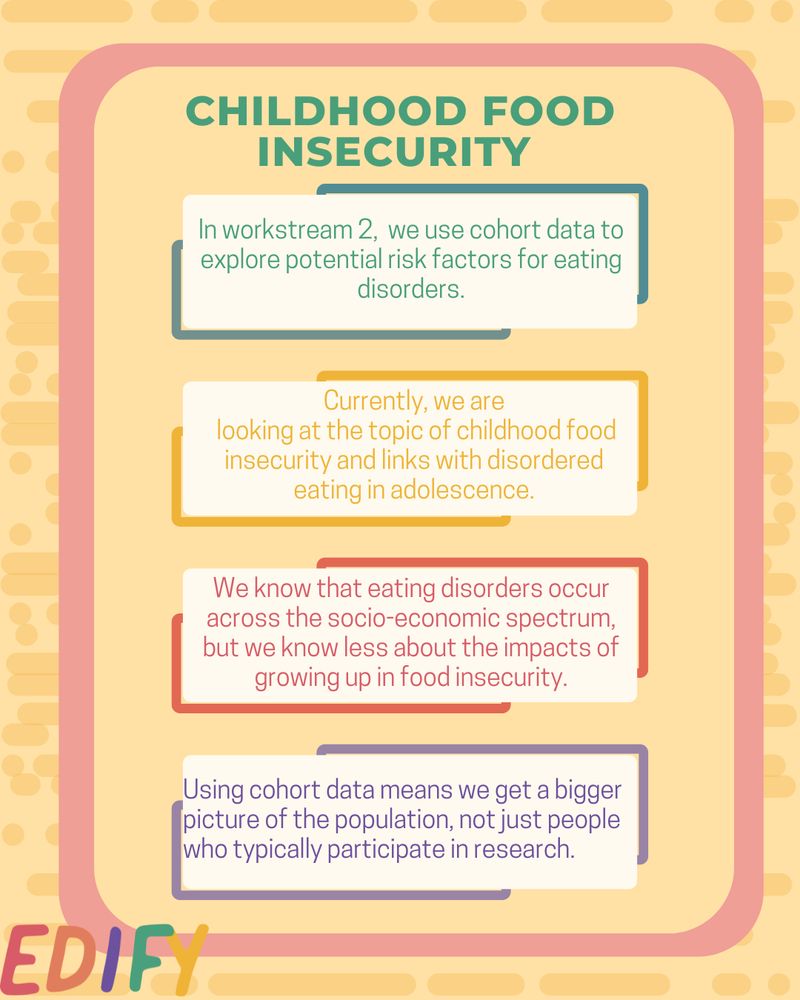
An infographic featuring four boxes arranged in a grid layout. Each box contains distinct text:
Box 1: In workstream 2, we use cohort data to explore potential risk factors for eating disorders.
Box 2: Currently, we are looking at the topic of childhood food insecurity and links with disordered eating in adolescence.
Box 3: We know that eating disorders occur across the socio-economic spectrum, but we know less about the impacts of growing up in food insecurity.
Box 4: Using cohort data means we get a bigger picture of the population, not just people who typically participate in research.
For day 3 of #EatingDisordersAwarenessWeek, we’re sharing work from EDIFY Workstream 2!
This workstream uses large cohort data to explore the interplay of risk and protective factors for eating disorders, including unique and shared pathways in different groups.
26.02.2025 08:29 — 👍 2 🔁 3 💬 1 📌 0
@kingsioppn.bsky.social @nihrmaudsleybrc.bsky.social
26.02.2025 08:23 — 👍 0 🔁 0 💬 0 📌 0
This workstream uses large cohort data to explore the interplay of risk and protective factors for eating disorders, including unique and shared pathways in different groups.
@tineopitz.bsky.social @drhelensharpe.bsky.social @kingsedresearch.bsky.social
26.02.2025 08:23 — 👍 0 🔁 0 💬 1 📌 0

This visual abstract describes key findings of a recent study conducted by researchers of the EDIFY team on the relationship between sleep and disordered eating. As part of this graphic, it is outlined that about one in four young people experience sleep problems. Furthermore, the graphic states that sleep and disordered eating can be linked through a variety of factors including disturbed mood. Based on information provided by more than 6,000 young people in the UK, we investigated if sleep and disordered eating are associated across time. Within our study, we found that sleep (as assessed at age 14) did not predict disordered eating at age 17. However, we found that disordered eating (as assessed at age 14) did predict poorer sleep quality at age 17 through depressive symptoms. We conclude that more research is needed to explore the relationship between sleep and different forms of disordered eating.
For day 3 of #EatingDisordersAwarenessWeek, we’re sharing work from EDIFY Workstream 2!
26.02.2025 08:23 — 👍 1 🔁 1 💬 1 📌 0
This workstream explores how young people experience and understand eating disorders, particularly focusing on those who feel unrepresented in the current ED narrative—co-creating their own stories, their way.
25.02.2025 10:37 — 👍 0 🔁 0 💬 0 📌 0
@kingsedresearch.bsky.social @kingsioppn.bsky.social @nihrmaudsleybrc.bsky.social
25.02.2025 10:36 — 👍 0 🔁 0 💬 0 📌 0

A digital poster from EDIFY and the University of Nottingham. The title reads “Workstream 1 update.” The text explains that researchers are studying how young people with lived experience of eating disorders discuss ED content on TikTok. The study also explores how the platform’s algorithm may create "echo chambers" that expose vulnerable users to more ED content. The poster features illustrations of three young people using smartphones. The University of Nottingham logo is in the top right corner.
For day 2 of #EatingDisordersAwarenessWeek, we’re sharing an update on EDIFY Workstream 1 from the University of Nottingham. @tamsinparnell.bsky.social
25.02.2025 10:36 — 👍 2 🔁 2 💬 2 📌 0
@kingsedresearch.bsky.social @eatingresearch.bsky.social @edresearch.bsky.social @basakince.bsky.social @kingsioppn.bsky.social
24.02.2025 11:21 — 👍 0 🔁 0 💬 0 📌 0
YouTube video by EDIFY research
Food Insecurity in Eating Disorders: A Short Animation
📣This #edaw2025, we wanted to share a recent animation we made with Woven Ink on food insecurity in people with eating disorders.
www.youtube.com/watch?v=lMhU...
24.02.2025 11:21 — 👍 4 🔁 5 💬 2 📌 1


📣Have you had treatment for anorexia that has not helped you recover fully?
Check out RaISE, a trial of non-invasive brain stimulation!
Participants receive 20 sessions of iTBS, £50 and can see a picture of their brain📷🧠
Email amelia.1.hemmings@kcl.ac.uk for more info!
27.01.2025 14:06 — 👍 0 🔁 0 💬 0 📌 0

Recruitment poster for a study looking at experience of help seeking for eating disorder care. text read: Are you aged 16 years or over? Do you have a current or past eating disorder? Do you identify as being part of any of the following groups? ethnic minority, men, LGBTQ+? We want to speak with people who are not well represented in services about their experience seeking help for an eating disorder. we want to improve access to eating disorder care and the treatments people are offered. you would need to complete a short survey about yourself and take part in an interview lasting up to an hour. If you would like to be involved contact jessica.wilkins@kcl.ac.uk
📢Call for participants 📢 We want to improve access to #eatingdisorder care!
If you identify as an underrepresented group in ED research, we would really like to hear about your experience of ED help seeking!
Contact jessica.wilkins@kcl.ac.uk to find out more and take part.
16.01.2025 12:02 — 👍 5 🔁 5 💬 0 📌 0
Redirecting
📢 Read the Estra team's new paper! Machine learning models for diagnosis and risk prediction in eating disorders, depression, and alcohol use disorder
doi.org/10.1016/j.ja... 🧠
02.01.2025 10:30 — 👍 3 🔁 1 💬 0 📌 0
Formed by The Medical Research Council (MRC), we're dedicated to advancing medical research, improving human health and changing people's lives.
https://www.medicalresearchfoundation.org.uk/
Communications Manager for the Medical Research Foundation @medresfdn.bsky.social
All views my own!
Globally renowned institute for research excellence and education in #Psychiatry, #Psychology, & #Neuroscience based at @kingscollegelondon.bsky.social
www.kcl.ac.uk/ioppn
Consultant Clinical Psychologist & Adjunct Reader | Eating disorders service, South London & Maudsley NHS Foundation Trust | IoPPN, King's College London
She/her. Views my own.
https://www.kcl.ac.uk/research/eating-disorders-clinical-research-networ
Consultant Clinical Psychologist & Adjunct Senior Lecturer | South London and Maudsley | Great Ormond Street Hospital | King’s College London. Views own.
Prof Psychiatric Genetics KCL. Lead King's Genomics facility, Genetic Links to Anxiety and Depression (GLAD) Study, and the UK Eating Disorders Genetics Initiative (EDGI-UK). Gratitude to my wonderful research group, staff, and collaborators.
Mental health writer, researcher, patient. Professionally & pathologically flexible. Creative arts. Practicing courage, creativity, and compassion.
Eating Disorders Therapist
National Co-Lead for FREED
Professor/Director @uofleatlab; #EatingDisorder Researcher & Therapist, creating new treatments for eating disorders, mom of 3 girls, fighting back against #weightstigma to save lives
PhD Candidate in Psychological Medicine at @kingsedresearch.bsky.social, researching eating disorder clinicians' experiences in the NHS.
Through research we’re creating a future where mental illnesses are understood, effectively treated and one day even prevented. #WithoutResearchItsJustGuesswork
Join the world’s largest study on #anxiety and #depression today: gladstudy.org.uk
Together, we can better understand eating disorders. Join us via edgiuk.org
🌤️ Hello, I’m the Mental Elf!
🌳 Follow me to keep up to date with the latest reliable #MentalHealthResearch.
👩🏽💻 #WorldBipolarDay webinar on March 30th
🍄 Do you need some #ElfHelp? https://elfi.sh/help
🔗 https://linktr.ee/thementalelf
We are part of the National Institute for Health and Care Research and hosted by South London and Maudsley NHS Foundation Trust in partnership with King's College London. www.maudsleybrc.nihr.ac.uk #mentalhealth
Weekly interview series with Kathy Pike, PhD and eating disorder expert clinicians, researchers, and people with lived experience
www.BigIdeasInEatingDisorders.com
A Wiley journal for cutting-edge research on eating disorders curated by the social media committee of IJED. https://onlinelibrary.wiley.com/journal/1098108x
Senior Lecturer researching eating disorders with fab team at @eatingresearch.bsky.social | University of Edinburgh
Research group based at Edinburgh University interested in the understanding and treatment of eating disorders and body image
National Institute for Health and Care Research - we fund, enable and deliver world-leading health and social care research that improves people's health and wellbeing, and promotes economic growth.
Impact, Innovation, Investment, Inclusion