Excited to share our new paper and lipid- and protein-directed photocatalytic labeling method (POCA) just out in @natchembio.nature.com. tinyurl.com/2kcxuvvv. Big congrats to first author Andrew Becker and the whole team for launching our lab into the wild world of singlet oxygen interactomics.
06.02.2026 20:18 — 👍 48 🔁 19 💬 1 📌 0
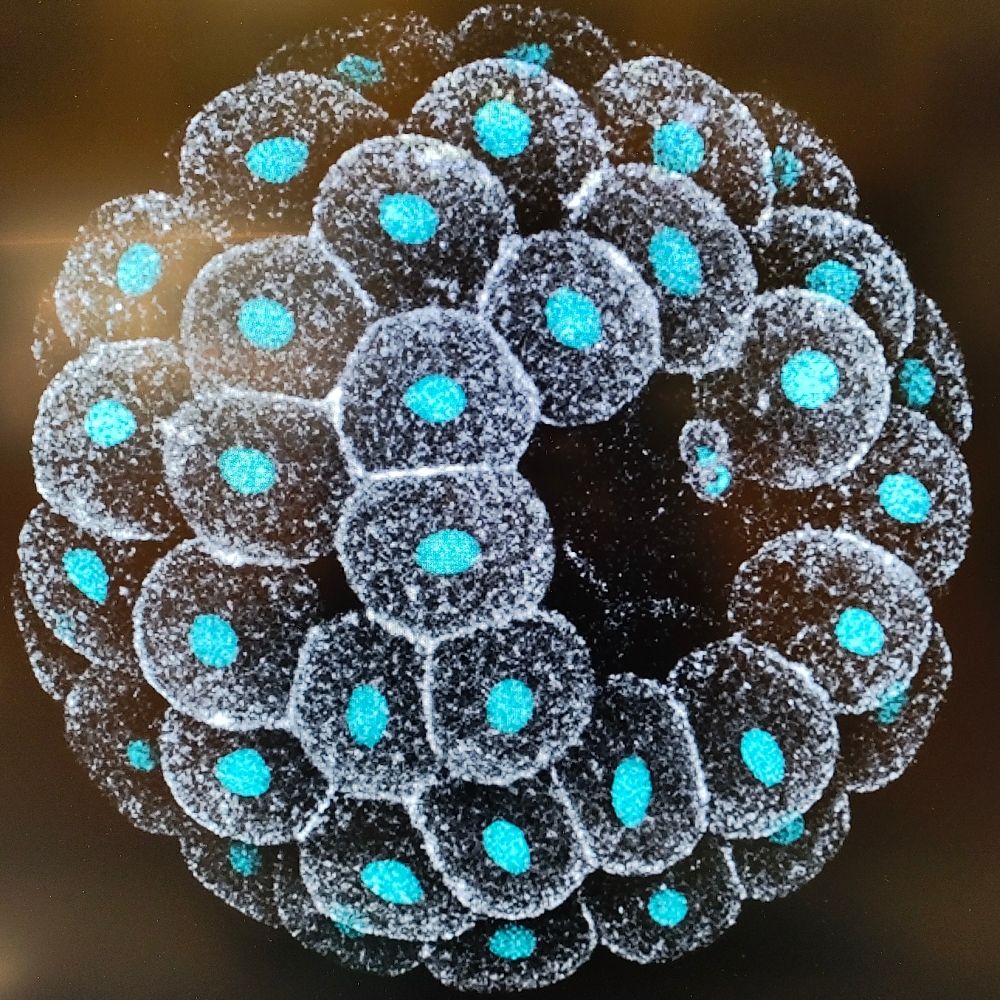
Really excited to share our new paper in @nature.com! We uncovered how a physical instability of the cytoplasm coupled with the cell cycle drives cytoplasmic partitioning in early embryos #zebrafish #drosophila. Read more in this🧵 www.nature.com/articles/s41... 🤩
@poldresden.bsky.social @mpi-cbg.de
28.01.2026 16:10 — 👍 173 🔁 51 💬 3 📌 8
We’re excited to share our latest preprint on the mechanism of excised linear intron stabilization in yeast! This work was led by PhD student @glennli.bsky.social and was a wonderful collaboration with @maxewilkinson.bsky.social. Link: www.biorxiv.org/content/10.6... (1/4)
23.01.2026 16:14 — 👍 58 🔁 25 💬 1 📌 2
Talk about efficient packing! Those little black dots are nucleosomes in the most detailed look yet at how chromatin condenses. That and more of the best in @science.org and science in this edition of #ScienceAdviser: www.science.org/content/arti... 🧪
09.12.2025 22:19 — 👍 64 🔁 9 💬 0 📌 0
Excited to share our latest fully in-house paper! 🎉
We show how cohesin integrates loop extrusion with sister tethering to guide the homology search during DNA repair.
Huge congratulations to all authors, and to @fedeteloni.bsky.social for leading this work 👏
We’re excited to see his next steps!
05.12.2025 07:46 — 👍 40 🔁 13 💬 2 📌 1
Our Science paper is out!
Huge congratulations to @huabin-zhou.bsky.social, Mike Rosen, and the brilliant @janhuemar.bsky.social @juliamaristany.bsky.social and @kieran-russell.bsky.social from our group
News: bit.ly/4avnkAr and bit.ly/3XBGVHS
Great perspective by @vram142.bsky.social +K Zhang
05.12.2025 09:47 — 👍 87 🔁 41 💬 2 📌 1
Super excited to share that our paper is now out in @science.org. Lots of work, but also lots of fun getting this out.
Be sure to check it out!
www.science.org/doi/10.1126/...
Also, follow:
@huabin-zhou.bsky.social @juliamaristany.bsky.social @kieran-russell.bsky.social @rcollepardo.bsky.social
04.12.2025 22:15 — 👍 46 🔁 11 💬 0 📌 2

Anthony A. Hyman will become EMBL’s next Director General.
He joins EMBL from @mpi-cbg.de in Dresden. He is also Professor of Molecular Biology @tudresden.bsky.social, and was a group leader at EMBL Heidelberg from 1993 to 1999.
www.embl.org/news/people-...
27.11.2025 13:02 — 👍 253 🔁 67 💬 11 📌 11
Still posting cytoskeleton videos, it seems. Actin this time.
Sample: Lifeact-eGFP in HeLa cells.
Modality: Airyscan confocal
Timestamp is mm:ss and the scale bar is 5 µm.
23.11.2025 03:21 — 👍 231 🔁 36 💬 14 📌 4
Key transcripts encoded centrin-like proteins, a frequent component of sensory/contractile structures in protists. We visualized tentacle ultrastructure by U-ExM with @dudinlab.bsky.social lab, discovering stunning tip and collar structures 🤯that add structural complexity to new tentacle formation.
18.11.2025 16:15 — 👍 24 🔁 8 💬 1 📌 1
Cellular structure self-organizes through an interplay between internal mechanisms and external cues. The single-celled suctorian P. collini builds a trap structure to capture large prey using microtubule feeding tentacles, creating feedback between cell morphology and prey availability.
18.11.2025 16:15 — 👍 91 🔁 22 💬 2 📌 14
Finally – there are many mysteries to still resolve for these cells. From dramatic metamorphic capabilities🤯 to prey preference and detection mechanisms 🕵️. For anyone interested in collaborating or getting their hands on these cells, these fantastic beasts culture well and we’re happy to share!
18.11.2025 16:15 — 👍 14 🔁 4 💬 0 📌 0
How do cells adapt morphology to function? In a 🔥 preprint by @zjmaggiexu.bsky.social , with @dudinlab.bsky.social and @amyweeks.bsky.social , we identify a self-organizing single-cell morphology circuit that optimizes the feeding trap structure of the suctorian P. collini. 🧵 tinyurl.com/4k8nv926
18.11.2025 16:15 — 👍 131 🔁 55 💬 4 📌 11
Thrilled to share our work on the 🔥 single-celled predator Podophrya collini, which rewires its cell morphology to hunt more efficiently. Huge thanks to our amazing team—Amy, Lauren, Omaya, Marine, Mari, and especially Scott—for making this shine! ✨
18.11.2025 17:12 — 👍 29 🔁 13 💬 1 📌 0
Very excited to present OpenCGChromatin🔥🔥🔥
A new coarse-grained model that probes full chromatin condensates at near-atomistic resolution to reveal the molecular regulation of chromatin structure and phase separation
Brilliantly led by @kieran-russell.bsky.social, with the Rosen and Orozco groups
18.11.2025 15:07 — 👍 48 🔁 15 💬 2 📌 1
Big congrats, Qixiang! Super cool study 🎉
10.11.2025 03:25 — 👍 0 🔁 0 💬 1 📌 0
Congratulations to all authors! Happy to have contributed to the cryo-EM side. It was a lot of fun learning more about the herpesvirus DNA replication process and how clinical drugs inhibit it 🦠💊. Big thanks to @cijilim.bsky.social and Tahir for the support!
10.11.2025 02:49 — 👍 10 🔁 2 💬 1 📌 0
Congrats CJ and all authors!! 🎉
31.10.2025 00:40 — 👍 1 🔁 0 💬 1 📌 0

Lab’s first paper is out!! We show the first structures of #Asgard #chromatin by #cryo-EM 🧬❄️
Asgard histones form closed and open hypernucleosomes. Closed are conserved across #Archaea, while open resemble eukaryotic H3–H4 octasomes and are Asgard-specific. More here: www.cell.com/molecular-ce...
28.10.2025 15:07 — 👍 331 🔁 115 💬 6 📌 9
Check out our new work, led by talented @janhuemar.bsky.social, where we uncover that pioneer factor Oct4 remodels chromatin for DNA access not by opening it but by exploiting nucleosome breathing and forming clusters 🔥🔥🔥
22.10.2025 05:10 — 👍 11 🔁 9 💬 0 📌 0

A mechanism for Oct4 binding to closed chromatin. We hypothesize that the sampling of inaccessible regions of the genome might be aided by the formation of clusters that grow bigger in the presence of chromatin, facilitating the finding of specific target genes in cellular reprogramming.
We propose that the reshaping of chromatin and the binding in a cluster-like manner can be one of the solutions to the so-called search problem. We hypothesize that this binding in high concentrations of Oct4 might be key to explaining how silenced genes are activated in cellular reprogramming.
21.10.2025 09:58 — 👍 3 🔁 1 💬 1 📌 0

A rendering of multiple Oct4 molecules bound to a chromatin fibre
🚨 🚨 🚨 New preprint alert!!! 🚨 🚨 🚨
In the past, we have learnt that Oct4 can induce nucleosome breathing on the mono-nucleosome level.
But what happens when you have a fibre of multiple nucleosomes?
www.biorxiv.org/content/10.1...
@rcollepardo.bsky.social @juliamaristany.bsky.social
21.10.2025 09:58 — 👍 25 🔁 9 💬 1 📌 2

An electrostatic repulsion model of centromere organisation
During cell division, chromosomes reorganise into compact bodies in which centromeres localise precisely at the chromatin surface to enable kinetochore-microtubule interactions essential for genome se...
1/ New preprint alert!
In collaboration between the Rosen, Redding, Collepardo-Guevara & Gerlich labs, we uncover a surprising principle of chromosome organisation: electrostatic repulsion positions centromeres at the chromosome surface during mitosis.
🔗 doi.org/10.1101/2025...
03.09.2025 08:11 — 👍 67 🔁 27 💬 2 📌 2
SNSF Ambizione Project Leader
Looking at tiny frozen mitochondria with big microscopes 🔬 cryoEM/cryoET
Green organisms 🌿 & evolution 🦠
Biozentrum, hosted in the Engel Lab, CH
🇫🇷 -> 🇩🇪 -> 🇨🇭
Website: https://www.waltzresearch.com/
Research, news, and commentary from Nature, the international science journal. For daily science news, get Nature Briefing: https://go.nature.com/get-Nature-Briefing
Shared account of the Barone Lab at Hopkins Marine Station, Stanford University
One of the world’s leading comprehensive cancer centers. To make an appointment: 833-637-6698
Editor of Science’s award-winning newsletter, ScienceAdviser | journalist | author | nerd | mom (not in that order)
Assistant Professor & Chancellor Scholar
Department of Microbiology, Biochemistry and Molecular Genetics | Center for Immunity and Inflammation | Rutgers New Jersey Medical School
Host-pathogen interactions, innate immune and metabolic responses
HHMI Fellow of the Life Sciences Research Foundation and Non-stipendiary EMBO Postdoctoral Fellow
at Stanford University (Bertozzi lab)
Working for a diverse, global and multidisciplinary scientific community focused on the cell, the basic unit of all life.
IMBA - Institute of Molecular Biotechnology: a leading research institute in Europe, focusing on functional genetics, RNA biology, and stem cell research.
Postdoc fellow in the @gerlichlab.bsky.social • Genomic integrity and nuclear processes • He/him
https://orcid.org/0000-0003-0953-8010
Senior editor @science.org. Molecular biology, #DNA, #RNA, #gene regulation, #epigenetics, nuclear biology, #chromatin biology, 3D #genome, #synbio, #CRISPR and gene editing, other bacterial immune systems, and #AI in all these
Cutting-edge research, news, commentary, and visuals from the Science family of journals. https://www.science.org
Willkommen an der TUD | The Collaborative University
inventive. transformative. engaged.
🗞️ tud.de/newsportal
🎓 tud.de/sins
ℹ️ tud.de/impressum
The European Molecular Biology Laboratory drives visionary basic research and technology development in the life sciences. www.embl.org
The MRC Laboratory of Molecular Biology aims to understand biological processes at the molecular level to help tackle human health problems and disease.
Associate Professor @University of Wisconsin-Madison. Previously Harvard University & Baylor College of Medicine.
www.enginlab.org
Assistant Professor of Genetics at Stanford | centromeres, heterochromatin, and long-read sequencing | 🇺🇸🇧🇴🏳️🌈 | altemoselab.stanford.edu
Wellcome Early Career Fellow, Jansen lab, University of Oxford | Christ Church, Oxford | All things (neo)centromeres and chromatin
Discovering Mechanisms of Chromatin Inheritance at the University of Oxford www.jansenlab.org