Discover the new CAMS Methane Hotspot Explorer app! Visualise CH4 plumes and identify their sources with this cutting-edge tool developed with the Netherlands Institute for Space Research.
Read more atmosphere.copernicus.eu/cams-methane...
#CopernicusAtmosphere
24.02.2025 10:54 —
👍 32
🔁 16
💬 1
📌 1

Hard to process the devastation I’ve witnessed in the last two days. Still in a state of shock for those who have lost so much in such a short period of time. #NoWords 💔
09.01.2025 02:41 —
👍 67517
🔁 6997
💬 2661
📌 483
We're excited to announce the launch of a new virtual institute! The Decarbonization and Energy Virtual Institute (DEVI) is seeking expressions of intent for innovative, cross-disciplinary projects that address methodological gaps in energy transition modeling.
Learn more at: lnkd.in/em2J3SxM
03.12.2024 09:44 —
👍 10
🔁 2
💬 1
📌 0
LinkedIn
This link will take you to a page that’s not on LinkedIn
🧪 📍 🌊 🦑 Amazing opportunity - OceanX has opened applications for 2025 spots in our Young Explorers and Early Career Explorers programs. This is an opportunity to join us on the OceanXplorer. Application sites: lnkd.in/ga_GuwRE
26.11.2024 03:38 —
👍 44
🔁 19
💬 0
📌 0


How will climate change in your region?
The C3S Atlas allows you to explore and analyse past and future climate monitoring and change information in a flexible way.🧵
20.11.2024 12:17 —
👍 89
🔁 35
💬 2
📌 4

Are we already breaching the Paris Agreement this year?
No, but... While it is almost certain that 2024 will be more than 1.5°C above the pre-industrial level, the limit set by the Paris Agreement applies to a long-term average of at least 20 years.🧵
15.11.2024 10:24 —
👍 138
🔁 51
💬 5
📌 3
An important area of transdisciplinary research...
14.11.2024 14:43 —
👍 2
🔁 0
💬 0
📌 0
Thank you @climateofgavin.bsky.social and @hausfath.bsky.social. This needed to be said and you said it so well. (And thanks for the nod to World Weather Attribution, R2O was one of our goals.)
14.11.2024 10:40 —
👍 7
🔁 1
💬 0
📌 0
Investing in R&D has never been more critical. In the US, R&D expenditure as a share of GDP has stagnated since the mid-1960s and is below 1%. We can do better.
13.11.2024 11:06 —
👍 3
🔁 1
💬 0
📌 0
Thank you, Pierre, for this critical work to better understand and constrain the global carbon budget! 🙏 A must-read thread for anyone who cares about bending the carbon curve. We live on a dynamic and changing planet, and many of those changes result from our choices.
13.11.2024 10:33 —
👍 3
🔁 0
💬 0
📌 0

Here is why 2024 is virtually certain be the warmest year on record and first one above 1.5°C 👇
08.11.2024 07:58 —
👍 111
🔁 72
💬 1
📌 12
Honored and grateful to have raised three future service dogs. 🙏 🐾 These amazing pups bring independence, comfort, and so much joy to their future human partners. ❤️ #GuideDogs #PuppyRaiser
09.11.2024 20:36 —
👍 1
🔁 0
💬 0
📌 0
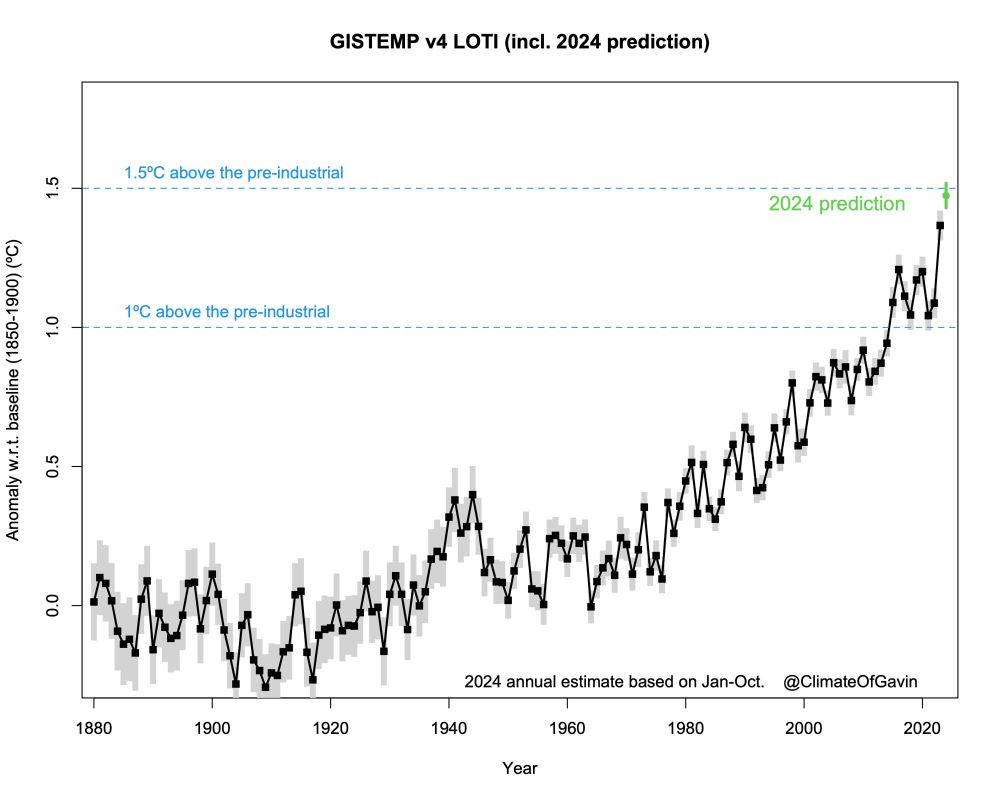
Time series from 1880 to 2023 showing steadily rising global temperatures and an estimate record for 2024.
With the October data in GISTEMP, it is almost certain that 2024 will be a new annual temperature record.
Best estimate is for 1.47°C above pre-industrial, but it could be above 1.5°C depending on the this month and next (of course).
08.11.2024 20:05 —
👍 207
🔁 95
💬 5
📌 5
The alarming slowdown of the ocean carbon pump shows why we need a global ocean health observing system. @SOCCOMProject @GO_BGC @bgc_argo data are critical to study how climate change is changing the ocean, especially the Southern Ocean.
bit.ly/3RH0yvR @ScienceMagazine
15.12.2023 16:42 —
👍 7
🔁 2
💬 1
📌 0
The SciComm Team at @mbarinews.bsky.social just posted our next 2-year Science Communication Fellowship opportunity. If you 💙 ocean science, tech, & conservation and are passionate about inclusive #SciComm, multimedia storytelling, & climate change, check it out: mbari.co/SciCommFello...
05.12.2023 15:57 —
👍 6
🔁 2
💬 0
📌 0

The new UNEP emissions gap report includes a chapter focusing on carbon dioxide removal.
It has a neat figure highlighting the feasibility, scalability, ease of MRV, environmental consequences, public perception, cost, and permanence of CDR pathways: www.unep.org/resources/em...
21.11.2023 00:43 —
👍 75
🔁 38
💬 8
📌 3

Helmet jellyfish in Kreisel tank when sediment is added, illuminated by red light.
Published today in Nat Comm: Experimental mining plumes and ocean warming trigger stress in a deep pelagic jellyfish. With Vanessa Stenvers, who also put together below video (and is not yet here) and a great team
🧪🦑🌎
rdcu.be/drFvO
21.11.2023 19:34 —
👍 14
🔁 8
💬 0
📌 0
Yes. We need to embrace our inner thalassophile. 💙🌊
22.11.2023 16:46 —
👍 1
🔁 0
💬 0
📌 0
We now have results from a modern reanalysis product (ERA5) that shows November 17th was in fact the first day the world has experienced that was 2C above the preindustrial (1850-1900) average.
Hopefully it will prove transitory, but its a worrying sign.
19.11.2023 20:59 —
👍 102
🔁 80
💬 7
📌 6

MBARI technology featured in an episode of BBC Studios Natural History Unit’s landmark series
MBARI robots and cameras allowed filmmakers to capture an intimate look at nesting deep-sea octopus for the new global series, Planet Earth III.
The Octopus Garden captured the curiosity of millions of people around the world. MBARI and its advanced deep-sea technology have helped BBC Studios Natural History Unit share the story of these deep-sea octopus moms as part of their new series, Planet Earth III.
www.mbari.org/news/mbari-t...
16.11.2023 22:23 —
👍 30
🔁 13
💬 1
📌 1
Another reason why climate & ocean scientists need to underscore that CDR - as Dave wrote in Nature - is not a climate "solution". This recent Nature commentary referred to CDR as a "scheme" - which struck me as an interesting word choice. bit.ly/3umthgh We need more thoughtful reporting like ICN!
19.11.2023 17:00 —
👍 2
🔁 0
💬 1
📌 0

Ocean-based climate interventions and their deep-sea impacts from Levin et al. 2023; DOI: 10.1126/science.ade7521.
I hope it does make it into the story. Referencing this would also be good: www.science.org/doi/10.1126/...
19.11.2023 12:00 —
👍 2
🔁 1
💬 0
📌 0
How do we balance the potential benefits of marine CO₂ removal (mCDR) against the risk of negative environmental impacts?
We need a code of conduct.
www.aspeninstitute.org/wp-content/u...
02.11.2023 21:13 —
👍 21
🔁 9
💬 1
📌 0
![Occidental to sell carbon dioxide removal credits to TD Bank
Reuters
November 1, 20232:12 PM GMT+1Updated 21 hours ago
[1/2]A sign for TD Canada Trust in Toronto, Ontario, Canada December 13, 2021. REUTERS/Carlos Osorio/File Photo Acquire Licensing Rights
Companies
Occidental Petroleum Corp
Toronto-Dominion Bank
Nov 1 (Reuters) - Occidental Petroleum (OXY.N) said on Wednesday it would sell 27,500 metric tons of direct air capture (DAC) carbon dioxide removal credits to TD Bank (TD.TO) over four years.
The credit purchase represents one of the largest DAC credit deals by a financial institution, the companies said, and TD plans to some of the credits to offset its own operational emissions.
TD will buy the credits from Occidental's carbon capture, utilization and sequestration unit 1PointFive's STRATOS, a DAC plant under construction in Texas.
The U.S. oil and gas producer is aiming to build a profitable business from providing services and technologies that pull CO2 out of t](https://cdn.bsky.app/img/feed_thumbnail/plain/did:plc:66lbtw2porscqpmair6mir37/bafkreigkbnrizloecno74fewa66qpomjhbzwif5atgpfujgr2sd43p6to4)
Occidental to sell carbon dioxide removal credits to TD Bank
Reuters
November 1, 20232:12 PM GMT+1Updated 21 hours ago
[1/2]A sign for TD Canada Trust in Toronto, Ontario, Canada December 13, 2021. REUTERS/Carlos Osorio/File Photo Acquire Licensing Rights
Companies
Occidental Petroleum Corp
Toronto-Dominion Bank
Nov 1 (Reuters) - Occidental Petroleum (OXY.N) said on Wednesday it would sell 27,500 metric tons of direct air capture (DAC) carbon dioxide removal credits to TD Bank (TD.TO) over four years.
The credit purchase represents one of the largest DAC credit deals by a financial institution, the companies said, and TD plans to some of the credits to offset its own operational emissions.
TD will buy the credits from Occidental's carbon capture, utilization and sequestration unit 1PointFive's STRATOS, a DAC plant under construction in Texas.
The U.S. oil and gas producer is aiming to build a profitable business from providing services and technologies that pull CO2 out of t

amount of financing provided by TD to various fossil projects

Best practicas
Type: Bank Top 60 Banks BOCсс х
Country
Type
Financial institutions
Projects
Expansion
Phase-ont
Arctic
Fracking
Tar sands
Canada
Bank
TD
1
0
0
A
Ultra deep water
Global Evaluation
Projects: Exclusion of financial services dedicated to oil and gas upstream projects in 1 unconventional sector (score 1).
Expansion: No commitment regarding this criterion
Phase-out: No commitment regarding this criterion
Source: Environmental and Social Credit Risk Process (2020)
Focus On Unconventional Fossil Fuels
Arctic: Exclusion of financial services dedicated to Arctic oil and gas upstream projects/Arctic definition: North of the Arctic Circle.
Fracking: No commitment regarding this criterion
Tar sands: No commitment regarding this criterion
Ultra-deep water: No commitment regarding this criterion
Recommendations
TD adopted an oil and gas policy in 2020, which only aims to exclude financial support for oil and gas upstream projects in the Arctic. The Canadian bank should now stop finan

Use the drop-down menu to explore the patterns in bank financing for fossil fuels over time and by sector. Click on any colored label on the x-axis to show or hide that data.
Total Fossil Fuel Financing
Financing across all sectors.
2016 2017 2018 2019 2020 2021 2022
Total Fossil Fuel Financing
Financing in US Dollars (B = Billions)
JPMorgan Chase
Citi
$OB $25B $50B
$75B
$1008
$1258
$1508
$1758
$200B
$2258
$2508
$2758
$300B
$3258
$350B
$3758
$400B
$4258
$450B $4
$434.15 B
Wells Fargo
Bank of America
RBC
$332.91 B
$316.70 B
$279.73 B
$249.98 B
MUFG
$219.64 B
Barclays
Mizuho
Scotiabank
$190.58 B
$189.61 B
$182.31 B
TD
$173.20 B
BNP Paribas
Morgan Stanley
$165.89 B
$153.43 B
HSBC
$144.93 B
Goldman Sachs
Bank of Montreal
SMBC Group
Bank of China
ICBC
$143.28 B
$138.38 B
$135.96 B
$134.46 B
$133.76 B
CIBC
$114.54 B
Credit Suisse
$104.62 B
One of the world's biggest fossil fuel companies is selling carbon offsets from a not-yet-operational CDR facility to TD bank, who have provided $173 billion USD in fossil financing since
10th worst fossil financer in the world
Do carbon removal companies care?
www.reuters.com/sustainabili...
02.11.2023 10:29 —
👍 17
🔁 10
💬 2
📌 0
$143 Billion...
That's the annual global price tag of extreme weather events attributed to climate change. A new study out in @NatureComms: bit.ly/45naE8y
06.10.2023 14:57 —
👍 6
🔁 2
💬 1
📌 0
As the impacts of climate change multiply, we need to scale our ability to autonomously monitor ocean health. MBARI engineers are working hard to make this happen.
26.09.2023 16:41 —
👍 3
🔁 0
💬 0
📌 0
And...Carbon Brief has been looking at carbon offsets. They mapped original media reports on the impacts of carbon-offset projects around the world. Nearly half of the reports found evidence of projects overstating their ability to cut emissions.
Worth a read: bit.ly/3ZsA3ws
26.09.2023 10:48 —
👍 2
🔁 0
💬 0
📌 0
Two complementary new climate reports:
The IEA's new NetZeroRoadmap focuses on:
- Tripling renewable capacity
- Doubling energy efficiency
- Cutting methane by 75%
More here: iea.li/3Ry8WOw
26.09.2023 10:47 —
👍 3
🔁 0
💬 0
📌 0


