OSF
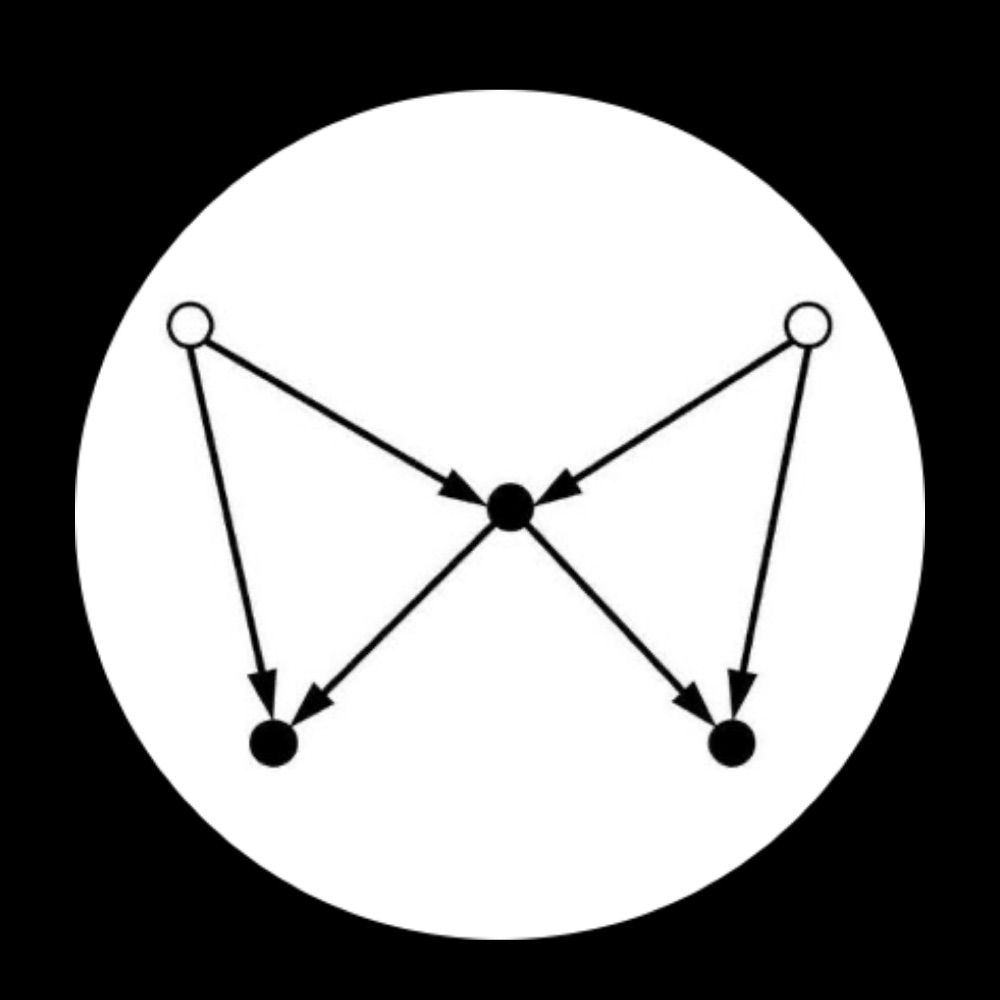
also, here is a DAG for the classical DiD by Card & Krueger (1994) osf.io/preprints/ps... Presenting it to an Econ audience, one question was, this seems not DiD bc there is no time and the interaction. Another fun claim of it: DiD can be, indeed has been used to deal with the POSITIVITY violation.
25.02.2026 01:13 — 👍 2 🔁 0 💬 1 📌 0
Lots to say on this, but one thing recently came to my mind is the isomorphism between “wide format” & “long format” for panel datasets. The latter treats time as a variable, which confuses the issue, at least conceptually. DiD with wide format is clear and here: journals.sagepub.com/doi/10.1177/...
25.02.2026 00:55 — 👍 3 🔁 4 💬 1 📌 0
that's what people think about true PS. For estimated or computed PS, different representations have been considered. One is Vs -> PS <- X, the other is just Vs -> PS. I used to think the former was right, but now I think it's the latter.
20.02.2026 06:26 — 👍 1 🔁 0 💬 0 📌 0
But I certainly agree that DAGs have weaknesses. Not everything can be explained with DAGs.
20.02.2026 06:20 — 👍 0 🔁 0 💬 0 📌 0
the coefs carry some "dependence" on A. But once the coefs are determined, PS is computed purely as a function of covariates by the coefs. DAG encodes that functional relationship, not the process by which the coef were determined. A's role in estimation doesn't justify A -> PS.
20.02.2026 06:19 — 👍 1 🔁 0 💬 1 📌 0

and it contains probably the 1st DAG representation of 2SLS, differing from Wald estimation. The 2SLS analogy was key to convincing me about the PS case. In the DAG, Cov(A-hat, Y)/Var(A-hat) = tau follows cleanly from path-tracing rules, and adding A → A-hat would break the IV identification.
19.02.2026 23:07 — 👍 3 🔁 0 💬 2 📌 1

Reconsidering the graphical representation of propensity scores in causal diagrams
I read with interest Mansournia et al.’s article ‘Balancing scores and causal diagrams’ [1]. While their effort to use directed acyclic graphs (DAGs) to il
How to draw propensity scores (PS) in DAGs? Some (me also) claim it is like "treatment -> PS <- covariates", since in order to compute PS we need both treatment and covariates. This view has confused me for so long, and now I think I was wrong. My letter here: track.smtpsendmail.com/9032119/c?p=...
19.02.2026 22:59 — 👍 18 🔁 12 💬 4 📌 0
OSF
A bit late, but you might find this interesting, osf.io/preprints/ps.... I think we have the same graph about Lord’s paradox.
26.12.2025 10:00 — 👍 1 🔁 0 💬 1 📌 0
This leads to an embarrassing thought: what I draw in my DAGs might itself be the result of a collider in some meta-DAG of the universe. I drew Sex → Weight and was so sure of the structure. But in a higher-order universe, this might itself be the result of collider conditioning.
22.10.2025 21:51 — 👍 2 🔁 0 💬 0 📌 0
What does “unconditional” really mean? P(data) seems unconditional, and P(data | boys) conditional. But imagine an alien landing on Earth and seeing P(data). It says, “Oh, so you’re conditioning on humans, not tigers.” Every “unconditional” is just conditional on a world we take for granted.
22.10.2025 15:14 — 👍 3 🔁 0 💬 1 📌 0
OSF
We’re too obsessed with decomposing direct and indirect effects in mediation. "mediation should not be understood in terms of decomposition...Once the priority of research questions is established, the practical irrelevance of statistical effect decomposition directly follows" osf.io/preprints/ps...
16.05.2025 04:47 — 👍 6 🔁 0 💬 0 📌 0
a fun part is, these two approaches might give conflicting results about the effect of T. I think this can be another version of Lord's paradox.
02.05.2025 01:32 — 👍 0 🔁 0 💬 0 📌 0
I think your approach is ok. You just defined your question as the effect of T on Y/X, and there’s nothing wrong with it. But it might be good to think about why you're using Y/X. If you want to account for the role of X, another option is Y~T+X, which gives the effect of T on Y holding X constant.
02.05.2025 01:28 — 👍 0 🔁 0 💬 1 📌 0
Card & Krueger's (1994) minimum wage study may be such an extreme case of confounding: "State" (NJ vs. PA), a confounder, perfectly correlates with the causal variable "minimum wage." Their interest was in the effect of minimum wage on employment, not the effect of restaurants' state location.
01.05.2025 01:18 — 👍 15 🔁 2 💬 0 📌 0

Visualization of Causal Structures in Pharmacovigilance Data Using DAGs
The PVdagger package provides tools for creating and visualizing Directed Acyclic Graphs (DAGs) with various biases and paths. This package is particularly useful for researchers and signal managers i...
Looking for a tool to more easily draw your DAGs and reason on them? Try PV-dagger (pvverse.github.io/pv_dagger/). Specifically designed by @fusarolimichele.bsky.social to deal with the complex DAGs involved in pharmacovigilance, helps positioning and color-coding confounds, measurement errors, etc
07.02.2025 11:46 — 👍 9 🔁 2 💬 0 📌 2
A key insight is the equivalence btw suppressors and instrumental variables. Yes, DAGs are useful for understanding why S is zero-related with Y, yet can increase the overall prediction.
27.01.2025 19:14 — 👍 5 🔁 2 💬 0 📌 0
 10.01.2025 14:11 — 👍 82 🔁 13 💬 1 📌 4
OSF
Card & Krueger’s minimum wage study may be a real example of a positivity violation. Their DiD addresses positivity, not unconfoundedness.
osf.io/preprints/ps...
25.01.2025 10:57 — 👍 2 🔁 0 💬 1 📌 0
This sounds like the same error I blogged about a few years ago, the common error of trying to control for population (or body size or many etc) by dividing the outcome variable by it. Props to the authors for seeking review and taking the issue seriously. Role models for us all.
21.01.2025 07:38 — 👍 102 🔁 20 💬 5 📌 1

Clear from the DAG, A² acts as an instrumental variable (conditional on A), enabling the identification of the M → Y effect even with U. This is what shorturl.at/1TgCm showed: mediation analysis can be valid (even with U) if the M model has a higher order of A than the Y model.
19.01.2025 05:00 — 👍 2 🔁 0 💬 1 📌 0
Very happy to share this final version with you. Thank you! ;-)
02.12.2024 07:59 — 👍 1 🔁 0 💬 0 📌 0


Easy to see why the cor btw the first-order and interaction terms (indicating collinearity) after centering becomes zero (though this is not the reason for centering); why centering X1 only (not X2) change the coef on X2 while leaving the coefs on X1 and the (centered) interaction term unchanged.
02.12.2024 02:07 — 👍 4 🔁 0 💬 0 📌 2
Assistant professor at Georgia State University, formerly at BYU. 6 kids. Study NGOs, human rights, #PublicPolicy, #Nonprofits, #Dataviz, #CausalInference.
#rstats forever.
andrewheiss.com
Signal: andrewheiss.01
Senior Research Associate in landscape ecology at the University of Victoria. Boreal and Arctic research with a dash of sarcasm. Associate editor at Journal of Wildlife Management. Website: andrewbarnas.ca
Sociologist at @gesis.org working with EU-SILC in @fdzgml.bsky.social. Research interests: econometrics, survey methodology, sociology of wealth, family sociology, integration/migration, ethnic segregation.🚩🏴🌻quantifa! Typos galore
Causal inference, assistant professor at CUNY SPH. All likes are endorsements, but maybe by my 3 year old who stole my phone.
Economics @SRCC (University of Delhi)
PhD | Epidemiology, Applied #CausalInference, #PublicHealth, Stroke research, improving quality, peer review, higher ed & research assessment reform
@ Charité in #Berlin
Likes: improving science & improv comedy
#EpiSky #Epidemiology #HigherEd #AcademicSky
Raising kids & bread & grant money. Cleaning data & diapers & fish. EA (bed nets, not light cone). Social scientist. typos. twitter.com/ryancbriggs
Senior researcher at CWTS, Leiden University. Computational social science, science studies, modelling & networks.
Ass-Prof of Public Policy at Warwick. Work mostly on wellbeing from an interdisciplinary perspective. Interested in *everything*. Run ePODstemology: https://www.buzzsprout.com/1763534/episodes
Philosophy of science, methodology of social sciences, wellbeing/happiness studies, evidence based policy, measurement/quantification. Professor at Cambridge HPS, Fellow of @kingscollege.bsky.social
https://philpeople.org/profiles/anna-alexandrova
Unemployed convalescent
Honorary Fellow at the University of Glasgow
I don’t know man, I just don’t know.
Evidence reviews, public health, epidemiology, statistics
https://seanharrison.blog/
Co-founder of Project Implicit, Society for Improving Psychological Science, and the Center for Open Science; Professor at the University of Virginia
Absentee mathematician gone teaching. Aspiring statistician. Original AndOrNot_robot. Stats & maths education.
Ph.D, stats lover/writer✍🏼, #statistics #scicomm #datascience #statstiktok 👩🏻💻 she/her
Fostering a dialogue between industry and academia on causal data science.
Causal Data Science Meeting 2025: causalscience.org
Accidental behavioural economist
koenfucius.substack.com
"The Causal Guy" http://causalpython.io
Author || Advisor || Educator
Host at http://CausalBanditsPodcast.com
Causal ML Tutor @ Uni of Oxford
CausalSky: https://bsky.app/profile/did:plc:imz3rf35poonl7yxt7bogui4/feed/aaamrclcu3tfa
Automatically tweets new posts from http://statmodeling.stat.columbia.edu
Please respond in the comment section of the blog.
Old posts spool at https://twitter.com/StatRetro