Boreal forest stream running through the forest. Temperature logger, leaf litter collection basket, and pitfall trap in the foreground.
I'm recruiting a #PhDstudent ! Deadline Feb 10th!
Explore how forest management shapes peatlands, riparian zones, streams and the #biodiversity that depends on them. www.slu.se/en/about-slu...
11.12.2025 08:08 — 👍 33 🔁 42 💬 2 📌 2
Session HS2.2.5
Bettina Schaefli and I warmly invite you to submit abstracts to a new EGU session
HS2.2.5 New Developments in Hydrological Synthesis
Abstract submission: www.egu26.eu/session/55911
1/6
10.12.2025 15:34 — 👍 9 🔁 5 💬 1 📌 0
No OSPA at this year's #AGU25, which is disappointing, because it made sure that students had at least 3 scientists come to their poster, ask questions, and provide anonymous (hopefully productive) feedback afterwards. Does anyone know why it was dropped? @hydrology-agu.bsky.social or @agu.org
10.12.2025 02:01 — 👍 6 🔁 3 💬 0 📌 0

✅ Final exams
✅ #AGU25 planning
⬛️ submit abstract to Biogeomon: bit.ly/biogeomon_ab...
08.12.2025 12:45 — 👍 2 🔁 2 💬 0 📌 0

Image description: Images featuring layers of soil. Text reads:' Happy International Soil Day with EGU logo'
🌱Happy International #Soil Day!
We'd like to highlight an incredible #paper in the journal SOIL by Raza et al. (2025), titled “Missing the input: the underrepresentation of plant physiology in global soil carbon research.”
🧵Read more in this #GeoLog : egu.eu/4LE7VG
📸Antonio Jordán on #imaggeo
05.12.2025 13:00 — 👍 16 🔁 5 💬 0 📌 0

#Job at #SLF in #Davos: We are looking for a #Postdoc in #climate impacts on hydrological extreme events. More information and application: apply.refline.ch/273855/1810/...
@hyclimm.bsky.social @manuelaibrunner.bsky.social
01.12.2025 13:48 — 👍 8 🔁 7 💬 0 📌 0

Back by popular demand: At #EGU26 we'll organize another BUGS session: Blunders, Unexpected Glitches, and Surprises!
Submit abstracts on ideas that seemed great but didn't work, errors and bugs that led to new insights (or funny stories), or any other unexpected results.
www.egu26.eu/session/56997
03.12.2025 13:58 — 👍 11 🔁 7 💬 1 📌 0
A book from the 19th century that depicts the Rhine Valley by creating an impression of three-dimensionality and spatial distance.
@MasayukiTsuda2 #globalmuseum #books #travel #19thcentury
02.12.2025 19:02 — 👍 3318 🔁 1244 💬 37 📌 120

Join The Onion
Don’t just read the news. Feel it. Be among the first to feel the news.
Hi everybody,
It's Black Friday, a big day for us at The Onion, since we rely almost entirely on your memberships.
Our goal for 2026? More print subscribers than the Washington Post.
This is, somehow, feasible.
So sign up! A year of print is $75 for the year today. Help us do a very funny thing.
28.11.2025 16:39 — 👍 3332 🔁 1022 💬 107 📌 166
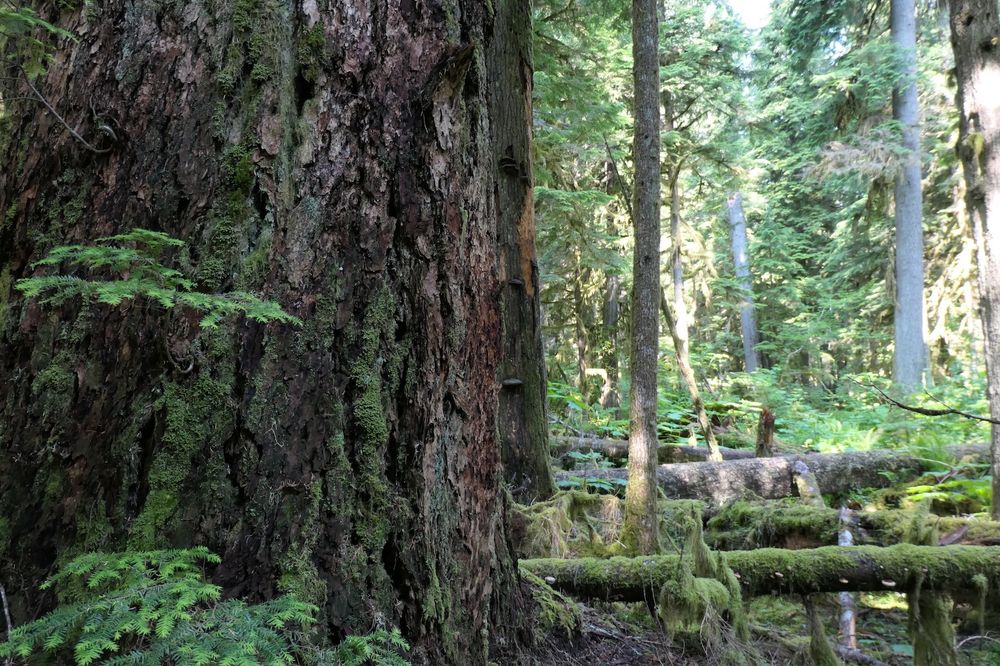

Our department at UBC is hiring for a professor of forest ecophysiology, including "tree ecophysiology; plant abiotic or biotic stress physiology; forest mortality and climate change responses; forest carbon balance; tree water relations; or nutrient use." Learn more at: tinyurl.com/5da56f5c
06.10.2025 22:12 — 👍 62 🔁 69 💬 0 📌 1
Dendrochronology Intensive Summer Course (DISC) 2026 | Laboratory of Tree-Ring Research
Join the Laboratory of Tree-Ring Research at the University of Arizona for our 2026 Dendrochronology Intensive Summer Course (DISC)! Spend 3 great weeks (May 18th to June 5, 2026) in the field, lab, and classroom learning first-hand how tree-ring research is done! ltrr.arizona.edu/summerschool
24.11.2025 22:01 — 👍 27 🔁 18 💬 1 📌 0
Time to get your public comments in on the proposed Waters of the U.S. rule that would strip protections for countless wetlands and streams.
Trout unlimited has a tool on their page that will automatically send your message to the EPA as well as your representatives:
www.tu.org/conservation...
23.11.2025 23:03 — 👍 131 🔁 111 💬 1 📌 2

Would you like to study #functional trait diversity and biogeochemical dynamics in rapidly changing #tundra ecosystems? Then this #PhD is for you! 👇 You will do fieldwork in #Alaska, #Svalbard and #Italy and work with amazing Matteo Petit Bon. Apply by Dec 19
herbivory.lbhi.is/2025/11/19/p...
23.11.2025 10:12 — 👍 10 🔁 10 💬 0 📌 0
That's really cool! I'm so happy for you that this all worked out!
21.11.2025 18:07 — 👍 2 🔁 0 💬 1 📌 0

Did this really happen
A lot of this sexist stuff still happens as put together in the cartoons at
didthisreallyhappen.net
21.11.2025 03:44 — 👍 3 🔁 0 💬 0 📌 0
Ojo Obrero
Ojo Obrero: Immigration advocacy and community engagement platform
Check out this site for current information on ICE sightings in North Carolina
ojonc.org
19.11.2025 13:23 — 👍 1 🔁 2 💬 1 📌 0

Work with #StableIsotopes in aquatic systems?
Submit your abstract to:
Session SS077
Stable Isotope Solutions to Aquatic Ecology Problems
ASLO‑SIL 2026 | Montreal | 12–16 May
Deadline: Nov 25
🔗 aslo.secure-platform.com/2026
#ASLOSIL26 #IsotopeEcology #AquaticEcology #Ecology #FoodWebs
17.11.2025 09:40 — 👍 6 🔁 4 💬 0 📌 5

Another great effort and teamwork from the past #WATSON #COST #Action www.watson-cost.eu to show a pan-European #database of #isotope #data in #soil #water and #xylem in #beech and #spruce #trees.
essd.copernicus.org/articles/17/...
And thank you @lehmannmm.bsky.social for the efficient leadership!
14.11.2025 22:44 — 👍 7 🔁 3 💬 0 📌 0
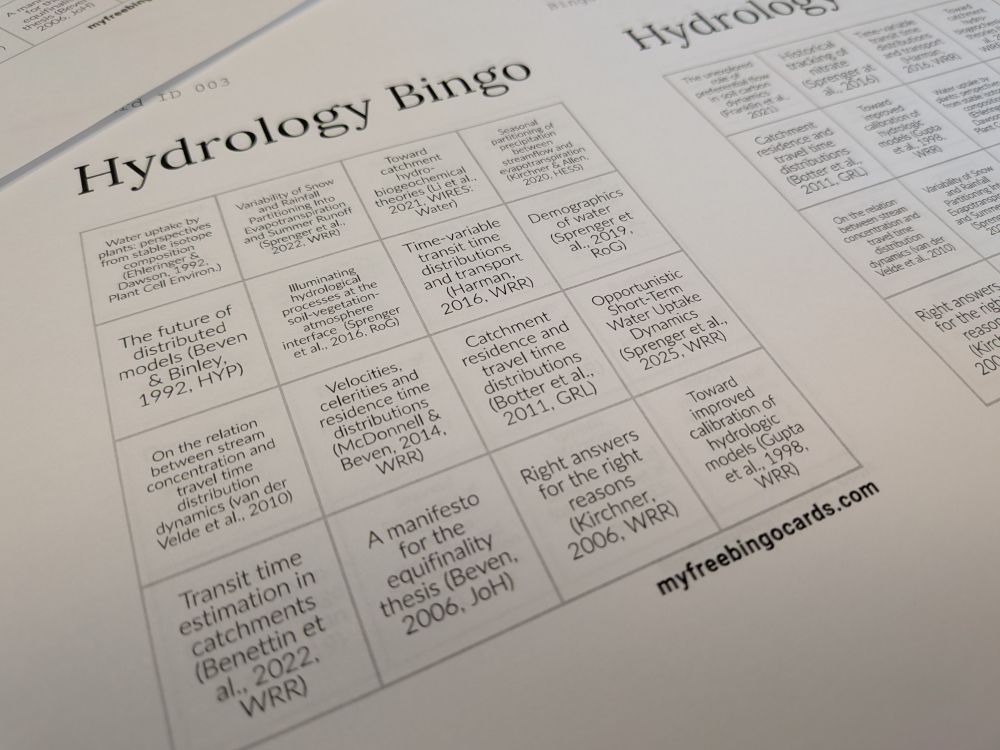
Photo of an example "Hydrology Bingo" sheet that contains scientific manuscripts that might come up during a chalk talk
I'm giving a chalk talk on Monday to Freshwater scientists in the Triangle Area that regularly come together in "Converge Meetings", initiated by @agdelv.bsky.social. I think of adding a Hydrology Bingo to go with concepts I'll be mentioning along the way. Distracting and silly? Or engaging and fun?
14.11.2025 16:12 — 👍 8 🔁 0 💬 1 📌 0
Details | Working at Bristol | University of Bristol
🚨Job opportunity🚨
We are hiring a 3yr research technician. If you love fieldwork, are passionate about forests & mountains, and want to up-skill in remote sensing, sensor networks and running field experiments this could be the dream job for you!
🧪🌳⛰️🛰️🌡️🍄
www.bristol.ac.uk/jobs/find/de...
14.11.2025 09:38 — 👍 42 🔁 43 💬 2 📌 3

The Securing American Funding and Expertise from Adversarial Research Exploitation (SAFE) Act would deny federal funding to any U.S. scientist who collaborates with anyone “affiliated with a hostile foreign entity,” a category that includes four countries: China, Russia, Iran, and North Korea. The prohibited activities would include joint research, co-authorship on papers, and advising a foreign graduate student or postdoctoral fellow. The language is retroactive, meaning any interactions during the previous 5 years could make a scientist ineligible for future federal funding.
I've been on the road so I'm behind the times—but if you wanted to destroy US science, I can think of no more expedient action.
Blatant unconstitutionality aside, fuck this backwards forwards and sideways.
www.science.org/content/article/u-s-congress-considers-sweeping-ban-chinese-collaborations
14.11.2025 03:02 — 👍 414 🔁 130 💬 15 📌 12

The top of my PhD hat decorated with a landscape depicting my field work conducted in Luxembourg study sites, where we drilled soil cores and sampled water for isotope analyses

After defending my PhD thesis at the University of Freiburg I received a doctoral hat of which the top was decorated by my colleagues with scenes showing my PhD work. Here a photo of me with my supervisor Markus Weiler and external committee member, Christine Stumpp.
Today, 10 years ago I defended my PhD thesis at the Uni. of Freiburg! Look at this great doctoral hat my colleagues created that showed my field work activities back then. Markus Weiler as supervisor, 2nd supervisor @kjmcguire.bsky.social connected via video, & Christine Stumpp as external expert.
14.11.2025 00:32 — 👍 14 🔁 0 💬 1 📌 0

Last #WARR in 2025!!
Drs. Theresa Blume (GFZ, Germany) + Holly Barnard (CU Boulder, US) on
Waters above + below ground:
How root uptake, transpiration, + subsurface stormflow connect drought, floods, ecosystems?
Register: psu.zoom.us/meeting/regi...
@waterbarnes.bsky.social
12.11.2025 21:56 — 👍 10 🔁 4 💬 0 📌 0

A table showing profit margins of major publishers. A snippet of text related to this table is below.
1. The four-fold drain
1.1 Money
Currently, academic publishing is dominated by profit-oriented, multinational companies for
whom scientific knowledge is a commodity to be sold back to the academic community who
created it. The dominant four are Elsevier, Springer Nature, Wiley and Taylor & Francis,
which collectively generated over US$7.1 billion in revenue from journal publishing in 2024
alone, and over US$12 billion in profits between 2019 and 2024 (Table 1A). Their profit
margins have always been over 30% in the last five years, and for the largest publisher
(Elsevier) always over 37%.
Against many comparators, across many sectors, scientific publishing is one of the most
consistently profitable industries (Table S1). These financial arrangements make a substantial
difference to science budgets. In 2024, 46% of Elsevier revenues and 53% of Taylor &
Francis revenues were generated in North America, meaning that North American
researchers were charged over US$2.27 billion by just two for-profit publishers. The
Canadian research councils and the US National Science Foundation were allocated US$9.3
billion in that year.

A figure detailing the drain on researcher time.
1. The four-fold drain
1.2 Time
The number of papers published each year is growing faster than the scientific workforce,
with the number of papers per researcher almost doubling between 1996 and 2022 (Figure
1A). This reflects the fact that publishers’ commercial desire to publish (sell) more material
has aligned well with the competitive prestige culture in which publications help secure jobs,
grants, promotions, and awards. To the extent that this growth is driven by a pressure for
profit, rather than scholarly imperatives, it distorts the way researchers spend their time.
The publishing system depends on unpaid reviewer labour, estimated to be over 130 million
unpaid hours annually in 2020 alone (9). Researchers have complained about the demands of
peer-review for decades, but the scale of the problem is now worse, with editors reporting
widespread difficulties recruiting reviewers. The growth in publications involves not only the
authors’ time, but that of academic editors and reviewers who are dealing with so many
review demands.
Even more seriously, the imperative to produce ever more articles reshapes the nature of
scientific inquiry. Evidence across multiple fields shows that more papers result in
‘ossification’, not new ideas (10). It may seem paradoxical that more papers can slow
progress until one considers how it affects researchers’ time. While rewards remain tied to
volume, prestige, and impact of publications, researchers will be nudged away from riskier,
local, interdisciplinary, and long-term work. The result is a treadmill of constant activity with
limited progress whereas core scholarly practices – such as reading, reflecting and engaging
with others’ contributions – is de-prioritized. What looks like productivity often masks
intellectual exhaustion built on a demoralizing, narrowing scientific vision.

A table of profit margins across industries. The section of text related to this table is below:
1. The four-fold drain
1.1 Money
Currently, academic publishing is dominated by profit-oriented, multinational companies for
whom scientific knowledge is a commodity to be sold back to the academic community who
created it. The dominant four are Elsevier, Springer Nature, Wiley and Taylor & Francis,
which collectively generated over US$7.1 billion in revenue from journal publishing in 2024
alone, and over US$12 billion in profits between 2019 and 2024 (Table 1A). Their profit
margins have always been over 30% in the last five years, and for the largest publisher
(Elsevier) always over 37%.
Against many comparators, across many sectors, scientific publishing is one of the most
consistently profitable industries (Table S1). These financial arrangements make a substantial
difference to science budgets. In 2024, 46% of Elsevier revenues and 53% of Taylor &
Francis revenues were generated in North America, meaning that North American
researchers were charged over US$2.27 billion by just two for-profit publishers. The
Canadian research councils and the US National Science Foundation were allocated US$9.3
billion in that year.

The costs of inaction are plain: wasted public funds, lost researcher time, compromised
scientific integrity and eroded public trust. Today, the system rewards commercial publishers
first, and science second. Without bold action from the funders we risk continuing to pour
resources into a system that prioritizes profit over the advancement of scientific knowledge.
We wrote the Strain on scientific publishing to highlight the problems of time & trust. With a fantastic group of co-authors, we present The Drain of Scientific Publishing:
a 🧵 1/n
Drain: arxiv.org/abs/2511.04820
Strain: direct.mit.edu/qss/article/...
Oligopoly: direct.mit.edu/qss/article/...
11.11.2025 11:52 — 👍 611 🔁 436 💬 8 📌 62

The Drain of Scientific Publishing
The domination of scientific publishing in the Global North by major commercial publishers is harmful to science. We need the most powerful members of the research community, funders, governments and ...
The Drain of Scientific Publishing details very clearly how for-profit publishers making >30% profit margins have corrupted any solution the research community has attempted.
Let's cut ourselves free.
Drain: arxiv.org/abs/2511.04820
Strain: bit.ly/StrainQSS
Oligopoly: bit.ly/OligSciPub
12/12
11.11.2025 11:52 — 👍 48 🔁 20 💬 2 📌 1

RSVP: AGU25 DSTC Social Event
Please let us know if you are likely to attend the social event at The Rusty Nail on Wednesday (Dec.17) from 7-9pm. This will be a joint social with the Near Surface Geophysics Session and we need…
Connect with us at #AGU25! The DS TC will be joining the Near Surface Geophysics section for an informal social, Wednesday, December 17, 7-9PM. Everyone is welcome! Mark your calendar & stay tuned for details. 🎉
Provide a tentative RSVP to help us plan:
11.11.2025 23:30 — 👍 3 🔁 3 💬 0 📌 0

This week in our #AGU25 #CatchmentHydrology Early Career series, we highlight: “Effects of Climate Change on the Hydrological Regime of a Mountainous Catchment: A Case Study from the Hindu Kush Himalayan Region” by
Malla Mani Kanta et al. (2025).
10.11.2025 14:37 — 👍 6 🔁 2 💬 1 📌 0
The best news, sports and video for Raleigh, Durham, Chapel Hill, Cary and central and eastern North Carolina.
The official Bluesky feed of McSweeney's Quarterly Concern, McSweeney's Internet Tendency, & McSweeney's Books.
.
Historian | Author of ‘Utopia for Realists’ (2014), ‘Humankind’ (2020) and ‘Moral Ambition’ (2025) | Co-founder of The School for Moral Ambition | moralambition.org | rutgerbregman.com
research scientist #BerkeleyLab #biometeorology #biogeoscience #ecohydrology #EddyCovariance #AmeriFlux #redwood, husband & dad https://sites.google.com/site/chuhousen/
Science journalism by Leonid Schneider 🇺🇦
Read at your own risk, people got sacked for much less. Posts may contain #antifa and #russophobia
https://forbetterscience.com/
Plant ecophysiologist | investigating drought and temperature sensitivity of boreal forest @UniNMBU from the ground and in the air 🌲✈️
Historian @ruhistorydept.bsky.social
Passionate interest in micrometeorological phenomena, especially when caused by the hydraulic properties of the soil.
CU Boulder Civil Engineering Ph.D. Student in the Hydro-Urban Bhaskar Research Group.
Interested in water conservation, urban hydrology, landscape change, urban microclimates, and remote sensing
University of Saskatchewan Environmental Engineering Alum
International Hydrology and Water Resources | Elevation models | Mapping | Landscape, Groundwater and Ecohydrological Systems Analyses
Ezra Klein’s tweets, articles, clips and podcasts on Bluesky.
International Relations prof at U. Illinois. Editor of Arc Digital. Author “Drones and Terrorism.” Politics, national security, and occasional nerdery.
California writer. Ida Tarbell stan. Beat: tech fascism, billionaire extremism, network state, crypto cartels.
Writing a book: “The Nerd Reich: Silicon Valley Fascism and the War on Global Democracy.”
The Nerd Reich: http://www.thenerdreich.com
Historian of science, focusing on genetics and eugenics in progressive era United States. Teaches the history of Detroit, Michigan, and the US at Wayne State University. Dad to Buddy (5) and Boogie (3).
He/him
💖💜💙
Founder and creative director of Bellingcat and director of Bellingcat Productions BV. Author of We Are Bellingcat.
U.S. Senator, Massachusetts. She/her/hers. Official Senate account.
https://substack.com/@senatorwarren
Satellite hydrologist, ASU Global Futures Professor, water and climate science communicator, leader of the WISE Research Group @wisegrouporg.bsky.social. Formerly NASA JPL Senior Water Scientist and ‘What About Water’ podcast host.