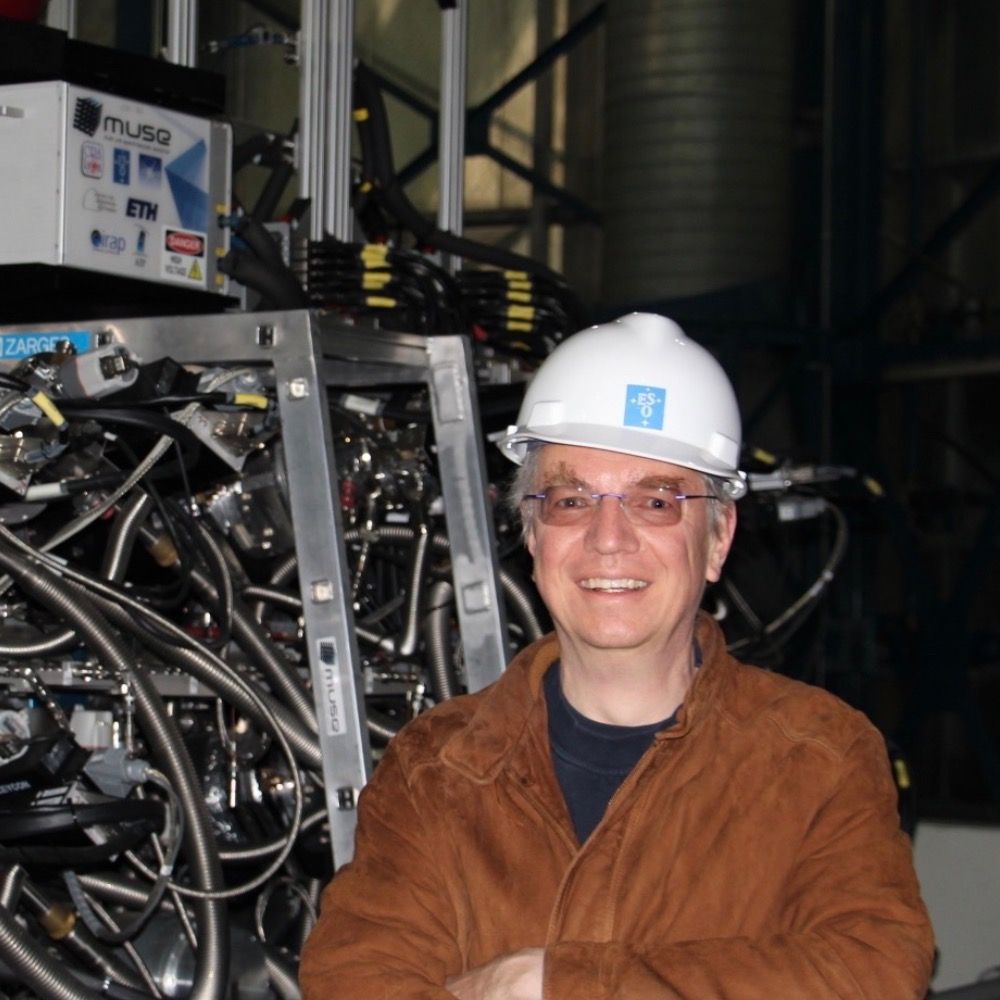
More night sky from my trip with @dorobaer and Bavarian science minister @markusblume75 to @esoastronomy Paranal Observatory. The only clouds over Paranal are the Magellanic Clouds. Only had 20 min before the Moon came out. bit.ly/4lB3t68 📷#astrophotography 🔭📷
06.02.2026 14:48 — 👍 21 🔁 4 💬 0 📌 0

Had the pleasure and privilege to accompany science minister @dorobaer.bsky.social and delegation to @eso.org Paranal Observatory. Good time to take a shot of Orion and surroundings, though I only had 1 hour before the near full moon came out ... bit.ly/4lB3t68 📷#astrophotography 🔭📷
06.02.2026 12:59 — 👍 18 🔁 0 💬 0 📌 0
Yep, for another object of the Maffei group, the hidden galaxy IC342, I showed that effect by dereddening the absorption https://app.astrobin.com/i/qe6m2a
27.01.2026 10:19 — 👍 1 🔁 0 💬 1 📌 0
Lensed QSOs are of increasing interest as they provide an independent method to measure the Hubble's constant and thus may eventually help explaining the tension between local measurements (based on Cepheids etc) and thus derived from the Cosmic Microwave Background.
27.01.2026 09:44 — 👍 4 🔁 0 💬 0 📌 0
QSO 0957+561 is located at a redshift of about 1.41, i.e. 8.7 billion light-years away - quite a deep peek from my backyard …!
27.01.2026 09:44 — 👍 3 🔁 0 💬 1 📌 0
About 10 arcmin north of NGC3079 (at about 1 o'clock see also annotated image revision B on astrobin) is the famous Twin Quasar QSO 0957+561, aka PGC 2518326, the first gravitationally lensed QSO discovered in 1979.
27.01.2026 09:44 — 👍 2 🔁 0 💬 1 📌 0

NGC 3079 is a close to edge-on barred spiral galaxy in the constellation of Ursa Major. Its distance is about 50 Million light-years. According to SIMBAD it is a Seyfert II galaxy, ie it exhibits nuclear activity.
bit.ly/4lB3t68 🔭#astrophotography 🔭📷
36 Sek.
27.01.2026 09:44 — 👍 10 🔁 2 💬 1 📌 0
Maffei 1, the closest giant elliptical would also be among the 10 brightest galaxies on the sky, but it is absorbed by almost 5mag of dust.
27.01.2026 09:26 — 👍 0 🔁 0 💬 0 📌 0
The best known member, IC342 - the hidden galaxy - would be visible by the naked eye, but substantial extinction by the Milky Way (the so-called zone of avoidance) make it to a rather faint object.
27.01.2026 09:26 — 👍 0 🔁 0 💬 1 📌 0
I have to admit I am quite intrigued by the Maffei Group. At a distance of only 10 Mpc, it is the galaxy group closest to the Local group. Yet, many of its members were only discovered some 50 years ago in infrared exposure.
27.01.2026 09:26 — 👍 0 🔁 0 💬 1 📌 0

My attempt on Maffei 2 - a pretty sizeable disk galaxy, but hidden behind the Galactic dust curtain - so only very few images can be found on astrobin. I had to stretch it rather aggressively to get the faint structure show up prominently. bit.ly/4lB3t68 🔭#astrophotography 🔭📷
27.01.2026 09:26 — 👍 30 🔁 5 💬 2 📌 0

https://www3.nasa.gov/send-your-name-with-artemis/
24.01.2026 14:12 — 👍 4 🔁 0 💬 0 📌 0

NGC 2681 is a lenticular galaxy in Ursa Major, presenting a bright nucleus embedded within a smooth, softly fading disk. Closer inspection reveals subtle structure in its inner regions, where traces of dust and faint stellar features hint at a more dynamic past. bit.ly/4lB3t68 🔭#astrophotography 🔭📷
21.01.2026 06:28 — 👍 32 🔁 4 💬 0 📌 0
Together with the disk galaxy Maffei-2 and the “hidden galaxy” IC342, Maffei-1 form the so called Maffei Group, one of the closed galaxy groups to the Milky Way with all its members sharing the same fate of being heavily obscured by the Milky Way and its dust.
20.01.2026 19:04 — 👍 2 🔁 0 💬 0 📌 0

Maffei-1 is the closest giant Elliptical to the Milky Way with a distance ~4Mpc. With a clear line of sight, Maffei-1 would be one of the brightest galaxies on the night sky. However, Maffei 1 suffers from almost 5 mag of extinction making it a hidden marvel. bit.ly/4lB3t68 🔭#astrophotography 🔭📷
20.01.2026 19:04 — 👍 16 🔁 3 💬 1 📌 0
Home - The Universe from my Backyard
Imaging the wonders of the Universe from light-polluted suburbia by Matthias Steinmetz
Interesting trivia: NGC2419 would be the brightest and best visible Globular Cluster for an observer in Andromeda who takes a more detailed look at the Milky Way bit.ly/4lB3t68 🔭#astrophotography 🔭📷
12.01.2026 19:58 — 👍 2 🔁 0 💬 0 📌 0

The Globular Cluster NGC 2419 also runs under the name “intergalactic wanderer” as its 3 billion year orbit around the Milky Way takes it to distances from the Galactic center more remote than the Magellanic Clouds, so indeed a wanderer between the worlds. bit.ly/4lB3t68 🔭#astrophotography 🔭📷
12.01.2026 19:58 — 👍 10 🔁 3 💬 1 📌 0

I finished a nice year of astrophotography with another @astrobin_com debut - the apparent galaxy pair UGC 3574 and UGC 3569. bit.ly/4lB3t68 🔭#astrophotography 🔭📷
01.01.2026 17:21 — 👍 17 🔁 2 💬 0 📌 0

Arp 206 a.k.a. NGC3432 is an edge-on SBm galaxy which is interacting with UGC 5983, a nearby dwarf galaxy. bit.ly/4lB3t68 🔭#astrophotography
01.01.2026 16:34 — 👍 13 🔁 0 💬 0 📌 0

Rechts oben in der Ecke steht in einer weißen Blase "tonspur Wissen“. Am rechten Bildrand ist ein Foto von Matthias Steinmetz zu sehen. Er ist Direktor des Leibniz-Instituts für Astrophysik Potsdam. Das Bild der Person ist schwarz-weiß eingefärbt, um die Konturen der Person beschnitten und zusätzlich weiß umrandet. In einer großen weißen Blase, die mittig-links im Bild platziert ist, steht: "4MOST - Ein neuer Blick ins All. Matthias Steinmetz. Leibniz-Institut für Astrophysik Potsdam ". Der Bildhintergrund ist ein blau-grün eingefärbtes Foto eines Blick ins Weltall mit einer Spiralgalaxie und einem Messkurve.
4MOST - Ein neuer Blick ins All.
Matthias Steinmetz ( @galacticrave.bsky.social ) von @aippotsdam.bsky.social & @unipotsdam.bsky.social zu Gast bei #TonspurWissen, dem #Podcast von @leibniz-gemeinschaft.de & Rheinischer Post.
👁️🔭🌟 pod.fo/e/364503
#Astrophysik #Astronomie #4MOST @4most-eu.bsky.social
12.12.2025 11:53 — 👍 4 🔁 3 💬 0 📌 0
YouTube video by Urknall, Weltall und das Leben
Falsche Hubble-Konstante? • Zwei Werte der Kosmologie für ein Universum | Matthias Steinmetz
🌌 Das Universum – unendliche Weiten. Wie schnell es sich ausdehnt, beschreibt die Hubble-Konstante, doch ihr genauer Wert ist umstritten. 💫 Mehr dazu im Vortrag von @galacticrave.bsky.social aus der Reihe der virtuellen #BabelsbergerSternnenächte ✨. Jetzt reinschauen: youtu.be/0wfPdhJWMTM
19.12.2025 13:44 — 👍 2 🔁 1 💬 0 📌 0

Arp 283 is a pair of interacting galaxies (consisting of NGC 2798 & 2799). The yellow/blue color contrast is nicely mirrored by two (neighboring bright stars rounding off this ensemble quite appealingly. bit.ly/4lB3t68 🔭#astrophotography
29.12.2025 17:49 — 👍 18 🔁 1 💬 0 📌 0

The colorful galaxy pair NGC1160/NGC1161 bit.ly/4lB3t68 🔭#astrophotography
28.12.2025 13:58 — 👍 16 🔁 2 💬 0 📌 0

UGC12632 with Galactic cirrus - for friends of obscure and obscured galaxies bit.ly/4lB3t68 🔭#astrophotography
27.12.2025 12:43 — 👍 14 🔁 4 💬 0 📌 0

ESO Director General Xavier Barcons (left) and Piero Benvenuti (right), IAU CPS Director, shake hands after signing an agreement. Posters of ESO and the International Astronomy Union’s Centre for the Protection of the Dark and Quiet Sky are visible behind them.
We are continuing to expand our efforts to protect the night skies.
ESO signed an agreement with the IAU's Centre for the Protection of the Dark and Quiet Sky to become a contributing partner.
https://www.eso.org/public/announcements/ann25010/
🔭 🧪
📷 A. Daniels (SKAO)
10.12.2025 13:11 — 👍 48 🔁 16 💬 0 📌 0

Stephan's Quintett bit.ly/4lB3t68 🔭#astrophotography🔭📷
06.12.2025 16:53 — 👍 49 🔁 5 💬 1 📌 0

NGC891 bit.ly/4lB3t68 🔭#astrophotography🔭📷
06.12.2025 16:50 — 👍 61 🔁 5 💬 1 📌 1

Whirlpool Galaxy M51 bit.ly/4lB3t68 🔭#astrophotography🔭📷
06.12.2025 16:48 — 👍 76 🔁 11 💬 1 📌 0

Cocoon nebula bit.ly/4lB3t68 🔭#astrophotography🔭📷
06.12.2025 16:46 — 👍 38 🔁 4 💬 0 📌 0
Autor
Süddeutsche Zeitung
Der siebte Tag/steady
Montaignes Katze
Meine Threema-ID: https://threema.id/TMT5SBWM
Home of Astrophotography since 2011.
Extragalactic astronomer | Sci-Com | Co-presenter @AwesomeAstroPod | Public speaker (inbox requests) | Lecturer | Cruise speaker | Managing Editor Fifth Star Labs Sky Guide (Apple) 🌌 | Infrequently BBC 📺 & 📻 | TedxCardiff | Lego builder | Owned by a cat
Astronomer in Aotearoa/New Zealand at the University of Canterbury.
Pusher of pixels, pens, arrays, and computer keys.
www.johncforbes.com
Astrophotonicist https://www.aip.de/en/members/kalaga-madhav/
Skeeting across the cosmos. #space #astronomy #astrophotography #science - Join our Online Observatory based in Texas offering downloads of our beautiful dark-sky wide-field and DSO data sets. https://sadrastro.com
Radio astronomy observatory, research centre, UNESCO World Heritage site, beautiful visitor galleries, free parking, and great coffee 😀📡🌟
🔗 https://www.jodrellbank.net/
Banner © Dr Anthony Holloway
Physicist, solar radio astronomy and space plasma theory & simulation, from Lingen in NW Germany, interests in astrophotography, sci-fi, running.
Love the Milky Way-Local Universe-Disk Systems-Dark Matter-New Physics with Data-Model-Simulations-Instruments. Love sports and history and travel, etc. Personal ORCID: https://orcid.org/0000-0001-8459-1036
Self imposed exile from the other social media
ARRAKIHS Mission Consortium official account
A new light on dark matter 🌌🔭 | #ARRAKIHSMission🚀 |
https://arrakihs-mission.taplink.ws/
Keeping you posted on space science activities from the European Space Agency.
Web: http://www.esa.int/science
Privacy Notice: esa.int/connectwithus
#astronomy #space #science
Lecturer in numerical cosmo @ LION+STRW Leiden University. Lead dev. of @swiftsimulation.bsky.social astro and cosmology code. #HPC. Creator of fake universes; all including cheese. 🇨🇭
www.matthieuschaller.com
Astronomer and associate professor at the University of Western Australia.
Professor für Astrophysik, JMU Würzburg
Scientist and former Karl Schwarzschild fellow at the Leibniz Institute for Astrophysics Potsdam. Previously, postdoctoral researcher at the Center for Astrophysics | Harvard & Smithsonian and PhD Student at the European Southern Observatory.
Astrophysikalische Grundlagenforschung von der Untersuchung unserer Sonne bis zur Entwicklung des Kosmos.
Webseite: www.aip.de