
Instead of listening to a rambling #SOTU address, why not read about the state of global biodiversity and how so many people are working to conserve nature around the world 🌎:
www.un.org/en/climatech...
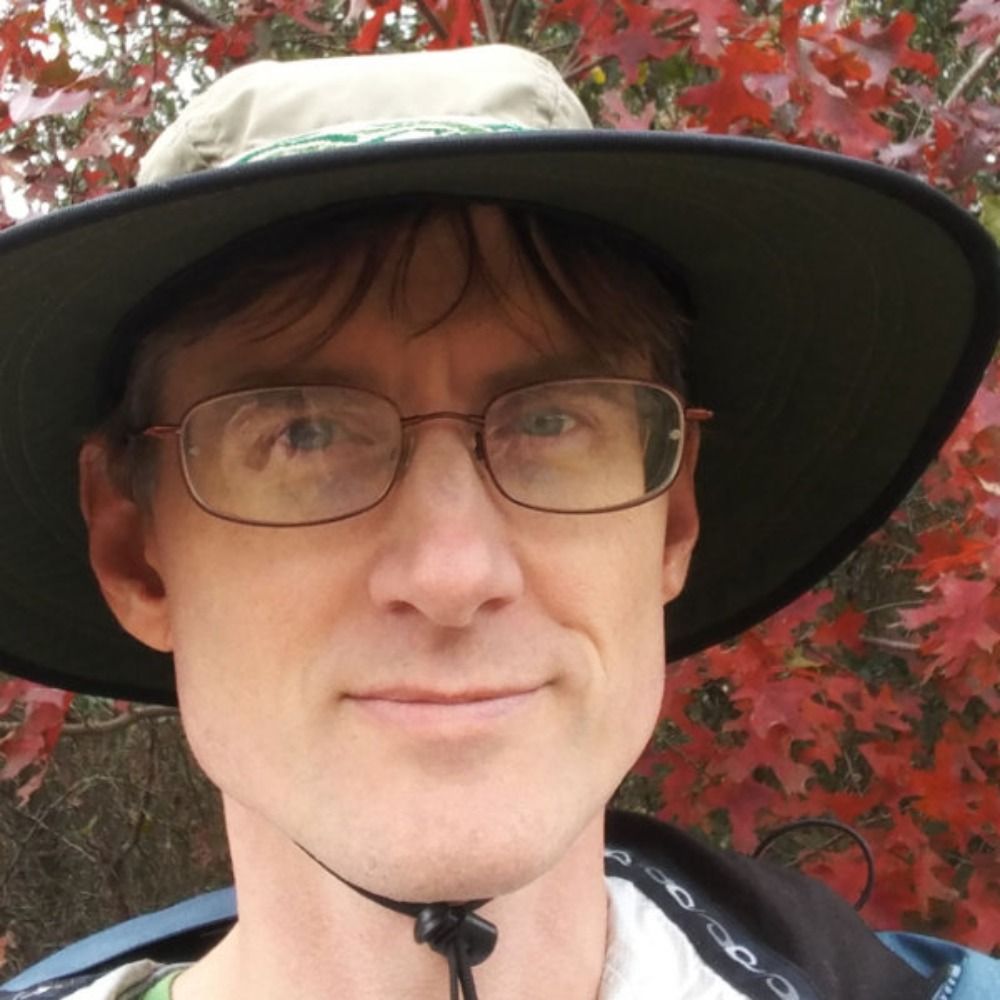
@josephtlapp.bsky.social
Grad student at Johns Hopkins studying the similarities between biological systems and computing systems, esp. networks. Sr. software engineer and amateur-but-published spider taxonomist. Occasional tree pics, cool bugs, bug poetry. Charlottesville, VA.
Instead of listening to a rambling #SOTU address, why not read about the state of global biodiversity and how so many people are working to conserve nature around the world 🌎:
www.un.org/en/climatech...
The spider is Mecaphesa sp.
09.02.2026 22:13 — 👍 1 🔁 0 💬 1 📌 0Six weeks ago: tied my shoes too tight and tore a ligament. I had tied and pulled the laces of my shoes, when a lace broke. After rummaging around, I found a spare pair, but after putting them on, I found them too short to tie. So I pulled them tight enough to squeeze out another inch and tie a bow.
06.01.2026 00:27 — 👍 0 🔁 0 💬 0 📌 0I just saw a glitch in the matrix. I put a bowl on the kitchen counter and dropped a handful of kibble in from a few inches up. One kibble rebounded up two feet to the height my eyes and landed behind the sink. That kibble had more kinetic energy than the potential energy of its drop would provide.
31.12.2025 19:28 — 👍 2 🔁 0 💬 0 📌 0
#Crabmas is nearly upon us! Reposting "The 12 Days of Crabmas" is my new holiday tradition 🦀🎄
#throwback #12daysofchristmas #crab
Our market got cancelled tomorrow (😭) so we have a bunch of these left now!
They're beautiful! You can learn about animals!
So many people in the last 2 weekends have said "Oh we should get this for your mom", and then they get one for the other person's mom. Just sayin'
SquidFacts.net
This is so much fun to watch!
06.12.2025 23:27 — 👍 1 🔁 0 💬 0 📌 0I've been avoiding casein because it's supposed to be the ingredient of dairy that promotes mucus production, giving me sinus headaches when my allergies act up. I'm pretty sure cheese and yogurt make things worse for me, but you have me wanting to investigate further.
30.11.2025 17:11 — 👍 3 🔁 0 💬 1 📌 0
Panel 01: A ball drawn on a whiteboard. The ball has two eyes on its "sides", the sides not facing you. A wooden teaching pointer is pointed at it, and someone is speaking from off-panel, saying "prey animals have eyes on the SIDES of their head, like this." Panel 02: The teaching point now points to another part of the whiteboard, where a ball has two eyes on its front. The off-panel speaker says "predator animals have eyes on the FRONT, like THIS." Panel 03: We zoom out and reveal the speaker to be Shen, who is holding the teaching pointer and asking the class ahead of him, "any questions?" Panel 04: It's 3 characters at tables in a classroom: A sheep with side eyes on one side, a tiger with front eyes on the other, and a shark raising his fin in the middle.
19.11.2025 23:38 — 👍 8107 🔁 1341 💬 56 📌 23Every once in a while I have to remove a large Pholcus phalangioides spider from my bathtub before my morning shower, but this morning I have to relocate three!
14.11.2025 12:16 — 👍 2 🔁 0 💬 0 📌 0Every time I read about insect trachea, I think of grasshoppers. I vaguely recall having read something about the efficiency with which oxygen delivers to the cells that power flight.
10.11.2025 23:39 — 👍 0 🔁 0 💬 0 📌 0We know this specifically for the fruit fly Drosophila melanogaster.
10.11.2025 23:31 — 👍 1 🔁 0 💬 1 📌 0Insect hemolymph does not supply the insect with O2. Instead, trachea branch from spiracles to provide O2 to the proximity of every cell. During development, cells deficient in oxygen release the signal protein FGF to draw the forming trachea nearby. (Alberts et al., Molec Bio of the Cell, 7th ed)
10.11.2025 23:28 — 👍 8 🔁 0 💬 1 📌 0It blew me away when I first learned this too. The next amazing thing is that transcription factor concentration gradients cause each region of nuclei to specialize into different cells, thereby dividing the insect into segments. I'm still trying to understand how gradients accomplish this.
09.11.2025 18:44 — 👍 3 🔁 0 💬 0 📌 0A fertilized insect egg doesn't repeatedly divide like a vertebrate egg. Instead, its nucleus duplicates itself thousands of times (6000 in fruit flies). These nuclei migrate to the cell periphery, where the membrane folds around them to form cells. (Alberts et al., Molec Bio of the Cell, 7th ed)
09.11.2025 18:14 — 👍 19 🔁 2 💬 3 📌 1"Some of the early microscopists imagined the entire shape and structure of the human body to be already present in the sperm as a 'homunculus,' a miniature human; after fertilization, the homunculus would simply grow and generate a full-sized person." (Alberts et al., Molec Bio of the Cell, 7th ed)
09.11.2025 02:30 — 👍 1 🔁 0 💬 0 📌 0
This digitally painted piece honors the survivor spirit of the coyote by tracing its lineage from the first cells of life to the animal trotting our landscapes today. Below the horizon, carefully chosen ancestors mark pivotal moments in adaptation, each contributing to the form and survivor we see today. Above the horizon, Coyote stands alert at the center, framed by both Denver’s skyline and a mountain backdrop, symbols of their ability to thrive in cities as well as wilderness. Embedded in the ground are the skulls and bones of carnivores whose lineages ended long ago, emphasizing Coyote’s persistence in contrast.
"I Contain Multitudes"
This digitally painted piece honors coyote by tracing its lineage from the first cells of life to the animal trotting our cities and the wilderness today.
The thread gives descriptions of all the extinct organisms shown in this piece (not to scale)
And that's how you integrate digital elements into an exhibition. Part of the temporary "China's Dinosaur World" at the Shanghai Natural History Museum, China. Closing this November.
Video source: Shanghai Let's Meet
The question of how DNA encoded proteins "stimulated great excitement. Here was a cryptogram set up by nature that, after more than 3 billion years of evolution, could finally be solved by one of the products of evolution—human beings." (Alberts et al., Molecular Biology of the Cell, 7th ed.)
25.09.2025 22:41 — 👍 5 🔁 2 💬 0 📌 0I had a dog who had three mast cell tumors removed over two years. Visits to the vet were so stressful for her that I decided I wouldn't put her through that again -- and she never had another mast cell tumor. She died years later at 16.5 from some autoimmune condition acquired from a dead Opossum.
19.09.2025 02:28 — 👍 5 🔁 0 💬 1 📌 0This is Google Docs. I still have tremendous trouble with Word even for more common words.
14.09.2025 21:16 — 👍 1 🔁 0 💬 0 📌 0A is my clear fav. I'd rank B as the least readable.
14.09.2025 18:30 — 👍 1 🔁 0 💬 0 📌 0
The mispelling "phospohdiesterase" is underlined in red, and the correct spelling "phosphodiesterase" is recommended instead.
I'm taking notes in Google Docs, and I've been impressed with how it recognizes all the technical jargon of molecular biology.
14.09.2025 17:59 — 👍 2 🔁 0 💬 1 📌 0DNA nucleotides appear to average a mutation rate ranging from 1 to 3 out of every 10 billion copied. This likely restricts organisms to having at most 30,000 genes that are "essential," placing an upper limit on the complexity of organisms. (Alberts et al., Molecular Biology of the Cell, 7th ed.)
11.09.2025 00:11 — 👍 3 🔁 0 💬 0 📌 0LOL! The book isn't arguing for random chance though. It lists six ways nucleotides can change.
08.09.2025 01:44 — 👍 0 🔁 0 💬 1 📌 0Your point is valid, but I don't believe the quote make any claim about what persists.
08.09.2025 01:33 — 👍 0 🔁 0 💬 0 📌 0Right. The text talks much about conserved regions. The claim isn't that the base pairs we have now have all changed in that time, only that replication has failed for each base pair during that time during some attempt at replication.
08.09.2025 01:27 — 👍 0 🔁 0 💬 1 📌 0It sounds like you're saying that although these base pair changes may have been "tried", many have not likely survived. Does that change the reported stats?
08.09.2025 01:22 — 👍 0 🔁 0 💬 1 📌 0From Alberts et al., Molecular Biology of the Cell, 7th ed. (2022)
08.09.2025 01:06 — 👍 0 🔁 0 💬 0 📌 0
