If you're in the Zurich area, join us for a special Schrödinger Colloquium on Monday. “From Atoms to Cosmos” will celebrate 100 y of Schrödinger equation, bridging chemistry, physics and cosmology. A surprise quantum dance event will follow in the Lichthof, with Priscilla Roeck & Killian Haselbeck
21.02.2026 13:45 — 👍 2 🔁 1 💬 0 📌 0


So far so good
18.02.2026 17:21 — 👍 5 🔁 0 💬 0 📌 0

Yes I should prepare my lectures for next week (semester start), I should read a PhD thesis, among others… but this was my main project for today - happy valentines ;)
14.02.2026 17:00 — 👍 4 🔁 0 💬 2 📌 0
Nice article, by Adam Begley, about Julian Barnes and his new book, Departure(s), in the @theatlantic.com “We must believe in love, just as we must believe in free will and objective truth.”
14.02.2026 11:48 — 👍 0 🔁 0 💬 0 📌 0
time ;)
08.02.2026 09:24 — 👍 1 🔁 0 💬 0 📌 0

Xenoscope, a tall xenon TPC, and its support structure
A new run with Xenoscope, a 2.6 m tall, two-phase xenon tome projection chamber, will start soon. Now the TPC is being reassembled and it looks almost like new ;-)
08.02.2026 07:59 — 👍 5 🔁 0 💬 1 📌 0

Muons are wonderful particles. Happy to be part of the new National Centre of Competence in Research "Muoniverse" www.muoniverse.ch, hosted by PSI & UZH. Muoniverse is one of the six funded new centres (www.wbf.admin.ch/en/newnsb/JE...), connecting science, engineering and arts. More details soon!
03.02.2026 09:05 — 👍 3 🔁 0 💬 0 📌 0

The energy spectrum of the first LEGEND-200 dataset, corresponding to 61.0 kg yr of germanium exposure, above the 39-Ar 𝑄_𝛽 =565 keV. The white histogram shows events passing quality and muon anticoincidence cuts and with energy deposited in one single HPGe detector. The main radioactive background contributors are indicated in green. The gray and red histograms show the subsets of events passing the PSD cut and additionally the LAr anticoincidence cut, respectively. The inset shows a close-up around the region of interest for 0𝜈𝛽𝛽 decay with finer binning. The expected contribution from the 2𝜈𝛽𝛽 decay of 76-Ge corresponds to the solid blue line. The events used to set a constraint on the 0𝜈𝛽𝛽 decay rate are contained by the analysis window, marked in green. Only two significant 𝛾 peaks (shaded areas) are expected within this window, and the corresponding 10 keV wide energy regions are excluded from the statistical analysis.
The first LEGEND-200 results are now published in @physrevlett.bsky.social journals.aps.org/prl/abstract...
No evidence for neutrinoless double beta decay,
with a lower limit on the 76-Ge half-life of 1.9 x 10^26 y. This corresponds to an upper limit on the Majorana ν mass of m_ββ < 75 - 200 meV
01.02.2026 08:25 — 👍 3 🔁 0 💬 0 📌 0

Using the Hubble Space Telescope 🔭, a team of astronomers have discovered a starless, gas-laden dark matter cloud believed to be a relic from the dawn of galaxy formation - the first verified discovery of its kind anywhere in the Universe ☁️. Check it out: https://ow.ly/e0WV50XT9Og #astronomy
11.01.2026 12:00 — 👍 4 🔁 3 💬 0 📌 0
You need to align with Polaris and then you can use the guiding scope for corrections
07.01.2026 17:32 — 👍 1 🔁 0 💬 0 📌 0
I meant photons (but also photos ;)
07.01.2026 09:45 — 👍 1 🔁 0 💬 0 📌 0

Plenty of photos here last night, but mostly from the moon ;)
07.01.2026 09:44 — 👍 1 🔁 0 💬 2 📌 0
It moves! We can watch as the Kepler supernova remnant changes over a quarter of century in X-rays from Chandra. #aas247
chandra.si.edu/photo/2026/k...
06.01.2026 21:23 — 👍 281 🔁 100 💬 7 📌 16

Sydney Opera House
This spectacular image of the planetary alignment of Saturn, Mars, Venus, and Jupiter above the Sydney Opera House was taken in the early morning around April 21, 2022, and featured as NASA's Astronomy Picture of the Day on April 26, 2022
28.12.2025 13:24 — 👍 1230 🔁 207 💬 1 📌 12

In Memory of Katherine Wright | Physics Magazine
We pay tribute to our friend and colleague, whose journalistic talent and commitment to inclusivity left an indelible mark on Physics Magazine.
Our colleague Katherine Wright, who began as an editor for PRL and went on to explore her passion as a great writer for
@physicsmagazine.bsky.social, passed away this fall from cancer, far too young. Here is a tribute to her: physics.aps.org/articles/v18...
23.12.2025 23:27 — 👍 48 🔁 13 💬 2 📌 1

If you're in Zurich, join us for today's Physics Colloquium at the @ethz.ch campus: Prof. Teresa Montaruli, from Université de Genève, will talk about "The Future of the Highest Energy Astrophysics with Gamma-Rays and Neutrinos"
colloquium.phys.ethz.ch/programme/cu...
10.12.2025 13:26 — 👍 4 🔁 1 💬 0 📌 0
Congratulations Sera!
10.12.2025 13:22 — 👍 1 🔁 0 💬 0 📌 0

Group picture in the Irchel Lichthof
New group picture taken yesterday (Sana is missing)
06.12.2025 06:52 — 👍 3 🔁 0 💬 0 📌 0
Thank you Nikita, very kind :)
19.10.2025 12:02 — 👍 1 🔁 0 💬 0 📌 0
I certainly enjoyed the meeting and I learned so much! Thank you again for the invitation :)
16.10.2025 16:42 — 👍 1 🔁 0 💬 1 📌 0

 13.10.2025 08:10 — 👍 1 🔁 0 💬 0 📌 0

The mesoSPIM 10-year Symposium
Day 1: Monday, October 13-th , Day 2: Tuesday, October 14-th, Day 3: Wednesday, October 15-th | Careum Auditorium
Beautiful day in Zurich for the start of the 10 Years of mesoSPIM workshop at the Careum this morning: www.ema.uzh.ch/en/register/... - organised by @mesospim.bsky.social
13.10.2025 08:09 — 👍 2 🔁 0 💬 1 📌 0

Study for life
09.10.2025 21:20 — 👍 178 🔁 32 💬 2 📌 2

Extract from Robert Hofstadter's Nobel Lecture on "The Electron-Scattering Method and Its Application to the Structure of Nuclei and Nucleons"

Electron-proton scattering: cross section versus scattering angle for 188 MeV electrons. Theoretical curves and experimental data.
Reading another famous Nobel Lecture, from 1961, for my introductory lecture to electron-nucleus and electron-nucleon scattering this morning (#KT-I) www.nobelprize.org/prizes/physi...
08.10.2025 07:02 — 👍 3 🔁 0 💬 0 📌 0
John Clarke, UC Berkeley emeritus professor, awarded 2025 Nobel Prize in Physics | Letters & Science
Congratulations to my wonderful colleague John Clarke! And to Berkeley, and to UC. And to everyone who still believes that foundational research is worth investing in
07.10.2025 23:55 — 👍 4 🔁 3 💬 0 📌 0
Congratulations to John Clarke, Michel H. Devoret and John M. Martinis! Very good news for quantum sensor based dark matter experiments :)
07.10.2025 10:15 — 👍 4 🔁 0 💬 0 📌 0

If you’re in Zurich, support the students’ demo against budget cuts in education - October 1, Helvetiaplatz www.vauz.uzh.ch/de/News/01.1...
28.09.2025 14:30 — 👍 1 🔁 0 💬 0 📌 0

Full coherence at fifty – CERN Courier
The CONUS+ collaboration presents evidence for CEνNS in the fully coherent regime.
CEνNS: an “act of hubris” fifty years ago, now observed by several experiments with neutrinos from stopped pion beams, nuclear reactors and the Sun: cerncourier.com/full-coheren...
26.09.2025 05:40 — 👍 4 🔁 0 💬 0 📌 1
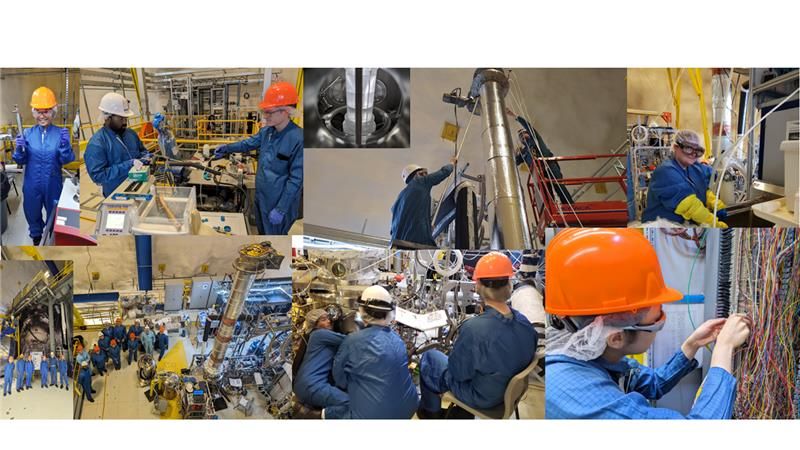
A collage of photos showing scientists and engineers working at SNOLAB on the DEAP-3600 experiment. Team members in blue cleanroom suits and orange or white helmets are operating equipment, handling cryogenic systems, monitoring instruments, and connecting wires. The central images highlight the detector and filling system used for the liquid argon fill.
Fresh from the underground: the third argon fill at DEAP-3600 is now complete ✅. The detector is filled to full capacity and ready for the next steps!
Work continues at @snolabscience.bsky.social
#teamwork #darkmatter
24.09.2025 14:10 — 👍 10 🔁 3 💬 0 📌 0
Theoretical astrophysicist specializing in the Universe and all that surrounds it. Based in Ireland. Personal account. Call me old-fashioned but I don't like fascists. He/him/his.
Blog: telescoper.blog
Physicist and Science Writer. Author of nineteen books, including Time Journeys, Cosmic Wormholes, Einstein's Dice, The Quantum Labyrinth, Synchronicity, Flashes of Creation, and The Allure of the Multiverse.
Dad, husband, astrophysicist, dog herder. Samuel T. and Fern Yanagisawa Regents Professor in Astronomy at UT Austin. This is a personal account and the views expressed in my posts here are mine. https://mrbk.github.io
High-energy physics magazine - reporting worldwide since 1959.
For physicists, engineers, computer scientists, policymakers and industry.
#CERNCourier
Physics prof @UCL, researcher @CERN, author
IOP Publishing is a society-owned scientific publisher, providing impact, recognition and value for the scientific community. IOP Publishing’s portfolio includes more than 90 journals.
Associate Professor @UCSanDiego, particle theory and cosmology
News, views and information for the global physics community. physicsworld.com
Imaging scientist, light-sheet aficionado, #mesoSPIM developer, open source contributor. Building cool microscopes for cool people.
www.mesospim.org
www.github.com/nvladimus
GRAPPA is a centre of excellence of the University of Amsterdam, focussing on Gravitation and Astroparticle Physics.
The official profile of the DEAP-3600 Collaboration: Dark Matter experiment using Argon Pulse Shape Discrimination at SNOLAB, Canada
Ohio State Arts and Sciences Distinguished Professor of Physics and Astronomy. Into neutrinos. Fresh off the turnip truck.
human person (she)
| cosmologist at Duke University
| member of @LSSTDESC @Roman
| did physics @XENONexperiment
| loves plots, coats, and The Wire
| opinions mine
Professor of Materials Theory at ETH Zürich
Fascinated by things very big, very small, and beyond the limits of the human senses. Founder of OpenMind: www.openmindmag.org Creator of the Invisible Universe column: https://invisibleuniverse.substack.com/
Where the future begins. 🚀🔬 One of the world’s leading universities for technology & natural sciences. Posts in both English and German.
www.ethz.ch
Cancer genomics, computational oncogenomics, open research data, progenetix.org, Global Alliance for Genomics and Healthe GA4GH, Swiss Institute of Bioinformatics, ELIXIR; Professor of Bioinformatics at the University of Zurich UZH
Neutrino Theory Network Fellow at @NewYorkUniversity, previously a N3AS postdoctoral fellow at @UCBerkeley and @UCSanDiego🐙
Theoretical Astro/Physicist:
https://chanda.science
First book:
https://tinyurl.com/DisorderedCosmos
PREORDER MY NEXT BOOK:
https://tinyurl.com/EdgeOfSpaceTime
Newsletter:
news.chanda.science
all Black/all Jewish. 🏳️🌈/agender/woman.
Posts by/for me🖖🏽
Astrophysicist, gravitational waves and multi-messenger astronomy, working mother, European + 🌍 @ ❤️, British + born in London UK, professor at the University of Potsdam, DESY & German Centre for Astrophysics (DZA); also @GRAPPAcentre at Univ. of Amsterdam.