Lauren Bird's Avatar

Lauren Bird

@laurenbird.bsky.social

Postdoc, Lamason lab @ MIT Biology (formerly Newton lab @ Unimelb). Interested in intracellular pathogens πŸ§«πŸ‘©πŸ»β€πŸ”¬ (she/her)

84 Followers  |  132 Following  |  4 Posts  |  Joined: 02.03.2025  |  1.4394

Latest posts by laurenbird.bsky.social on Bluesky


Preview
Intralysosomal pathogens differentially influence the proteolytic potential of their niche | Infection and Immunity Evading lysosomal degradation is of critical importance to successful intracellular pathogens. The lysosome, classically considered the waste disposal and recycling center of the cell, is a hostile en...

Coxiella & Leishmania both reside within a lysosome-like compartment in human cells, but appear to modulate the protease cohort in different ways. I’m pleased to share our latest story here, out this week in I&I: journals.asm.org/doi/10.1128/...
@hayleyjnewton.bsky.social @lauraem-lab.bsky.social

07.01.2026 03:31 β€” πŸ‘ 5    πŸ” 1    πŸ’¬ 0    πŸ“Œ 0

Check out our latest paper from first author Allison Scott using a powerful enrichment strategy to enable transcriptional profiling of the early stages of a rickettsial infection

06.01.2026 11:49 β€” πŸ‘ 6    πŸ” 3    πŸ’¬ 0    πŸ“Œ 0

Thrilled to share our latest story from postdoc @sitbrandon.bsky.social! Using a functional genetic screen, he discovered an unexpected way that Rickettsia relies on the host to stabilize the Sca2 surface protein that drives pathogen motility and virulence.

29.10.2025 10:59 β€” πŸ‘ 1    πŸ” 1    πŸ’¬ 0    πŸ“Œ 0
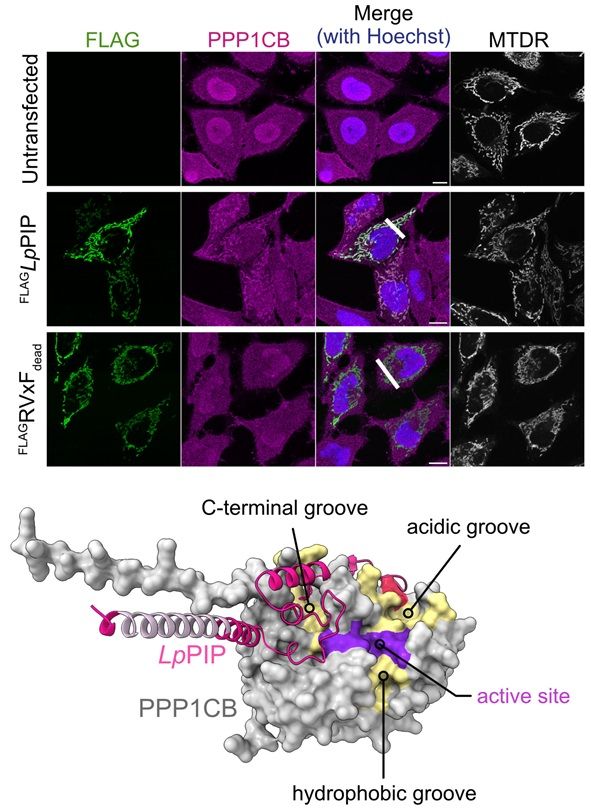
Top: HeLa cells expressing FLAGLpPIP, or FLAGRVxFdead were stained with 100 nM MitoTracker Deep Red FM (mitochondria; MTDR) and, following fixation, processed for immunofluorescence using antibodies against FLAG (green) and PPP1CB (magenta). Nuclei were stained with Hoechst 33258 (blue). Scale bar represents 10 ΞΌm. Fluorescence signal profiles of FLAG and PPP1CB were measured across the indicated line of interest. Bottom: AlphaFold3 structure of LpPIP-PPP1CB complex labeled with the active site (purple) and three substrate binding grooves (yellow) of PPP1CB.

Top: HeLa cells expressing FLAGLpPIP, or FLAGRVxFdead were stained with 100 nM MitoTracker Deep Red FM (mitochondria; MTDR) and, following fixation, processed for immunofluorescence using antibodies against FLAG (green) and PPP1CB (magenta). Nuclei were stained with Hoechst 33258 (blue). Scale bar represents 10 ΞΌm. Fluorescence signal profiles of FLAG and PPP1CB were measured across the indicated line of interest. Bottom: AlphaFold3 structure of LpPIP-PPP1CB complex labeled with the active site (purple) and three substrate binding grooves (yellow) of PPP1CB.

#Legionella pumps 100s of effector proteins into host cells, including to #mitochondria. @drdstojanovski.bsky.social &co show that effector LpPIP is a tail-anchored protein of the MOM that recruits protein phosphatase 1 to modulate the host mitochondrial P-proteome @plosbiology.org πŸ§ͺ plos.io/4f2T5kE

25.07.2025 13:57 β€” πŸ‘ 12    πŸ” 5    πŸ’¬ 0    πŸ“Œ 0

Congrats Thomas and team!

02.07.2025 02:33 β€” πŸ‘ 1    πŸ” 0    πŸ’¬ 0    πŸ“Œ 0
Preview
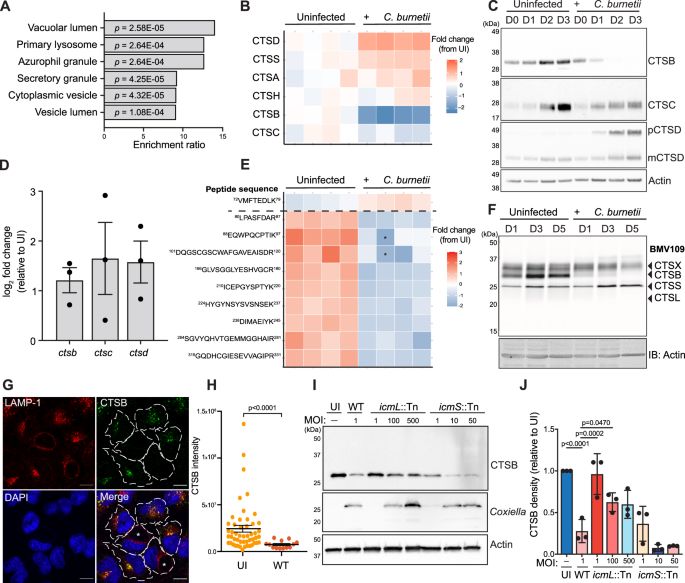
Coxiella burnetii manipulates the lysosomal protease cathepsin B to facilitate intracellular success - Nature Communications The zoonotic pathogen Coxiella burnetiiestablishes a unique intracellular niche within a lysosome-derived vacuole. Here Bird et al. undertook proteomic, cell biology and microbiology approaches to cha...

We also show that Coxiella incites the extracellular secretion of lysosomal content in a T4SS independent manner.

A wonderfully enjoyable collaboration with @lauraem-lab.bsky.social & @hayleyjnewton.bsky.social labs (with significant mass spec guidance from @nickescott.bsky.social!)

25.04.2025 00:14 β€” πŸ‘ 6    πŸ” 1    πŸ’¬ 0    πŸ“Œ 0
Preview
Coxiella burnetii manipulates the lysosomal protease cathepsin B to facilitate intracellular success - Nature Communications The zoonotic pathogen Coxiella burnetiiestablishes a unique intracellular niche within a lysosome-derived vacuole. Here Bird et al. undertook proteomic, cell biology and microbiology approaches to cha...

Excited to share this story from my PhD, out today in Nature Communications! We show that Coxiella removes cathepsin B to reduce lysosomal hostility and promote bacterial success. This depends on a vacuole established by effector CvpB.

www.nature.com/articles/s41...

25.04.2025 00:14 β€” πŸ‘ 24    πŸ” 4    πŸ’¬ 2    πŸ“Œ 3

@laurenbird is following 20 prominent accounts