Thanks a lot Simon!
23.01.2026 13:27 — 👍 0 🔁 0 💬 0 📌 0

This work suggests we need to look at aging as a complex system with critical transitions, not just gradual wear and tear.
23.01.2026 07:19 — 👍 8 🔁 1 💬 0 📌 1
Why does this matter? If decline is "punctuated," treating aging as a smooth erosion misses the critical windows for intervention. We need to understand what triggers the transition from a stable plateau to a drop.
23.01.2026 07:19 — 👍 1 🔁 0 💬 1 📌 0

However, the core finding was that the "Smooth Decline" is largely a statistical artifact of averaging. When we look at individuals, we see that memory aging is often "punctuated": extended plateaus of stability interrupted by abrupt, state-like transitions of loss.
23.01.2026 07:18 — 👍 3 🔁 1 💬 1 📌 0

We harmonized data across 3 major cohorts (SHARE, HRS, Betula). We also looked at MRI data from ~2,000 people to see the brain basis of these changes. Stability is real for ~10% > 70 years over a decade, with less brain atrophy in the medial temporal lobe.
23.01.2026 07:18 — 👍 1 🔁 0 💬 1 📌 0

Does memory fade slowly, or in drops and bursts? We analyzed 728k tests from 210k people. Key finding: “stability” isn’t a trait you either have or don’t have - it’s often a time-limited state at different points in aging. Preprint "Punctuated Memory Change": 👇 www.biorxiv.org/content/10.6...
23.01.2026 07:17 — 👍 15 🔁 12 💬 2 📌 0

An international research effort combining brain imaging and memory testing from thousands of adults is offering a clearer picture of how age-related brain changes affect memory. @andersfjell.bsky.social Learn More in Nature Communications @natureportfolio.nature.com 👉 www.nature.com/articles/s41...
14.01.2026 18:53 — 👍 7 🔁 5 💬 0 📌 1

Why do some people lose memory faster with age? A mega-analysis of 13 longitudinal datasets (3,700+ adults, 10,000+ MRIs) shows that memory decline tracks brain atrophy, especially in the hippocampus, and that these links strengthen with age, but not APOE status: www.nature.com/articles/s41...
27.11.2025 09:36 — 👍 15 🔁 6 💬 0 📌 0
" Our mega-analysis reveals a nonlinear relationship between memory decline and brain atrophy, primarily affecting individuals with above-average brain structural decline. "
27.11.2025 22:20 — 👍 8 🔁 3 💬 0 📌 0

Very impressed with @didacvp.bsky.social's work in @natcomms.nature.com, the most thorough mapping of longitudinal memory-atrophy relationships in normal aging, showing both global and memory-specific associations, which grow stronger with age. Early accsess here: www.nature.com/articles/s41...
28.11.2025 15:01 — 👍 3 🔁 3 💬 0 📌 1
Thanks for the fun and interesting discussions @kathrynbates.bsky.social and Chloe Carrick
12.11.2025 06:38 — 👍 0 🔁 0 💬 0 📌 0

Older woman with brain drawing superimposed on her head. Stock image.
Over 12,500 brain scans from cognitively healthy adults reveal that sex differences in age-related brain atrophy can’t explain why women have higher rates of Alzheimer's disease. The authors call for research into alternative explanations. In PNAS: https://ow.ly/hIYj50XgiCn
22.10.2025 17:01 — 👍 8 🔁 5 💬 0 📌 0

It is this type of sky over the university. Morning office window view.
20.10.2025 06:11 — 👍 1 🔁 0 💬 0 📌 0

@nature.com made a news piece on our new @pnas.org paper. Good job Anne Ravndal!
Men’s brains shrink faster than women’s: what that means for Alzheimer’s.
www.nature.com/articles/d41...
14.10.2025 06:25 — 👍 11 🔁 3 💬 0 📌 1
Takeaway: sex gaps in structural brain aging are modest and we must look beyond atrophy to explain women’s higher AD diagnosis rates. Other biomarkers? Or maybe non-biological causes?
14.10.2025 06:06 — 👍 5 🔁 2 💬 0 📌 0
Effects remained even when accounting for amyloid level. Reflect an immune response to accumulating, sub-threshold Aβ? Preexisting effects of higher cortical thickness in those that subsequently develop high Aβ? Protective factor?
21.08.2025 07:44 — 👍 0 🔁 0 💬 0 📌 0
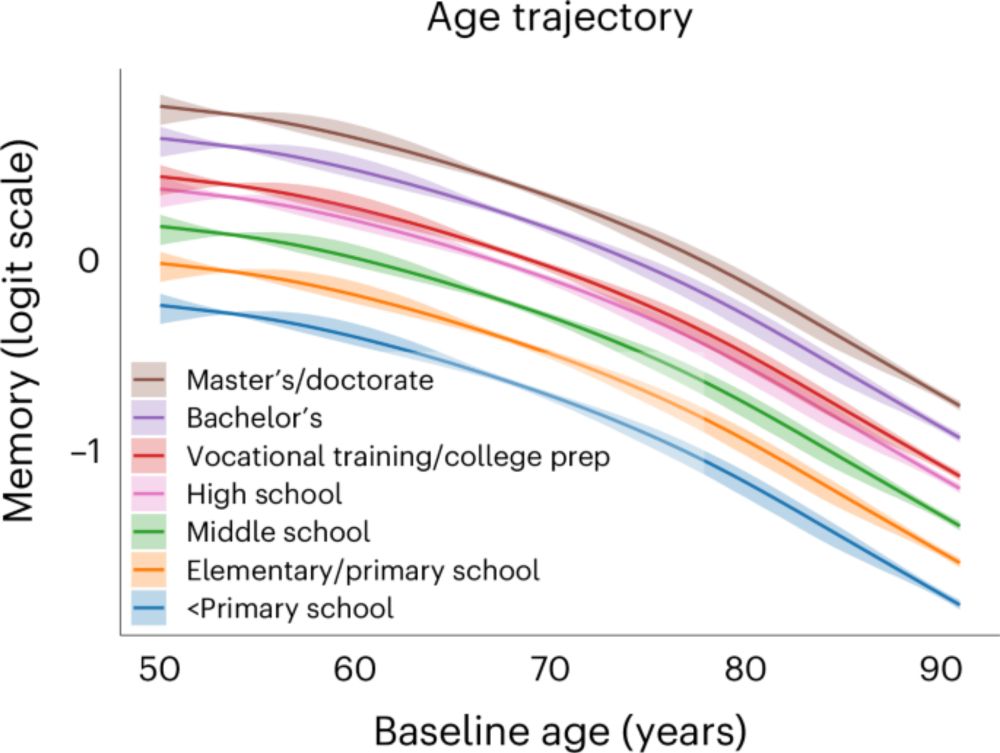
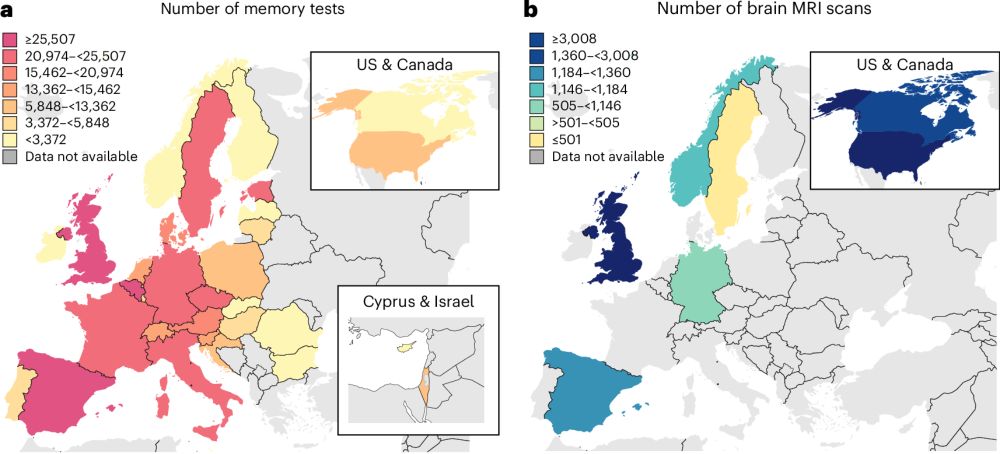
🧠💡 CAN YOU SAVE YOUR FUTURE BRAIN BY GETTING A DEGREE? A new Nature Medicine paper—led by @andersfjell.bsky.social—analyzed 407,000 memory tests and 15,000 brain scans across 33 countries to find out whether education protect you from cognitive decline at older ages. The answer: not really. [1/5]
04.08.2025 20:33 — 👍 14 🔁 3 💬 1 📌 0
People with more education did better — but declined just as fast. The takeaway: To reduce dementia risk, we may need to shift from boosting adult cognitive reserve to investing in early education. #Lifecourse #BrainHealth #DementiaPrevention
01.08.2025 11:40 — 👍 1 🔁 0 💬 0 📌 0

The three #LancetCommission reports on #DementiaPrevention have shifted focus from early schooling to longer education as protection against dementia. Our new results suggest this shift may be misguided: early-life factors, not adult education, likely drive the effect.
01.08.2025 11:40 — 👍 0 🔁 1 💬 1 📌 0
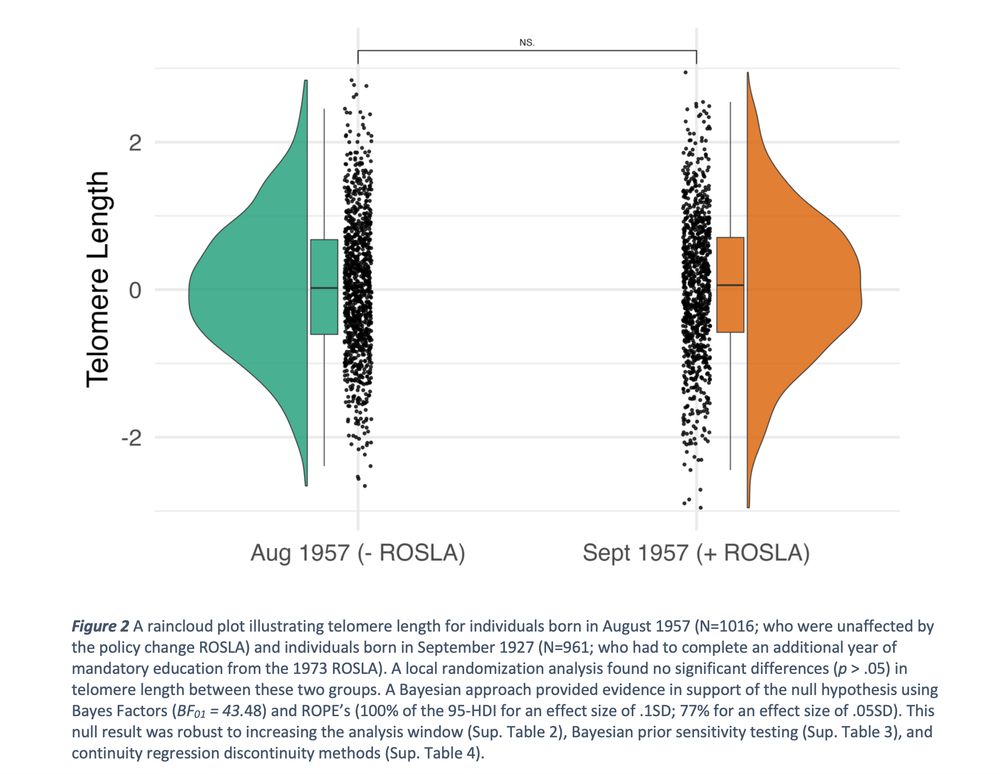
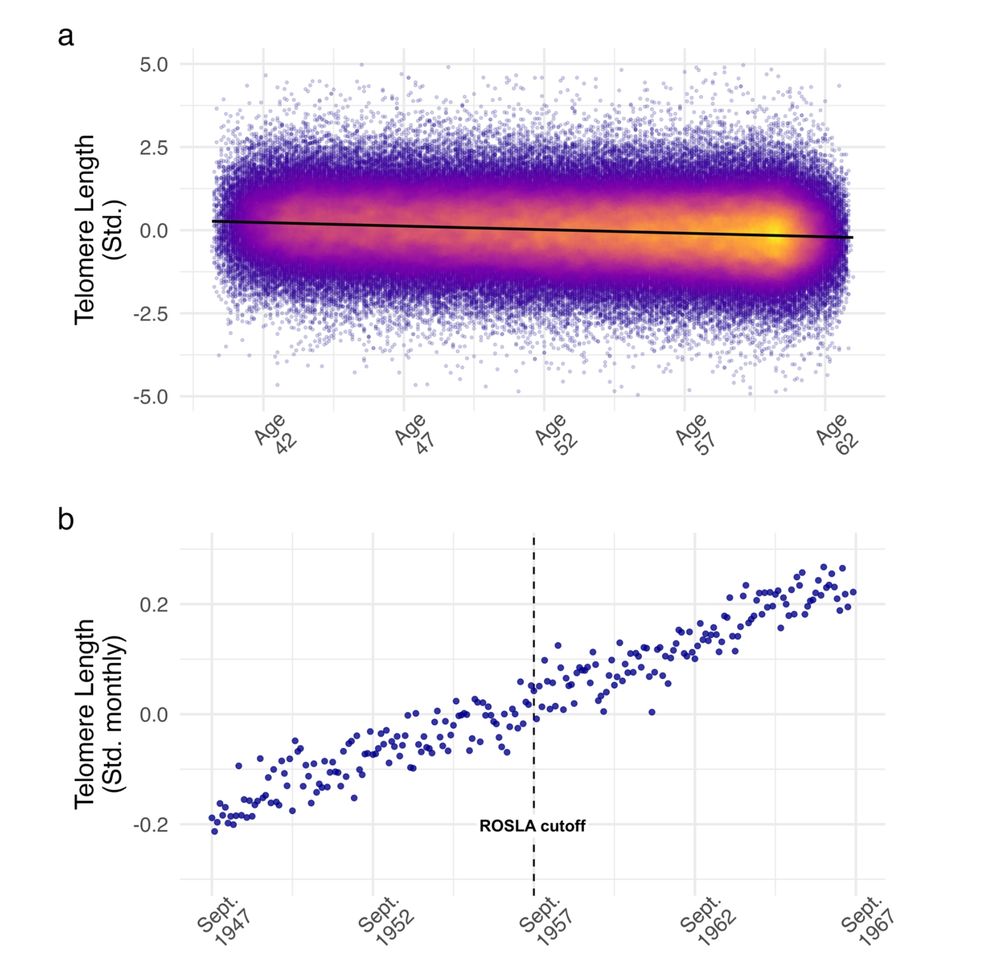
New paper by @njudd.com shows that an additional year of education doesn't causally affect telomere length in old age, despite many (theory) accounts arguing otherwise. It's been desk rejected by 13 journals happy to publish small 'positive' telomere studies. Sigh. www.biorxiv.org/content/10.1...
30.06.2025 17:35 — 👍 48 🔁 15 💬 1 📌 2
This is a really interesting paper - showing what you can and cannot infer about individual differences in change from x-sect data. A take-home-message is that typical brain age models cannot be used to measure differences in brain aging - deviations reflect stable differences between people.
30.05.2025 09:04 — 👍 1 🔁 0 💬 0 📌 0

Finally, similar to the conclusion of @didacvp.bsky.social direct.mit.edu/imag/article... long follow-up time between scans yields much higher sensitivity to detect individual differences in change than many scans: 2 scans over 4 yr better than 12 scans over 1 yr
30.05.2025 08:57 — 👍 0 🔁 0 💬 0 📌 0
PhD student @Harvard Psychology, Buckner Lab
Researching aging-related changes in brain health and cognition
@TuftsUniversity alum
🧑🧒🧒 Clinical Psychologist specializing in child and adolescent psychology
🧠 PhD student working on emotional problem development, brain and risk factors
@Neurocognitive Development Group PROMENTA, University of Oslo 🇳🇴
Research Fellow at King's College London in youth development and mental health, host of The Science or Fiction Podcast www.scienceorfiction.co.uk
PhD in Developmental Science | JSMF Postdoctoral Fellow studying the development of social cognition & interaction | Complex Systems Lab| UPenn | She/her
Imaging neuroscientist.
Brain (bio)markers, big data, MRI, meta & open/better science. Views are my own.
We are an interdisciplinary group studying human development across the lifespan at the Max Planck Institute for Human Development in Berlin. See https://www.mpib-berlin.mpg.de/research/research-centers/lifespan-psychology
Canadian social/cultural psychologist at UBC. Japanophile. Author of "Start making Sense," "DNA is not Destiny" and "Cultural Psychology."
Assistant Professor @Lund University | Neurodegenerative disease | Neuroimaging | AI | Multi-omics |
Copenhagen-based 🇩🇰 human developmental neuroscientist.
Interested in brain and behavioral developmental trajectories.
Loves heavy lifting 🏋️♀️
She/Her
www.drcmr.dk/brain-maturation
Statistics and Machine Learning, AI for a better world, academics, opinions with a colour.
Assistant Professor UMN | Studying individual differences in brain and cognitive aging. I am hiring a postdoc - https://elliottlab.psych.umn.edu/join-lab
Group Leader @ University of Tübingen
Laboratory for Mental Health Mapping
https://mhm-lab.GitHub.io
Brain/Mental Health & Machine Learning
Behavior genetics, clinical psychology, Mets. Occasional politics.
Substack (free): https://ericturkheimer.substack.com/
Book Is Out! Understanding the Nature-Nurture Debate
https://shorturl.at/Ce2hf
Electronic Version: https://shorturl.at/Fq2jv
Neuroimaging & Neuropsychology | Ageing & Alzheimer's disease | Lifestyle, sex/gender & genetic risks
Brain imaging research, Oxford
EiC, Imaging Neuroscience https://bsky.app/profile/imagingneurosci.bsky.social
Genetics, brain and more 🇦🇺🇫🇷
Working with the University of Queensland, Inria (France), Paris Brain Institute and QIMR Berghofer
Led by Beth Mormino @ Stanford. We investigate aging and neurodegenerative disease in preclinical populations utilizing biofluid and imaging biomarkers, fMRI and MRI. 🧠
https://med.stanford.edu/mormino-lab.html
Assistant prof. in NeuroInformatics & Director of Neuroimaging at the Autism Research Centre both at Cambridge Uni and fellow at Trinity College Cambridge.
www.neuroinformatics.science