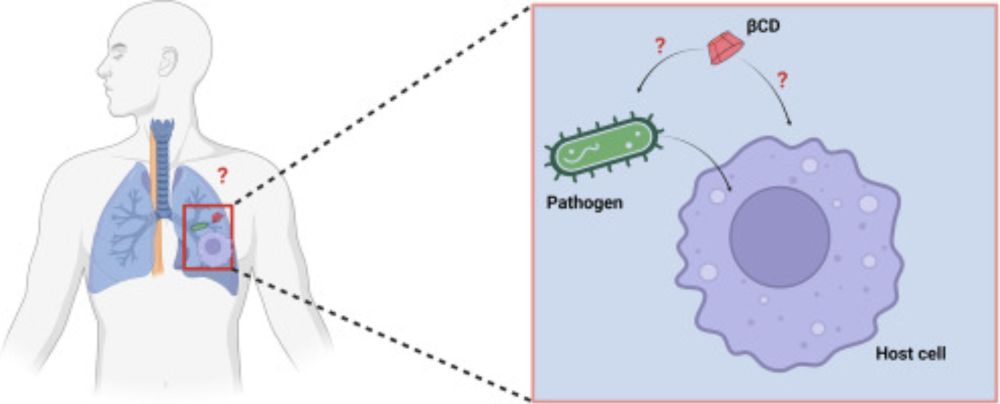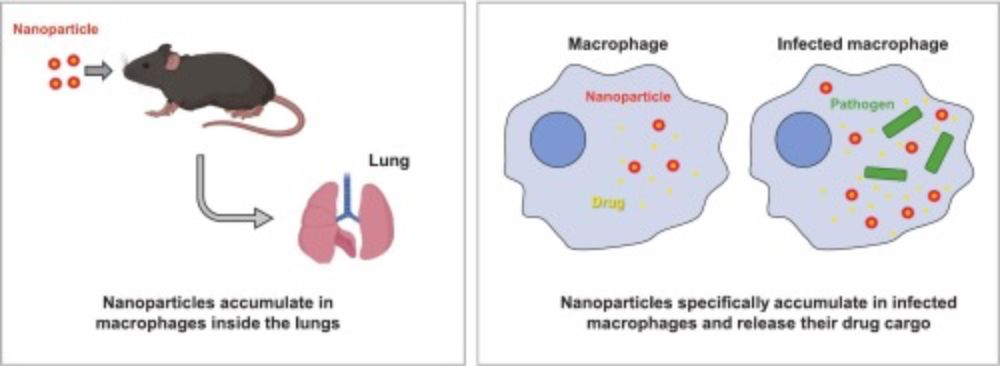
Selective accumulation of nanoparticles in infected cells for targeted drug delivery
In response to the escalating threat of infectious diseases and antimicrobial resistance, novel therapeutic strategies are under active development. A…
📢 A new pub in Journal of Controlled Release by Dr @arnaudmachelart.bsky.social group and Dr Ruxandra Gref team
“Selective accumulation of nanoparticles in infected cells for targeted drug delivery”
@inserm.fr @cnrs-hautsdefrance.bsky.social @rechercheulille.bsky.social @pasteurlille.bsky.social
22.11.2025 05:17 — 👍 4 🔁 2 💬 1 📌 0

Maladie de Lyme : comment la bactérie « Borrelia burgdorferi » nous infecte
Transmise par les tiques, la maladie de Lyme est causée par des bactéries capables de se camoufler, de s’adapter et de résister à nos défenses immunitaires grâce à d’ingénieux stratagèmes.
#Recherche
Issus du décryptage de la méthode de camouflage très efficace de la bactérie responsable de la maladie de #Lyme, 2 projets de #vaccins permettent de l’attaquer avant qu’elle ne puisse recourir à ce stratagème.
Par @sebbontempsgallo.bsky.social de @cnrs.fr
17.11.2025 08:30 — 👍 2 🔁 2 💬 0 📌 0
Félicitations pour cette nouvelle étape et bonne continuation à Bordeaux !
11.11.2025 10:09 — 👍 1 🔁 0 💬 1 📌 0
@pasteurlille.bsky.social @rechercheulille.bsky.social @cnrs.fr @cnrsbiologie.bsky.social @inserm.fr @chulille.bsky.social
11.11.2025 10:02 — 👍 0 🔁 0 💬 0 📌 0

Maladie de Lyme : comment la bactérie « Borrelia burgdorferi » nous infecte
Transmise par les tiques, la maladie de Lyme est causée par des bactéries capables de se camoufler, de s’adapter et de résister à nos défenses immunitaires grâce à d’ingénieux stratagèmes.
Nouvel article dans @theconversation.com FR : Maladie de Lyme : comment la bactérie Borrelia burgdorferi nous infecte
Comment cette bactérie déjoue notre système immunitaire et inspire de nouvelles pistes vaccinales
@cnrs-hautsdefrance.bsky.social @univlille.bsky.social
11.11.2025 10:02 — 👍 5 🔁 1 💬 1 📌 0

🚨 Postdoc Opportunity – Pathogen-Host Interaction 🚨 (2.5y)
🦠 Join our team to uncover the molecular mechanisms of Y. pestis infection in fleas within a @anrs-mie.bsky.social PEPR-funded project!
🔬 Profile: PhD in microbiology
#Postdoc #Microbiology #YersiniaPestis #ResearchJobs
05.10.2025 15:08 — 👍 8 🔁 4 💬 1 📌 0
🚨 Postdoc Opportunity – Pathogen-Host Interaction 🚨
🦠 Join our team to uncover the molecular mechanisms of Y. pestis infection in fleas within a PEPR-funded project! (2.5y)
🔬 Profile: PhD in microbiology
#Postdoc #Microbiology #YersiniaPestis #ResearchJobs
05.10.2025 15:07 — 👍 1 🔁 0 💬 1 📌 0
@cnrs-hautsdefrance.bsky.social @univlille.bsky.social @rechercheulille.bsky.social @inserm.fr
17.09.2025 02:01 — 👍 0 🔁 0 💬 0 📌 0

The Plague & Yersinia pestis team @pasteurlille.bsky.social , led by F Sebbane, shared their latest research at the Yersinia 15th Symposium in Ulaanbaatar! A Baillez presented his thesis work, A Dewitte and @sebbontempsgallo.bsky.social showcased their recent findings.
@rolandelliagus.bsky.social
17.09.2025 02:01 — 👍 7 🔁 1 💬 1 📌 1

First day of the 15th International #Yersinia symposium in Ulaanbaatar, Mongolia
16.09.2025 02:41 — 👍 0 🔁 0 💬 0 📌 0

🎓 Funded PhD position available in the team of M. Pichavant & P. Gosset! Send your CV and a brief note on why you’re excited about this opportunity.
@cnrs-hautsdefrance.bsky.social @pasteurlille.bsky.social @univlille.bsky.social @inserm.fr @chulille.bsky.social
02.09.2025 09:10 — 👍 3 🔁 2 💬 0 📌 0

Cas de peste détecté aux États-Unis : peut-on encore mourir de cette maladie ? | Ouest-France
[Ouest-France] Un cas de peste a été détecté en Californie, aux États-Unis, mardi 19 août. Pourrait-on voir réapparaître la bactérie responsable de la maladie en France, où la dernière infection connu...
⚠️ Cas de peste détecté aux USA : peut-on encore mourir de cette maladie ? Le 19 août 2025 un cas a été confirmé en Californie
Dans un article @ouest-france.fr Dr Sebbane, Chef d'équipe @inserm.fr fait le point.
@pasteurlille.bsky.social @cnrs-hautsdefrance.bsky.social @rechercheulille.bsky.social
22.08.2025 15:22 — 👍 4 🔁 1 💬 0 📌 0

Insights into Yersinia pestis evolution through rearrangement analysis of 242 complete genomes - Nature Genetics
Analysis of synteny blocks and genomic rearrangement patterns of 178 newly sequenced and 64 publicly available complete genomes of Yersinia pestis highlights the impact of key variations on genes invo...
Just out in Nature Genetics @natureportfolio.nature.com !
Wu et al. analyzed 242 Yersinia pestis genomes, uncovering IS-driven rearrangements, which enhanced #phylogenetic resolution and resolved the third #pandemic’s polytomy, revealing adaptive changes in #virulence and #stress response.
05.08.2025 12:24 — 👍 5 🔁 2 💬 0 📌 1
This work was funded by the @cnrs.fr through MITI and the @agencerecherche.bsky.social
@pasteurlille.bsky.social @univlille.bsky.social @fst-ulille.bsky.social @inserm.fr @chulille.bsky.social
02.08.2025 12:59 — 👍 0 🔁 0 💬 0 📌 0

Protocol to monitor activation of a two-component system in Dickeya dadantii during chicory leaf infection using Phos-tag gel
Quantifying the phosphorylation levels of proteins involved in bacterial signaling pathways is essential for understanding their role in stress adapta…
New pub in STAR Protocols @cp-starprotocols.bsky.social to detect the phosphorylation level of response regulators of two-component systems during host infection using a Phos-tag approach.
By @ugsf-lille.bsky.social @ciilofficiel.bsky.social
@univlille.bsky.social @cnrs-hautsdefrance.bsky.social
02.08.2025 12:59 — 👍 4 🔁 2 💬 1 📌 0
[Resources]
#AlphaFold protein and PPI prediction databases
1️⃣ Predictomes (genome maintenance & H2A/H2b) predictomes.org
2️⃣ Flypredictome www.flyrnai.org/tools/fly_pr...
3️⃣ Human interactome prodata.swmed.edu/humanPPI
4️⃣ BFVD (viral proteins) bfvd.steineggerlab.workers.dev
1/2
30.07.2025 11:28 — 👍 32 🔁 11 💬 1 📌 1
Bacterial cell wall & periplasm paradigm shift - important read #MicroSky
www.nature.com/articles/s41...
29.07.2025 16:01 — 👍 33 🔁 18 💬 1 📌 0

Climate differentially impacts ticks infected and uninfected with Borrelia burgdorferi
Climate parameters show negative correlations with B. burgdorferi infection prevalence but low impact on uninfected tick density.
#Climate extremes may reduce #Lymedisease risk?
Broughton et al. show Borrelia burgdorferi prevalence in Ixodes pacificus ticks declines under climate stress—challenging long-held assumptions about vector-borne disease and global warming.
#VectorBiology
21.07.2025 06:37 — 👍 0 🔁 0 💬 0 📌 0
We will soon hire a postdoctoral fellow. Please contact me for more details.
16.07.2025 11:40 — 👍 3 🔁 2 💬 0 📌 0
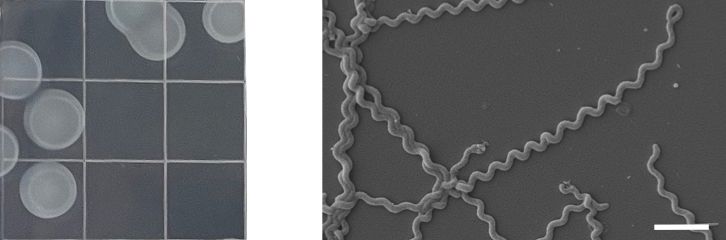
A new study delivers the most comprehensive phylogenomic analysis of Spirochaetes to date, revealing their deep evolutionary roots and shedding light on the loss of spiral morphology and host adaptation.
✍️ @microbiomol.bsky.social and coll. @pasteur.fr
📖 shorturl.at/UxAWu
#MicroSky
07.07.2025 05:20 — 👍 7 🔁 3 💬 0 📌 0
Special thanks to Dr @brandonrobin.bsky.social !
The project was carried out at @ciilofficiel.bsky.social ( @cnrs-hautsdefrance.bsky.social @inserm.fr @pasteurlille.bsky.social @univlille.bsky.social ) with financial support from @agencerecherche.bsky.social and @erc.europa.eu
01.07.2025 19:35 — 👍 3 🔁 0 💬 0 📌 0

Exploring temperature-dependent transcriptomic adaptations in Yersinia pestis using direct cDNA sequencing by Oxford Nanopore Technologies - Scientific Reports
Scientific Reports - Exploring temperature-dependent transcriptomic adaptations in Yersinia pestis using direct cDNA sequencing by Oxford Nanopore Technologies
📢 Our latest article is out!
We present a cost-effective in-house #RNASeq workflow using @nanoporetech.com direct cDNA, perfect for high-risk pathogens.
Applied to #Yersinia pestis, transcriptomic profiling (21 °C/flea vs 37 °C/host) reveals novel operons & sulfur metabolism upregulation.
01.07.2025 19:35 — 👍 5 🔁 2 💬 1 📌 0
Chercheuse, expérimentation, médiation scientifique, arts, bd...
Relaying microbiology news, articles and comments relevant to aspects on bacteria, fungi, viruses and other microbes / microorganisms. Microbes are 💪
Our lab uncovers hidden microbial complexity and evolutionary innovations that challenge traditional views of bacterial life
https://www.vollandlab.com/
Assistant Professor at Toulouse University, interested in medicinal chemistry, organic synthesis, natural products and biochemistry. In the global effort to combat antimicrobial resistance.
Observatoire français des tornades et orages violents | Tornado storm french laboratory | météo, climat, risques | keraunos.org
Cell aims to publish the most exciting and provocative research in biology. Posts by Scientific Editors on the Cell editorial team. See the latest papers at https://www.cell.com/cell/
A monthly, peer-reviewed journal from Cell Press devoted to Systems Biology. Posts from the Editors.
The scientific editors of Cell Host & Microbe, a Cell Press journal, bring you the latest information and insights from the forefront of host-microbe research.
A multi-disciplinary, gold #OA journal publishing cutting-edge methodological advances. @cellpress.bsky.social
A Cell Press journal publishing cutting-edge research in metabolism biology, from molecular/cellular biology to translational and clinical studies.
An open access journal from @CellPress.bsky.social, publishing cutting-edge research across the physical sciences. Posts by the editorial team. https://cell.com/cell-reports-physical-science/home
TIBS is celebrating its 50th anniversary in 2026 - join in the fun and share your ideas with us!
To learn more, visit: https://www.cell.com/trends/biochemical-sciences/anniversary
Managed by editor @sanniejculbertson.bsky.social
Posts by Shankar Iyer, editor of Trends in Microbiology.
A reviews journal from Cell Press that fosters an appreciation for advances being made on all fronts of genetic research.
Editor: Maria Smit
https://www.cell.com/trends/genetics/home
Cell Press partners with scientists across all disciplines to publish and share work that will inspire future directions in research. #ScienceThatInspires
Pursuing my PhD in Microbiology at the University of Namur under Dr Regis Hallez.
Entomology research tech with Agriculture and Agri-Food Canada, living in southwest BC.