Knowing little about this, I’d ask how complex matrix C (the FC map) is - how many baseline circuits and regions there are. If it’s only a few highly connected regions in few circuits (eg the DMN), then I see their point. If the # of circuits >> # patients and lesions, then LNM should be valid?
18.01.2026 12:19 —
👍 1
🔁 0
💬 0
📌 0

Graph titled "Paying for Impact 2025" showing Article Processing Charge (APC) vs Impact Factor for a selection of top journals in neuroscience - linear trendline R^2=0.636
Updating this graph for the holidays 🎁
(datapoints are a selection of journals publishing in neuroscience)
24.12.2025 22:00 —
👍 12
🔁 3
💬 0
📌 0

Introducing Nature Baubles
Science has changed.
Introducing Nature Baubles, the latest addition to Nature Portfolio. open.substack.com/pub/andrewms...
24.12.2025 02:43 —
👍 3
🔁 0
💬 0
📌 0
Hi Usha, I would be happy to discuss the misinformed narrative about the Alzheimer’s field Piller is pushing. And perhaps you or he can explain why my ongoing work and that of thousands of others is part of a “Devastating Legacy of Lies.”
03.12.2025 11:31 —
👍 1
🔁 0
💬 0
📌 0
I fully agree. The term LLPS is probably not the correct one to describe what happens in cells.
However, the formation of dynamic low-order condensates driven by low affinity multivalent proteins (often highly disordered) seems to occur in cells.
30.11.2025 16:06 —
👍 9
🔁 2
💬 1
📌 0
If not LLPS, what term would you use to describe these quick off-rate polyvalent structures that show rapid FRAP recovery, droplet-mixing, etc? QuORPS?
16.11.2025 23:44 —
👍 2
🔁 0
💬 2
📌 0
Well I see the appeal of using “liquid” as a term to describe a collection of polyvalent interactors, sliding along one another through rapid associations and dissociations. What would be a better term for this, distinct from aggregates with irreversible monovalent (oligovalent?) interactions?
16.11.2025 19:33 —
👍 2
🔁 0
💬 1
📌 0
Do you think it better to describe condensates as concentrations of disordered macromolecules with specific but polyvalent interactions and quick off-rates?
16.11.2025 18:41 —
👍 3
🔁 0
💬 1
📌 0

Any cryoEM folks know what these strange zebra-stripe particles are in a prep from human brain?
31.10.2025 14:00 —
👍 3
🔁 0
💬 0
📌 0
We are looking to hire a postdoc to take this and other TDP-43 assay development forward! Please re-post!
24.10.2025 20:58 —
👍 3
🔁 1
💬 1
📌 0
Genetic and proteomic analysis identifies BAG3 as an amyloid-responsive regulator of neuronal proteostasis
Our study “Genetic and proteomic analysis identifies BAG3 as an amyloid‑responsive regulator of neuronal proteostasis" was published in Acta Neuropathologica this week! Congratulations to lead author Zach Augur, who will be defending his thesis later this week!!
link.springer.com/epdf/10.1007...
15.10.2025 14:08 —
👍 4
🔁 3
💬 0
📌 0
My lab is hiring a postdoc to work on new TDP-43 biomarkers! Please get in touch and re-post!
25.07.2025 15:18 —
👍 6
🔁 8
💬 0
📌 1

New hope for Alzheimer’s: Groundbreaking Harvard study finds lithium reverses brain aging - The Boston Globe
The research suggests a new approach to preventing and treating the mind-robbing disease.
BREAKING: Field makes inchwise progress over decades on intractable problem of dementia with interesting leads and blind alleys but smart people are doing their best and please don’t overinterpret their results because it takes a long time for a real breakthrough
www.bostonglobe.com/2025/08/06/m...
07.08.2025 14:19 —
👍 3
🔁 0
💬 0
📌 0
First highlight...
Senator Capito started of the discussion saying that the bill contains AN INCREASE for NIH.
The details are not available, but the bill will be released ofter the hearing.
This is not a done-deal, but it does show where the Senate is on a bipartisan basis.
31.07.2025 16:12 —
👍 120
🔁 29
💬 2
📌 7
My lab is hiring a postdoc to work on new TDP-43 biomarkers! Please get in touch and re-post!
25.07.2025 15:18 —
👍 6
🔁 8
💬 0
📌 1
Well said!
27.05.2025 23:49 —
👍 3
🔁 0
💬 1
📌 0
Thanks guys. To be clear, I still favor that antibody directly binding to CAA could be a cause of ARIA. We just found that the difference in ARIA-E between lec and adu can’t be fully explained by differences in CAA preference.
22.05.2025 12:51 —
👍 3
🔁 0
💬 1
📌 0
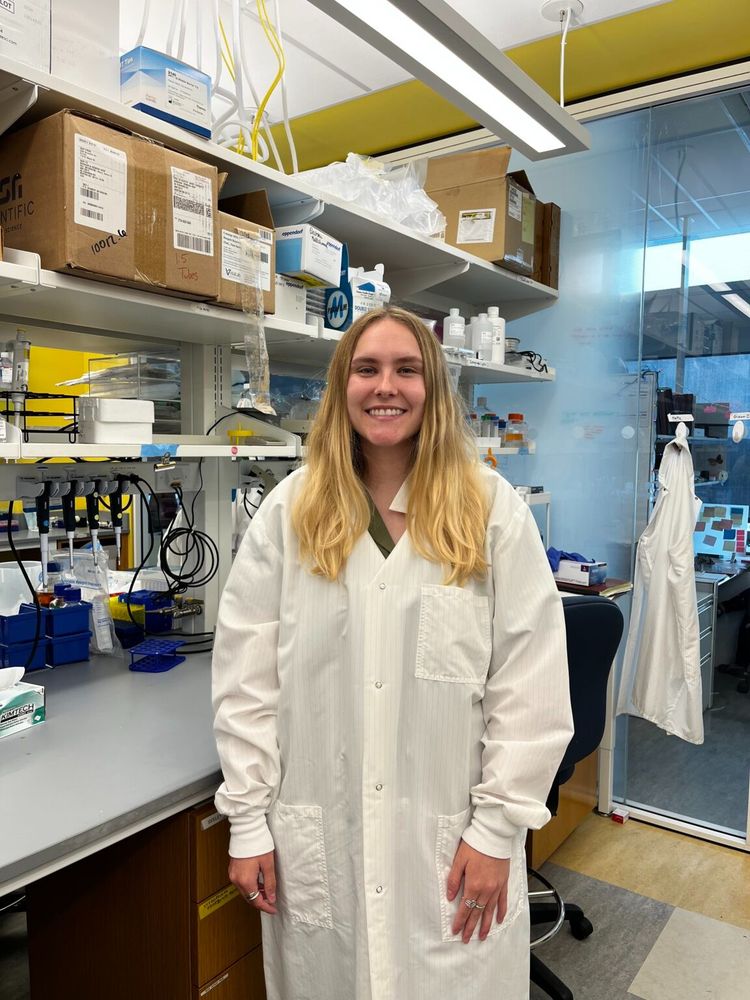
Congratulations our newly-minted PhD candidate Olivia Pembridge on passing her PQE with flying colors today! Olivia will be using a wide array of iPSC and organoid models to study mechanisms of neurodevelopment!
11.04.2025 23:50 —
👍 9
🔁 4
💬 0
📌 0
If you're headed to #ADPD next week, be sure to stop by the TYP lab presentations by @gizemterzioglu.bsky.social and Zach Augur to learn about some of the amazing work the lab is doing!
28.03.2025 22:12 —
👍 8
🔁 2
💬 1
📌 1
Zach Augur will be presenting a poster during Shift 1 on April 2nd and 3rd titled "BAG3 IN ALZHEIMER’S DISEASE AND ITS IMPACT ON ASTROCYTE FUNCTION AND DISEASE PROGRESSION"
28.03.2025 22:13 —
👍 3
🔁 2
💬 1
📌 0
@gizemterzioglu.bsky.social will be presenting at the Microglia Symposium on the afternoon of April 4th! Her talk is titled "INPP5D/SHIP1 REGULATES MICROGLIA FUNCTION AND INFLAMMATORY RESPONSE IN ALZHEIMER'S DISEASE"
28.03.2025 22:27 —
👍 5
🔁 3
💬 0
📌 0