De novo origin and evolution of an antimicrobial protein function https://www.biorxiv.org/content/10.64898/2026.02.05.703623v1
07.02.2026 06:31 — 👍 2 🔁 1 💬 0 📌 0
Check out our new review in Nature Reviews Genetics on de novo emerged genes and proteins. How they emerge, are lost and persist - and how de novo emerged proteins relate to randomized proteins! @bornberglab.bsky.social www.nature.com/articles/s41...
28.01.2026 18:23 — 👍 52 🔁 25 💬 3 📌 2

Emergence and evolution of protein-coding de novo genes
Nature Reviews Genetics - De novo gene evolution entails the birth of new genes from previously non-coding DNA. In this Review, Bornberg-Bauer and Eicholt overview how protein-coding de novo genes...
New review out in Nat Rev Genet: Emergence & evolution of protein-coding de novo genes by Erich and Lars Eicholt @lacholt.bsky.social. How non-coding DNA becomes translated, persists or is lost in populations, and can yield structured/functional proteins—plus methods & open questions! rdcu.be/e09SM
28.01.2026 18:18 — 👍 16 🔁 6 💬 1 📌 1

🚨Hiring a postdoc!
Are you interested in #evolutionarygenomics, #sexchromosomes, #transposableelements & #Sexspecific #recombination in 🐸🧬?
Join my lab @vubrussel.bsky.social
🔹 @fwovlaanderen.bsky.social funded up to 3y
🔹 Deadline 10/3/2026
🔹 Start ~1/6/2026
Apply 👉: jobs.vub.be/job/Elsene-P...
22.01.2026 09:37 — 👍 8 🔁 8 💬 0 📌 0
Pervasive translation of short open reading frames and de novo gene emergence in Arabidopsis
Ancestrally non-genic sequences are now widely recognized as potential reservoirs for the de novo emergence of new genes. Across clades, some de novo genes were proven to have substantial phenotypic effects, and to contribute to the emergence of novel biological functions. Yet, still very little is known about the starting material from which de novo genes emerge, especially in plants. To fill this gap, we generated Ribosome Profiling data from the closely related species Arabidopsis halleri, A. lyrata and A. thaliana and characterized genome-wide patterns of translation across them. Synteny analysis revealed 211 Open Reading Frames (ORFs) that have emerged de novo within the Arabidopsis genus and already exhibit signs of active translation. Most of these de novo translated ORFs were species- and even accession-specific, indicating their transient nature, with patterns of polymorphism consistent with neutral evolution in natural populations. They were also significantly shorter and less expressed than conserved Coding DNA Sequences (CDS), and their GC content increased with phylogenetic conservation. While most of them were located in intergenic regions and are thus newly discovered, 34 were previously annotated as CDS in at least one genome, and are promising putative genes. Our results demonstrate the abundance of translation events outside of conserved CDS, and their role as starting material for the emergence of novel genes in plants. ### Competing Interest Statement The authors have declared no competing interest. Université de Lille, https://ror.org/0546v5182
🧬 What does the starting material from which genes could emerge #denovo look like?
🌱 We used #RiboSeq to investigate the landscape of translated de novo ORFs in 3 #Arabidopsis species, and how they might be linked to gene birth!
📝 Check out our preprint here:
doi.org/10.1101/2025...
20.01.2026 10:58 — 👍 9 🔁 6 💬 1 📌 0

De Novo Genes: Current Status and Future Goals
Abstract. The recent Society for Molecular Biology and Evolution Satellite Meeting on De Novo Gene Birth, hosted at Texas A&M University on November 6
@ccasola.bsky.social, V. Luria, @vakirlis.bsky.social & @lizhao.bsky.social discuss advances and open questions in de novo gene emergence and evolution presented at the SMBE Satellite Meeting on De Novo Gene Birth (@official-smbe.bsky.social).
🔗 doi.org/10.1093/gbe/evaf230
#genome #evolution
29.12.2025 18:30 — 👍 9 🔁 7 💬 0 📌 0

a woman says " would you like to join us " with her eyes closed
ALT: a woman says " would you like to join us " with her eyes closed
📢 Open faculty position – Origins of Life
We have an opening in our section at the University of Geneva! 🧬🚀
SPREAD THE WORD
Apply here: jobs.unige.ch/www/wd_porta...
16.01.2026 17:49 — 👍 45 🔁 39 💬 1 📌 1

It was an immense pleasure to be back in Lille and present work from my PhD @popgroup2026.bsky.social , a huge thanks to the organizers! 😁
#PGG59
09.01.2026 10:30 — 👍 7 🔁 1 💬 0 📌 0
Post-Doc – bornberglab.org
📢 Job alert: Post-Doc Position in the project "Functional annotation of genomic🧬 innovations in a densely populated clade🪰 with deep learning 💻" Join the GEvol community in a collaborative project between @bornberglab.bsky.social and @katharinahoff.bsky.social lab.
👉 bornberglab.org/post-doc-pos...
26.11.2025 10:09 — 👍 5 🔁 7 💬 0 📌 0
Open Positions – GEvol – DFG SPP 2349
Open Positions – GEvol – DFG SPP 2349
Postdoctoral Research Associates are sought for the GEvol project on evolutionary genomics. Candidates should have programming and data analysis skills. More info: https://g-evol.uni-muenster.de/open-positions/ #postdoc
03.12.2025 15:32 — 👍 1 🔁 9 💬 0 📌 0
My generation had to deal with datasets where Excel had autocorrected gene names to dates. Future generations are going to have to deal with the hallucinations of slopbots.
14.08.2025 14:03 — 👍 45 🔁 20 💬 0 📌 0

A table showing profit margins of major publishers. A snippet of text related to this table is below.
1. The four-fold drain
1.1 Money
Currently, academic publishing is dominated by profit-oriented, multinational companies for
whom scientific knowledge is a commodity to be sold back to the academic community who
created it. The dominant four are Elsevier, Springer Nature, Wiley and Taylor & Francis,
which collectively generated over US$7.1 billion in revenue from journal publishing in 2024
alone, and over US$12 billion in profits between 2019 and 2024 (Table 1A). Their profit
margins have always been over 30% in the last five years, and for the largest publisher
(Elsevier) always over 37%.
Against many comparators, across many sectors, scientific publishing is one of the most
consistently profitable industries (Table S1). These financial arrangements make a substantial
difference to science budgets. In 2024, 46% of Elsevier revenues and 53% of Taylor &
Francis revenues were generated in North America, meaning that North American
researchers were charged over US$2.27 billion by just two for-profit publishers. The
Canadian research councils and the US National Science Foundation were allocated US$9.3
billion in that year.

A figure detailing the drain on researcher time.
1. The four-fold drain
1.2 Time
The number of papers published each year is growing faster than the scientific workforce,
with the number of papers per researcher almost doubling between 1996 and 2022 (Figure
1A). This reflects the fact that publishers’ commercial desire to publish (sell) more material
has aligned well with the competitive prestige culture in which publications help secure jobs,
grants, promotions, and awards. To the extent that this growth is driven by a pressure for
profit, rather than scholarly imperatives, it distorts the way researchers spend their time.
The publishing system depends on unpaid reviewer labour, estimated to be over 130 million
unpaid hours annually in 2020 alone (9). Researchers have complained about the demands of
peer-review for decades, but the scale of the problem is now worse, with editors reporting
widespread difficulties recruiting reviewers. The growth in publications involves not only the
authors’ time, but that of academic editors and reviewers who are dealing with so many
review demands.
Even more seriously, the imperative to produce ever more articles reshapes the nature of
scientific inquiry. Evidence across multiple fields shows that more papers result in
‘ossification’, not new ideas (10). It may seem paradoxical that more papers can slow
progress until one considers how it affects researchers’ time. While rewards remain tied to
volume, prestige, and impact of publications, researchers will be nudged away from riskier,
local, interdisciplinary, and long-term work. The result is a treadmill of constant activity with
limited progress whereas core scholarly practices – such as reading, reflecting and engaging
with others’ contributions – is de-prioritized. What looks like productivity often masks
intellectual exhaustion built on a demoralizing, narrowing scientific vision.

A table of profit margins across industries. The section of text related to this table is below:
1. The four-fold drain
1.1 Money
Currently, academic publishing is dominated by profit-oriented, multinational companies for
whom scientific knowledge is a commodity to be sold back to the academic community who
created it. The dominant four are Elsevier, Springer Nature, Wiley and Taylor & Francis,
which collectively generated over US$7.1 billion in revenue from journal publishing in 2024
alone, and over US$12 billion in profits between 2019 and 2024 (Table 1A). Their profit
margins have always been over 30% in the last five years, and for the largest publisher
(Elsevier) always over 37%.
Against many comparators, across many sectors, scientific publishing is one of the most
consistently profitable industries (Table S1). These financial arrangements make a substantial
difference to science budgets. In 2024, 46% of Elsevier revenues and 53% of Taylor &
Francis revenues were generated in North America, meaning that North American
researchers were charged over US$2.27 billion by just two for-profit publishers. The
Canadian research councils and the US National Science Foundation were allocated US$9.3
billion in that year.

The costs of inaction are plain: wasted public funds, lost researcher time, compromised
scientific integrity and eroded public trust. Today, the system rewards commercial publishers
first, and science second. Without bold action from the funders we risk continuing to pour
resources into a system that prioritizes profit over the advancement of scientific knowledge.
We wrote the Strain on scientific publishing to highlight the problems of time & trust. With a fantastic group of co-authors, we present The Drain of Scientific Publishing:
a 🧵 1/n
Drain: arxiv.org/abs/2511.04820
Strain: direct.mit.edu/qss/article/...
Oligopoly: direct.mit.edu/qss/article/...
11.11.2025 11:52 — 👍 641 🔁 453 💬 8 📌 66

FlyBase secures funding for year, but future still uncertain
The FlyBase team’s fundraising efforts have proven successful in the short term, but restoration of its federal grant remains uncertain.
🪰 folks! I spoke to the Transmitter about FlyBase. As noted at flybase.org, bridge $ ran out and many staff were laid off.
Good news is stopgap contributions will keep core FlyBase operations active. But community support remains essential. Please donate @FlyBase and share! 1/2
tinyurl.com/FlyBase
29.10.2025 12:31 — 👍 51 🔁 35 💬 2 📌 0

#PortraitdeScience 👩🔬
Découvrez le Portrait de @mariemonniaux.bsky.social, chargée de recherche #EvoEcoPaleo !
Marie Monniaux consacre ses recherches à un phénomène fascinant : l’auto-incompatibilité chez les fleurs🌷
➡️ www.hauts-de-france.cnrs.fr/fr/cnrsinfo/...
👋 @cnrsecologie.bsky.social
16.09.2025 08:59 — 👍 10 🔁 5 💬 0 📌 1
bioRxiv bat signal. We had a huge influx of submissions around Labor Day and now have a backlog. If any affiliates are available to screen, we'd be eternally grateful!
04.09.2025 17:44 — 👍 22 🔁 19 💬 5 📌 0
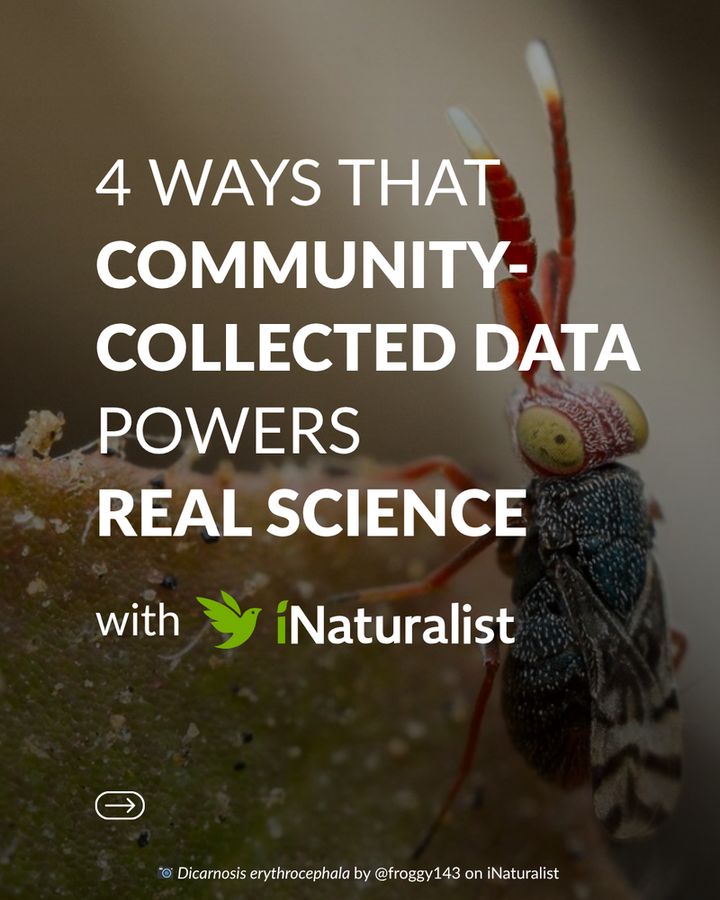
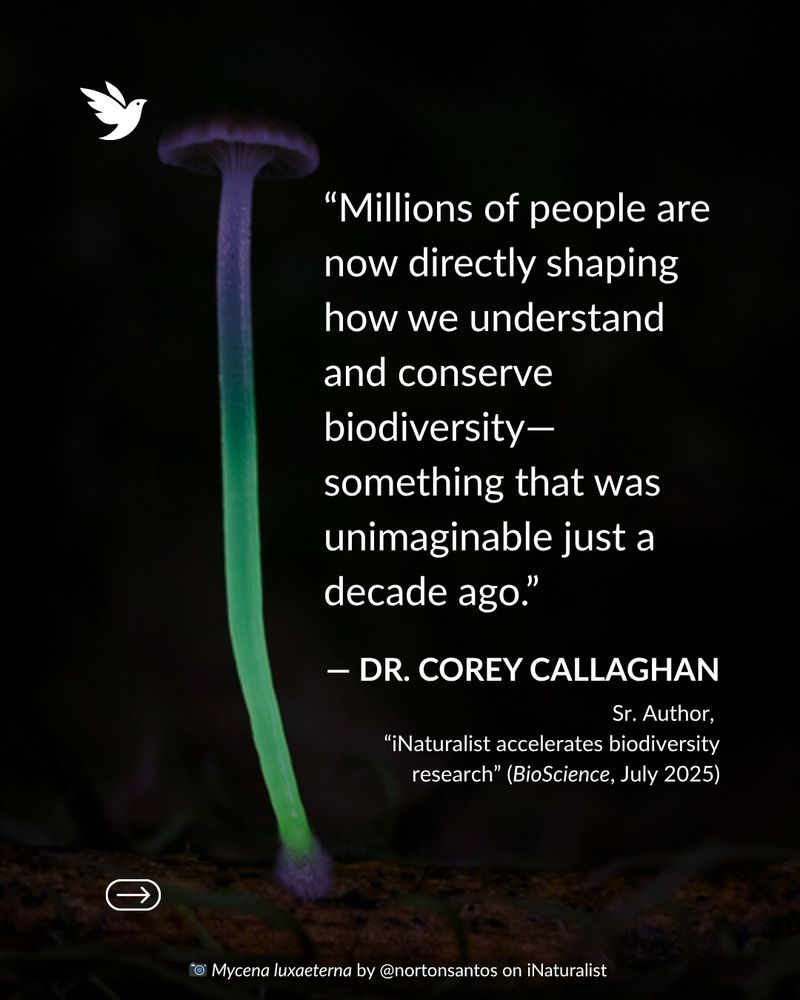
This new paper documents a tenfold increase in research papers using community-collected iNaturalist data over just five years: tr.ee/89Ot3I
According to the study, here are four key ways that iNaturalist data directly powers science 🧵⤵️
28.07.2025 16:37 — 👍 110 🔁 43 💬 2 📌 3
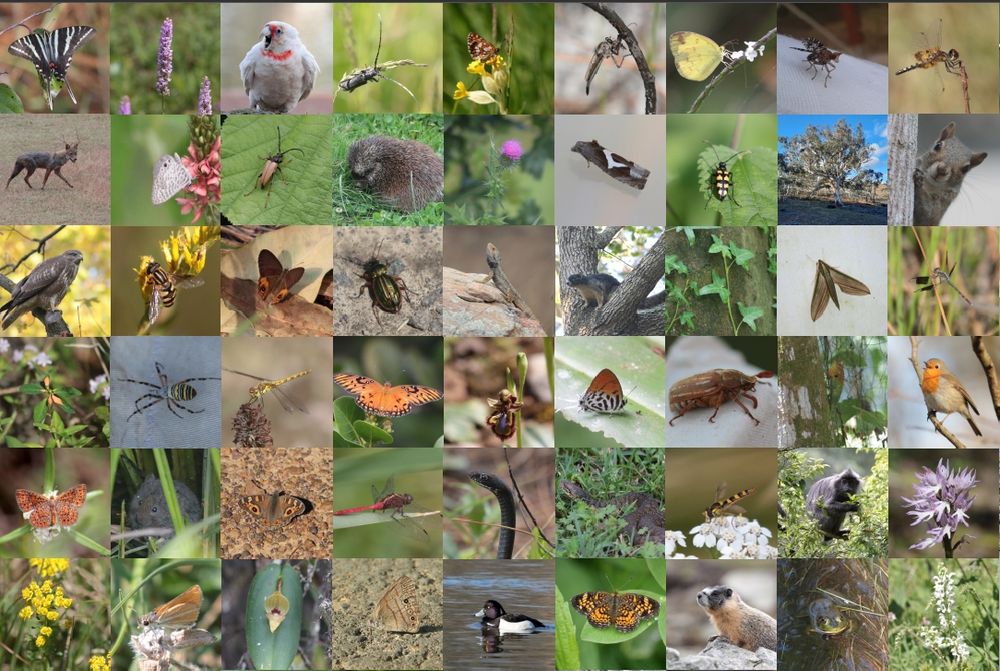
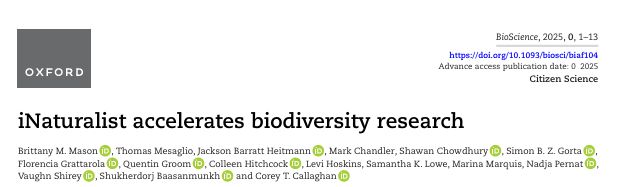
Our new paper in BioScience shows how iNaturalist data is powering research across the globe, with use growing 10x in 5 years and spanning 128 countries & 638 families of life.
Paper: doi.org/10.1093/bios...
@ifas.ufl.edu @inaturalist.bsky.social
#Biodiversity #iNaturalist #OpenScience
28.07.2025 15:41 — 👍 14 🔁 7 💬 2 📌 1
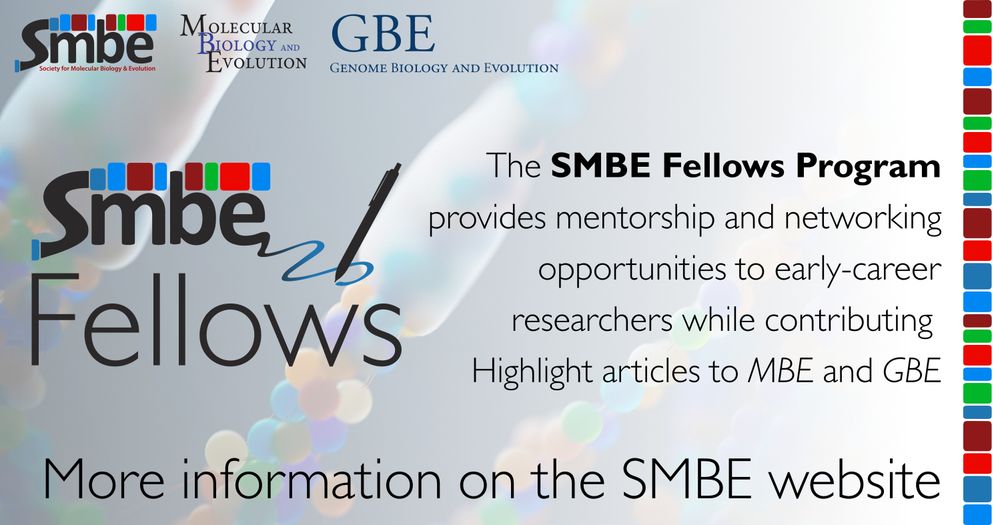
We are excited to announce the SMBE Fellows Program! ✍️
Designed to provide networking and mentorship opportunities to early-career researchers through scientific writing in evolutionary biology for @molbioevol.bsky.social and @genomebiolevol.bsky.social
📆 Aug. 31
🔗 smbe.org/smbe-fellows-program
28.07.2025 08:53 — 👍 42 🔁 36 💬 2 📌 2
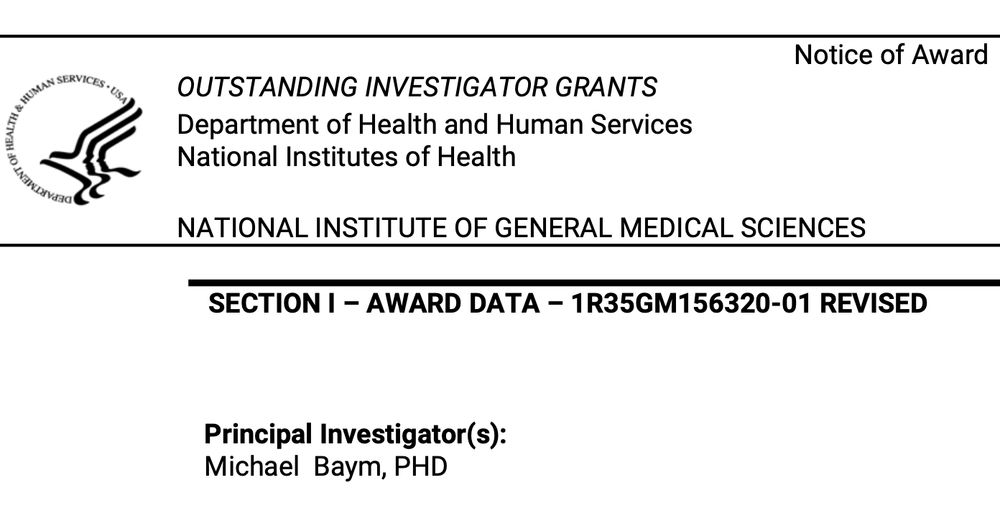
A screenshot of the termination notice showing "Outstanding Investigator Grants"
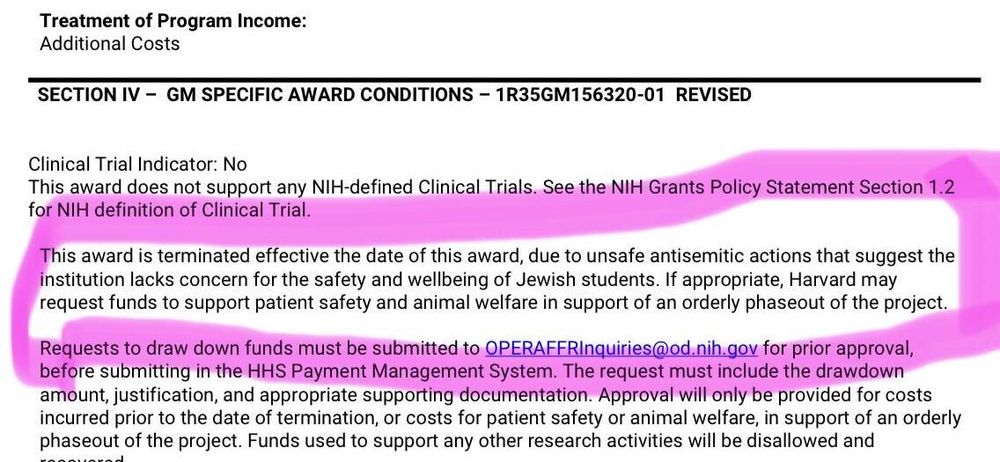
A screenshot of the termination notice with "This award is terminated effective the date of this award, due to unsafe antisemitic actions that suggest the institution lacks concern for the safety and wellbeing of Jewish students." highlighted
Yesterday, the NIH R35 “Outstanding Investigator” grant to fund scientists in my lab studying antibiotic resistance was terminated for reasons not related to the content of the science, or any actions taken by me or members of my lab
13.05.2025 23:37 — 👍 879 🔁 579 💬 144 📌 73
🚨 Another major round of #NSF terminations today 😞. Please report and encourage your colleagues to as well! We need this info to shed light on the damage caused, and to organize and advocate for science that includes and benefits all. airtable.com/appGKlSVeXni... 🧪
25.04.2025 17:54 — 👍 131 🔁 107 💬 0 📌 6
Si tel n'est pas le cas, il serait peut-être judicieux d'effectuer un petit rappel auprès de vos effectifs 😉
06.04.2025 11:08 — 👍 0 🔁 0 💬 0 📌 0
Bonjour chère @education-gouv.bsky.social,
Ma mère institutrice au sein de l'académie d'Amiens, a demandé une journée pour être présente à ma soutenance.
Son absence lui est maintenant reprochée par le rectorat, selon lequel une soutenance de thèse n'est pas un "motif valable".
Vous confirmez ?
06.04.2025 11:07 — 👍 0 🔁 0 💬 1 📌 0
Postdoc in Claudia Bank’s group at the University of Bern. Promoters, emergence, fitness landscapes, dogs 🐶 and triathlon 🏊 🚲 🏃. He/him 🏳🌈.
timothyfuqua.com
PhD Candidate
Barber lab, University of Oregon
Microbiology Biochemistry Evolutionary biology
Evolutionary Genomics Researcher
Adaptation, Transposon Elements, and Population Genetics.
University of Münster, Germany
Evolution, Ecology & Genomics | @erc.europa.eu grantee | Assistant Professor @VUBrussel | immigrant🇨🇳🇳🇱🇨🇭🇬🇷🇳🇱🇺🇸🇧🇪| mom to two👶 runner #newPI
Evolutionary biologist interested in the population genetics and genomics of selfing organisms.
Post-doc at Uni. of Edinburgh.
PhD student in Uppsala University and Zhejiang University
Bluesky account of the DFG-funded SPP 2349 "Genomic Basis of Evolutionary Innovations" (coordinator: E. Bornberg-Bauer, University Münster)
http://g-evol.com
Seminar on Protein Structure Evolution every 2nd Tue, 4 PM GMT.
Link: https://tinyurl.com/prose-seminar2
By @claudiaalcar.bsky.social @caro-rocha.bsky.social @lacholt.bsky.social @zachary-ardern.bsky.social @romeritos.bsky.social @hassanzaman.bsky.social
Deeply curious about Life, the Universe and Everything
Evolution · SynBio · Gene Regulation · Microbes
Group Leader @EPFL.bsky.social ELISIR Scholar - Systems and Synthetic Evolutionary Biology Lab
PostDoc @Wagner Lab UZH
🇧🇷🌈 he/him
The 2026 edition will be held in Lille (France) on 7-9 January ! https://populationgeneticsgroup.org.uk/
Personally done with meiosis I. Professionally in love with it.
Permanent researcher at I2BC 🇫🇷 Arabidopsis 🌱 Sordaria 🍄 Genetics/Genomics 🧬 Fixed and live imaging 🔬.
#meiosis4ever her/she
Chief Science and Strategy Officer, openRxiv. Co-Founder, bioRxiv and medRxiv.
RNA biologist who enjoys travelling, art galleries, food, listening to Bruce Springsteen, hiking and spending time with family. My group at Leeds dissect mechanisms of translational regulation, ribosomes and novel sites of translation.
The Earth BioGenome Project (EBP), a moonshot for biology, aims to sequence, catalog, and characterize the genomes of all of Earth's eukaryotic biodiversity over a period of ten years.
🌲Keep up with all EBP updates: https://linktr.ee/earthbiogenomeproject
The European Liaison Office of the German Research Organisations (KoWi) informs, advises and trains on EU research funding.
GBE publishes leading original research at the interface between evolutionary biology and genomics.
🔗 academic.oup.com/gbe
🏠 @official-smbe.bsky.social
🤝 @molbioevol.bsky.social
#genome #evolution #science #biology #societyjournal
MBE publishes fresh insights into the patterns and processes that impact the evolution of life at molecular levels.
🔗 academic.oup.com/mbe
🏠 @official-smbe.bsky.social
🤝 @genomebiolevol.bsky.social
#evobio #molbio #science #biology #societyjournal
Exploring #SyntheticBiology & #Bioinformatics + Documenting my learning journey | Built by @noureldenrihan.bsky.social | 🌐 djosergenomics.github.io
Working @adelmanlab.bsky.social @hms-bcmp.bsky.social + Vik Khurana lab @mgbresearch.bsky.social. Previously at Eilers/Wolf Lab @uni-wuerzburg.de. Interested in transcription and dsRNA biology - with a special focus on RNA Pol II.
Originally from Slovenia, currently living in Uppsala 🇸🇪
PhD Candidate @uu.se at Ivarsson lab studying #evolution of #structure and #function in #denovo microproteins.
Dark proteome explorer 🚀 lover of #IDPs🍜 and #SLiMs🧩