apod.1082117200.bin
#apod 2026-02-09
Miranda Revisited
Web page: https://apod.nasa.gov/apod/ap260209.html

@wigmund.bsky.social
40+ year old with a pair of cats living in Northwest Arkansas that likes a bunch of random shit. I sometimes get out on the weekends to take nature photos. Feel free to correct any labels I have on my photos, not an expert and appreciate the help.
apod.1082117200.bin
#apod 2026-02-09
Miranda Revisited
Web page: https://apod.nasa.gov/apod/ap260209.html

A Great Grey Owl with wings spread and legs stretched out.

A juvenile Barred Owl looks out from behind a tree.

A Northern Saw Whet owl sitting on a branch. It is brown and white with piercing yellow eyes.

A Boreal Owl sitting on a branch. She looks almost round and has bright yellow eyes. She is unbelievably adorable.
Happy Superb Owl Sunday! #SuperbOwl #owls #wildlife
08.02.2026 17:14 — 👍 188 🔁 37 💬 4 📌 1
Most of the Sun is pictured peeking over a hill. On the surface of the Sun are several sunspots including a very large sunspot region toward the center-right. Please see the explanation for more detailed information.
🔭 Active Sunspot Region 4366 Crosses the Sun
Image Credit & Copyright: Daniel Korona
apod.nasa.gov/apod/ap26020...
sabrina carpenter singing islands in the stream w the muppets has healed me in ways i did not know i needed
06.02.2026 02:46 — 👍 1925 🔁 592 💬 24 📌 91Today was a decent 42nd birthday.
Had lunch with my grands (grandmother turned 87 yesterday) and my maternal folks from a local cuban joint while rewatching the new Muppet Show.
Fried pork chunks with grilled onions, black beans and white rice along with a couple of maduros is ridiculously filling

Bruce McCandless floating untethered in space anove the Earth.
this ICONIC and terrifying photo was taken on this day in 1984.
it shows astronaut bruce mccandless floating UNTETHERED in space.
The aurora last night in Beaver, Alaska was just incredible. This is a real-time video (not sped up) of the crazy motion I saw. Also, look how BRIGHT it is, wow!
07.02.2026 21:02 — 👍 3460 🔁 717 💬 69 📌 50
Image of the Yeti in the skiing Windows game SkiFree eating the player
Breaking: Tragedy at the Winter Olympics
07.02.2026 15:39 — 👍 7274 🔁 2232 💬 67 📌 61Horror movie in which the party being chased by a seemingly unstoppable monster find that it is empowered by and tracks whoever is currently attracted to it.
Movie goes paranoia route as party tries to figure out who's the monsterfucker and how attracted one can be without triggering the sexy beast

A cartoon illustration of a woman playing a video game in on old mansion surrounded by little ghosts watching. Caption reads "Self-isolating in the old mansion hadn't really been very isolating at all."
Company. #grickledoodle #ghosts #isolation #games #horror #cartoon #art #drawing #funny
07.02.2026 20:31 — 👍 361 🔁 93 💬 0 📌 4Take 2 minutes of your time and watch "The Hyrule Fantasy", a lovely Zelda fan film by french animator Ousmane Cissé.
www.catsuka.com/news/2026-02...

#InTheDarknessISee how my cat perks right up.
06.02.2026 00:23 — 👍 599 🔁 66 💬 11 📌 4
Peering from the shadows, the Saturn-facing hemisphere of tantalizing inner moon Enceladus poses in this Cassini spacecraft image. North is up in the dramatic scene captured during November 2016 as Cassini's camera was pointed in a nearly sunward direction about 130,000 kilometers from the moon's bright crescent. In fact, the distant world reflects over 90 percent of the sunlight it receives, giving its surface about the same reflectivity as fresh snow. A mere 500 kilometers in diameter, Enceladus is a surprisingly active moon. Data and images collected during Cassini's flybys have revealed water vapor and ice grains spewing from south polar geysers and evidence of an ocean of liquid water hidden beneath the moon's icy crust.
🔭 Crescent Enceladus
Image Credit: Cassini Imaging Team, SSI, JPL, ESA, NASA
apod.nasa.gov/apod/ap26020...
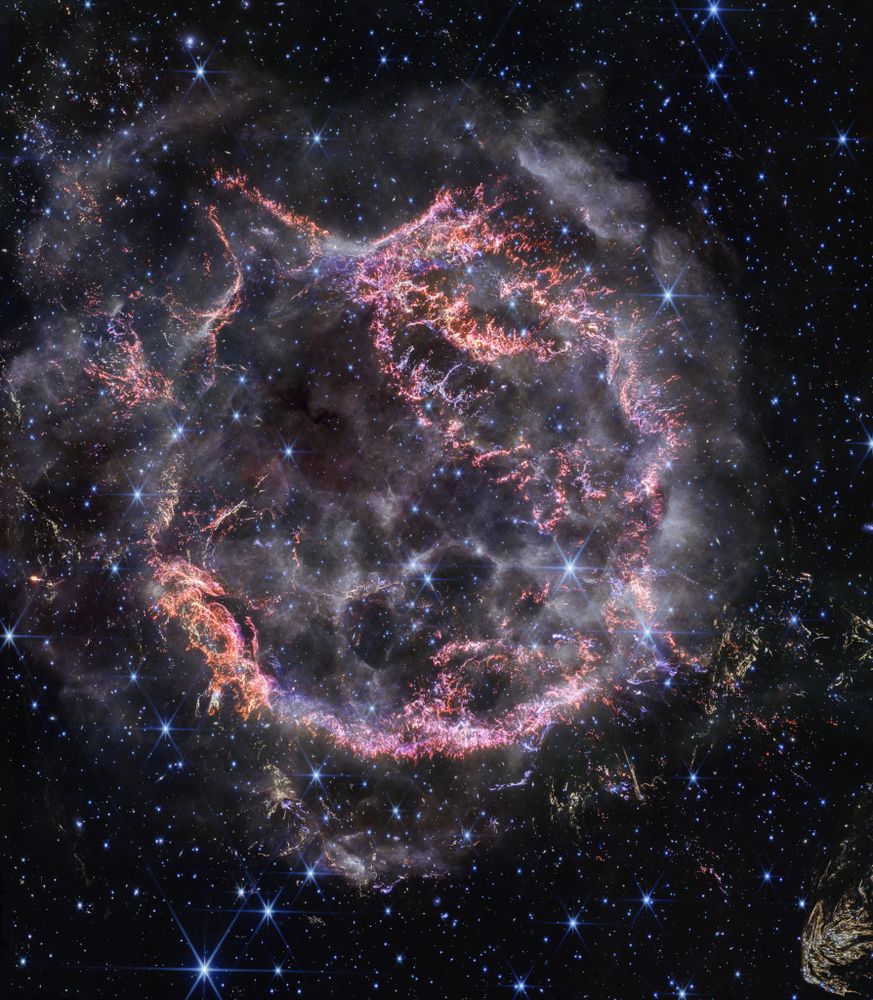
Massive stars in our Milky Way Galaxy live spectacular lives. Collapsing from vast cosmic clouds, their nuclear furnaces ignite and create heavy elements in their cores. After only a few million years for the most massive stars, the enriched material is blasted back into interstellar space where star formation can begin anew. The expanding debris cloud known as Cassiopeia A is an example of this final phase of the stellar life cycle. Light from the supernova explosion that created this remnant would have been first seen in planet Earth's sky about 350 years ago, although it took that light 11,000 years to reach us. This sharp NIRCam image from the James Webb Space Telescope shows the still-hot filaments and knots in the supernova remnant. The whitish, smoke-like outer shell of the expanding blast wave is about 20 light-years across. A series of light echoes from the massive star's cataclysmic explosion are also identified in Webb's detailed images of the surrounding interstellar medium.
🔭 Supernova Remnant Cassiopeia A
Image Credit: NASA, ESA, CSA, STScI; D. Milisavljevic (Purdue University), T. Temim (Princeton University), I. De Looze (University of Gent)
apod.nasa.gov/apod/ap26020...
I'd say Mary overall since she's a free-roaming fae even if she is bound to helping dysfunctional families and doesn't have a domain she can warp at will like Jareth's Labyrinth (though Dick Van Dyke may count for her). Jareth is also hampered by having literature written about how to deal with him.
06.02.2026 05:32 — 👍 2 🔁 0 💬 0 📌 0
I wrote about the new Muppet Show, which is, thank God, exactly like the old Muppet Show.
04.02.2026 21:35 — 👍 1777 🔁 269 💬 28 📌 55Our Lil Sugar Bombs... they grow up so fast.
#Fallout #Sugarbomb #HankMacLean
Just give Genndy Tartakovsky the money to make as many seasons of Primal as he feels like
03.02.2026 04:20 — 👍 11 🔁 2 💬 1 📌 0
Active galaxy NGC 1275 is the central, dominant member of the large and relatively nearby Perseus Cluster of Galaxies. Wild-looking at visible wavelengths, the active galaxy is also a prodigious source of x-rays and radio emission. NGC 1275 accretes matter as entire galaxies fall into it, ultimately feeding a supermassive black hole at the galaxy's core. Narrowband image data used in this sharp telescopic image highlights the resulting galactic debris and filaments of glowing gas, some up to 20,000 light-years long. The filaments persist in NGC 1275, even though the turmoil of galactic collisions should destroy them. What keeps the filaments together? Observations indicate that the structures, pushed out from the galaxy's center by the black hole's activity, are held together by magnetic fields. Also known as Perseus A, NGC 1275 itself spans over 100,000 light years and lies about 230 million light years away.
🔭 NGC 1275 in the Perseus Cluster
Image Credit & Copyright: Michal Wierzbinski, Hellas-Sky
apod.nasa.gov/apod/ap26020...

A spiral galaxy is shown that seems to have rings in place of spiral arms. The outer ring is blue and filled with stars, while the inner ring is more red. The center has a vertical bar. Please see the explanation for more detailed information.
🔭 Spiral Galaxy NGC 1512: Wide Field
Image Credit & Copyright: Daniel Stern
apod.nasa.gov/apod/ap26020...
Edgar the Bug needs to tidy up his skin suit
04.02.2026 01:47 — 👍 0 🔁 0 💬 1 📌 0
A dense starfield surrounds a blue and red nebula that stretches from the lower left to the upper right. The outer parts of the nebula are blue and filamentary, while the innermost part is red and bright. Please see the explanation for more detailed information.
🔭 Red Spider Planetary Nebula from Webb
Image Credit: ESA/Webb, NASA & CSA, J. H. Kastner (RIT)
apod.nasa.gov/apod/ap26020...

In addition to designing the Kennedy Center, Fayetteville native Edward Durell Stone also masterminded the Museum of Modern Art and Radio City Musical Hall, among countless other buildings.
03.02.2026 22:47 — 👍 9 🔁 4 💬 1 📌 0
A complex nebula is shown that is mostly blue and red on the left half and mostly brown on the right. Several bright stars are visible, and many filaments run through, in particular on brown dust filamnents on the image right. Please see the explanation for more detailed information.
🔭 Orion: The Running Man Nebula
Image Credit & Copyright: Robert G. Lyons (Robservatory)
apod.nasa.gov/apod/ap26020...

Several craters are visible on a tan surface. The largest crater, on the right, has internal markings that make it look like a winking face with a smile. Please see the explanation for more detailed information.
🔭 Galle: Happy Face Crater on Mars
Image Credit: NASA, MGS, MSSS
apod.nasa.gov/apod/ap26020...
I'd be perpetually angry too if I was stuck with some 1890s waxed hairstyle on top of my little head.
31.01.2026 13:33 — 👍 0 🔁 0 💬 0 📌 0
On flight day 13 (November 28, 2022) of the Artemis 1 mission, the Orion spacecraft reached its maximum distance from Earth. At over 430,000 kilometers from Earth, its distant retrograde orbit also puts Orion nearly 70,000 kilometers from the Moon. In the same field of view in this video frame from flight day 13, planet and large natural satellite even appear about the same apparent size from the spacecraft's perspective. On flight day 26 (December 11, 2022), the uncrewed spacecraft splashed down on its home world concluding the historic Artemis I mission. The Artemis II mission, carrying 4 astronauts around the moon and back again, will launch no earlier than February 8.
🔭 Artemis I: Flight Day 13
Image Credit: NASA, Artemis I
apod.nasa.gov/apod/ap26013...

NGC 1333 is seen in visible light as a reflection nebula, dominated by bluish hues characteristic of starlight reflected by interstellar dust. A mere 1,000 light-years distant toward the heroic constellation Perseus, it lies at the edge of a large, star-forming molecular cloud. This telescopic close-up spans over two full moons on the sky or just over 15 light-years at the estimated distance of NGC 1333. It shows details of the dusty region along with telltale hints of contrasty red emission from Herbig-Haro objects, jets and shocked glowing gas emanating from recently formed stars. In fact, NGC 1333 contains hundreds of stars less than a million years old, most still hidden from optical telescopes by the pervasive stardust. The chaotic environment may be similar to one in which our own Sun formed over 4.5 billion years ago.
🔭 NGC 1333: Stellar Nursery in Perseus
Image Credit & Copyright: Robert Eder
apod.nasa.gov/apod/ap26013...

Distorted galaxy NGC 2442 can be found in the southern constellation of the flying fish, (Piscis) Volans. Located about 50 million light-years away, the galaxy's two spiral arms extending from a pronounced central bar give it a hook-shaped appearance in this deep and colorful image, with foreground stars scattered across the telescopic field of view. The image also reveals the distant galaxy's obscuring dust lanes, young blue star clusters and reddish star forming regions surrounding a core of yellowish light from an older population of stars. But the star forming regions seem more concentrated along the drawn-out (upper right) spiral arm. The distorted structure is likely the result of an ancient close encounter with a smaller galaxy that lies off top left of the frame. This telescopic field of view spans over 200,000 light-years at the estimated distance of NGC 2442.
🔭 NGC 2442: Galaxy in Volans
Image Credit & Copyright: Mike Selby
apod.nasa.gov/apod/ap26012...

So if you meet with these historians
I'll tell you what to say
Tell them that the Nazis
Never really went away
They're out there burning houses down
And peddling racist lies
And we'll never rest again
Until every Nazi dies.