Our paper is now out in Nature:
“Ancient co-option of LTR retrotransposons as yeast centromeres”
www.nature.com/articles/s41...
A short thread on how retrotransposons helped give rise to yeast point centromeres.
1/14

@mosaiclep.bsky.social
Lepidoptera doctor 🧬 🐛 🦋 Interested in all things evolution, development, genomics and bugs 🪲 🐝 Postdoc. He/him 🌈
Our paper is now out in Nature:
“Ancient co-option of LTR retrotransposons as yeast centromeres”
www.nature.com/articles/s41...
A short thread on how retrotransposons helped give rise to yeast point centromeres.
1/14
BREAKING: The Department of Education has ended its directive that attempted to restrict diversity, equity, and inclusion efforts in schools nationwide.
This is a victory for academic freedom and education equity.

🧬✨ New 2-part review on the evolution of regulatory DNA (enhancers & promoters)! What started as conversations between Gasper Tkačik @istaresearch.bsky.social and our group @embl.org grew into a broader synthesis.
Preprints here:
Part 1: arxiv.org/abs/2601.19681
Part 2: arxiv.org/abs/2601.21480
Once it became clear that an ICE agent could commit murder in broad daylight with no consequences except the VPOTUS defending him with no heed to the facts and instead vilifying and prosecuting the victim, we opened the door to roving death squads.
But there is no statute of limitations for murder.
If this is what they do to white American citizens in front of everyone, imagine what happens to non-white people behind closed doors.
24.01.2026 19:34 — 👍 692 🔁 197 💬 11 📌 4Alex Pretti was a colleague at the VA. We hired him to recruit for our trial. He became an ICU nurse- I lover working with him. He was a good kind person who lived to help and these fuckers executed him.
White. Hot. Rage.

The commitments in the SAFE Labs Handbook.
A new community-driven lab handbook for reducing conflict and creating more positive and equitable work environments gets strong support from a survey of 200 researchers.
buff.ly/K7CGFLV

"I don’t know why my fellowship was terminated. I suspect that it has something to do with studying a species that doesn’t fit the binary of what we expect to see in nature, with completely different males and females."
@carlzimmer.com profiles my wonderful coauthor @jjinsing.bsky.social Gift link.
Live thread of the NSF biology virtual office hour:
🧵
It's out, Minos transgenesis in the pantry moth by
@donyaniyaz.bsky.social
@lucalivraghi.bsky.social
High efficient, glowing eye and silk gland markers
peerj.com/articles/202...
@peerj.bsky.social

A nudibranch sea slug with two horn like rhinophores, two oral tentacles and a lot of finger like cerata covering its back the body is translucent with highlights of blue, orange and brown
Once again I'm begging people not to compare politicians to invertebrates. Inverts are cool and diverse and play an important ecological role. Politicians are the lower order.
10.11.2025 18:42 — 👍 141 🔁 32 💬 1 📌 1
My first paper as a first author is officially out 🎉 @elife.bsky.social
We show that the iridescent colour of Morphos 🦋 tends to converge in sympatry while their chemical signals diverge, illustrating the constrasting effect natural and sexual selection on trait evolution.
doi.org/10.7554/eLif...

What an amazing paper from the Bonasio lab! Domesticated retroviral proteins and RNA-modifying enzymes that regulate RNA loading into and transportation via extracellular vesicles (1/2). www.biorxiv.org/content/10.1...
05.11.2025 14:20 — 👍 20 🔁 4 💬 1 📌 050 years ago, King & Wilson published a foundational paper that underlies the cis-regulatory paradigm (CRP) of #DevoEvo #EvoDevo, i.e., that *almost* all morphological evolution is driven by mutations in regulatory elements, rather than proteins, and it all arose from simple misunderstanding 🧪 🧵
29.10.2025 00:35 — 👍 73 🔁 32 💬 8 📌 5
Out now on the cover of @journal-evo.bsky.social!
Led by Sarah Khalil, we took a genomic approach to investigate the hybrid zone between different-colored Red-backed Fairywren subspecies. We found some interesting candidate genes under selection. Check it out! academic.oup.com/evolut/advan...
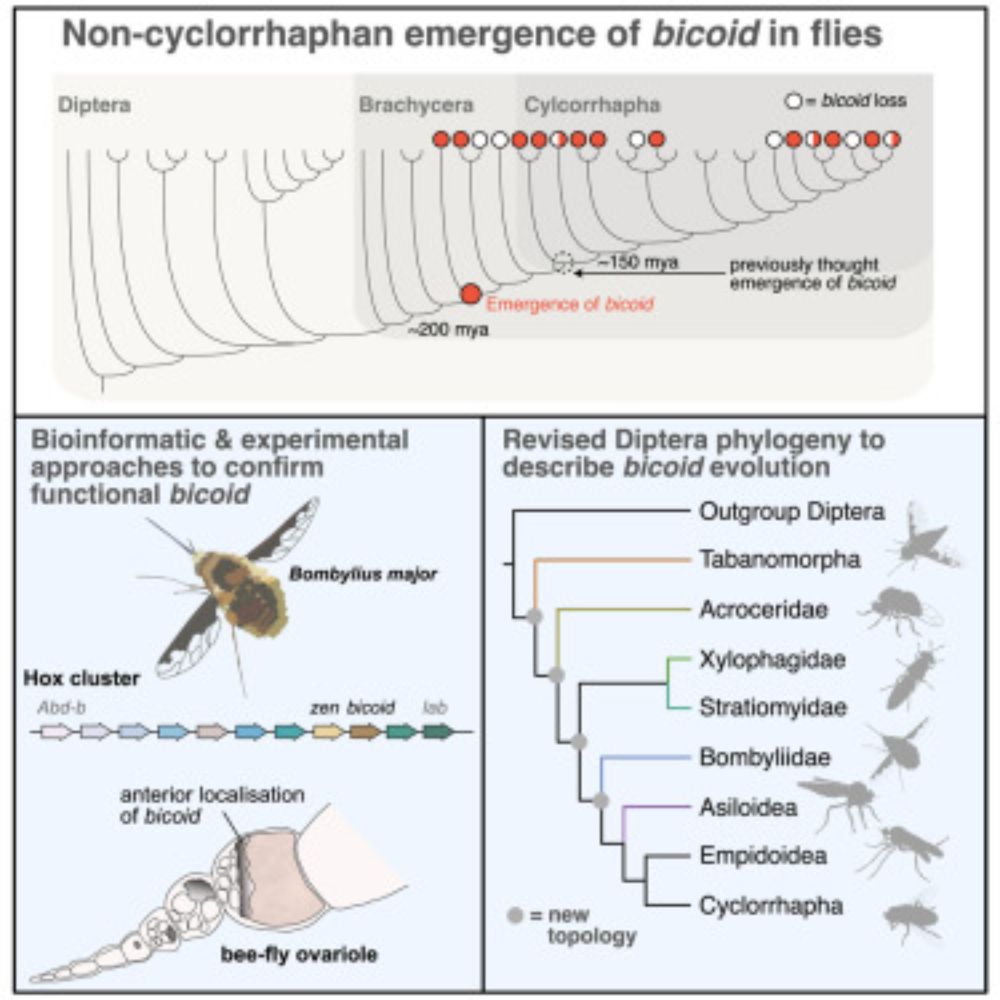
Latest work out today in @currentbiology.bsky.social
We find the fly development gene bicoid is much older than previously thought (~20 million yrs older!) 🪰🧬
To pinpoint its origins we tackled the Diptera phylogeny, providing some resolution (many open questions remain).
🔗 tinyurl.com/2vyuevpy

I still think this #SciComm deserves a #Pulitzer.
#InsectApocalypse
www.reuters.com/graphics/GLO...

So many issues with this new mandatory genetic test for women. World Athletics’ mandatory genetic test for women athletes is misguided. I should know – I discovered the relevant gene in 1990 www.mcri.edu.au/news/insight...
05.08.2025 10:29 — 👍 27 🔁 14 💬 1 📌 0
So excited to share this preprint from the Rosin lab in collaboration with the Hawley lab and @eelcotromer.bsky.social on moth spermatogenesis! We investigate the meiotic errors that occur during the formation of apyrene sperm (that have no DNA) in silkworms!
www.biorxiv.org/content/10.1...
My prediction is that in that scenario, he blames the Bureau of Labor Statistics, which puts out employment data. Calls them corrupt, run by Democrats, out to get him. Fires people there, insists their numbers cannot be trusted, White House puts out its own fictitious data to make Trump look good
17.04.2025 11:54 — 👍 3274 🔁 513 💬 101 📌 268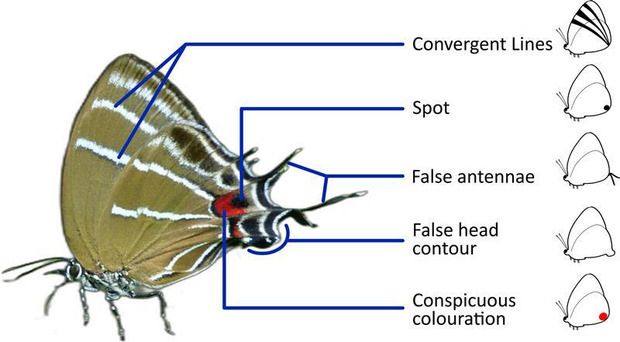
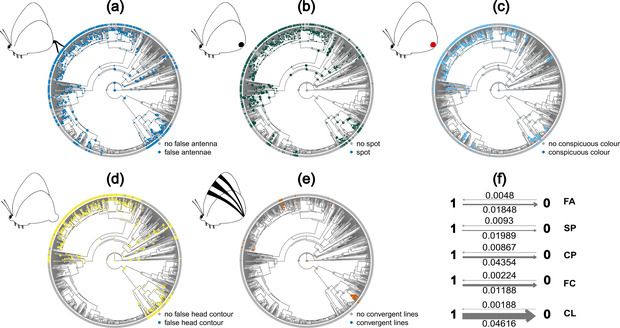
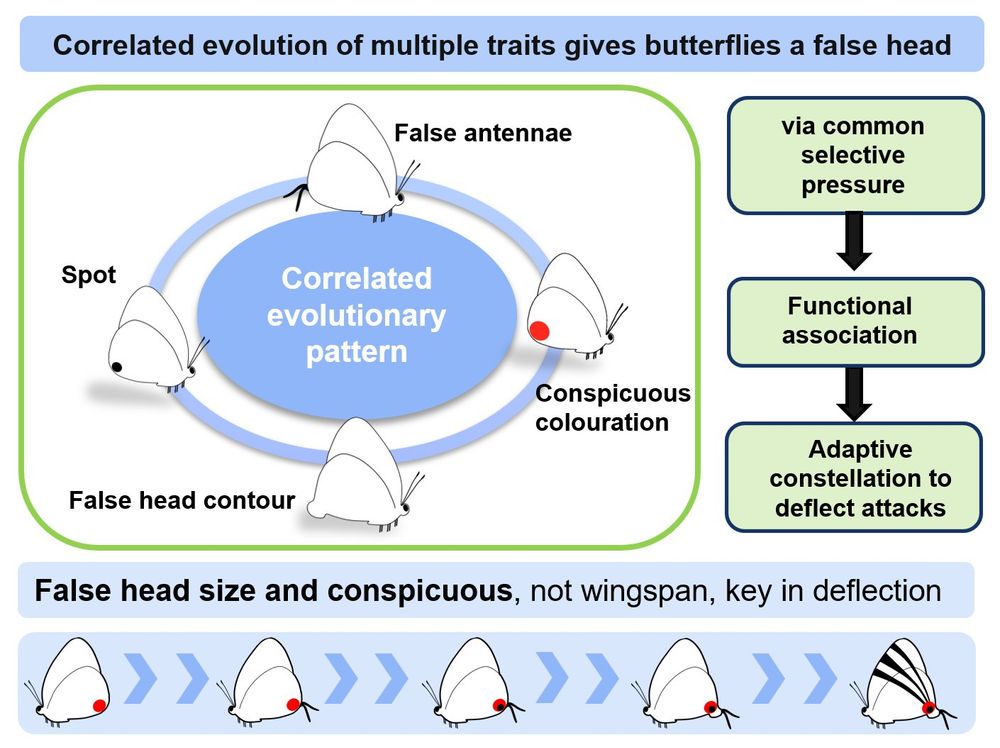
Our false head work is out! By analysing ~1000 #butterflies, we found many traits at posterior end of hindwings evolved correlatedly, likely forming a trait complex w/adaptive function to dupe predators into thinking these traits together are actual head!!
royalsocietypublishing.org/doi/10.1098/...
As thrilled as I am to share this, it wouldn’t have been possible without other members of @fascinatingpupa.bsky.social lab particularly Sydney Yu (not on Bluesky), a brilliant former undergrad whose honors thesis kicked off this discovery.Super grateful to have had her on this journey! (6/6)
07.07.2025 16:18 — 👍 2 🔁 0 💬 0 📌 0
This suggests that fruit fly’s alula may be a reduced vannus, meaning Drosophila wings are just one-third of the ancestral insect wing. To understand how wings evolved into today’s wild diversity, we need to look beyond flies to other broad winged insects like butterflies, moths & more. (5/6)
07.07.2025 16:18 — 👍 5 🔁 0 💬 1 📌 0
Knockdown of mirror in fruit fly wings results in the loss of a proximal-posterior lobe called the “alula” – a membranous structure present exclusively in some #Diptera like fruit flies (doi.org/10.1242/dev....). (4/6)
07.07.2025 16:18 — 👍 4 🔁 1 💬 1 📌 0
"mirror" is not only expressed in this posterior region of the wing disc, but #CRISPR knockouts result in mosaics where the vannus is entirely lost or partially reduced accompanied by vein anomalies and the spread of color patterns! (3/6)
07.07.2025 16:18 — 👍 1 🔁 0 💬 1 📌 0
The posterior part of wings in broad winged insects like butterflies has a lobe like region called “vannus” which is bordered by the anal (2A) vein. Across butterfly families, the vannus is usually characterized by distinct silver scales and devoid of color patterns like the rest of the wing. (2/6)
07.07.2025 16:18 — 👍 1 🔁 0 💬 1 📌 0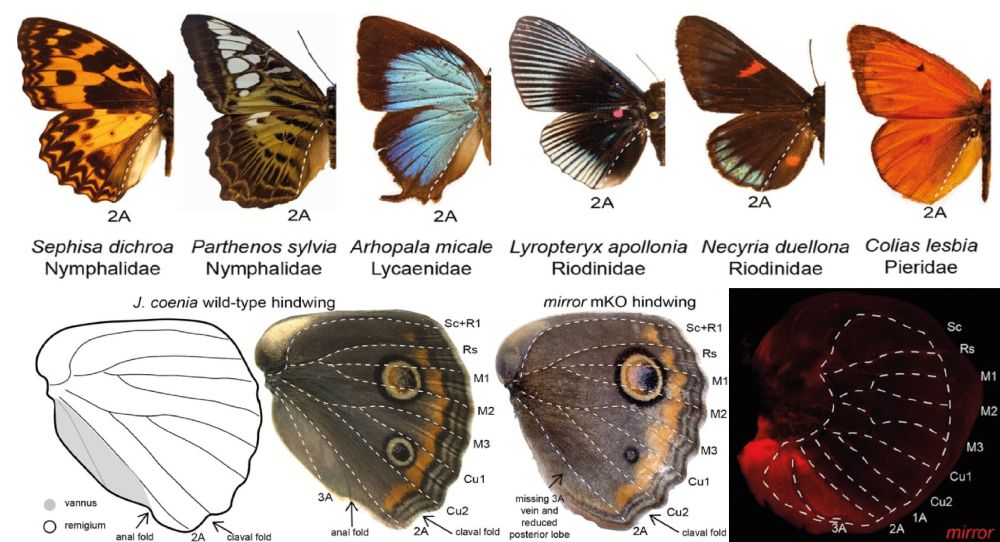
Very excited to share the first chapter of my PhD thesis out in @elife.bsky.social : doi.org/10.7554/eLif...
We discovered how the gene "mirror" is necessary for specifying the “vannus”, a unique domain in the posterior part of butterfly wings. 🦋🦋 (1/6)
#CRISPR #butterfly #genomics

The life of each of us began when a sperm and an egg came together. But what happens at a molecular level?
Our latest work in Cell led by @vdeneke.bsky.social & Andreas Blaha reveals a conserved fertilization complex that bridges sperm and egg in vertebrates! (1/11)
www.cell.com/cell/fulltex...
While helping out on a cool genomics project recently, I came to realise I’d been taught a pretty big inaccuracy about the events that occur at fertilization. I suspect that almost everyone reading this has the same misapprehension, so let’s do some learning together: 1/
30.05.2025 18:51 — 👍 98 🔁 40 💬 2 📌 5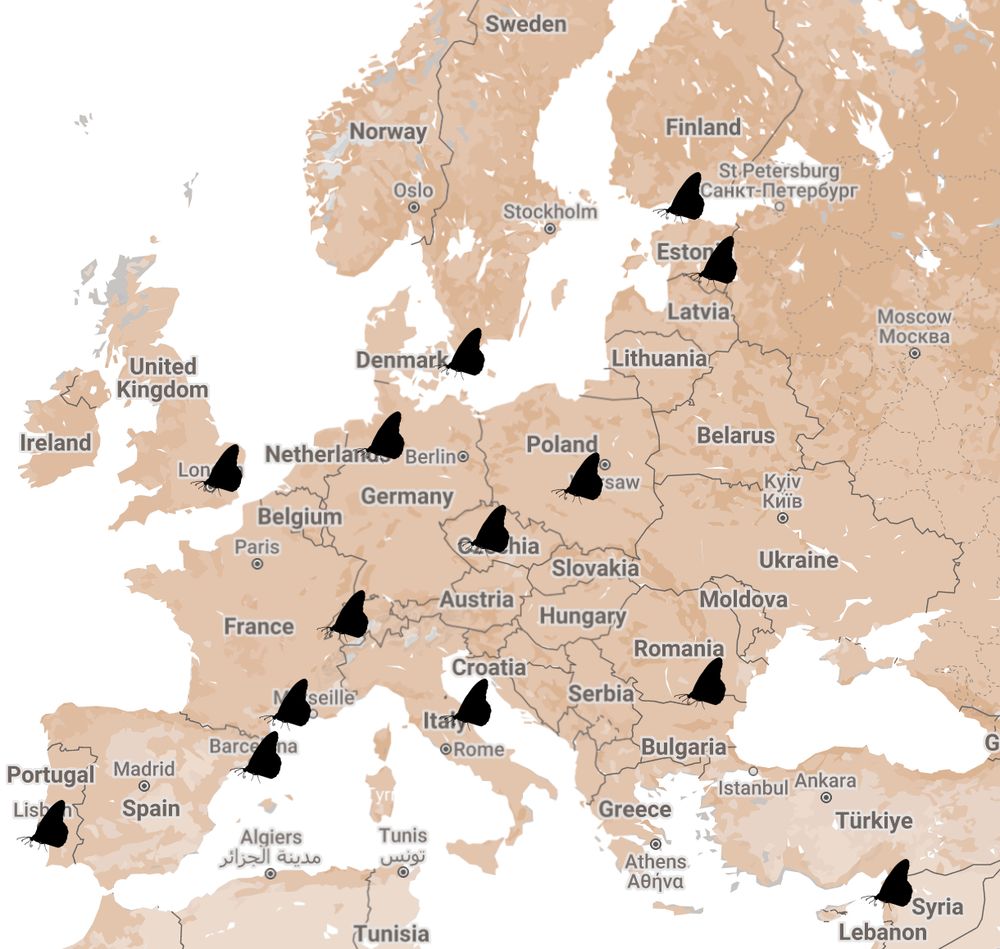
The aim of this proposal is to place population genomic insights into a comparative framework to gain fundamental insights into the determinants of evolutionary outcomes. The project will work within LepEU, the European Lepidopteran Population Genomics Consortium (https://lepeu.github.io/). LepEU provides access to field samples from European populations of diverse species. Chromosome-scale reference genomes are provided by Project Psyche (https://www.projectpsyche.org/). Networking during the postdoc will be facilitated by participation in the 10kLepGenomes COST Action (https://10klepgenomes.eu/). Existing datasets await analysis, while additional samples need DNA extraction and submission for sequencing. Functional validation capability (CRISPR/Cas9 gene manipulations) is also available to test emergent hypotheses of allele-to-phenotype impacts. Personal research interests of the postdoc will be important to determine the exact project, as the project has a generous sequencing budget.
The successful applicant should have a PhD (obtained within 6 years of the application deadline) in a suitable subject area, such as evolutionary biology or population genomics. A strong interest in population genomics, local adaptation, comparative analyses, and experience working with genomic-scale data is essential. The candidate must have a documented publication record demonstrating relevant skills. Experience working with bioinformatic pipelines (e.g., Snakemake), or working with butterflies is welcome but not essential. The net salary is 28,000 SEK/month (~2,430 Euro, not subject to Swedish income tax) and comes directly from the Carl-Trygger Foundation stipend, which is paid out directly to the postdoc. Only PhD candidates acquired outside of the host department can apply. Currently, the lab of Prof. Wheat consists of 3 postdoctoral researchers, while the Dept. of Zoology provides a vibrant and excellent research environment of active, dynamic researchers. Applications should include: i) a succinct description of research interests and experience, detailing your contribution to any relevant publications (max 1 page), ii) why you are the ideal candidate for this position in the lab (max 1 page); iii) a CV including a list of publications, and iv) the name and contact information of two personal references. Applications will be reviewed on a rolling basis with a deadline of 23 August 2025. The project is planned to start on 1 October, but flexibility in the starting date can be provided for a suitable candidate. Please contact Prof. Wheat for additional information.
🚨Postdoc opportunity🚨: LepEU postdoc: comparative population genomics of European scale adaptation in butterflies
2 year, full-time PD in my group, Stockholm Univ.
Applications assed on rolling basis, deadline: 23 August 2025. Planned start 1 Oct.
Details:
christopherwheatlab.wordpress.com