*Cephalanthera longifolia
11.06.2025 20:07 — 👍 1 🔁 0 💬 0 📌 0
Ouch il faut un master en bricolage 😅
11.06.2025 20:05 — 👍 1 🔁 0 💬 1 📌 0
Pourtant c'est une chouette ville pour le vélo, je m'y sens généralement à l'aise.
11.06.2025 19:58 — 👍 0 🔁 0 💬 1 📌 0
Tu peux me chercher longtemps à Leuven 🤣
11.06.2025 19:58 — 👍 1 🔁 0 💬 1 📌 0
Houlà, mon compte LKD est encore moins vivant que celui-ci 😂
11.06.2025 19:27 — 👍 1 🔁 0 💬 2 📌 0

De graines de soja brutes.
Pour presser, j'ai improvisé avec une passoire, une assiette et un grand bocal rempli d'eau au dessus.
11.06.2025 19:25 — 👍 1 🔁 0 💬 1 📌 0
Je le suis ailleurs :)
11.06.2025 19:05 — 👍 2 🔁 0 💬 1 📌 0


Et hier c'était tofu maison à partir de graines de soja, expérience intéressante !
10.06.2025 20:51 — 👍 1 🔁 0 💬 1 📌 0
J'adore faire des gnocchis avec tout et n'importe quoi : les classiques à la patate, oranges à la carotte ou à la courge, verts aux épinards ou mauves à la betterave. Les possibilités sont nombreuses !
(👋 ça fait longtemps en effet !)
10.06.2025 20:49 — 👍 5 🔁 0 💬 5 📌 0

Pourquoi le pamplemousse est-il le cauchemar du pharmacien ?
Parce qu’il est un inhibiteur enzymatique puissant et à ce titre, il est à l’origine de nombreuses interactions médicamenteuses !
Pamplemousse et médicaments, a thread 🧵👇🏻
06.12.2024 23:18 — 👍 325 🔁 157 💬 18 📌 20

Insectes pollinisateurs diurnes et nocturnes du Saule marsault.
A: Andrena fulva, B: A. vaga, C: Colletes cunicularius, D: Bombus pascuorum (reine), E: Bombus lucorum (reine), F: Bombus pratorum (reine), G: Scathophaga stercoraria, H: Melolontha melolontha, I: Orthosia incerta, J: Eupsilia transversa, K: Conistra vaccinii, L: Agrochola circellaris, M: Epirrhoe alternata, N: Pterophoridae sp., O: Chrysoperla carnea.
Crédits K. Ohashi CC-by
Breaking news très en retard, mais breaking quand même :
j'apprends à l'instant que le très odorant, nectarifère et précoce Saule marsault présente 3 stratégies de pollinisation différentes : vent, papillons nocturnes et abeilles, mouches et coléoptères diurnes. 🧵 1/8
01.12.2024 18:14 — 👍 17 🔁 7 💬 1 📌 0
YouTube video by Escaped Sapiens
The Future of Protein: Breeding The Super Tuber | Padraic Flood | Escaped Sapiens #73
Je suis tombé sur cette itw et c'est tellement inspirant, pédagogique et enthousiasmant
P. Flood s'est lancé dans un projet qui peut paraitre dingue mais tellement bien pensé
domestiquer la gesse tubéreuse (Lathyrus tuberosus) pour en faire une nouvelle plante cultivée
youtu.be/vTclAA4XV98?...
01.12.2024 16:48 — 👍 18 🔁 3 💬 2 📌 0
Merci !
01.12.2024 20:46 — 👍 1 🔁 0 💬 0 📌 0
YouTube video by Les Revues du Monde
Pourquoi le corps humain est-il complètement cheaté ?
J'ai regardé cette nouvelle vidéo de Charlie Danger des Revues du Monde qui traite en gros du propre de l'Homme afin d'expliquer pourquoi nous sommes l'espèce ayant le plus gros impact sur l'écosystème Terre. J'ai plusieurs choses à dire dessus 1/22
www.youtube.com/watch?v=BCJj...
17.11.2024 19:32 — 👍 49 🔁 26 💬 10 📌 1

CLIMATE CHANGE CLIFFS NOTES:
It's happening.
Scientists agree.
Yes, it's us.
It's not too late.
We can do something about it.
06.06.2024 10:03 — 👍 699 🔁 228 💬 9 📌 7
![Screen d'un article de La Libre sur Facebook.
"L'océan arrive-t-il à ses limites dans l'absorption de l'excès de chaleur émises par les activités humaines [...]"](https://cdn.bsky.app/img/feed_thumbnail/plain/did:plc:z6ojlhdhmfigedctnrs5d6bo/bafkreiehofem5mlixfxetr26rffada6dzbqrdyi7yxy7srelvcelpcddoq@jpeg)
Screen d'un article de La Libre sur Facebook.
"L'océan arrive-t-il à ses limites dans l'absorption de l'excès de chaleur émises par les activités humaines [...]"
La moitié des réactions à cet article qui interviewe 3 scientifiques à propos du réchauffement des océans et ses conséquences sont des "😂".
On est pas bien, là, dans le déni ?
06.06.2024 17:10 — 👍 4 🔁 0 💬 0 📌 0

Connaissez vous les orobranches ? Fleurs de la familles des lamiales (comme la menthe), elles sont caractérisées par l'absence de chlorophylle 1/5
05.06.2024 12:09 — 👍 10 🔁 1 💬 2 📌 0

Photo of an unripe capsule in longitudinal section. The ovules are attached to a column that rises up in the center of the locule but does not connect with the top of the locule.
This rough dissection of a Silene banksia fruit shows a single locule (chamber) with the immature seeds on a free-central placenta. The placenta is a central stalk that does not reach the top of the locule, hence “free.” #placentation #Caryophyllaceae #Botany #PlantScience 🌾🧪
05.06.2024 17:02 — 👍 11 🔁 1 💬 0 📌 0

Photo of a tomato cut in cross-section and back-lit. The tomato has three locules. Three massive placentae are attached in the axillary position of the three septa. The seeds are visible attached to the placentae.
This photo of tomato fruit shows a fruit with three carpels forming three locules (chambers). A large, intruding placenta (with its seeds) is clearly visible in each locule. This is axile placentation. #placentation #Solanaceae : Jo Christian Oterhals CC BY-NC-ND 2
#Botany #PlantScience 🌾🧪
04.06.2024 16:19 — 👍 23 🔁 5 💬 0 📌 0
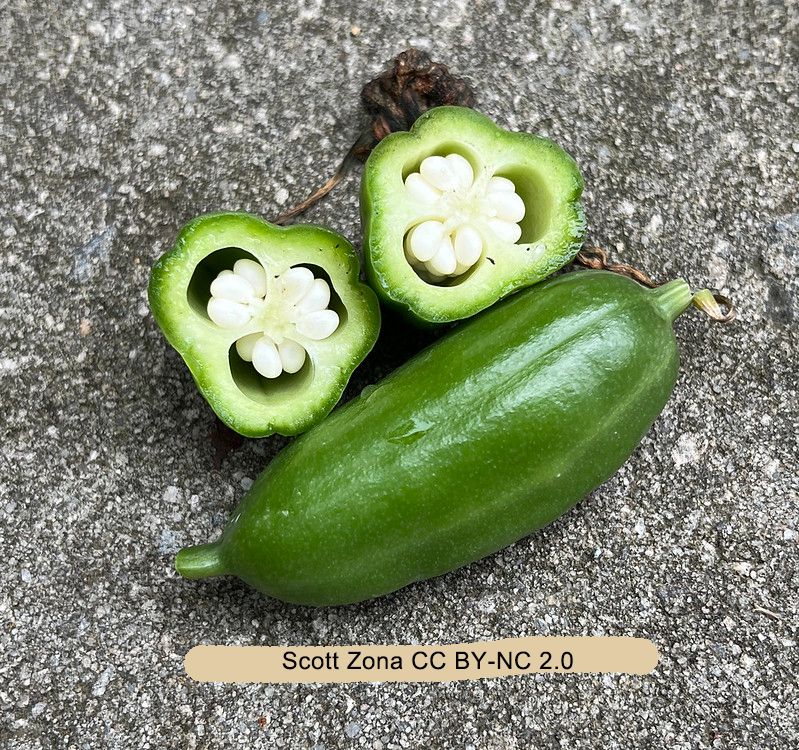
Photo of two green (unripe) capsules of Iris. One is cut in cross-section. The capsule is divided into three locules by septa. The unripe seeds are attached to placentae in the axils of the three septa.
Axile placentation is very common in the plant kingdom (maybe the most common among multicarpellate families?). The placentae & ovules (→seeds) are in the axils of each carpel, as seen here in the immature tricarpellate fruits of Iris tectorum. #Iridaceae #placentation #Botany #PlantScience 🌾🧪
04.06.2024 11:09 — 👍 13 🔁 1 💬 1 📌 1
1 chapitre = 1 période (Pléistocène > Paléocène) où époque (Crétacé > Édiacarien) qui, chaque fois, se base sur un riche site fossilifère pour nous décrire la biodiversité de l'époque et les grandes innovations évolutives.
02.06.2024 21:22 — 👍 1 🔁 0 💬 0 📌 0

Livre "Otherlands" de Thomas Halliday avec une fougère sur la couverture.
Je viens de finir ce livre, que je recommande vivement à toute personne intéressée par l'histoire naturelle.
C'est un fabuleux voyage qui remonte le temps, du Pléistocène au Précambrien.
02.06.2024 21:19 — 👍 3 🔁 0 💬 2 📌 0

Close-up photo of rows of young fava beans in pods that have been split open. Shihmei Barger CC BY-NC-ND 2.0
Vicia faba (#Fabaceae; : Shihmei Barger CCBYNCND2) #seeds contain vicine, an alkaloid glycoside that causes a form of hemolytic anemia, favism, in people lacking the gene for glucose-6-phosphate dehydrogenase. Vincine is toxic to Callosobruchus maculatus larvae. #toxins #Botany #PlantScience 🌾🧪
27.03.2024 16:10 — 👍 23 🔁 4 💬 2 📌 0

Anémone pulsatille

Fleur d'anémone pulsatille vue de face.
L'observation botanique du jour.
Anémone pulsatille (Pulsatilla vulgaris, #Ranunculaceae), une rareté.
17.03.2024 13:03 — 👍 10 🔁 2 💬 0 📌 0

Corydale à fleurs roses qui émerge d'un tapis de feuilles mortes.

Corydale à fleurs roses qui émerge d'un tapis de feuilles mortes.
Floraison de Corydalis solida (corydale solide, #Papaveraceae) observée au détour d'une sortie à vélo vers la vallée de la Meuse. J'adore cette espèce.
#Botany #Wildflowers
11.03.2024 07:36 — 👍 3 🔁 0 💬 1 📌 0

Cellules vertes à contour sinueux et stomates.
Épiderme d'une feuille de haricot.
06.03.2024 14:23 — 👍 6 🔁 0 💬 0 📌 0
@cnrs.bsky.social researcher at @IGFLyon.bsky.social, working on #microbiota #physiology #nutrition #intestine. I like the gut, beer, metal and rugby.
Professor of Cycling | CEO Urban Cycling Institute
Ingénieur de recherche : arboriculture, climat, pesticides / producteur de musique @ Grandepolis / Papa d'un enfant avec paralysie cérébrale.
CNRS Postdoc @ IJM | Cytoskeleton bio*(physics + chemistry) 🔬🩻 | Science and Technology Studies enjoyer 📖 | Keeping an eye on the return of race science 🧬
Mi-grognon mi-moelleux.
Science sans conscience n'est qu'inconscience.
👨🎓 : Ecologie/Géomatique.
Prof de Bio à Marseille. #Science #Gauche #Guitare #Antifasciste
Traducteur mélomane.
Spécisme hate account.
Better a pig than a fascist.
Contre l'exploitation animale.
Justice pour tous les sentients.
official Bluesky account (check username👆)
Bugs, feature requests, feedback: support@bsky.app
Plant Scientist
R&D Trait Program Manager (Biotic Stress) @KWSGroup.bsky.social
Web: https://linktr.ee/somssich
Personal Account
The Botanical Society of America mission is to inspire and promote an inclusive global community committed to advancing fundamental knowledge and innovation in the botanical sciences for the benefit of people and the environment.
Biodiversity | Ecology | Physiology | Theory | Climate Change | Macroecology | Scaling | biendata.org; Prof. EEB Univ of Arizona, External Prof Santa Fe Institute, Assoc Res Oxford Univ UK; Proud father, 🌵🇺🇸🇬🇧🇸🇪🌲 Gift med en svensk
Prof | #Restoration #Conservation | #WomenInSTEM | Lead Editor @aer-ese-bes.bsky.social | NatGeo Explorer | Work/life | Politics | she/her | https://hjones82.wixsite.com/website
ecologist | plants | open data | Universidad Mayor (Chile) | Rasgos-CL (www.rasgos.cl) | he/him/él | #BlackLivesMatter | www.dylancraven.com
Biodiversity, evolution, oceans, people. Opinions and enthusiasm my own.
Scientist | #Arctic | #Belowground | #Roots | #ScienceEmbroidery | Opinions my own | She/Her | Editor @newphyt
www.colleeniversen.com
IG: @colleeniversen
Living my purpose
Writer:
Books #LessonsFromPlants (https://www.hup.harvard.edu/books/9780674241282) & #WhenTreesTestify (https://us.macmillan.com/books/9781250335166/whentreestestify/)
Professor
#Leadership|#Mentoring|#EquityReadingList/#DEIReadingList
Evolutionary ecologist, Botanist, Associate Professor at Davidson College (PUI 💪🏼), she/her
🔗smwadgymar.weebly.com