Behind the Research: Insights from the Authors
Q: Could you share with us why your team initiated this project?
A: Our team has always been deeply interested in the topic of team conflict. Earlier meta-analyses produced somewhat different conclusions as new empirical findings accumulated. In light of this, we wanted to take advantage of the now much richer empirical base to conduct the most comprehensive synthesis to date. In addition, the literature often documents that team conflict can be positively or negatively associated with performance. This motivated us to explore potential moderators at the between-study level to account for such heterogeneity.

Behind the Research: Insights from the Authors
Q: Many doctoral and master’s students are learning meta-analysis, but oftentimes they simply code variables and report associations without generating meaningful theoretical contributions. Using your article as an example, could you share how to conduct a high-quality meta-analysis?
A: I believe that conducting a meta-analysis is no different from conducting any empirical study: methodological rigor and theoretical insight must go hand in hand. When researchers have only a superficial understanding of the method, they tend to overlook the potential theoretical implications of their results.
Take meta-analysis as an example. A common analytical pitfall is to focus solely on the population average estimate between two variables, while ignoring heterogeneity. Yet heterogeneity precisely signals the presence of moderators. Our overall approach in this article was therefore to attend to both the average effects and the heterogeneity, and then explain that heterogeneity. This approach relies on a solid grasp of the meta-analytic method itself; methodological depth lays a strong foundation for theoretical contribution.
At the same time, a deep understanding of the research domain helps identify appropriate moderators. For instance, we included conflict symmetry as a moderator because it is theoretically grounded in the team conflict literature. From this perspective, a high-quality meta-analysis must also be built upon accurate domain knowledge and conceptual clarity.

Behind the Research: Insights from the Authors
Q: What were the biggest challenges you encountered during this meta-analysis?
A: On the theoretical side, the main challenge was that several earlier meta-analyses on the same topic had already become highly cited JAP papers. Reviewers therefore felt that this area had been examined quite “thoroughly.” To address this concern, we highlighted several theoretical questions that previous meta-analyses had not fully resolved. We also incorporated a new conflict dimension—status conflict—to broaden the scope of the current meta-analysis.
On the methodological side, we emphasized the use of more robust meta-regression techniques to systematically examine the effects of moderators.
On the operational side, each new comment from reviewers often required recoding part of the dataset, which made the workload considerably demanding.
Behind the Research: Insights from the Authors
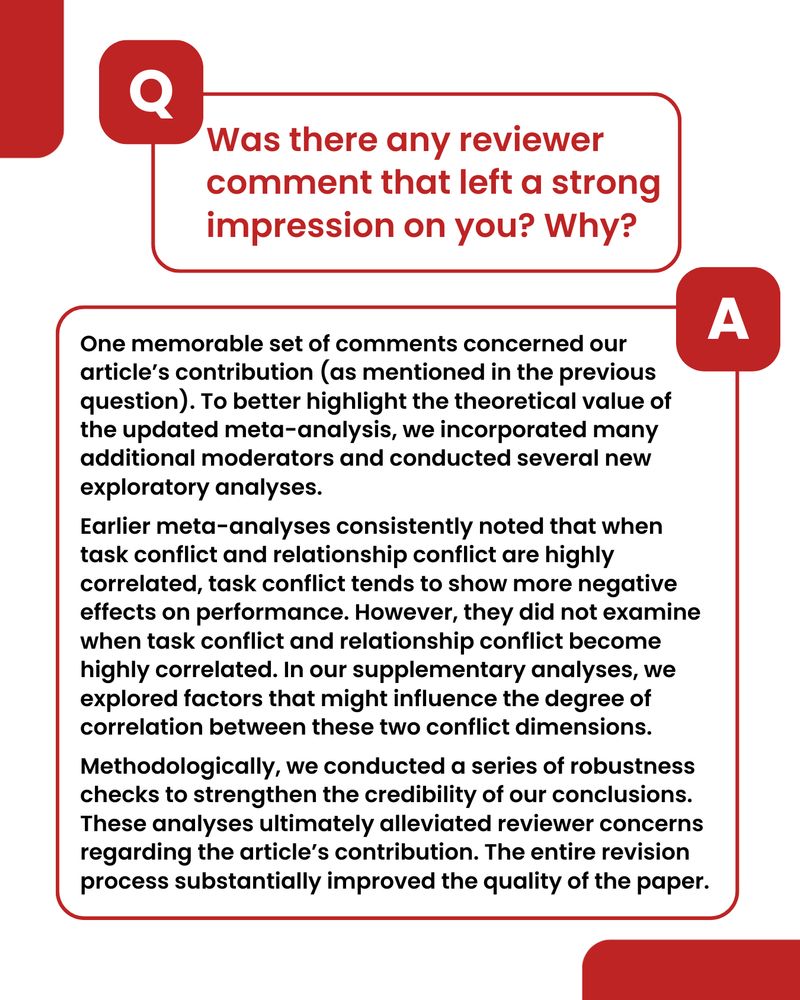
Q: Was there any reviewer comment that left a strong impression on you? Why?
A: One memorable set of comments concerned our article’s contribution (as mentioned in the previous question). To better highlight the theoretical value of the updated meta-analysis, we incorporated many additional moderators and conducted several new exploratory analyses.
Earlier meta-analyses consistently noted that when task conflict and relationship conflict are highly correlated, task conflict tends to show more negative effects on performance. However, they did not examine when task conflict and relationship conflict become highly correlated. In our supplementary analyses, we explored factors that might influence the degree of correlation between these two conflict dimensions.
Methodologically, we conducted a series of robustness checks to strengthen the credibility of our conclusions. These analyses ultimately alleviated reviewer concerns regarding the article’s contribution. The entire revision process substantially improved the quality of the paper.
Can conflict ever be good?
A meta-analysis from Yuan et al. (2025) show that task, relationship, process, and status conflict are all negatively associated with team performance.
Moderating factors:
- National culture
- Team characteristics
- Methodological factors
📄 doi.org/10.1037/apl0001315
26.11.2025 14:57 — 👍 1 🔁 0 💬 0 📌 0
How do employees react when they witness mistreatment at work? 🤔
A meta-analysis by Hill et al. (2025) shows that observers of workplace mistreatment often feel anger toward perpetrators, empathy for victims, and even schadenfreude.
📄Full article available here: doi.org/10.1037/apl0001211
03.11.2025 13:15 — 👍 0 🔁 0 💬 0 📌 0
How do employees behave after witnessing sexual harassment?
Research by Liang and Park (2025) identified 5 intervention behaviors and that bystanders typically fall into 1 of 3 intervention patterns:
- active 📣
- low-risk 🫂
- no/limited 🤐
📄Full article available here: doi.org/10.1037/apl0001280
20.10.2025 14:34 — 👍 1 🔁 1 💬 0 📌 0
Can parents' stress cross over to their children? 🔄
New research by French and colleagues (2025) published in the Journal of Applied Psychology suggests that stress from both work and nonwork can ricochet from parents to their adolescents.
📄Full article available here: doi.org/10.1037/apl0...
15.10.2025 16:06 — 👍 4 🔁 1 💬 0 📌 2