I would say PFAS or absestos but this is pretty closely aligned with my assessment.
09.02.2026 06:59 — 👍 0 🔁 0 💬 0 📌 0

Why substitution matters: focusing only on declines at regulated sites can overstate the policy’s net effect if demand shifts to unregulated alternatives.
15.01.2026 06:01 — 👍 0 🔁 0 💬 0 📌 0

Main result (3 months post-law): searches for the major compliant platform fell by ~51%. At the same time, searches rose for a major non-compliant platform (+48.1%) and VPN services (+23.6%).
15.01.2026 06:01 — 👍 0 🔁 0 💬 1 📌 0

“Four-panel synthetic control figure using state-level Google Trends. After age-verification laws take effect, searches for the compliant platform drop sharply relative to the synthetic control, while searches for the non-compliant platform rise. Searches for VPNs also increase, and generic adult-content searches increase modestly. Pre-treatment trends are closely matched.”
Design (pre-registered): synthetic control using state-level Google Trends. Outcomes track searches for a compliant platform, a non-compliant platform, VPNs, and generic adult-content search intent.
15.01.2026 06:01 — 👍 0 🔁 0 💬 1 📌 0
Context: starting in Jan 2023, Louisiana and 20+ states passed age-verification rules. The legal dispute is about constitutionality. Our question is behavioral: what happens after implementation?
15.01.2026 06:01 — 👍 0 🔁 0 💬 1 📌 0
yes please
16.12.2025 22:32 — 👍 0 🔁 0 💬 0 📌 0
Thank you. RSS Feeds may have been the apex of the internet before enshittification took hold.
13.11.2025 16:50 — 👍 3 🔁 0 💬 1 📌 0
I remember the pain of having to continually raise y axes during the great recession. I remember how much code broke when the log of oil prices broke because it went negative. This is another failure of imagination that my code would not anticipate. I am sorry in advance.
06.11.2025 20:30 — 👍 4 🔁 0 💬 0 📌 0

Come check out my talk tomorrow and learn about the impact of age verification laws on user search behavior
@stanfordcyber.bsky.social #TSRconf
osf.io/4cjpw_v2/dow...
25.09.2025 21:41 — 👍 3 🔁 1 💬 0 📌 0

C2C graphic image promoting the Student Pathways Dataset
We’re taking the first step towards our Query Builder project📊 🗣️After launching in April, users shared interest in accessing the data powering Student Pathways beyond the preset visualizations. We’re meeting your needs by providing an accessible format to dive into the data now! bit.ly/C2C-datasets
16.09.2025 17:03 — 👍 1 🔁 1 💬 0 📌 1
what’s the topic? i had one that was pending before the supreme court.
29.07.2025 00:28 — 👍 1 🔁 0 💬 0 📌 0
If you are a macroeconomist, I would say lock in your estimates of the output gap now and potential gdp now. I believe this is going to be the most important question in macroeconomic policy for next 12 months.
04.05.2025 05:09 — 👍 0 🔁 0 💬 0 📌 0
Trump's tariffs are a massive tax that YOU will pay.
That means higher prices and serious pain for families and small businesses across our country.
Repost if you agree Republicans need to join Democrats and vote to END the chaos & REVERSE these reckless tariffs.
10.04.2025 19:29 — 👍 228 🔁 107 💬 14 📌 4
I am OOO but one of the things I have been thinking about is how this pairs with the notion of overalignment ies.ed.gov/ncee/wwc/Doc...
01.04.2025 05:46 — 👍 1 🔁 0 💬 1 📌 0
I admire your courage and sacrifice. I nuked mine and only had 1k followers.
19.03.2025 15:16 — 👍 3 🔁 0 💬 0 📌 0
Very useful thread. This also a helpful reminder for folks who are working with coarse statistical tables and historical documents as well.
15.03.2025 06:15 — 👍 7 🔁 1 💬 0 📌 0
If you have research dependent on these data here is my suggestion
1/N
Big picture:
Create a dataset of cell means (cells must be big enough to pass disclosure)
- load these cell means into many, many tables & put through review
-These cell means can then be used in OLS - which runs on means
15.03.2025 00:21 — 👍 99 🔁 55 💬 4 📌 7

AERA has just learned that all restricted-use NCES data licenses will be cancelled, possibly as early as March 20. We urgently request that all AERA members and others in the research community with restricted-use licenses take these two actions: www.aera.net/Research-Pol...
14.03.2025 19:09 — 👍 123 🔁 182 💬 3 📌 33
OSF
Simulation studies are common in psychometrics. We are trying to make them more relevant to practice by increasing their connection to empirical data. Feedback welcome!
osf.io/preprints/ps...
12.03.2025 13:31 — 👍 1 🔁 1 💬 0 📌 0
Thanks for helpful comments from @robbwiller.bsky.social @jrothst.bsky.social @nickhuntington12.bsky.social and many others
11.03.2025 17:27 — 👍 1 🔁 0 💬 0 📌 0
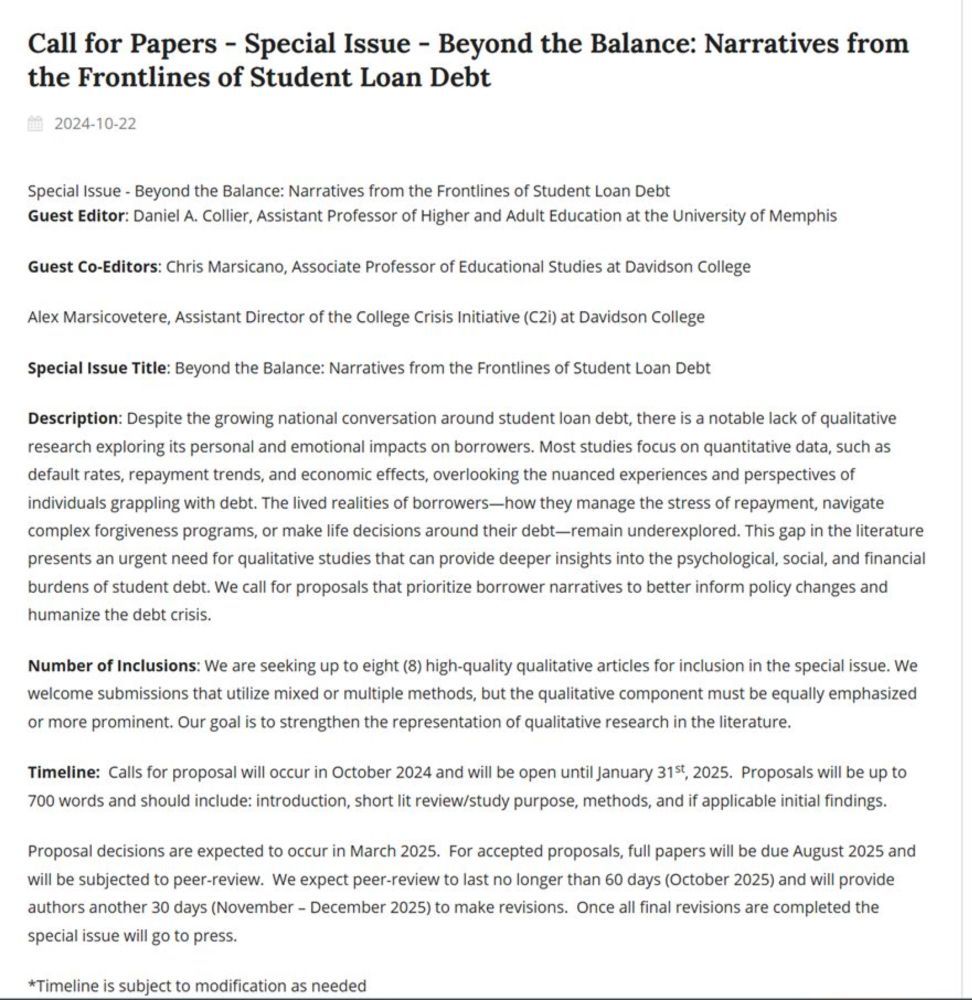
Description: Despite the growing national conversation around student loan debt, there is a notable lack of qualitative research exploring its personal and emotional impacts on borrowers. Most studies focus on quantitative data, such as default rates, repayment trends, and economic effects, overlooking the nuanced experiences and perspectives of individuals grappling with debt. The lived realities of borrowers—how they manage the stress of repayment, navigate complex forgiveness programs, or make life decisions around their debt—remain underexplored. This gap in the literature presents an urgent need for qualitative studies that can provide deeper insights into the psychological, social, and financial burdens of student debt. We call for proposals that prioritize borrower narratives to better inform policy changes and humanize the debt crisis.
Number of Inclusions: We are seeking up to eight (8) high-quality qualitative articles for inclusion in the special issue. We welcome submissions that utilize mixed or multiple methods, but the qualitative component must be equally emphasized or more prominent. Our goal is to strengthen the representation of qualitative research in the literature.
Timeline: Calls for proposal will occur in October 2024 and will be open until March 31st, 2025. Proposals will be up to 700 words and should include: introduction, short lit review/study purpose, methods, and if applicable initial findings.
Proposal decisions are expected to occur in July 2025. For accepted proposals, full papers will be due August 2025 and will be subjected to peer-review. We expect peer-review to last no longer than 60 days (November 2025) and will provide authors another 30 days (December 2025 - January 2026) to make revisions. Once all final revisions are completed the special issue will go to press.
Hey, I am guest-editing an issue on student loans.
RE: collapse of Academic Twitter, we're extending the call for abstracts til March 31st.
If you have #Qualitative work on #studentloans, submit!
Requote and share widely.
#AcademicSky #EduSky #HigherEd
ojed.org/hepe/announc...
*Link works now
05.03.2025 19:21 — 👍 25 🔁 25 💬 2 📌 2
Very excited to be a part of this and cautiously optimistic I might be the first person to cite it.
27.02.2025 00:04 — 👍 5 🔁 0 💬 0 📌 0
Do you need educational and psychological item response data to do your research? The IRW has 600 item response datasets (more coming!), distributed in a standardized format and ready for analysis.
10.12.2024 17:39 — 👍 35 🔁 20 💬 2 📌 3
Minneapolis, MN. Interested in making the world more just and healthy for our kids. Professional experience in education and nonprofits.
Ph.D, stats lover/writer✍🏼, #statistics #scicomm #datascience #statstiktok 👩🏻💻 she/her
Assistant Professor improving (assessment of) measurement in intensive longitudinal data
Department of Methodology and Statistics, Tilburg University, The Netherlands
Ambassador for the Tilburg Experience Sampling Center: https://experiencesampling.nl/
Author of Calculated Risk Real Estate Newsletter at http://calculatedrisk.substack.com and Economic Weekly at https://economicweekly.substack.com/
social & data scientist — sociology phd candidate @ columbia university. researching cities, policing, inequality, uses and abuses of big data.
https://sociology.columbia.edu/content/taylor-b-alarcon
github.com/taylorbalarcon
Writing a data-driven newsletter about economics @ apricitas.io
Nuance? In this Economy
Full Employment Stan, Brazilian Coffee Tariff Victim |
https://bettercities.substack.com/
Better cities and transit are possible 🚇
#1 Congestion pricing stan
#1 RFK Jr. hater
i am a cognitive scientist working on auditory perception at the University of Auckland and the Yale Child Study Center 🇳🇿🇺🇸🇫🇷🇨🇦
lab: themusiclab.org
personal: mehr.nz
intro to my research: youtu.be/-vJ7Jygr1eg
Personal account. Personal views. Frank G. Millard Professor of Law, University of Michigan Law School & Arlene Susan Kohn Professor of Social Policy, University of Michigan Ford School of Public Policy. Former General Counsel, HHS and OMB.
Journalist. Health, science, tech in plain English and in context. Truth is not liberal bias. Facts matter, but stories stick. maggie.34 on Signal maggiefox.com
https://www.scientificamerican.com/author/maggie-fox/
onehealthtrust.org podcast host
Dartmouth political scientist and Bright Line Watch co-director. Previously Upshot NYT / CJR contributor, Spinsanity co-founder, All the President's Spin co-author.
https://sites.dartmouth.edu/nyhan/
http://brightlinewatch.org
Just asking questions.
Senior Editor, Lawfaremedia.org.
Send story ideas and tips to anna.bower@lawfaremedia.org
Incoming Assistant Teaching Professor at Villanova University • Clinical Research Specialist at UNC Charlotte’s Violence Prevention Center • Research Fellow @ the Kinsey Institute • Focused on gender, sexuality, and body image
Follow for voting rights and disability law updates, with a focus on NY election law.
Disability voting access advocate, NY Attorney, PhD in neuroscience, former college professor. Posting in my personal capacity, not on behalf of any organization.
Economist and Styslinger Fellow at Stanford University’s Hoover Institution studying the labor market returns to job training programs and business incentives.
https://www.nataliemillar.net
macro, fiscal, Fed. creator of the Sahm rule recession indicator. Stay-At-Home Macro (SAHM) Substack.
Economist: Labo(u)r, Macro, Inequality || Ass't Prof @MITSloan @MIT_IWER || Nonres fellow @piie
Historian: White Flight; New Suburban History; Fog of War; One Nation Under God; Fault Lines; Voter Suppression; Myth America. CAMPAIGN TRAILS: campaign-trails.ghost.io
Assistant Professor of Education Policy, Organization, & Leadership, University of Illinois Urbana-Champaign. Former middle school science teacher in Oakland and Los Angeles.
https://www.paul-bruno.com/
https://www.last.fm/user/pabruno
Science journalist, bylines all over the place.
Book: NOT A SCIENTIST: How politicians mistake, misrepresent, and utterly mangle science (WW Norton).
www.davelevitan.com
Sign up: www.gravityisgone.com