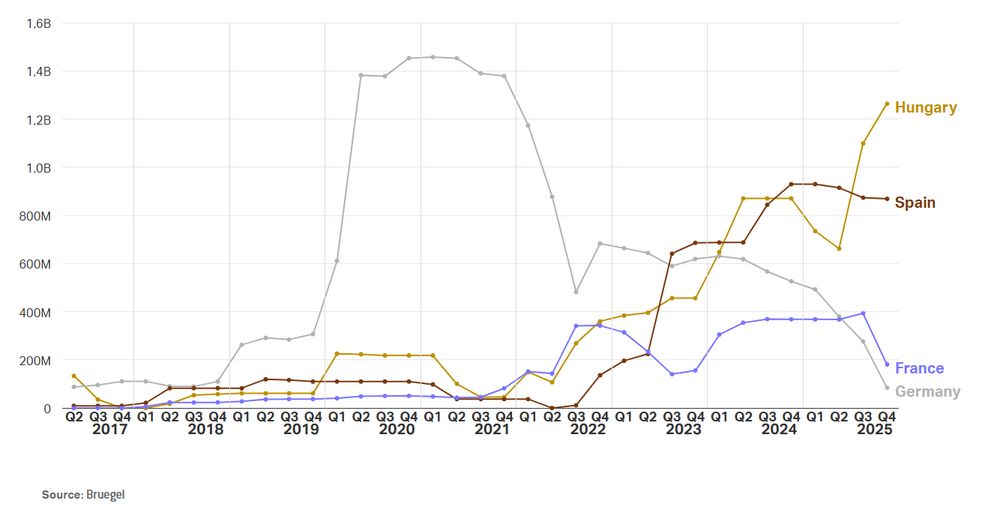
Very interesting data from Bruegel showing the changing geography of clean investment (solar, battery, and EVs) in Europe. Will Hungary and Spain emerge as Europe’s cleantech manufacturing champions?
04.12.2025 09:37 — 👍 6 🔁 2 💬 5 📌 0
@jordischroeder.bsky.social
PhD Candidate at FU Berlin, EQUALFIN doctoral program “Finance and Inequality in Times of Polycrisis” IMFS | Central Banking | Political Economy
Very interesting data from Bruegel showing the changing geography of clean investment (solar, battery, and EVs) in Europe. Will Hungary and Spain emerge as Europe’s cleantech manufacturing champions?
04.12.2025 09:37 — 👍 6 🔁 2 💬 5 📌 0
The people from the Net Zero Industry Lab have done it, it is still rookie numbers compared to Chinese FDI in Indonesia. static1.squarespace.com/static/64ca7...
04.12.2025 14:54 — 👍 1 🔁 0 💬 0 📌 0But I think you meant @palmapolyak.bsky.social ? Hehe
04.12.2025 09:43 — 👍 1 🔁 0 💬 1 📌 0Yup! Big fan of Palma's work :)
04.12.2025 09:42 — 👍 0 🔁 0 💬 1 📌 0
Source: european-clean-tech-tracker.bruegel.org/investments/...
04.12.2025 09:42 — 👍 0 🔁 0 💬 0 📌 0The numbers for Hungary are truly staggering. In 2025 Q3, Bruegel records €1.3 billion in investment in solar, batteries, and EVs. This is a very substantial share of that same quarter’s gross fixed capital formation, which stands at €12 billion.
04.12.2025 09:41 — 👍 0 🔁 0 💬 1 📌 0
Very interesting data from Bruegel showing the changing geography of clean investment (solar, battery, and EVs) in Europe. Will Hungary and Spain emerge as Europe’s cleantech manufacturing champions?
04.12.2025 09:37 — 👍 6 🔁 2 💬 5 📌 0
"Empirical evidence also supports the view of a gradually diminishing import intensity of China’s economic activity. "
12.11.2025 09:45 — 👍 0 🔁 0 💬 0 📌 0
Import decreases are concentrated in consumer and intermediate goods, as well as imports from advanced economies.
12.11.2025 09:45 — 👍 0 🔁 0 💬 1 📌 0
Some nice graphs on Chinese trade patterns from the ECB: "Weak domestic demand appears to be the missing link in explaining China’s strong exports to Europe – more so than tariff-related trade diversion."
www.ecb.europa.eu/press/econom...
Given the current bleak state of things, I appreciate @ember-energy.org for making me feel optimistic one report at a time
06.11.2025 15:13 — 👍 0 🔁 0 💬 0 📌 0
Line goes up!
ember-energy.org/latest-insig...

This is absolutely nuts.
06.11.2025 15:05 — 👍 6 🔁 3 💬 1 📌 0in the past the ECB mostly relied on refinancing operations to provide liquidity, rather than on bond purchases as the Fed did. But I agree that separating the role of these potential interventions from the normalisation path is a way to potentially indefinitely postpone these other discussions.
06.11.2025 14:09 — 👍 2 🔁 0 💬 0 📌 0I would push back slightly on this. I suppose the distinction they are trying to make here concerns the purpose of these purchases (e.g. purchasing bonds to address fragmentation risks or when reaching the ZLB vs doing so to cover liquidity needs arising from autonomous factors). At the same time,+
06.11.2025 14:09 — 👍 0 🔁 0 💬 1 📌 0If they are used, the path towards normalisation would be interrupted, and the ECB would not reach the "endpoint" of the new operational framework. What worries me is that, if that were to be the case, the implementation of green structural operations would keep being postponed.
06.11.2025 13:32 — 👍 0 🔁 0 💬 1 📌 0Yeah, all the discussion around the new operational framework assumes a normalisation path in which these interventions do not take place, while at the same time making clear they remain part of the ECB's policy toolkit and could still be used.
06.11.2025 13:32 — 👍 0 🔁 0 💬 1 📌 0
Last year we wrote a report where we proposed an alternative framework with more policy space to enable the guiding principle of supporting the transition to a green economy, if that's of interest to anyone: positivemoney.org/eu/publicati...
06.11.2025 11:50 — 👍 1 🔁 0 💬 1 📌 0I'm currently writing a report on the role of structural operations, and it is quite humbling to see how what takes me two paragraphs to explain clumsily, Schnabel manages to perfectly summarise in one sentence :|
06.11.2025 11:50 — 👍 0 🔁 0 💬 1 📌 0
Finally, we have the first ECB “estimate” of future bank demand for excess reserves, ranging from €600 billion to €2.2 trillion, depending on banks’ HQLA holdings and LCR targets.
06.11.2025 11:50 — 👍 1 🔁 0 💬 1 📌 0
Compared to other countries, excess reserves remain abundant in the euro area, with the spread of repo rates over policy rates currently slightly negative.
06.11.2025 11:50 — 👍 1 🔁 0 💬 1 📌 0
However, this increases duration risk in banks' balance sheets. An increase in government bond rates would have a significant impact on banks' LCRs. The role of reserves as HQLA is one of the main reasons why today’s normalisation does not entail a return to the pre-GFC framework.
06.11.2025 11:50 — 👍 0 🔁 0 💬 1 📌 0

As reserves have decreased, banks have absorbed the decline in HQLA assets by purchasing government bonds, keeping their LCRs relatively stable.
06.11.2025 11:50 — 👍 0 🔁 0 💬 1 📌 0We still have no information on how exactly these structural monetary policy operations will be designed so as to support the transition to a green economy, which was one of the guiding principles of the new operational framework.
06.11.2025 11:50 — 👍 0 🔁 0 💬 1 📌 0In its structural portfolio of securities, the ECB will target shorter-dated assets for three reasons: (i) to avoid interfering with the monetary policy stance (ii) to maintain policy space (iii) to ensure financial soundness (i.e. to avoid the losses experienced in the past tightening cycle).
06.11.2025 11:50 — 👍 0 🔁 0 💬 1 📌 0
As for structural monetary policy operations, the ECB will first launch structural refinancing operations, followed later by a structural securities portfolio once legacy bond holdings have wound down sufficiently. Before implementation, MROs and 3m LTROs need to pick up considerably.
06.11.2025 11:50 — 👍 0 🔁 0 💬 1 📌 1
Very interesting speech from @isabelschnabel.bsky.social on the future of the ECB's operational framework.
Some insights and graphs from the speech in the thread below.
www.ecb.europa.eu/press/key/da...
That plot on real exports is brutal. Like a live view of the ECB going through the five stages of grief over the death of export-led growth. Seems we're one projection away from acceptance.
06.11.2025 09:24 — 👍 20 🔁 7 💬 2 📌 0
While China's exports to the US have decreased, they have strongly increased for ASEAN countries.
(www.ecb.europa.eu//press/key/d...)

Interesting figures from Philip Lane. The constant downward revision to real exports is quite telling.
06.11.2025 09:03 — 👍 9 🔁 2 💬 1 📌 1