I don't teach history! Thanks for the helpful links, I will read them. My Dutch is also mediocre/ok.
14.02.2026 20:15 — 👍 0 🔁 0 💬 0 📌 0
Yes, great example, thank you. I teach this history of protest in Amsterdam. It is perhaps a better case than Paris to reveal the feedback loop between individual actions, policy and infrastructure change, and back to individual actions.
13.02.2026 11:40 — 👍 0 🔁 0 💬 1 📌 0
That's revealing. I didn't realize the rates were so modest to begin with. No wonder I always read about the change in relative rather than absolute rates!
13.02.2026 11:38 — 👍 2 🔁 0 💬 0 📌 0
Useful history. I think 10 years could be seen as fast for this level of transformation. I'm not surprised that policy and luck help; more, where did the political will come from?
12.02.2026 22:08 — 👍 0 🔁 0 💬 0 📌 0
That's illuminating, thank you.
12.02.2026 11:19 — 👍 1 🔁 0 💬 0 📌 0
Paris invested heavily in bike infrastructure and saw a massive increase in ridership. Does anyone know about research on where the willingness and investment came from, e.g., attitudes, priorities, city-level meetings, national conversations? How do such changes in policy and infrastructure emerge?
12.02.2026 09:28 — 👍 18 🔁 0 💬 6 📌 0
Yeah. It's not just bad coverage in education. The more fundamental problems I think are the lack of error correction either during peer review or after publication; there being no consequences for a paper getting it wrong.
06.02.2026 16:13 — 👍 2 🔁 0 💬 0 📌 0


Are female economists treated differently than males in academic seminars?
These authors wanted to know whether gender shapes how scholars are treated when presenting research.
So they built a massive dataset of 2,000+ economics seminars, job talks, and conference presentations from 2019–2023...
03.02.2026 20:54 — 👍 410 🔁 190 💬 9 📌 39

Shaming climate wrongdoers
Shaming climate wrongdoers, Yadin, Sharon, Maibach, Edward
If ever there was a moment to shame climate wrongdoers, that moment is now. To that end, I offer a recently published article (by @sharonyadin.bsky.social & me) on how ordinary folks like you & me--plus civil society & governments--can harness the power of shame.
@ioppublishing.bsky.social
22.01.2026 19:10 — 👍 8 🔁 4 💬 0 📌 0


EN
Do your laundry for science from your own home! Sign up here for our Citizen Science project and collect the microplastics from your clothes.
NL
Doe thuis jou was voor de wetenschap! Meld je hier aan voor ons Citizen Science project en verzamel de microplastics van jouw kleding.
20.01.2026 10:29 — 👍 5 🔁 4 💬 0 📌 0

‘We got lazy and complacent’: Swedish pensioners explain how abolishing the wealth tax changed their country
For some Swedes, the question isn’t simply whether a wealth tax works, but what kind of society has been lost with its abolition.
theconversation.com/we-got-lazy-...
Lots of debate in NL right now about our wealth tax and the changing rules. There's uncertainty and I think that also causes distaste. If it was just 'the way we do it' it would be easier to be proud of what values and benefits it supports, maybe?
20.01.2026 10:19 — 👍 1 🔁 0 💬 0 📌 0

Picture showing the cover of the book this post is about.
I have thoroughly enjoyed reading Science in Resistance: The scientist rebellion for climate justice by Fernando Racimo. Maybe not very surprising, after all, it was reading a paper by Fernando that made me join Scientist Rebellion three years ago.
🧵
03.01.2026 16:18 — 👍 38 🔁 16 💬 1 📌 1

In Ukraine, a New Arsenal of Killer A.I. Drones Is Being Born
www.nytimes.com/2025/12/31/m...
We could just wring our hands and decry autonomous lethal drones, but before judgment it's worth pausing just to recognize how much has changed in the past few years and where it leaves us, Ukraine, and the future of war.
05.01.2026 20:53 — 👍 4 🔁 1 💬 1 📌 0
Stimulating. I have adapted from Buddhism as well, more for academic psychology than for politics. Agreed that compassion is not conditional on the target in moral terms. Instrumentally, I don't see rapid societal change through without winners and losers, heroes and villains, as we wrote about.
29.12.2025 19:29 — 👍 1 🔁 0 💬 1 📌 0
Well, I like your writing and argument.
I hear a lot on the left that we need as wide a tent as possible, but in practice championing seems to expose political vulnerability.
Maybe part of this is short vs long term success. Certainly disenfranchisement is unstable and unjust.
29.12.2025 17:53 — 👍 1 🔁 0 💬 1 📌 0
Certainly capital is an enemy, but I'm not even convinced that democracy is the solution. The country doing the most for the energy transition is not very democratic
29.12.2025 16:30 — 👍 0 🔁 0 💬 1 📌 0
There is no laissez-faire capitalism, so the only questions are where we want to lean on the wheel and how much
29.12.2025 15:48 — 👍 2 🔁 0 💬 1 📌 0
Interesting summary, thanks. We can reject any theory of cognition where the person is an island.
29.12.2025 03:12 — 👍 1 🔁 0 💬 0 📌 0

Opinion | Willpower Doesn’t Work. This Does.
On willpower being overrated
Explore this gift article from The New York Times. You can read it for free without a subscription. www.nytimes.com/2025/12/28/o...
28.12.2025 19:22 — 👍 3 🔁 1 💬 1 📌 0
Took me a long time too. Compelling
25.12.2025 10:02 — 👍 5 🔁 0 💬 0 📌 0

Birth Lottery
If you were reborn today, where would you land? And how would that change your life?
Giving what we can has implemented a fun game where you spin a globe to see how your starting point in life would compare if you were reborn today, randomly somewhere on earth.
www.givingwhatwecan.org/birth-lottery
25.12.2025 09:31 — 👍 272 🔁 106 💬 15 📌 13
no *you're* crying
Happy Christmas!
25.12.2025 09:14 — 👍 29 🔁 7 💬 2 📌 0
My inbox is a de-facto to-do list. When using Outlook, an email feature I really miss, was it in gmail in the past?, was to snooze a message into the future UNLESS I receive a response in the meantime. That way, items don't disappear off the list, and I don't get extra messages.
23.12.2025 12:15 — 👍 0 🔁 0 💬 0 📌 0

Fig. 3. Scatter plots of the synthetic and empirical estimates, validation study (Stage 2). Showing N = 30,135 item-pair correlations, N = 257 scale reliabilities, and N = 1,568 scale-pair correlations for (top) the pretrained SBERT model and (bottom) the fine-tuned SurveyBot3000 model. SBERT = all-mpnet-base-v2 model.

Fig. 4. Prediction error of the synthetic estimates, validation study (Stage 2). Our prediction model allowed the error term to vary freely according to the predictor, the synthetic estimate. The thin-plate splines show that some synthetic estimates were predictably more accurate.

Fig. 5. Accuracy by domain. Accuracy differed across domains. SurveyBot3000 accuracy (colored) was always higher than SBERT accuracy (gray). Results were largely consistent whether accuracy of items was tested (left, circle) within domains or (right, cross) across domains.
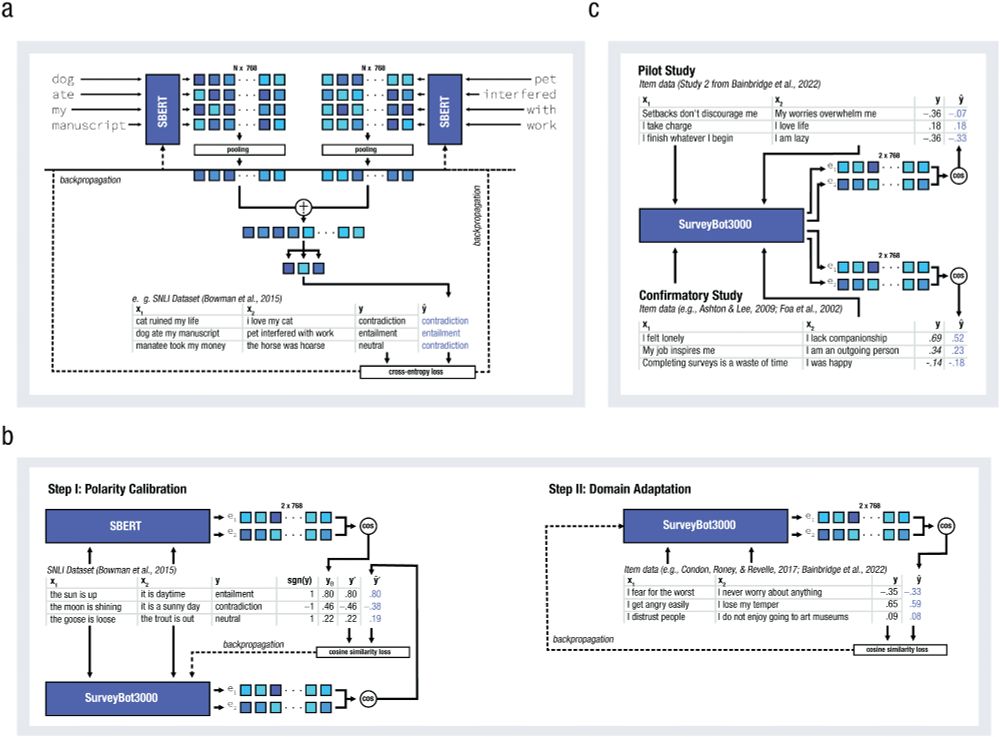
Fig. 1. Multistep training procedure for the SurveyBot3000, which produces synthetic estimates of interitem correlations. (a) Pretraining base model (SBERT). (b) Fine-tuning SurveyBot3000. (c) Validation. SBERT = all-mpnet-base-v2 model.
Finally, @bjoernhommel.bsky.social's and my paper introducing the SurveyBot3000 is officially out in AMPPS. It's a fine-tuned language model that guesstimates correlations between survey items from text alone. Not perfectly, but useful for search, for example.
journals.sagepub.com/doi/10.1177/...
18.12.2025 20:20 — 👍 81 🔁 33 💬 2 📌 6
A thousand percent. Dying young helped. Gordon Lightfoot didn't age too poorly. One political song was banned in 30 US states. Not too shabby
15.12.2025 23:15 — 👍 1 🔁 0 💬 1 📌 0
YouTube video by TopNotch
Winne - 'Crime Passionel ' ft. Dick Klees #5 Winne Zonder Strijd
was it? Wow, crazy. I doubted later that I had chosen the right track. 'Baby Love' is also groovy.
Next entry: Dutch and not even the Osdorp Posse? www.youtube.com/watch?v=7gWc...
15.12.2025 12:28 — 👍 0 🔁 0 💬 0 📌 0
YouTube video by MCSolaarVEVO
MC Solaar - Onzième commandement (Audio Officiel)
youtu.be/FXsCBvSjdYg?... staying french, this guy has a masters in sociology I think
14.12.2025 18:21 — 👍 1 🔁 0 💬 1 📌 0
ECCO is an independent Italian, non-profit think tank dedicated to climate change and the energy transition.
Join our mission to accelerate climate action in Italy, the Mediterranean, Europe and around the world #ECCOThinkTank.
https://eccoclimate.org/
Geboren @ 326 ppm
When will decent people stand up to the bullies of this world.
Bikes, synths, maps, LCC, homegrown, homebrewed, G/green.
Croydon / S London mostly.
https://cycle.travel/by/angus_hewlett
Personal views. Actual contents may vary. May contain cats.
Former dean, Center for Advanced Study in the Visual Arts, National Gallery of Art; UCLA professor emeritus; and left-handed art historian who sees lots of shiny objects.
Sentientism, food policy for desired/anticipated consumption patterns, plant-based food for climate, consumption behaviour, history and reporting of global goals, framing.
Postdoc @ University of Amsterdam; working on Applied Statistics, Time Series Modeling, Dynamical Systems, Generative AI, Climate Change; www.jonashaslbeck.com
#SocialScientist #Geographer 🌏 Resilience Lead at Climate Change Advisory Council Secretariat Ireland
🌎 Visiting Scholar @ICARUS 🌍 He/Him #SDGs 🌻 Co-Chair of International Climate Council Network Adaptation Working Group🌍 https://linktr.ee/floodsg
Behavioral scientist. Psych. blogger.
“You even picked the ideal weather. Overcast and chilly. Perfect for staying inside and reading"
voxpopsci.com
Reporter at Euronews covering EU politics. Lover of cinema, sushi and synonyms. Brussels resident since 2018. All views my own! 🦄
Prickly environmental & health social scientist who prefers posting about my family, dogs, and music. Formerly: UMass, UPenn, Yale Law, UOregon. Currently doing an academic-industry tap dance.
Social and environmental psychologist. University of Wisconsin-Stevens Point. Group identities, temporal psychology, collective emotions, and climate change.
Applying Developmental Pscyh theory and research on adolescent emotion & regulation, parent-child interaction dynamics to more robust and informative understanding of youth digital experiences
Professor of Political Science at Stanford | Exploring money in politics, campaigns and elections, ideology, the courts, and inequality | Author of The Judicial Tug of War cup.org/2LEoMrs | https://data4democracy.substack.com
Social Psychologist studying manhood, masculinity, gender, lgbtq+ prejudice, underdogs. Amateur artist. Decent guitar player/bad singer. Aspiring optimist. Transgender ally.
Sustainable Consumption | Environmental Psychology
PhD Researcher, Consumer Psychology & Marketing, University of Amsterdam | MSc. Social Psychology, VU Amsterdam '21 | BA Psychology, Koc University '19
https://www.linkedin.com/in/sezin-ekinci/
Broadcaster @lbc.co.uk
Author: https://www.waterstones.com/book/how-they-broke-britain/james-obrien/9780753560365
Dedicated to sharing and developing insights into environmental psychology. Account managed by BPS Environmental Psychology Section Committee. RTs are NOT endorsements.
https://www.bps.org.uk/member-networks/environmental-psychology-section
Researcher of online rumors & disinformation. Former basketball player. Prof at University of Washington, HCDE. Co-founder of the UW Center for an Informed Public. Personal account: Views may not reflect those of my employer.
PoliSci PhD student @ Harvard / 🇬🇧🏳️🌈 / Creator of MyLittleCrony.com
Signal: @sehill.11