Unicorn, Fox Fur and Christmas Tree apod.nasa.gov/apod/ap25122...
A star forming region cataloged as NGC 2264, this beautiful but complex arrangement of interstellar gas and dust is about 2,700 light-years distant in the faint but fanciful constellation Monoceros, the Unicorn.
25.12.2025 07:12 — 👍 983 🔁 169 💬 14 📌 8

Our galaxy, the Milky Way, is moving towards the Andromeda galaxy. Astronomers predict that in about 4 billion years, the two galaxies will collide and begin to merge. The Solar System's fate is uncertain. It might end up in the final, larger galaxy, orbiting further from the core than it does now, or it might be ejected into space altogether.
#ArtAdventCalendar day 23
Milky Way and Andromeda enjoy a dance of death. They're moving towards each other and will begin to merge in a few billion years.
Crikey!
23.12.2025 13:28 — 👍 676 🔁 104 💬 47 📌 10

Imaged with APM 140mm doublet, 0.8x reducer, asi1600mm mono camera, and ZWO RGB filters.
M33 Triangulum Galaxy, 2021-08-06 - From Ryan Kinnett (rkinnett.bsky.social) - https://flic.kr/p/2mgieU9
06.12.2025 20:00 — 👍 144 🔁 26 💬 0 📌 2
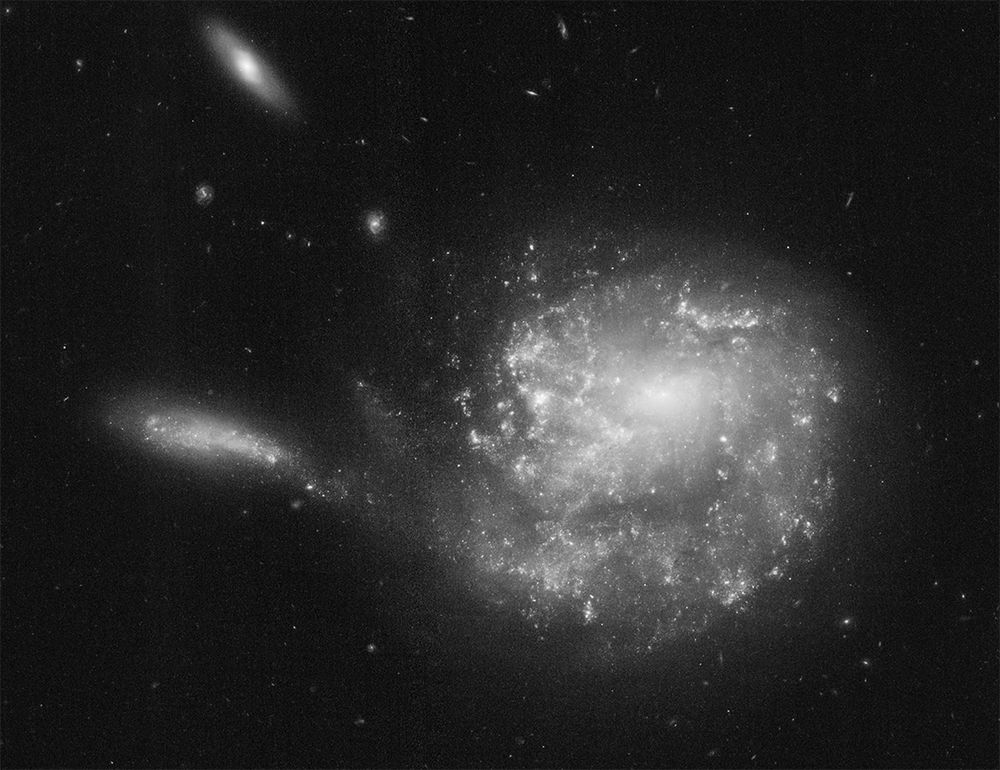
A greyscale image of a spiral galaxy and its smaller companion. The frame is dominated by the large spiral. It has a small core that sits in the middle of a spiral structure. The one spiral arm begins at about 9 o'clock and curves clockwise around the galaxy, completing a full circle. The arm is unusually thick, fanning out with many bright star clusters. To the left of the spiral is a smaller galaxy, seen almost edge-on. It appears as an elongated oval dotted with stars. The long axis of the oval is almost horizontal. Connecting the two galaxies is a faint bridge of gas and stars. A few smaller background galaxies dot the black background of space. The image has some detector noise which have not been removed.
Hubble image of Arp 24, also known as NGC 3445.
NGC 3445 has one fan-like spiral arm that is dotted with star-forming regions. It is connected to its companion galaxy, seen nearly edge-on to the left, by a weak bridge.
Credit: NASA, ESA, STScI, J. Dalcanton, Judy Schmidt
Source
06.12.2025 12:31 — 👍 407 🔁 43 💬 1 📌 0

A grainy, black and white image of two interacting galaxies. A large spiral galaxy with dark dust lanes is in the center of the image. It is tilted slightly, so that its disk forms an oval rather than a circle. The faint ends of spiral arms extend beyond the edge of the disk and appear to connect to its companion galaxy above it. The bright elliptical galaxy is oval shaped with a bright center that gets gradually fainter and more transparent towards its edges. A few white dots, which are stars, are seen on the black background of space.
Image of Arp 94, also known as NGC 3226 and NGC 3227, from Halton Arp's Atlas of Peculiar Galaxies (1966).
In the original catalog it was in the category: Spiral galaxies - Elliptical companions. Spiral NGC 3227 interacts with elliptical NGC 3226.
Source
06.12.2025 00:31 — 👍 383 🔁 32 💬 1 📌 1
🧵
The #JWST has recently given us one of the most beautiful images of late years: the stellar system Apep, a trio of massive stars surrounded by four perfect dust spirals that look almost drawn by hand.
➡️ science.nasa.gov/missions/web...
🔭 🧪 #science #stellarastro #astro
1/9
05.12.2025 00:25 — 👍 351 🔁 75 💬 8 📌 2

Image of comet 3I/ATLAS posted on facebook by Gerald Rhemann
Text:
Interstellar Comet 3I/Atlas 02 12 2025 UT 01h39m
Location: Farm Tivoli, Namibia
Telescope: ASA Astrograph 12" f3.6
Camera: ZWO ASI 6200 MM Pro
Exp. Time: LRGB 20/6/6/6 min.
North is up FOV: 75x110´
Gerald Rhemann and Michael Jäger
Here is a stunning image of Interstellar Comet 3I/ATLAS, taken on Dec. 2 by astrophotographers Gerald Rhemann and Michael Jäger, showing the comet's long wispy plasma tail in full glory and a dusty anti-tail.
www.facebook.com/groups/22700...
#Astronomy
1/n
05.12.2025 13:20 — 👍 1202 🔁 171 💬 18 📌 6
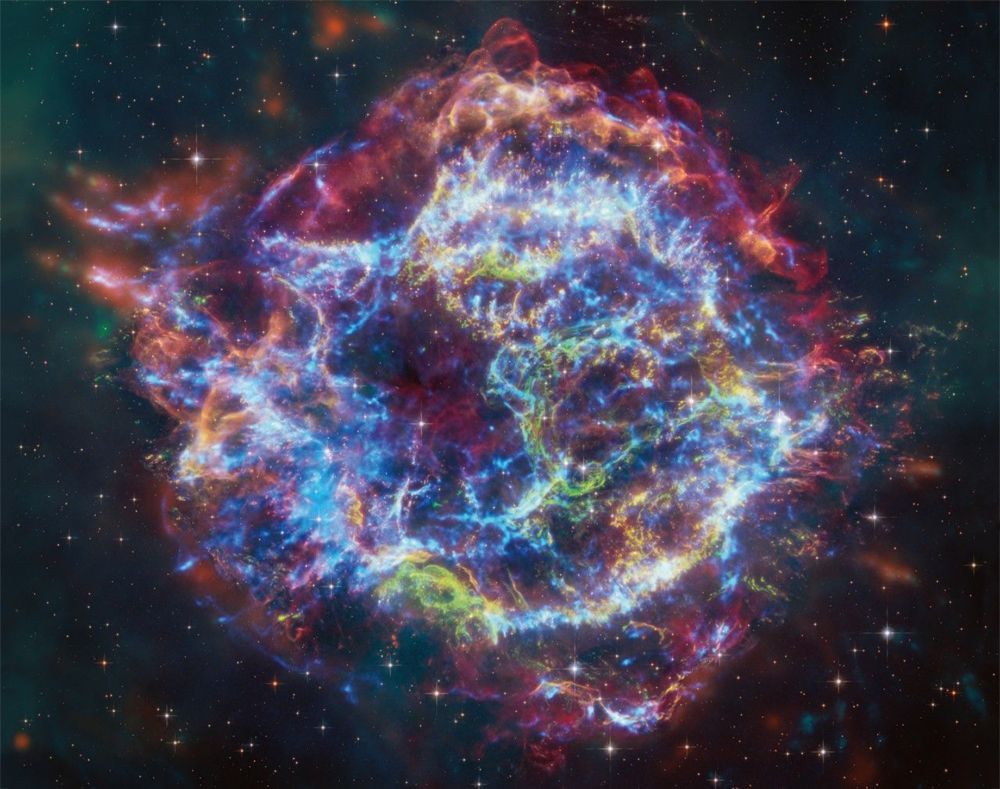
NASA-JAXA XRISM Finds Elemental Bounty in Supernova Remnant science.nasa.gov/missions/xri...
For the first time, scientists have made a clear X-ray detection of chlorine and potassium in the wreckage of a star using data from the Japan-led XRISM (X-ray Imaging and Spectroscopy Mission) spacecraft.
05.12.2025 17:16 — 👍 1282 🔁 219 💬 20 📌 15

The Bipolar Jets of KX Andromedae apod.nasa.gov/apod/ap25120...
Blasting outward from variable star KX Andromedae, these stunning bipolar jets are 19 light-years long.
05.12.2025 17:10 — 👍 1781 🔁 271 💬 21 📌 21
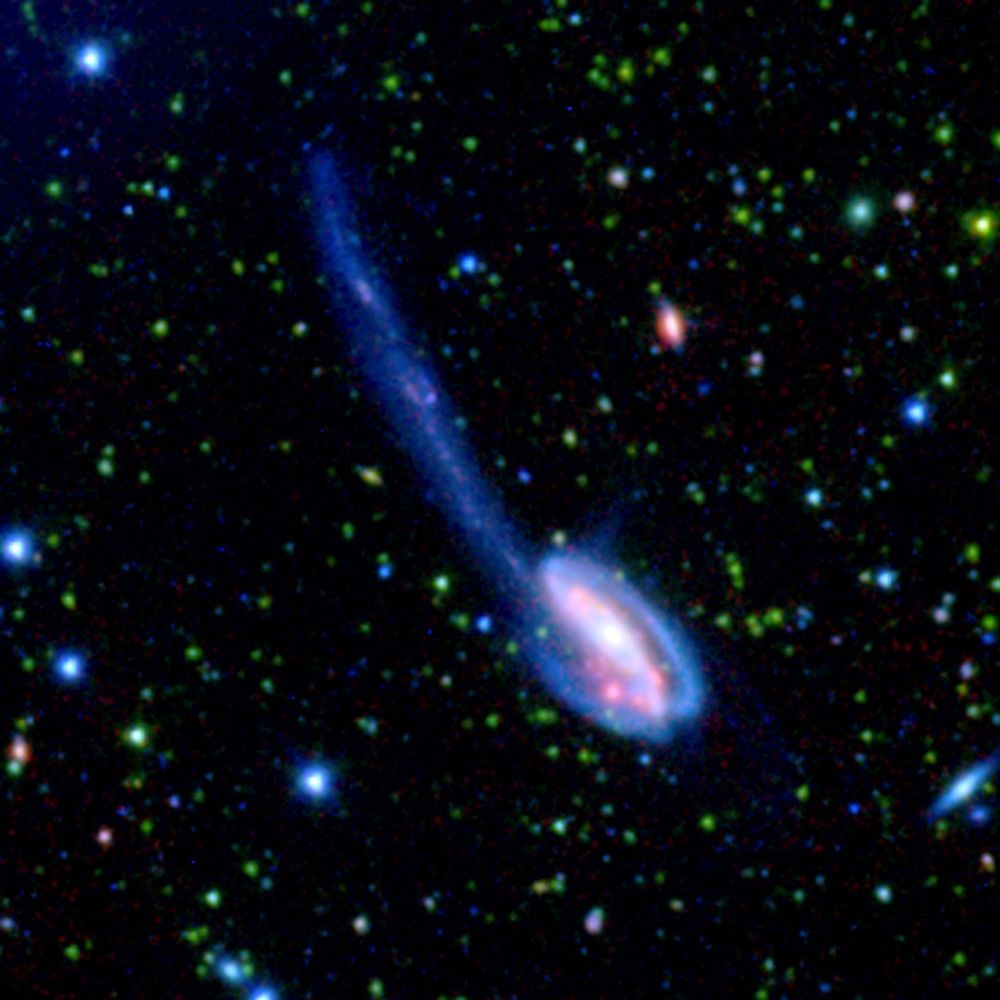
In the bottom right corner is a spiral galaxy with a bright pink-white central core encircled by two wispy arms that form a loose spiral around the core. The view is somewhat oblique, giving the galaxy an oval appearance. A long, thin, diffuse stream of blue stars and gas extends from the upper left side of the galaxy up to the upper left corner of the frame. Scattered across the background are hundreds of tiny smudges of light, which are stars and background galaxies. They vary slightly in size, shape, and color. Most appear in the shape of small dots, ovals, or lines. They come in different shades of red, blue and green.
Spitzer image of Arp 188, also known as the Tadpole Galaxy.
It is a result of a recent galactic interaction. A small intruder galaxy created a 280,000 light-year-long tail of stars and gas.
Credit: NASA/JPL-Caltech/C. Lonsdale (IPAC/Caltech), SWIRE Team
Source
02.12.2025 00:31 — 👍 67 🔁 13 💬 1 📌 1

Amazing: NGC 5335 in exquisite detail.
This flocculent spiral galaxy features patchy star-forming regions and no clear spiral arms, giving it a soft, irregular appearance.
(Credit: NASA, ESA, STScI)
25.11.2025 18:19 — 👍 138 🔁 33 💬 3 📌 1

IC-1805 -The Soul Nebula. HOO process
40 mins from 10th November 2025.
ZS61, ASI 585MC, L-eXtreme filter.
#astronomy #astrophotography
11.11.2025 13:17 — 👍 3382 🔁 451 💬 59 📌 20

SPACE/FULLMOON.GIF
31.10.2025 15:20 — 👍 1077 🔁 101 💬 15 📌 1

Image of the comet posted on X by KRL @KennethLerose
"You saw the cell phone shot on my last post and here’s the one from my camera for Comet C/2025 Lemmon last night with Mt Shasta. ☄️"
Comet C/2025 A6 (Lemmon) over Mt Shasta, California, beautifully captured by photographer Kenneth LeRose last night.
☄️
Kenneth LeRose's website - www.krlphoto.com/shop-art
More on the comet at fosstodon.org/@AkaSci/1153...
#Astronomy
17.10.2025 23:22 — 👍 1028 🔁 173 💬 26 📌 10

A clumpy galaxy, possibly merging from the Galaxy Zoo: Hubble project, classified by 117 volunteers.
A clumpy galaxy, possibly merging, observed with the Hubble Space Telescope in the AEGIS survey.
It is at redshift 0.95 (lookback time 7.74 billion years) with coordinates (214.25472, 52.49353).
117 volunteers classified this galaxy in Galaxy Zoo: Hubble.
16.09.2025 01:22 — 👍 10 🔁 1 💬 0 📌 0

A spectacular sight!
NGC 3256 is a peculiar galaxy formed from the collision of two separate galaxies in the constellation of Vela located about 122 million light-years away and belongs to the Hydra–Centaurus Supercluster complex.
(Credit: ESA/Hubble, NASA)
05.09.2025 16:22 — 👍 72 🔁 11 💬 1 📌 0

The Spider Nebula | NASA
29.08.2025 10:25 — 👍 282 🔁 51 💬 1 📌 1
Sun ejecting Plasma, as captured by the Parker Solar Probe.
-Credits: NASA
24.07.2025 20:28 — 👍 7900 🔁 1397 💬 263 📌 155

With its helical appearance resembling a snail’s shell, this reflection nebula seems to spiral out from a luminous central star in this NASA/ESA Hubble Space Telescope image.
The star in the center, known as V1331 Cyg and located in the dark cloud LDN 981 — or, more commonly, Lynds 981 — had previously been defined as a T Tauri star. A T Tauri is a young star — or Young Stellar Object — that is starting to contract to become a main sequence star similar to the sun.
What makes V1331Cyg special is the fact that we look almost exactly at one of its poles. Usually, the view of a young star is obscured by the dust from the circumstellar disc and the envelope that surround it. However, with V1331Cyg we are actually looking in the exact direction of a jet driven by the star that is clearing the dust and giving us this magnificent view.
This view provides an almost undisturbed view of the star and its immediate surroundings allowing astronomers to study it in greater detail and look for features that might suggest the formation of a very low-mass object in the outer circumstellar disk.
NASA image use policy.
NASA Goddard Space Flight Center enables NASA’s mission through four scientific endeavors: Earth Science, Heliophysics, Solar System Exploration, and Astrophysics. Goddard plays a leading role in NASA’s accomplishments by contributing compelling scientific knowledge to advance the Agency’s mission.
Follow us on Twitter
Like us on Facebook
Find us on Instagram
Hubble Sees a Young Star Take Center Stage - From Goddard Space Flight Center - https://flic.kr/p/rssNC7
30.06.2025 19:00 — 👍 451 🔁 63 💬 3 📌 2

The NASA/ESA Hubble Space Telescope highlights the nearby galaxy NGC 4449. The galaxy is about 12.5 million light-years away in the constellation Canes Venatici (The Hunting Dogs) & is know as a starburst galaxy due to many new stars being created.
More info: esahubble.org/images/potw2...
25.06.2025 23:43 — 👍 1357 🔁 159 💬 17 📌 5

Stunning: NGC 685, a barred spiral galaxy 64 million light-years away, ablaze with young blue stars and glowing pink H II gas clouds—signs of ongoing star birth
(Credit: ESA/Hubble & NASA, J. Lee, F. Belfiore)
07.06.2025 17:34 — 👍 25 🔁 6 💬 0 📌 0

Centaurus A. A glowing orange region shines at the upper left corner, with dark brown and black dust cascading diagonally down to the lower right. Distant stars dot the hazy background of space. Bright pink regions of star formation are interspersed throughout the dust.

Angled from the upper left corner to the lower right corner is a cone-shaped orange-red cloud known as Herbig-Haro 49/50. This feature takes up about three-fourths of the length of this angle. The upper left end of this feature has a translucent, rounded end. The conical feature widens slightly from the rounded end at the upper right down to the lower right. Along the cone there are additional rounded edges, like edges of a wave, and intricate foamy-like details, as well as a clearer view of the black background of space. In the upper left, overlapping with the rounded end of Herbig-Haro 49/50, is a background spiral galaxy with a concentrated blue center that fades outward to blend with red spiral arms. The background of space is speckled with some white stars and smaller, more numerous, fainter white galaxies throughout.

A massive spiral galaxy fills the image, with its bright yellow core seen near the upper left. Spiral arms whirl outward, laced through with dark brown dust and bright blue patches of star formation.

The image is divided horizontally by an undulating line between a cloudscape forming a nebula along the bottom portion and a comparatively clear upper portion. Speckled across both portions is a starfield, showing innumerable stars of many sizes. The smallest of these are small, distant, and faint points of light. The largest of these appear larger, closer, brighter, and more fully resolved with 8-point diffraction spikes. The upper portion of the image is blueish, and has wispy translucent cloud-like streaks rising from the nebula below. The orangish cloudy formation in the bottom half varies in density and ranges from translucent to opaque. The stars vary in color, the majority of which, have a blue or orange hue. The cloud-like structure of the nebula contains ridges, peaks, and valleys – an appearance very similar to a mountain range. Three long diffraction spikes from the top right edge of the image suggest the presence of a large star just out of view.
concerned about the state of the world because of two powerful men fighting? doomscrolling again?
stop. breathe. enjoy the universe for a brief moment
05.06.2025 21:38 — 👍 5191 🔁 661 💬 125 📌 23

Spectacular: The glittering specks in this image, resembling a distant flock of flying birds, are the stars that make up the dwarf galaxy ESO 540-31.
(Credit: ESA/Hubble & NASA - Acknowledgement: Luca Limatola)
31.05.2025 17:19 — 👍 25 🔁 4 💬 0 📌 0

A spiral galaxy in space. It is seen tilted at an angle, as a stormy disc filled with clouds of stars and dust. It is coloured more yellowish in the centre, and bluer out to the edge of the disc, where the ends of curved spiral arms break away from the disc. Spots of red light scattered through the galaxy mark where stars are actively forming. The galaxy is on a black background.
🔭 This weeks NASA/ESA Hubble Space Telescope image of the week features the stately and inclined spiral galaxy NGC 3511.
From Hubble’s vantage point in orbit around Earth, NGC 3511 is tilted by about 70 degrees!
19.05.2025 08:43 — 👍 681 🔁 79 💬 4 📌 3
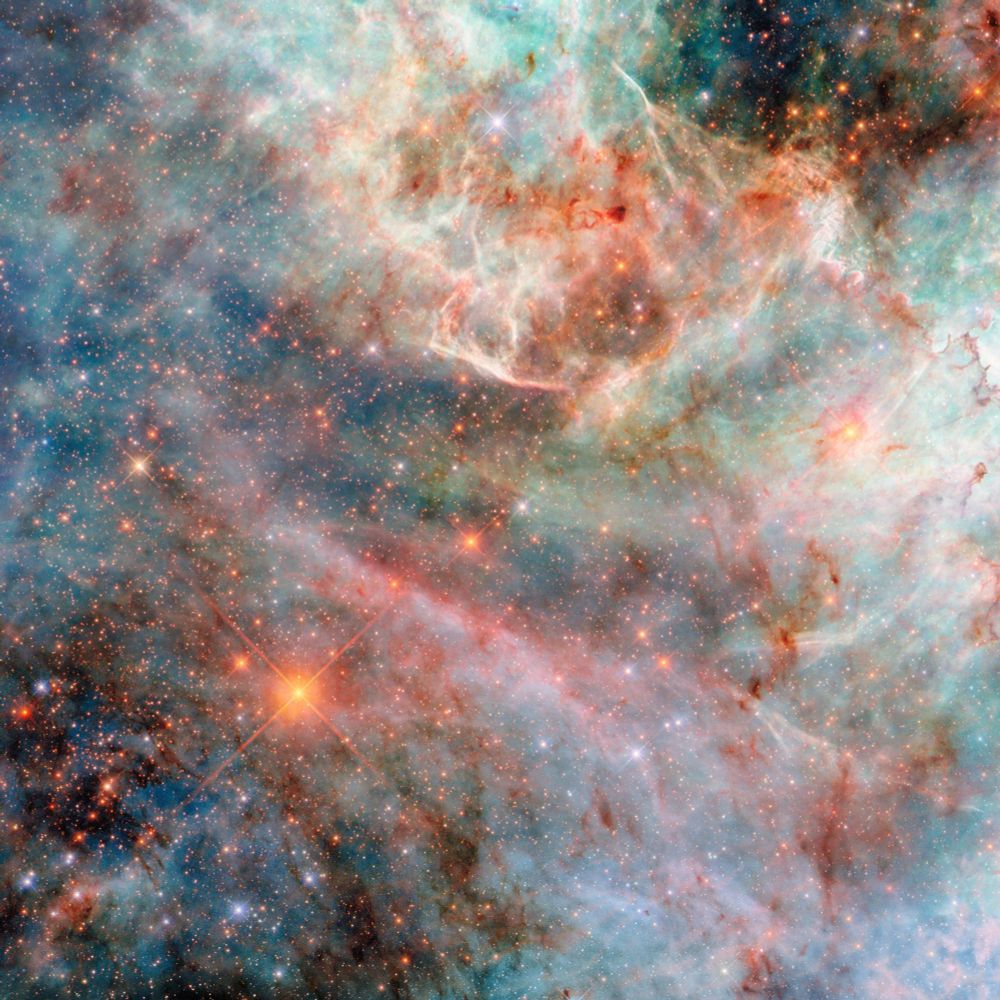
Part of a nebula in space. Layers of gas and dust clouds in different colors, from blue and green shades to pink, red, and black, each indicating light emitted by different molecules, comprise the nebula. The background cloud layers are thicker and puffier, though still translucent, and the upper layers are thin and bright at the edges. Behind the clouds are many small, mostly orange and some blue, stars.
LOOK AT TODAY’S BEAUTIFUL NEW HUBBLE IMAGE OF THE LARGE MAGELLANIC CLOUD!!! 🌌
16.05.2025 17:23 — 👍 3691 🔁 456 💬 52 📌 18
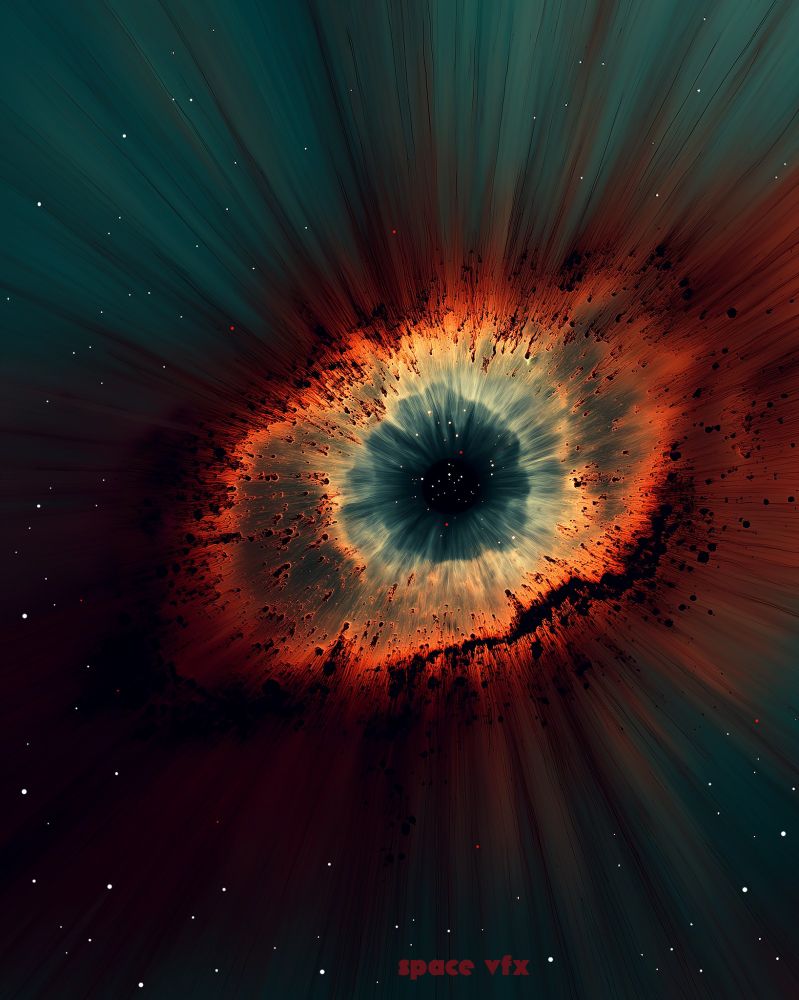
A digital space artwork depicting a striking supernova remnant. A dark central core is surrounded by a glowing halo in white, orange, and deep red, with radiating shockwave-like streaks. Dark patches suggest interstellar dust and gas. The overall composition blends scientific elements with artistic interpretation.
A supernova remnant unveils a star’s explosive end—a black hole cradled in ethereal ejecta, its shockwaves rippling through the cosmos with celestial grace.
15.05.2025 13:04 — 👍 2112 🔁 249 💬 63 📌 32
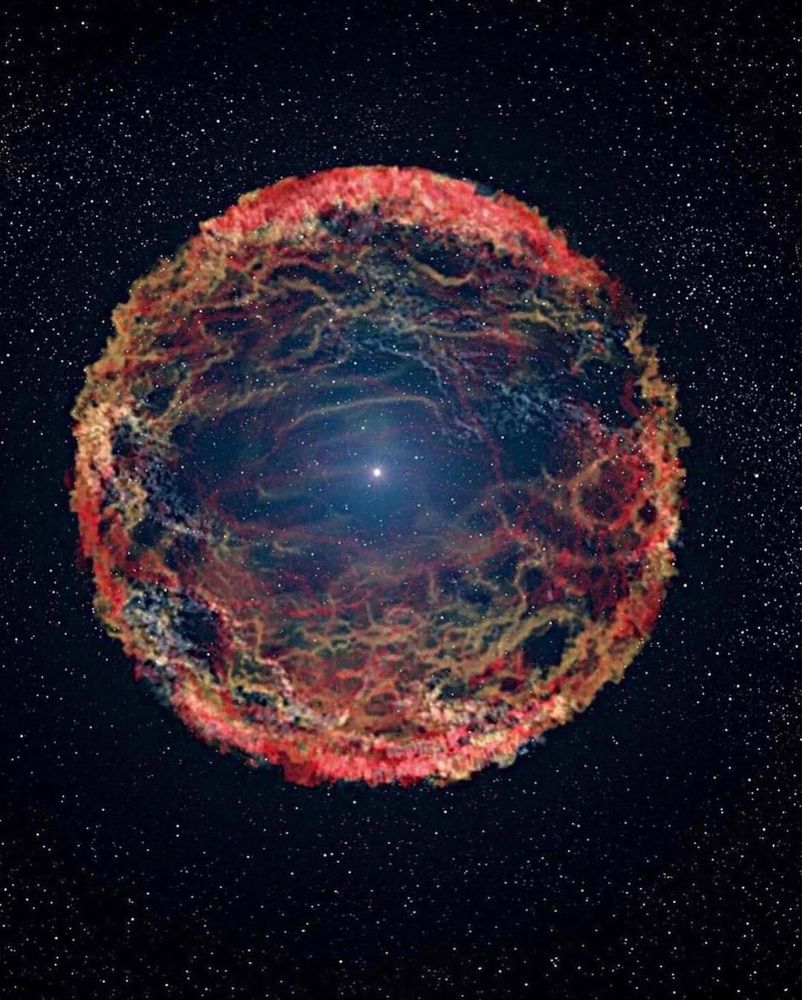
A mysterious supernova discovered in 2014 stayed bright for years, defying expectations by brightening and fading multiple times. Scientists suspect a massive star, possibly generating antimatter, caused the repeated eruptions.
Credit: NASA/ESA/G. Bacon, STScI
A mysterious supernova discovered in 2014 stayed bright for years, defying expectations by brightening and fading multiple times. Scientists suspect a massive star, possibly generating antimatter, caused the repeated eruptions.
Credit: NASA/ESA/G. Bacon, STScI
15.05.2025 16:30 — 👍 1524 🔁 212 💬 25 📌 17

This amazing image shows a thin section of a supernova remnant caused by a stellar explosion that occurred more than 1,000 years ago. It is a composite of hydrogen-light observations taken with Hubble's Advanced Camera
Credit: NASA, ESA, and the Hubble Heritage Team (STScI/AURA)
06.05.2025 17:23 — 👍 44 🔁 6 💬 1 📌 0
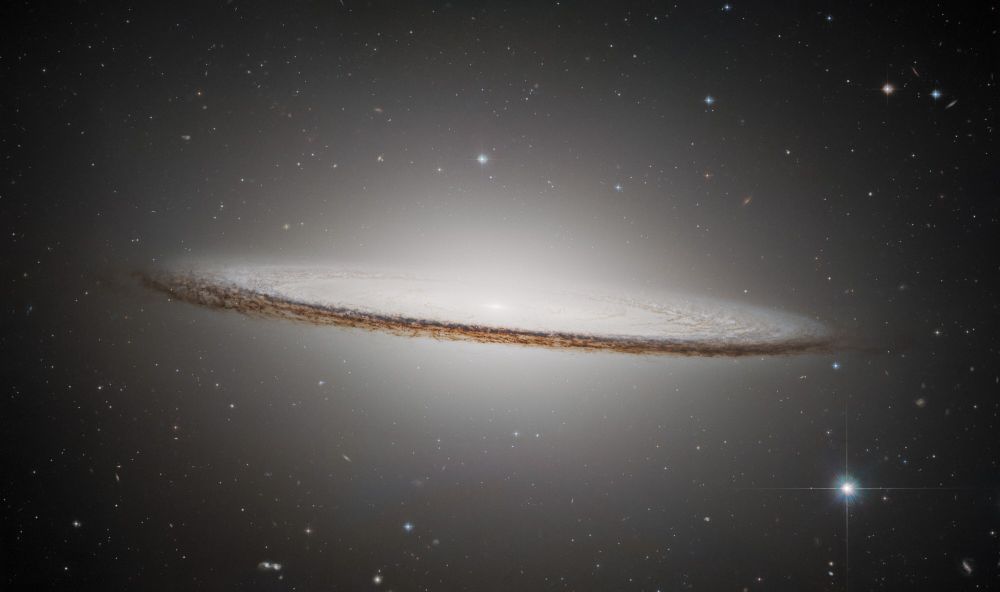
The Sombrero Galaxy is an oblong, pale white disc with a glowing core. It appears nearly edge-on but is slanted slightly in the front, presenting a slightly top-down view of the inner region of the galaxy and its bright core. The outer disc is darker with shades of brown and black. Different coloured distant galaxies and various stars are speckled among the black background of space surrounding the galaxy.
The NASA/ESA Hubble Space Telescope has returned to an old time favourite for its #Hubble35 anniversary!
The enigmatic Sombrero Galaxy has features of both spiral and elliptical galaxies. Read more 👉 www.esa.int/ESA_Multimed...
🔭 🧪
16.04.2025 14:01 — 👍 429 🔁 50 💬 7 📌 9