Thanks that's helpful, and yeah sounds simpler than a modularity algorithm.
04.02.2026 00:06 — 👍 0 🔁 0 💬 0 📌 0
Important work! Curious how you all define “precision”? (without having combed the methods). Trying to build a mental model around minimum viable criteria for PNM.
03.02.2026 21:01 — 👍 0 🔁 0 💬 1 📌 0
Nice work! Especially reassuring to see null findings with some disorders.
01.02.2026 19:58 — 👍 1 🔁 0 💬 0 📌 0

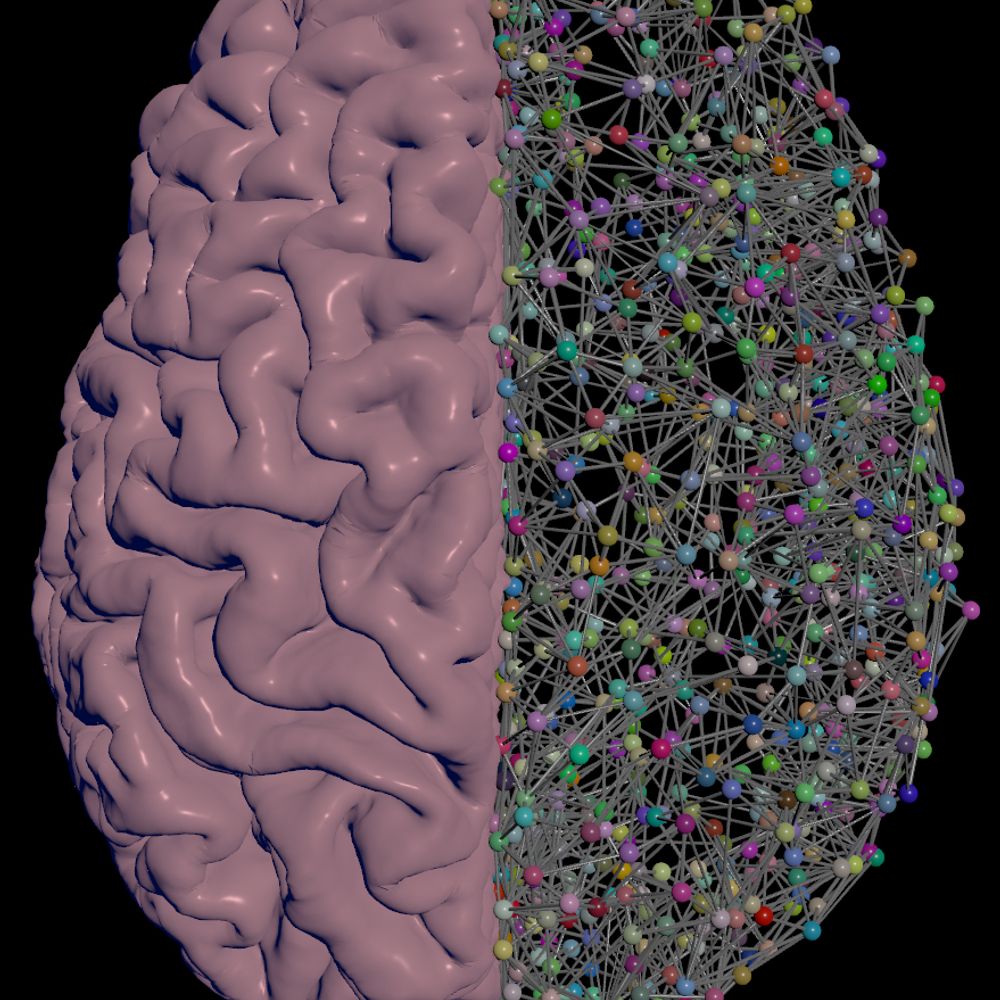
A brief history of precision self-scanning
When a researcher solved a logistical problem by going rogue, the idea proved remarkably infectious.
When a brain researcher solved a logistical problem by going rogue, the idea proved remarkably infectious.
By @lyrebard.bsky.social
#neuroskyence
www.thetransmitter.org/brain-imagin...
21.01.2026 15:37 — 👍 41 🔁 15 💬 0 📌 3
One major benefit resulting from all the LNM studies, regardless of how the dust settles: a massive collection of lesions have been compiled. That can be a powerful reference set for future studies testing how clustered a new set of lesions are.
17.01.2026 06:27 — 👍 0 🔁 0 💬 0 📌 0
For existing LNM studies, preprocessing choices for the normative connectome play a big role in determining how the LNM maps look. Global signal regression is going to change the degree distribution, and we know GSR is not a no-brainer.
17.01.2026 06:27 — 👍 0 🔁 0 💬 1 📌 0

Functional network collapse in neurodegenerative disease - Nature Communications
This study demonstrates that brain functional network imbalance appears linked to progressive brain atrophy and cognitive decline across the dementia spectrum.
Maybe a set of lesions converge on how they perturb the low-dimensional functional state space (h/t D Jones). We talk about this in our recent atrophy-FC paper: www.nature.com/articles/s41.... I think structure-function methods like ours can help link disparate lesions to common cognitive outcomes.
17.01.2026 06:27 — 👍 0 🔁 0 💬 1 📌 0
The core question motivating LNM studies is: how do disparate lesions converge on a common syndrome? Put another way: what's the structure-function-cognition mapping? I think patient fMRI is crucial here!
17.01.2026 06:27 — 👍 0 🔁 0 💬 1 📌 0
To strengthen the "chance" case, the simulated null lesions should have the same spatial autocorrelation as the true lesions.
17.01.2026 06:27 — 👍 0 🔁 0 💬 1 📌 0
For future "LNM 2.0" studies, a good research question may simply be: does a set of lesions cluster on some spatial feature - connectivity, gradient, gene expression - more than expected by chance?
17.01.2026 06:27 — 👍 1 🔁 0 💬 1 📌 1
If they did, you'd get different LNM connectivity maps back for different syndromes. Instead, the lesions are actually uniformly distributed across the connectome, which results in you getting the functional connectome degree map back as the LNM map.
17.01.2026 06:27 — 👍 0 🔁 0 💬 1 📌 0
The LNM method in a nutshell is: do the lesions for a syndrome cluster on some spatial feature of the healthy functional connectome? The takeaway from this study: no, the lesions don't cluster.
17.01.2026 06:27 — 👍 0 🔁 0 💬 1 📌 0
This is strong and careful work. I like how they boiled LNM down to its essence: LNM = sum(M x C). They clearly thought deeply about the method.
17.01.2026 06:27 — 👍 0 🔁 0 💬 1 📌 0
Been pondering the lesion network mapping study all day. Here's my $0.02 [🧵]:
17.01.2026 06:27 — 👍 5 🔁 0 💬 1 📌 0
I am recruiting a Postdoc to join my lab at UMN. If you or someone you know is interested in studying individual differences in brain and cognitive aging, check out the listing and my website in my bio and apply!
I appreciate RTs to help get the word out as well :)
09.01.2026 21:13 — 👍 15 🔁 16 💬 1 📌 0
Paradigm shift away from regionalization, finally?
24.12.2025 05:47 — 👍 0 🔁 0 💬 1 📌 0
Radiata
Where to next?
- Deploy this biomarker as a real world test (radiata.ai)
- Develop non-invasive neurostimulation therapy for functional connectivity imbalances
- Apply eigenmode analysis to develop new fMRI biomarkers
25.11.2025 17:17 — 👍 0 🔁 0 💬 0 📌 0
- @lollopasquini.bsky.social's curiosity led to us looking into gradients, which led to the idea of gradient imbalance and hypo/hyper connectivity in dementia. Just followed the thread.
25.11.2025 17:17 — 👍 0 🔁 0 💬 1 📌 0
- Eigenmode analysis finally made sense after reading Strogatz’s “Nonlinear dynamics and chaos” and taking a long hike to the beach at Point Reyes.
25.11.2025 17:17 — 👍 0 🔁 0 💬 1 📌 0
Things that happened along the way:
- Back in 2013, Helen Zhou’s Brain paper about convergent and divergent functional connectivity in AD/FTD got lodged in my mind and never left.
- The idea for structure-function mapping in AD and FTD came at OHBM 2019 in Rome. Idea to paper took a long time.
25.11.2025 17:17 — 👍 0 🔁 0 💬 1 📌 0
Sincere thanks to the participants, outstanding colleagues at the @ucsfmac.bsky.social, and to the Tau Consortium for support. 🙏
25.11.2025 17:17 — 👍 1 🔁 0 💬 1 📌 0

Key finding 5: Sensory-association imbalance is a promising cognitive biomarker for prognosis/monitoring because 1) higher imbalance at baseline predicts accelerated cognitive decline and 2) functional biomarkers will likely show more dynamic response to treatment.
25.11.2025 17:17 — 👍 0 🔁 0 💬 1 📌 0

Key finding 4: Structure and function biomarker scores both contribute to cognitive impairment.
25.11.2025 17:17 — 👍 0 🔁 0 💬 1 📌 0

Key finding 3: Eigenmode analysis reveals reductions in gradient amplitude and phase, which we call collapse. Those disruptions that add up to observed FC differences.
25.11.2025 17:17 — 👍 0 🔁 0 💬 1 📌 0

Key finding 2: Hypo and hyperconnectivity appear as two sides of the same coin. Different atrophy patterns perturb specific functional gradients, in which anticorrelated network pairs are embedded.
25.11.2025 17:17 — 👍 2 🔁 0 💬 1 📌 0

Key finding 1: Sensory-association functional connectivity imbalance (SAI) appears in all syndromes. As atrophy increases, sensory connectivity weakens and association connectivity gets stronger. Did not expect this.
25.11.2025 17:17 — 👍 1 🔁 0 💬 1 📌 0

We mapped structure-function relationships in Alzheimer’s disease and frontotemporal dementia. This was a good cohort because the atrophy patterns collectively cover almost the entire brain.
25.11.2025 17:17 — 👍 1 🔁 0 💬 1 📌 0

fMRI Course
Instructors
❤️ Bluesky fMRI people! 3-day #fMRI course live online Jan 7-9, 2026.
#SPM, #ICA, GLM, connectivity, mediation, MRI physics, #DataScience with @vcalhoun.bsky.social and Kent Kiehl.
We love talking methods & connecting with colleagues! Come join us!
Register here:
sites.google.com/dartmouth.ed...
14.11.2025 18:04 — 👍 52 🔁 28 💬 1 📌 2
Canada Research Chair (Tier 1) & Full Prof | I study cog neuro of memory & aging w interests in sex differences, midlife & menopause, AD risk, & health equity | Views are my own |
🇨🇦
https://bheamlab.ca
#neuroskyence
Brain imaging research, Oxford
EiC, Imaging Neuroscience https://bsky.app/profile/imagingneurosci.bsky.social
neuroscience, physiology, resting state fMRI
🇦🇺
Assistant Professor of Psychiatry.
Network neuroscience, NeuroAI, multimodal MRI, precision psychiatry.
parkeslab.com
Professor of Psychology & Data Science at @UVA; #Scientist, #Scholar, #Student; Thinking about the #brain as a #DataScience - way too much; #MRI #EEG #PET
Professor at Imperial College London and Principal Scientist at Google DeepMind. Posting in a personal capacity. To send me a message please use email.
Assistant Professor, UCSF. Computational neuroscientist working at the intersection of age, emotions, and psychedelics.
principal sciolist. mostly made of ice cream
Assistant Professor @Lund University | Neurodegenerative disease | Neuroimaging | AI | Multi-omics |
Neuroscientist and psychologist interested in better treatments, brains & psychosis. Research Fellow @UniMelb @orygen_aus
physician-scientist, author, editor
https://www.scripps.edu/faculty/topol/
Ground Truths https://erictopol.substack.com
SUPER AGERS https://www.simonandschuster.com/books/Super-Agers/Eric-Topol/9781668067666
Scientist • Cognitive and Systems Neuroscience • Dynamic Minds and Brains • Postdoc at the University of Pittsburgh • Open Science • Solidarity • he/him
Neuroimaging & Neuropsychology | Ageing & Alzheimer's disease | Lifestyle, sex/gender & genetic risks
(PhD, BSc) Chief Scientific Officer at http://brainkey.ai.
Fatherhood, Science, Gaming & BrainKey news. My thoughts are my own.
Designing experiments to sort the universe of possible medicines for the mind.
Professor @ Duke U • Fascinated by the 🧠 • Studying Memory using Mobile Neurotechnologies & Wearables • SuthanaLab.com
Led by Beth Mormino @ Stanford. We investigate aging and neurodegenerative disease in preclinical populations utilizing biofluid and imaging biomarkers, fMRI and MRI. 🧠
https://med.stanford.edu/mormino-lab.html