As explained further below, however, your status as an inferior officer under Article II of the Constitution renders you an “at-will” employee, and your removal is beyond the purview of Title VII. Regarding your client’s claim that her employment as an Immigration Judge was terminated, this decision was a lawful exercise of the Attorney General’s authority under Article II of the Constitution. Article II of the Constitution allows the President and heads of departments exercising his power to remove inferior officers without cause, subject to only narrow exceptions that do not apply to your former position. No statute provides otherwise, and even if it did, the statute would run afoul of Article II.
DOJ says immigration judges, as "inferior officers," may be fired on the basis of sex, religion, race, or national origin. Leaving aside the law, it's *politically* remarkable they're taking this position.
washingtonlitigationgroup.org/news/former-...
storage.courtlistener.com/recap/gov.us...
01.12.2025 18:40 — 👍 990 🔁 386 💬 35 📌 29
Chris's independent media outlet - Law Dork - does such important work democratizing information about the courts.
It is a worthy cause to support - so get a paid subscription if you can!!
01.12.2025 18:00 — 👍 107 🔁 22 💬 3 📌 2
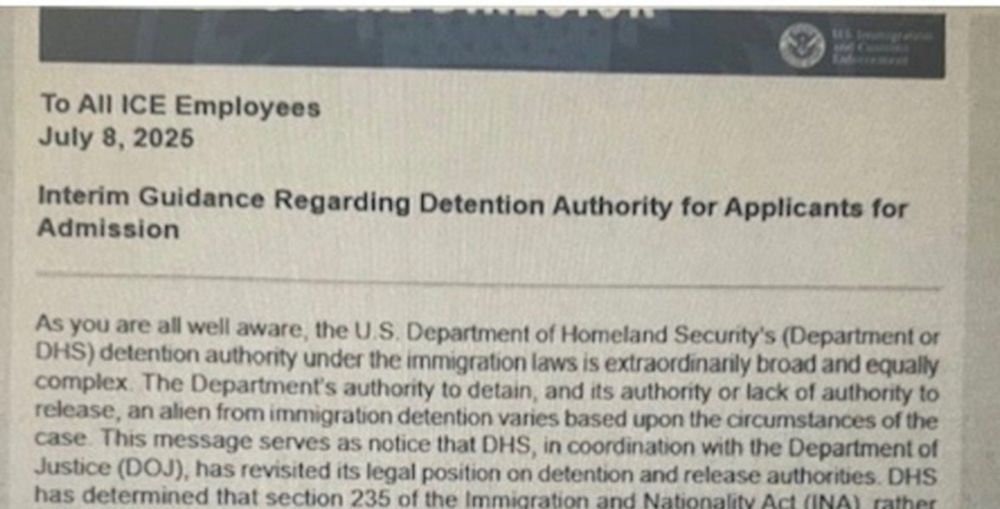
195. The Immigration Detention Flood
The Trump administration's attempt to quietly—but massively—expand who can be detained pending their removal has been met with overwhelming pushback from a remarkably large number of district courts.
There's a lot going on, and immigration law is notoriously labyrinthine. But it's still wild both that (1) the Trump administration is trying to treat millions of non-citizens who have lived here for years/decades as "arriving aliens"; & (2) *hundreds* of courts have (almost unanimously!) said "no":
01.12.2025 14:52 — 👍 879 🔁 247 💬 12 📌 7
Reading the deposition he gave in Chicago you can understand why it is that Judge Ellis tore into him.
The first substantive question is "What is your role in Operation Midway Blitz?" Bovino essentially gives his title and no further details. 8 pages later, the lawyer gives up.
29.11.2025 02:56 — 👍 1284 🔁 382 💬 28 📌 5

In a 3-0 decision, the Court of Appeals rules against the Trump administration on the appointment of Alina Habba as interim US attorney in New Jersey www.documentcloud.org/documents/26...
01.12.2025 14:05 — 👍 1559 🔁 312 💬 34 📌 15
I'm @profmmurray.bsky.social's #3 favorite thing!!!!
😲🤪😛🙃
30.11.2025 14:18 — 👍 38 🔁 3 💬 1 📌 0
Please join my friend @cfcolemanjr.bsky.social on ‘Velshi’ @ 10a-1p w/
@deanobeidallah.bsky.social
@normeisen.bsky.social
@stevebenen.com
@dahlialithwick.bsky.social
@mjsdc.bsky.social
@imillhiser.bsky.social
@leahlitman.bsky.social
@adamsmith.house.gov
@ucheblackstockmd.bsky.social
1/2
#Velshi
30.11.2025 12:58 — 👍 75 🔁 11 💬 9 📌 0

Mini goldendoodle in go blue bandana with blue bow
Go Blue!
29.11.2025 17:56 — 👍 161 🔁 5 💬 7 📌 1

Hegseth order on first Caribbean boat strike, officials say: Kill them all
Defense Secretary Pete Hegseth issued a verbal order to kill all crew members in the Sept. 2 strike on a suspected drug boat. Navy SEALs fired a second missile.
Textbook war crime/extrajudicial killing
"Two survivors were clinging to the smoldering wreck. The Special Operations commander overseeing the Sept. 2 attack ... ordered a second strike to comply with Hegseth’s instructions."
Report by @alexhorton.bsky.social @ellenwapo.bsky.social o.bsky.social
28.11.2025 18:13 — 👍 6815 🔁 2791 💬 388 📌 451
Social science takes time. Here, social scientists analyze a decade of evidence to show that a Supreme Court decision designed to suppress the black vote actually did. SCOTUS may soon obliterate the rest of the Voting Rights Act and we should not be shy about calling out what's going on here.
26.11.2025 15:58 — 👍 150 🔁 86 💬 4 📌 3
Question about the dissent by (the far-right) Justice Ziegler: Does this quote actually appear in Moore v. Harper? Did Moore say that state courts' role in congressional redistricting is "exceedingly limited"? I don't think it did! vhdshf2oms2wcnsvk7sdv3so.blob.core.windows.net/thearp-media...
25.11.2025 21:10 — 👍 412 🔁 95 💬 26 📌 25
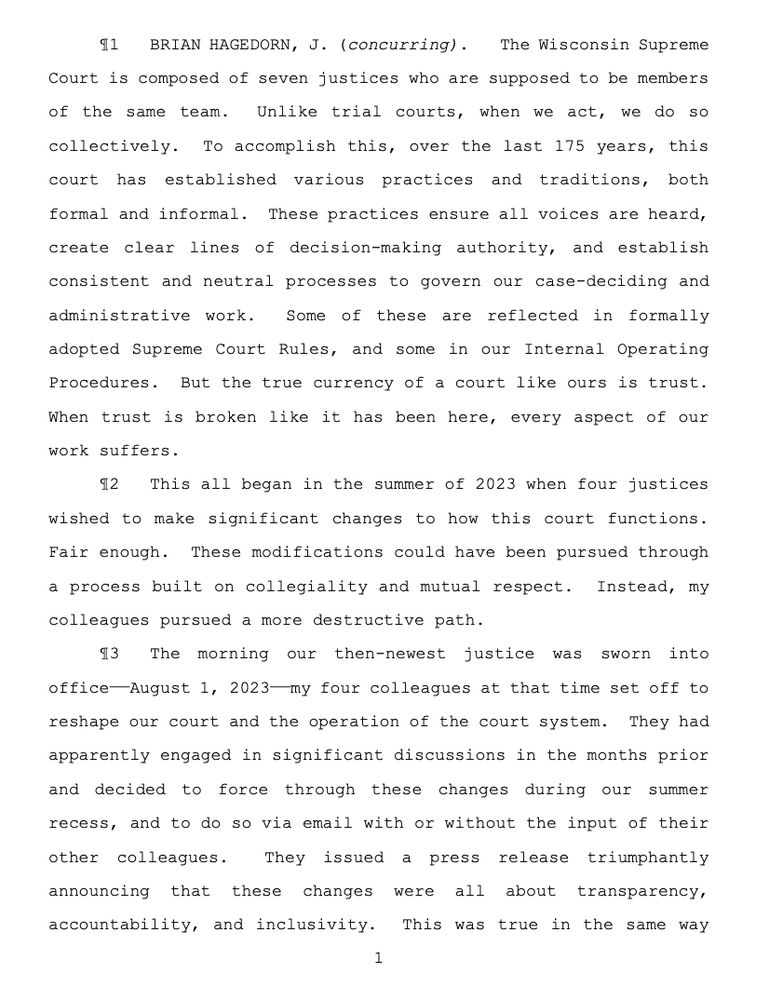
BRIAN HAGEDORN, J. (concurring). The Wisconsin Supreme
Court is composed of seven justices who are supposed to be members
of the same team. Unlike trial courts, when we act, we do so
collectively. To accomplish this, over the last 175 years, this
court has established various practices and traditions, both
formal and informal. These practices ensure all voices are heard,
create clear lines of decision-making authority, and establish
consistent and neutral processes to govern our case-deciding and
administrative work. Some of these are reflected in formally
adopted Supreme Court Rules, and some in our Internal Operating
Procedures. But the true currency of a court like ours is trust.
When trust is broken like it has been here, every aspect of our
work suffers.
¶2 This all began in the summer of 2023 when four justices
wished to make significant changes to how this court functions.
Fair enough. These modifications could have been pursued through
a process built on collegiality and mutual respect. Instead, my
colleagues pursued a more destructive path.
¶3 The morning our then-newest justice was sworn into
office——August 1, 2023——my four colleagues at that time set off to
reshape our court and the operation of the court system. They had
apparently engaged in significant discussions in the months prior
and decided to force through these changes during our summer
recess, and to do so via email with or without the input of their
other colleagues. They issued a press release triumphantly
announcing that these changes were all about transparency,
accountability, and inclusivity. This was true in the same way

Pearl Harbor was a strike for peace in the Pacific. I will not
rehash every detail (Justice Ziegler's excellent writing recounts
much of the history), but the reader deserves a taste.
¶4 The first shot sounded when my four colleagues fired the
Director of State Courts, who functions as the CEO of
administrative matters for the entire judicial branch. Without
following any established process, one of my colleagues sent an
email proposing that we fire our Director and install a new, preselected interim Director in his place. This happened through
email, over the course of two business days, while the Director
was out of town on state business, during our summer recess. He
never received a performance review indicating concerns; he was
simply told his employment was over. This came just months after
some of these same colleagues emphasized the importance of having
all justices participate in hiring key staff.
¶5 Later that same week, my colleagues proposed dramatic
changes via email affecting both our case-deciding and
administrative responsibilities. The email invited justices to
attend a new, unscheduled meeting of the court later that week to
discuss the proposals. One justice said she could not be there;
another objected to the meeting as outside our court calendar.
The meeting would go forward no matter what, we were told. I
implored my colleagues to reconsider, to treat their fellow
colleagues with the respect they would want if circumstances were
reversed. They refused. The meeting went on as expected, and
with only four members present, they voted to fundamentally remake
our court.

¶7 Among their changes, my colleagues radically altered the
role of the chief justice. They created a new, three-person
administrative committee (on which the chief justice would
ostensibly sit) to take over nearly all of the chief justice's
most important administrative duties. And they did so in the face
of serious objections that these changes violated the Wisconsin
Constitution, which says the chief justice "shall be the
administrative head of the judicial system." Wis. Const. art.
VII, § 4. One justice who in the past championed the
constitutional role of the chief justice suddenly changed course.
Again, these actions stripping the chief justice of powers she had
exercised for as long as anyone could remember were proposed via
email, and were voted on a few days later during an unscheduled
meeting of just four justices during our summer recess. Not
exactly transparent, accountable, and inclusive.
¶8 Another significant series of amendments to our internal
rules involved modifying the way we consider certain kinds of
cases, essentially making it much easier for this court to expedite
cases coming to us outside the normal appeals process. Why the
change? As everyone understood, my colleagues had the not-sosecret goal of swiftly hearing particular politically charged
cases. This was all by design.
¶9 And how did this experiment go? Not well.
Administratively, it was not clear who was in charge. We
experienced significant breakdowns in communication amidst a lack
of clarity about who was doing what. Our staff was often caught
in the middle of a court that did not have established lines of

communication and authority. And when the Director of State Courts
was unceremoniously fired for what many perceived as political
reasons, it sent a shockwave through the system. Furthermore, my
colleagues' changes were not one and done. Throughout the past
two years, they continued to modify the court's procedures in a
similar ad-hoc fashion, often after realizing problems with their
earlier ill-considered changes. This only added to the confusion.
¶10 Finally, at one of the court's internal conferences this
past June, my colleagues shifted course. One of the four announced
she was "withdrawing" her prior votes from the past two years
(which, by the way, is not a thing) with the idea that every
disputed change was now, all of a sudden, reversed. What changed?
Again, it was no mystery. My colleagues wanted to take power away
from then-Chief Justice Annette Ziegler. Such a move ensured that
my colleagues would run the court through the administrative
committee. Following the April 2025 election, they concluded they
would have the votes to elect a chief justice of their choosing
and have a block of votes to support her, so they no longer needed
to seize those powers. This is not a cynical take. It is exactly
what happened.
¶11 What's past is past, however. I have no desire to hold
this against my colleagues, and I am grateful they have changed
course. In fact, I was happy to work collaboratively on many
operational changes reflected in this order, most of which I
When liberals secured a majority on the Wisconsin Supreme Court in 2023, they changed internal procedures—over the objection of the conservative chief justice, who claimed they were taking away her power. Today the justices released MESSY details about the affair...
www.wicourts.gov/sc/rulhear/D...
25.11.2025 20:32 — 👍 405 🔁 110 💬 16 📌 17

The Trump administration made erroneous claims to the Supreme Court, mischaracterizing the responsiveness of local police and the actions of protesters in a filing asking the justices to sign off on the deployment of hundreds of National Guard troops to Chicago, a New York Times investigation found.
The emergency request, filed by the solicitor general, D. John Sauer, which draws heavily from court declarations made by two Homeland Security officials, misstates what happened in the aftermath of a car crash and shooting on Oct. 4 in Chicago that involved Border Patrol agents.
A Times analysis of hours of police radio and hundreds of videos posted to social media refutes the federal government’s claims that the Chicago Police Department didn’t respond quickly to the scene, leaving federal agents to fend for themselves during what they called a riot.
This is the same playbook the Trump administration ran in Portland, where DHS officials falsely accused local police of failing to help them (or not arriving quickly enough). Strikes me as a problem that the government lies so freely to the Supreme Court now. www.nytimes.com/2025/11/25/u...
25.11.2025 20:12 — 👍 572 🔁 201 💬 28 📌 17

Mini goldendoodle with paws on knee
we do not deserve dogs
25.11.2025 17:53 — 👍 261 🔁 5 💬 13 📌 0
YouTube video by Pod Save America
BREAKING: Trump Suffers MAJOR LOSS In Court
I talked to Jon Lovett about the dismissal of the Comey and James indictments: m.youtube.com/watch?v=BlTY...
24.11.2025 23:41 — 👍 95 🔁 13 💬 2 📌 1
When you are only 5s in and @leahlitman.bsky.social says
"Don't worry we consume the content for you and are about to report back"
Two things spring to mind.
1. Yep, that's exactly why I listen to this podcast
2. This will mean changing the bulb
For reference: youtu.be/Qa_gZ_7sdZg?...
24.11.2025 14:37 — 👍 15 🔁 3 💬 0 📌 0

I saw Cady Heron wearing army pants and flip flops, so I bought army pants and flip flops.
23.11.2025 19:35 — 👍 320 🔁 35 💬 16 📌 4
"The prose is quiet good though"
23.11.2025 17:22 — 👍 25 🔁 6 💬 4 📌 0
Litman: Justice "Barrett insists that we “listen to the law”—but can she even hear what the law is saying given her disconnect from our current reality?"
"Her failure to acknowledge that reality makes the book seem, however inadvertently, like an effort to burnish an authoritarian regime..."
1/14
23.11.2025 16:26 — 👍 97 🔁 25 💬 5 📌 0

Is Justice Barrett Listening? | Los Angeles Review of Books
Leah Litman prosecutes Justice Amy Coney Barrett’s new legal memoir, “Listening to the Law: Reflections on the Court and Constitution.”
“The book is so immersed in its own world that it reads, at times, like fan service. Much of what Barrett writes is in the register of reassurance, but only for people who think like her.” @leahlitman.bsky.social
23.11.2025 14:17 — 👍 69 🔁 17 💬 5 📌 0

President Piggy
This is what consequence-free misogyny looks like.
A very good piece. “The fact that many men believe they no longer even have to pretend to respect women in order to participate in public life makes it unlikely that anything will change anytime soon.”
22.11.2025 21:27 — 👍 495 🔁 153 💬 8 📌 13
If they/Alito didn’t immediately pause it, Steve, then George Soros would win!
22.11.2025 00:48 — 👍 194 🔁 11 💬 6 📌 0

Supreme Court of the United States
No. 25A608
GREG ABBOTT, GOVERNOR OF TEXAS, ET AL., C
Applicants
V.
LEAGUE OF UNITED LATIN AMERICAN CITIZENS, ET AL.
ORDER
UPON CONSIDERATION of the application of counsel for the
applicants,
IT IS ORDERED that the November 18, 2025 order of the United
States District Court for the Western District of Texas, case No. 3:21-cv-259
is hereby administratively stayed pending further order of the undersigned or of the Court. It is further ordered that a response to the application be filed on or before Monday, November 24, 2025, by 5 p.m. (EST).
#BREAKING: Just hours after Texas asked #SCOTUS to pause Tuesday’s ruling that had blocked its new House congressional district maps, Justice Alito has issued a temporary “administrative” stay pausing that ruling (and putting the new maps back into place) while the full Court considers next steps:
22.11.2025 00:42 — 👍 611 🔁 266 💬 80 📌 44
I had such a wonderful time at Berkeley Law!
One of the Berkeley Bears even gave my little bear a little present:
21.11.2025 18:12 — 👍 129 🔁 7 💬 2 📌 0


Thank you to Professor Leah Litman — Strict Scrutiny co-host, law professor, and former Supreme Court clerk — for joining us at Berkeley Law to discuss her new book 𝘓𝘢𝘸𝘭𝘦𝘴𝘴: 𝘏𝘰𝘸 𝘵𝘩𝘦 𝘚𝘶𝘱𝘳𝘦𝘮𝘦 𝘊𝘰𝘶𝘳𝘵 𝘙𝘶𝘯𝘴 𝘰𝘯 𝘊𝘰𝘯𝘴𝘦𝘳𝘷𝘢𝘵𝘪𝘷𝘦 𝘎𝘳𝘪𝘦𝘷𝘢𝘯𝘤𝘦, 𝘍𝘳𝘪𝘯𝘨𝘦 𝘛𝘩𝘦𝘰𝘳𝘪𝘦𝘴, 𝘢𝘯𝘥 𝘉𝘢𝘥 𝘝𝘪𝘣𝘦𝘴. @leahlitman.bsky.social #BerkeleyLaw
21.11.2025 18:05 — 👍 33 🔁 6 💬 0 📌 1
okay this made my day!!!!!
If Adam Serwer liked LAWLESS: How the Supreme Court Runs on Conservative Grievance, Fringe Theories, & Bad Vibes ...
... why not get a copy for the holidays?
(from bookshop dot org of course)
bookshop.org/p/books/lawl...
21.11.2025 16:54 — 👍 95 🔁 15 💬 2 📌 1
Dad ☆ Husband ☆ Low-Key Nerd ☆ EdD / JD
https://substack.com/@logicallyjc 👈 Subscribe
Pres & CEO @DemocracyForward.org | lawyer | supporter of the arts | (cowboy) boot lover | alum of ACOG, WilmerHale, Covington, Baylor U, Georgetown Law | our kids will ask what we did | views mine
Journalist & Pulitzer finalist Historian. Fmr ed, @PoliticoMag & @washingtonian. Author of "Watergate: A New History" and "The Only Plane in the Sky" and other books. garrett.graff AT gmail OR ProtonMail. Subscribe to my newsletter: Doomsdayscenario.co
Sociologist. Author. Professor. Roosevelt Institute Fellow. Expert on families, schools, kids, privilege, and power. Bylines in NYT, WaPo, MSNBC, Atlantic, etc.
"Other countries have social safety nets. The US has women."
www.jessicacalarco.com
Democratic political strategist, analyst, commentator. Hopium purveyor. More than 30 years in the fight.
My primary political home is on Substack.
Join me there too - https://www.hopiumchronicles.com/
Fearless, adversarial journalism. Join our newsletter to get our best investigative reporting delivered to you: https://theintercept.com/newsletter/
Media attorney | Journalist
Publisher of The Bulwark. Host of the Focus Group Podcast. Co-host, The Next Level. Become a subscriber: http://TheBulwark.com/join
Professor of Political Science at Stanford | Exploring money in politics, campaigns and elections, ideology, the courts, and inequality | Author of The Judicial Tug of War cup.org/2LEoMrs | https://data4democracy.substack.com
Life’s hard. Laugh harder. I fight f*ckery with a smile.
#theBreakdown @lincolnproject.us
Punching Up @lincolnsquare.media
Democracy👍🏾 Voting 🎉 Civil rights, yes please!
LEGAL AF 24/7
Co-Fndr Legal AF pod x Legal AF YouTube. Almost 1 billion YoutTube views. Proud husband & girl-dad. Never quiet.
youtube.com/@LegalAFMTN
https://youtube.com/playlist?list=PL36GQAccexbz4-p9WBKv4tzSrajRZNCtz&si=C26q-VLDkmYZgHyJ
Founder & Executive Director, Lawyers for Good Government (L4GG) and the L4GG Action Fund. Posts here represent my personal views only etc etc
Donate at : L4GG.org/POWER
Host of #AssemblyRequired. Democracy, DEI, policy, small business & storytelling. Opinions are my own. My latest novel CODED JUSTICE IS OUT NOW!
Washington, D.C.-based Senior National Reporter at The Advocate.
I love sushi. Cilantro tastes good to me, and not like soap. My opinions are mine and obviously always correct. 🇩🇪🏳️🌈🇺🇸🕷
Politics nerd and big fan of democracy. (he/him)
Signal: cwdc.98
Hosted by Sam Seder & Emma Vigeland. MR is an unbought, unbossed daily political talk show. Awarded @PodcastAwards Best Political Podcast 5 times #LeftIsBest https://majorityreportradio.com/about
Philadelphia-based 91st Most Powerful Lawyer in Pennsylvania (City and State PA, 2023) specializing in political law. Opinions are mine alone.
Creator of the Universe.
Join God’s newsletter:
https://www.thegodpodcast.com