IGGSy 2026 is coming!
July 5 - 9, join researchers from around the world to explore genome graphs, pangenomics, and metagenomics, including a dedicated Human Pangenome Project session with keynotes from HPRC members.
Registration open now!
iggsy.org
10.02.2026 18:24 — 👍 2 🔁 1 💬 0 📌 0
A scalable, lossless indexing method enables haplotype-aware querying of pangenome graphs.
Tested on HPRC graphs, it scales efficiently while preserving accurate mapping.
Uncover the research behind it: www.biorxiv.org/content/10.1...
23.01.2026 19:25 — 👍 3 🔁 1 💬 0 📌 0
Congrats @lukasheumos.bsky.social !!!!!!
08.01.2026 18:43 — 👍 1 🔁 0 💬 0 📌 0

Vikram Shivakumar telling us about "Partitioned Multi-MUM finding for scalable pangenomics" #WABI25! So many kinds of matches!
20.08.2025 14:33 — 👍 8 🔁 3 💬 0 📌 0

Anchor-based merging requires a common sequence (red) present in each partition. Multi-MUMs are merged by identifying overlaps between partition-specific matches in the anchor coordinate space, and a uniqueness threshold determines if a MUM is still unique in each partition after truncation. (B) String-based merging enables computation of multi-MUMs between partitions without a common sequence. An example tree (left) is shown, highlighting the use case where partial multi-MUMs specific to internal nodes (starred) can be computed by merging subclade- based partitions up a tree. (right) MUM overlaps are computed by running Mumemto on the MUM sequences, and the uniqueness threshold array ensures overlaps remain unique across the merged dataset. (C) An example Burrows-Wheeler Transform (BWT), matrix (BWM), and Longest Common Prefix (LCP) array, with sequence IDs for each suffix shown (ID). A non-maximal unique match (UM) is shown, and the uniqueness threshold for this match is found using the flanking LCP values. (D) A partial multi-MUM (in blue) is found in all-but-one sequence (excluded in red). Using two anchor sequences (red and orange), all-but-one partial MUMs can be computed using an augmented anchor-based merging method.


(A) Phylogeny of geographically diverse A. thaliana accessions (Lian et al. 2024), with broad geographical regions colored. Internal nodes are labeled with the coverage of partial multi-MUMs across the leaves of each node. Internal node partial MUMs are computed by merging subtree-based partitions progressively up the phylogeny. (B) Global multi-MUM synteny across the full dataset shown in blue (with inversions in green). Global MUMs are computed by merging all partitions together (representing the root node). Additionally, three geographically distinct subgroups are highlighted and partition-specific multi-MUMs (in purple, with inversions in pink) reveal local structural variation in centromeric regions.
Great talk by Vikram @vikramshivakumar.bsky.social on studying pangenomes and synteny visualization in #WABI25
Github: github.com/vikshiv/mume...
First paper: genomebiology.biomedcentral.com/articles/10....
Second: www.biorxiv.org/content/10.1... #WABI2025
20.08.2025 15:03 — 👍 22 🔁 8 💬 0 📌 0

Ali Ghaffaari introduces "DiVerG: A Scalable Distance Index for Validation of Paires-End Alignments in Sequence Graphs" #WABI25
20.08.2025 15:54 — 👍 4 🔁 1 💬 0 📌 0

"Human readable compression of GFA paths using grammar-based code" being presented by Peter Heringer at #WABI25
20.08.2025 17:42 — 👍 9 🔁 3 💬 0 📌 0
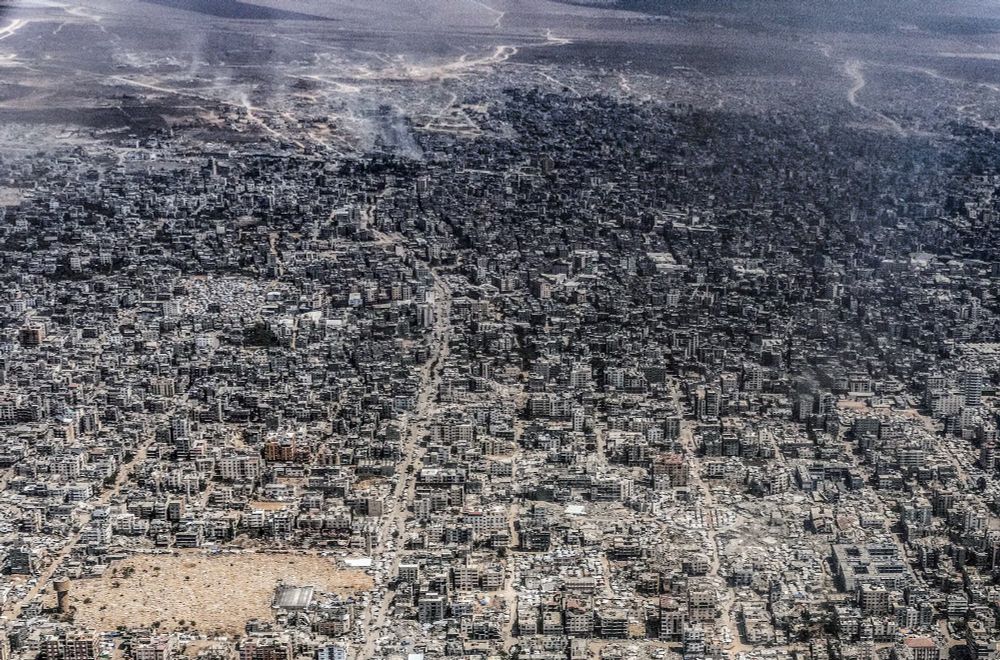
Aerial shot of Gaza City, burned and bombed into burned and shattered, unliveable wreckage as far as can be seen.

Whole area that used to be houses, shops, public transport routes, made into rubble and blackened, unliveable ruins. Aerial shot shows vast area entirely obliterated as habitable, attacked again and again by Israeli forces.
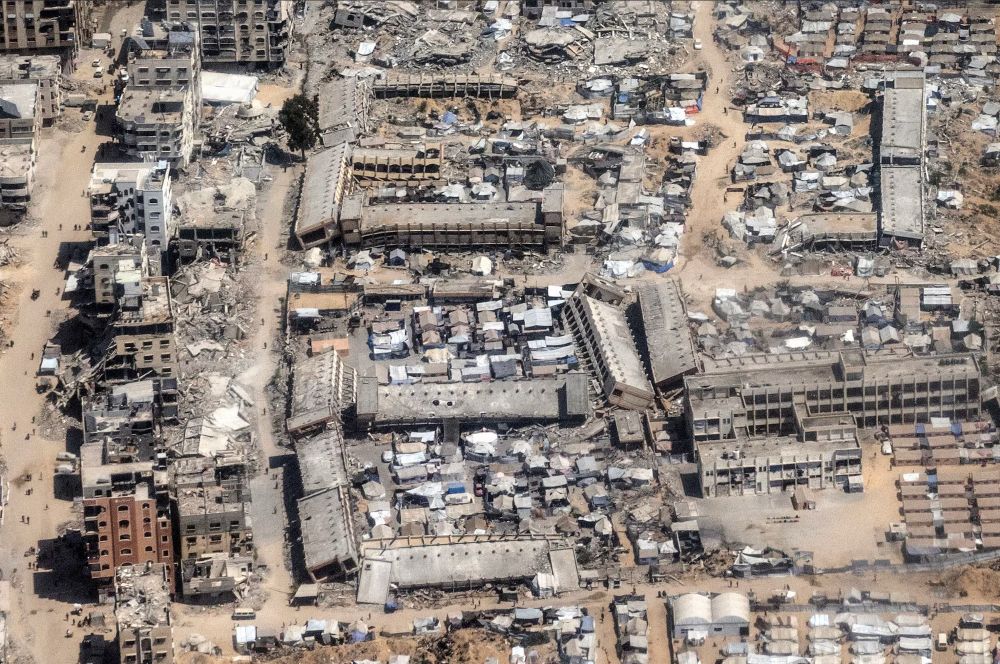
Several wrecked Gaza schools, shown from the air, pulverised by Israel's forces: windows all gaping, bombed out and covered in ash and dust. Some people are trying to live in makeshift camps amid the destruction, in former quadrangles and bomb sites.

Aerial shots of neighbourhoods with destroyed apartment buildings, houses, offices and shops, all bombed by Israel's government. Starving people are trying to live in tents and makeshift cubbies on the former roundabouts on a main road.
This what Israel has done to Gaza. Forbidden pics by a Washington Post photographer whose Jordanian air crew didn't pass on Israel's order to only photograph aid being dropped. City, suburbs, schools, people: bombed to rubble. People being starved in makeshift camps on road roundabouts. #Genocide
03.08.2025 04:31 — 👍 608 🔁 436 💬 17 📌 15
Now published! Note that since Vikram's original post (quoted here), he's made it easy to dynamically update a set of multi-MUMs (e.g. when more genomes are added to a pangenome) and to find multi-MUMs for huge collections like HPRCv2 genomebiology.biomedcentral.com/articles/10....
17.06.2025 14:02 — 👍 53 🔁 22 💬 1 📌 1

Standing up for science in the redwoods :)
07.03.2025 20:26 — 👍 10 🔁 1 💬 0 📌 0
Have done. To avoid Messenger and WhatsApp use signal.org
The best way to beat these Trolls is a) block them and b) Hurt them where it hurts them the most - their wallet and pride!
11.01.2025 17:59 — 👍 105 🔁 43 💬 8 📌 2

Weekly Recap (Nov 2024, part 3)
Pangenome graph construction with nf-core/pangenome, pangenome graphs, single cell multi-omics, RNA foundation models, Nextflow for B-cell receptor sequencing from nontargeted bulk RNA-seq, ...
New weekly recap: Pangenome graph construction with nf-core/pangenome, pangenome graphs, single cell multi-omics, RNA foundation models, Nextflow for B-cell receptor sequencing from nontargeted bulk RNA-seq, ... https://blog.stephenturner.us/p/weekly-recap-nov-2024-part-3 🧬🖥️🧪
22.11.2024 11:10 — 👍 31 🔁 6 💬 0 📌 0
A platform for life sciences. Publications, research protocols, news, events, jobs and more. Sign up at https://www.lifescience.net.
Incoming DDLS Assistant Professor, Data Science and AI
division, Chalmers University | Formerly at JHU-LangmeadLab, UNIL-DessimozLab, WUR-deRidderGroup | Pangenomics for studying genome variation and evolution | Hiring PhDs/Postdocs CGRLab.github.io
The goal of the Canadian BioGenome Project is to produce high-quality reference genomes 🧬 for all Canadian species 🌎
Sequencing Canada's Biodiversity 🌿🦋🐍🧬🐢🦌🐸🌳🐿🐙🦈🦦
Learn more: https://linktr.ee/canadianbiogenome
The Earth BioGenome Project (EBP), a moonshot for biology, aims to sequence, catalog, and characterize the genomes of all of Earth's eukaryotic biodiversity over a period of ten years.
🌲Keep up with all EBP updates: https://linktr.ee/earthbiogenomeproject
PhD Student @ JHU Langmead Lab
The new foundation for documents: Limitless power to write, create, and automate anything that you can fit on a page.
Postdoc on high troughput bioinformatics @ KIT Karlsruhe;
IMO, ICPC, Xoogler, Rust, road-cycling, hiking, wild camping, photography
The SIB Swiss Institute of Bioinformatics is an internationally recognized non-profit organization dedicated to biological and biomedical #DataScience.
We provide essential resources, expertise and services and represent Swiss bioinformatics.
FAIRsharing content & community lead, partial to good research data management, (meta)data standardisation and the FAIR principles.
Works at @ox.ac.uk
https://www.unimedizin-mainz.de/medizinische-mikrobiologie-und-hygiene/
#DGfI #DGHM #EFIS #IUIS / 🦖☄️🦠🔬🧫🐁🧍/ #immunometabolism / #host-pathogen interaction / 🇪🇺 / #UM #JGU: excellence in basic research and health care / own views only
Passionate about the complexity of genomes 🧬🔬➡️💻
Bioinformatic consultant at S-line Bioinformatic consulting and scientific director for @wiseancestors.bsky.social
🌱
Views are my own.
Die DFG ist die größte Forschungsförderorganisation und die Selbstverwaltungsorganisation der Wissenschaft in Deutschland.
www.dfg.de
Impressum: https://www.dfg.de/de/service/kontakt/impressum
Social Media-Netiquette: https://www.dfg.de/de/service/presse
Genome assemblers and their friends. Postdoc at https://genomeinformatics.github.io/
Studying genomics, machine learning, and fruit. My code is like our genomes -- most of it is junk.
Assistant Professor UMass Chan
Previously IMP Vienna, Stanford Genetics, UW CSE.
surfer, dad, (former) neuroscientist, research technologist, entrepreneur, open science advocate, sometimes writer.
PhD candidate | Comparative Genomics | Population Genetics | Environmental Engineering
🏞️🐻🧬💻
Researcher in @BonsaiSeqBioinfo
Lille, France. Bioinformatics, data-structures for DNA/RNA.
Research scientist. I like algorithms, bioinformatics, computer science, and HPC.