What’s your end of the year task? Cleaning all the reason we use in half a year. Of course on an indestructible Amersham era pump with its detector intact
12.12.2025 17:54 — 👍 15 🔁 0 💬 0 📌 0
@klausenhauser.bsky.social
🇨🇦🇭🇰 @EPFL_en protein production + structure facility 🇨🇭| ex @ubc @uwaterloo @unige_en | here for #proteins #structuralbiology #xray #cryoem #plants #mountains #politics #transit #urbanism 🐱🐈 staying for the #hottakes | My views here🧪🧬🌱🔬🏳️🌈
What’s your end of the year task? Cleaning all the reason we use in half a year. Of course on an indestructible Amersham era pump with its detector intact
12.12.2025 17:54 — 👍 15 🔁 0 💬 0 📌 0
Seen elsewhere… and was triggered. Don’t think I would set up the void peak that has the lower melting temperature if I only had one chance. The small monomer and higher melting curve in the dotted example however.. don’t trust your AI infographics
11.12.2025 16:46 — 👍 4 🔁 0 💬 0 📌 0
Saw this nice short protocol paper on LI. Not totally HTP but totally feasible in an academic lab. Right in the intersection of drug discovery, automation, structural biology and protein expression. Ps the guys looking for a job downunder!
www.biorxiv.org/content/10.6...

Most protein design binders look the same, bundles of alpha helices or clearly a VHH. But the strategies in getting there are getting more diverse. The pipelines that humans are deciding to use are super interesting. proteinbase.com/competitions...
04.12.2025 07:32 — 👍 2 🔁 1 💬 0 📌 0Lots of fun working on this project! Looking forward to see more and more animations published in the future!
03.12.2025 08:02 — 👍 5 🔁 2 💬 0 📌 0From a pathogenic bacteria…. Of flies
20.11.2025 18:51 — 👍 1 🔁 0 💬 0 📌 0
Let’s wrap things up: my commentary on the Asgard hypernucleosomes.
Congratulations to all the authors of the paper 🍾!
kwnsfk27.r.eu-west-1.awstrack.me/L0/https:%2F...
Cryo-EM reveals open and closed Asgard chromatin assemblies: Molecular Cell www.cell.com/molecular-ce...
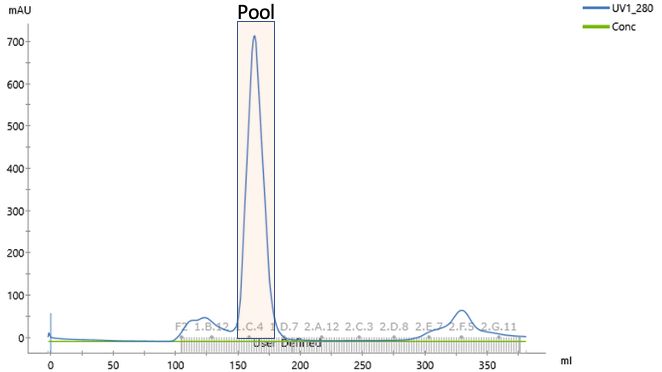
Interesting SEC as well. Hint: putative lectin binder.
20.11.2025 17:21 — 👍 3 🔁 0 💬 1 📌 0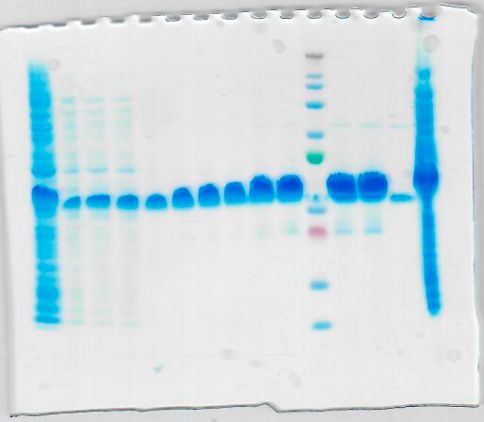
looking back at things to delete. I loved this protein. It makes for fun questions to ask for undergrads.
20.11.2025 17:18 — 👍 7 🔁 0 💬 1 📌 0so good 🥮
18.11.2025 16:04 — 👍 1 🔁 0 💬 0 📌 0always exceptions. but Im still not happy!
18.11.2025 16:03 — 👍 0 🔁 0 💬 0 📌 0#1 lesson I give to protein designers for wet lab purposes : Please design with a Trp and/or multiple Tyr. Please do not design with 10 cysteines.
18.11.2025 13:48 — 👍 18 🔁 4 💬 2 📌 0It looked better in 4K
13.11.2025 18:16 — 👍 2 🔁 0 💬 1 📌 0For-profit journals are supposed to improve research quality, yet they're perversely incentivized to churn out whatever they can monetize. This was happening before AI (see Strain: bit.ly/43gJPUM), and AI will make it worse.
It's insane that we volunteer our time to help them do so.
4/n

A table showing profit margins of major publishers. A snippet of text related to this table is below. 1. The four-fold drain 1.1 Money Currently, academic publishing is dominated by profit-oriented, multinational companies for whom scientific knowledge is a commodity to be sold back to the academic community who created it. The dominant four are Elsevier, Springer Nature, Wiley and Taylor & Francis, which collectively generated over US$7.1 billion in revenue from journal publishing in 2024 alone, and over US$12 billion in profits between 2019 and 2024 (Table 1A). Their profit margins have always been over 30% in the last five years, and for the largest publisher (Elsevier) always over 37%. Against many comparators, across many sectors, scientific publishing is one of the most consistently profitable industries (Table S1). These financial arrangements make a substantial difference to science budgets. In 2024, 46% of Elsevier revenues and 53% of Taylor & Francis revenues were generated in North America, meaning that North American researchers were charged over US$2.27 billion by just two for-profit publishers. The Canadian research councils and the US National Science Foundation were allocated US$9.3 billion in that year.

A figure detailing the drain on researcher time. 1. The four-fold drain 1.2 Time The number of papers published each year is growing faster than the scientific workforce, with the number of papers per researcher almost doubling between 1996 and 2022 (Figure 1A). This reflects the fact that publishers’ commercial desire to publish (sell) more material has aligned well with the competitive prestige culture in which publications help secure jobs, grants, promotions, and awards. To the extent that this growth is driven by a pressure for profit, rather than scholarly imperatives, it distorts the way researchers spend their time. The publishing system depends on unpaid reviewer labour, estimated to be over 130 million unpaid hours annually in 2020 alone (9). Researchers have complained about the demands of peer-review for decades, but the scale of the problem is now worse, with editors reporting widespread difficulties recruiting reviewers. The growth in publications involves not only the authors’ time, but that of academic editors and reviewers who are dealing with so many review demands. Even more seriously, the imperative to produce ever more articles reshapes the nature of scientific inquiry. Evidence across multiple fields shows that more papers result in ‘ossification’, not new ideas (10). It may seem paradoxical that more papers can slow progress until one considers how it affects researchers’ time. While rewards remain tied to volume, prestige, and impact of publications, researchers will be nudged away from riskier, local, interdisciplinary, and long-term work. The result is a treadmill of constant activity with limited progress whereas core scholarly practices – such as reading, reflecting and engaging with others’ contributions – is de-prioritized. What looks like productivity often masks intellectual exhaustion built on a demoralizing, narrowing scientific vision.

A table of profit margins across industries. The section of text related to this table is below: 1. The four-fold drain 1.1 Money Currently, academic publishing is dominated by profit-oriented, multinational companies for whom scientific knowledge is a commodity to be sold back to the academic community who created it. The dominant four are Elsevier, Springer Nature, Wiley and Taylor & Francis, which collectively generated over US$7.1 billion in revenue from journal publishing in 2024 alone, and over US$12 billion in profits between 2019 and 2024 (Table 1A). Their profit margins have always been over 30% in the last five years, and for the largest publisher (Elsevier) always over 37%. Against many comparators, across many sectors, scientific publishing is one of the most consistently profitable industries (Table S1). These financial arrangements make a substantial difference to science budgets. In 2024, 46% of Elsevier revenues and 53% of Taylor & Francis revenues were generated in North America, meaning that North American researchers were charged over US$2.27 billion by just two for-profit publishers. The Canadian research councils and the US National Science Foundation were allocated US$9.3 billion in that year.

The costs of inaction are plain: wasted public funds, lost researcher time, compromised scientific integrity and eroded public trust. Today, the system rewards commercial publishers first, and science second. Without bold action from the funders we risk continuing to pour resources into a system that prioritizes profit over the advancement of scientific knowledge.
We wrote the Strain on scientific publishing to highlight the problems of time & trust. With a fantastic group of co-authors, we present The Drain of Scientific Publishing:
a 🧵 1/n
Drain: arxiv.org/abs/2511.04820
Strain: direct.mit.edu/qss/article/...
Oligopoly: direct.mit.edu/qss/article/...

Good end to a week with a good batch of 🧬✂️
13.11.2025 16:36 — 👍 7 🔁 1 💬 1 📌 0
Want @cytiva.bsky.social please make a Gradient Supedex www.sciencedirect.com/science/arti...
10.11.2025 19:03 — 👍 4 🔁 0 💬 0 📌 0Saw this over on LI. Very slick and rasy to use mask generator. No more tinkering around needed like before. mcalbyrne.com/cryomaskr.html
Video: www.linkedin.com/posts/mcalby...

Cleaning an office and this is my absolute nightmare circa 2008. Thank goodness most people have moved beyond word files and sequences… but not all 😌
05.11.2025 08:43 — 👍 7 🔁 0 💬 0 📌 0Ever since this observation, still haven’t found a pattern
30.10.2025 07:16 — 👍 1 🔁 1 💬 1 📌 0
developer.nvidia.com/blog/introdu...
Will this finally be a codon optimizer that works? Still haven’t ever used a magic bullet but I do know not only the codons but the whole sequence play a big role
I am delighted to share this work, led by Miguel Alcantar and done in collaboration with Amgen, on the OrthoRep-driven evolution of computationally designed minibinders. Here, we focus not only on getting high affinity, but also on mapping sequence-affinity landscapes of diverse outcomes.
28.10.2025 07:33 — 👍 3 🔁 2 💬 1 📌 0No. I don’t feel like I need to do more than I did before. Nor do I do this on any other similar social media. It should just be easy and works, without being intrusive or nasty.
24.10.2025 15:34 — 👍 0 🔁 0 💬 1 📌 0That sounds slightly less scientific :) hallucination has a balance of just random but also truth. Kind of like real dreams
24.10.2025 07:15 — 👍 1 🔁 0 💬 0 📌 0This is most important when I’m scrolling and want to stumble on to interesting papers and findings.
I also understand the moment they make more of an algorithm it’ll be gamed
I think everyone has their reasons and brain sanity and safety is one of the most important. Personally I just don’t find the critical mass nor the type of ephemeral (yet algo forced) connections. Here you have to look to connect vs being fed potential connections.
23.10.2025 22:35 — 👍 1 🔁 0 💬 1 📌 0I think the word itself already gives negative vibes, but red flag level?
23.10.2025 22:26 — 👍 0 🔁 0 💬 1 📌 0We train machine learning models on millions of proteins. But when it comes to making predictions, do we need them to understand all proteins at once? Often, we need an accurate model for the specific protein we are studying or designing. We address this with ProteinTTT arxiv.org/abs/2411.02109 1/🧵
23.10.2025 13:08 — 👍 68 🔁 25 💬 2 📌 0


Just did my multiple choice get to know the country 🇨🇭 naturalization test. Now time for some sauna.. wait that’s the wrong country 🇫🇮 .
22.10.2025 13:35 — 👍 8 🔁 0 💬 0 📌 0Most useful paper I read today
21.10.2025 17:41 — 👍 1 🔁 0 💬 1 📌 0