Very nice modeling work by a great team: @drelenamiu.bsky.social @ndersen.bsky.social @sheinalew.bsky.social @felixthehauskat.bsky.social 👇
22.01.2026 18:13 — 👍 7 🔁 3 💬 0 📌 0
We found that childhood exploration helps individual problem solving, but cumulative cultural evolution drowns out the individual effect
22.01.2026 13:04 — 👍 10 🔁 1 💬 0 📌 0
We set out to understand if childhood exploration drives problem solving and innovation in cumulative cultural evolution
22.01.2026 13:02 — 👍 7 🔁 0 💬 1 📌 0

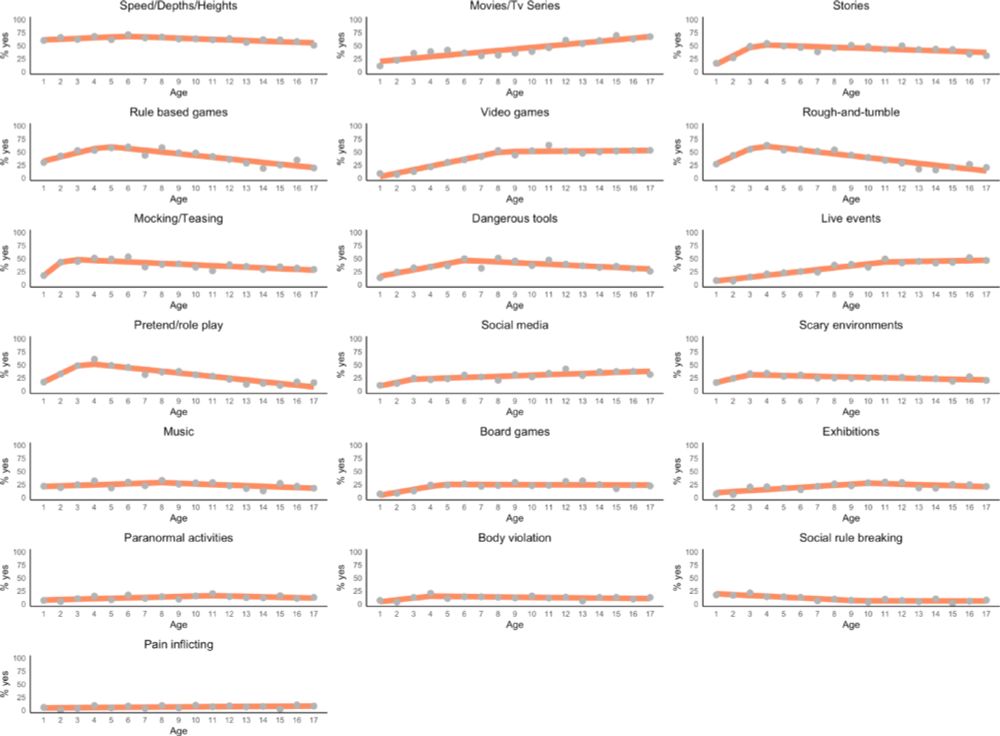
Simulation-based inference with deep learning suggests speed climbers combine innovation and copying to improve performance
Abstract. In the Olympic sport of speed climbing, athletes compete to reach the top of a 15 m wall as quickly as possible. Since the standardization of the
Proc B with @sampassmore.bsky.social! We used simulations to explore the innovation strategies of speed climbers 🧗♀️ Innovation is higher among slower athletes and lower when the population size is larger, and the overall balance of innovation and copying appears to be suboptimal 🔗 bit.ly/499QjZM
08.01.2026 14:00 — 👍 42 🔁 18 💬 3 📌 4

Picture of front cover of Theme Issue entitled "Transforming cultural evolution research and its application to global futures." The image on the front cover is of a Yao honey hunter in Mozambique holding retrieved honeycomb.
Today sees the publication of the Theme Issue featuring the CES Transformation Fund grant scheme. Enjoy! royalsocietypublishing.org/rstb/issue/3...
@durhamdcerc.bsky.social @durhamanthropology.bsky.social @cultevolfunding.bsky.social @culturalevolsoc.bsky.social
04.12.2025 11:07 — 👍 50 🔁 30 💬 1 📌 6
And of course @carlsbergfondet.dk for the financial support.
07.11.2025 11:47 — 👍 2 🔁 0 💬 1 📌 0
Huge thanks to @drelenamiu.bsky.social @felixthehauskat.bsky.social @sheinalew.bsky.social @ndersen.bsky.social for organizing an excellent & true _work_-shop @aiasdk.bsky.social. I go back with a long reading list, tons of notes & food for thought re: extended childhood, innovation & evolution 🙏
07.11.2025 07:59 — 👍 7 🔁 1 💬 0 📌 0
Huge thanks to our organising team @felixthehauskat.bsky.social, @sheinalew.bsky.social, @ndersen.bsky.social, @mathildevm.bsky.social, Luseadra McKerracher, and everyone who joined us from near and (very) far.
07.11.2025 11:40 — 👍 7 🔁 0 💬 1 📌 0

Young chimps play weird with tools and other objects & this can lead to innovation! Moss sponging, doll play, leaf clipping to ask for carrying. If copied and retained, rare kid innovations can contribute to cultural complexity 🧪🔬🐵
My fav article I've ever worked on: www.nature.com/articles/s41...
21.10.2025 12:15 — 👍 84 🔁 31 💬 2 📌 1

How do humans keep inventing tools and technologies that no single person could create alone?
Our new preprint, led by
@anilyaman.bsky.social & @ts-brain.bsky.social
shows that semantic knowledge guides innovation and drives cultural evolution. 🧠📘 arxiv.org/abs/2510.12837
16.10.2025 13:48 — 👍 101 🔁 36 💬 1 📌 0
Fees and Funding - Durham University
@durhampsych.bsky.social current has 5 (FIVE!!) PhD studentships being advertised!
3 to work with me on children as agents of cultural evolution
2 to work with @drboothroyd.bsky.social on examining school-based body image interventions.
Please share and apply!
www.durham.ac.uk/departments/...
11.09.2025 09:12 — 👍 68 🔁 84 💬 0 📌 5

Description of agreement with fertility values. (a) Summary of agreement rates with the value statements for all women, and total completed fertility for post-reproductive women who agreed/disagreed. (b) Posterior predicted probability of agreement with each of the 7 value statements, as a function of the responder’s education.
A study of 22 rural communities in Poland looks at how female friendships influence women’s decisions about how many children to have. Educated women with more emotionally supportive friends outside their kin networks have fewer children. In PNAS Nexus: academic.oup.com/pnasnexus/ar...
12.05.2025 17:37 — 👍 2 🔁 2 💬 0 📌 0
I'm THRILLED that our book is out. This book, with other 60 contributors from across the globe (!!!) is a love letter to the science we want to do, and a how-to guide for how to do it. Please read it and share it!
09.05.2025 16:33 — 👍 91 🔁 39 💬 5 📌 3
Job announcement 🚨: paid fieldwork opportunity with Sanguatsiniq research project! Details in thread ⬇️ Please share!
07.05.2025 09:00 — 👍 27 🔁 38 💬 1 📌 2
So much fun, thanks @masonyoungblood.bsky.social for putting it all together!
02.05.2025 17:24 — 👍 2 🔁 0 💬 0 📌 0
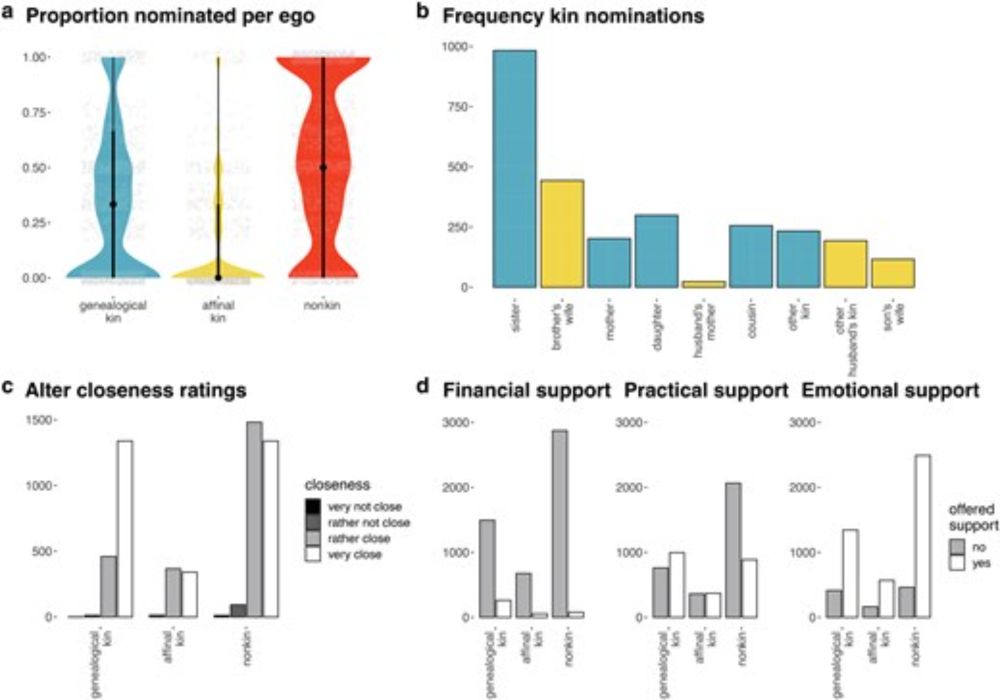
Finally, we propose emotional support as a key moderator of norm change in the domain of fertility, with implications for cultural change more broadly
02.05.2025 12:01 — 👍 3 🔁 1 💬 0 📌 0
We identify changes in friendship composition and in the types of support that flow across these relationships, and link these changes to key reproductive attitudes and values – this shift seems to be driven by educated women who exchange more emotional support with (nonkin) friends
02.05.2025 12:00 — 👍 2 🔁 0 💬 1 📌 0
We focus on close personal networks to understand mechanistically the spread of reproductive cultural norms - we use causal inference techniques and (many!) hierarchical Bayesian models to understand how personal support networks change in communities experiencing social and economic shifts
02.05.2025 12:00 — 👍 3 🔁 0 💬 1 📌 0
This paper is now published. www.nature.com/articles/s44...
17.04.2025 18:25 — 👍 35 🔁 13 💬 3 📌 2

Postnatal dependency as the foundation of social learning in humans | Proceedings of the Royal Society B: Biological Sciences
Humans have developed a sophisticated system of cultural transmission that allows
for complex, non-genetically specified behaviours to be passed on from one generation
to the next. This system relies ...
“the prolonged period of post-natal dependency experienced by infants contributes to development of social learning. Because of motor limitations, infants learn to interact with & act through caregivers, establishing social learning skills that continue to develop as children become less dependent”
18.04.2025 13:43 — 👍 12 🔁 4 💬 0 📌 0

Quote: " In sum, leader-directed teaching of opaque cooperative norms would be a mutually beneficial strategy, where the costs incurred by influential teachers are, at least partly, outweighed by the long-term benefits of cultivating cooperation within the group."

Mosaic plot illustrating the relationship between evidence for teaching and non-teaching social learning, based on a binary researcher-coded measure of teaching.
"Although instrumental cultural transmission frequently occurs through both teaching and non-teaching social learning, opaque cultural information is predominantly transmitted through teaching, with relatively fewer instances of non-teaching social learning."
With @sheinalew.bsky.social: Teaching is associated with the transmission of opaque culture and leadership across 23 egalitarian hunter-gatherer societies, in @naturecomms.bsky.social
#evolution #culture 🧪 #LeadSciSky #CultEvo
www.nature.com/articles/s41...
11.04.2025 07:35 — 👍 46 🔁 19 💬 1 📌 0
I'm glad to be reminded of my favourite lab name!
01.04.2025 16:49 — 👍 0 🔁 0 💬 1 📌 0
New pre-print out with @ndersen.bsky.social @sheinalew.bsky.social @felixthehauskat.bsky.social on how childhood exploration drives population-level innovation in cultural evolution www.biorxiv.org/content/10.1...
01.04.2025 16:48 — 👍 34 🔁 14 💬 1 📌 0
Postdoc @jhucompsci.bsky.social, PhD @uoftpsychology.bsky.social. Computational modeller of social learning, social learner of computational models. https://rgelpi.github.io
Psychologist, but not the kind that can help you
Theoretical biologist
Postdoc @mainzuniversity.bsky.social
Evolution & development, gene regulation, health & disease, symbiosis
And a fondness for the humanities
https://scholar.google.com/citations?user=Sz-2qz4AAAAJ&hl=en
Discover new research from across the sciences and highlights from the world's longest-running journal archive. Part of @royalsociety.org royalsociety.org/journals
phd student building computational models of social cognition + culture @ edinburgh | prev imperial, ucl, inria
https://maxtaylordavi.es
PI Computational Cognitive Science (BoCoCo) lab in Edinburgh 🏴
https://zhaobn.github.io
Cognitive scientist, philosopher, and psychologist at Berkeley, author of The Scientist in the Crib, The Philosophical Baby and The Gardener and the Carpenter and grandmother of six.
Cognitive scientist studying the development of the social mind. Assistant professor at UCSB. 🇨🇦🏳️🌈 (he/him)
bmwoo.github.io
Developmental and cultural psychologist
Research interests: development of religious and cultural concepts; ritual; religion and coping; Indonesia; China
Human Origins | Macro History | Anthropology | Neuroscience | Philosophy
Posting as Ilari Mäkelä, host of On Humans.
https://onhumans.substack.com/about
Archaeologist interested in the evolution of technology.
Research Scientist
Center for Applied Fire and Ecosystem Science,
New Mexico Consortium
31 yo, computational cognitive science 🇩🇰 🇫🇷 @AarhusUni_int
| music producer 📀X2 💿 X1 | also 🐶📸🧗
Computational Social Science researcher interested in Human Coordination and Climate Action. Professor of Data Science at the IT University of Copenhagen. Network Science | NLP | AI agents | Urban Informatics
http://www.lajello.com
Unparalleled reporting and commentary on politics and culture, plus humor and cartoons, fiction and poetry. Get our Daily newsletter: http://nyer.cm/gtI6pVM
Follow The New Yorker’s writers and contributors: https://go.bsky.app/Gh5bFwS
Associate professor, Department of Business and Management // fellow Danish Institute for Advanced Study & Digital Democracy Center, University of Southern Denmark
Researching primate behaviours | Postdoc at UZH Evo Anthro & NCCR Evolving Language | Former Postdoc at MPI Animal Behavior & DPhil at Oxford Biology | Tools & Culture, Language Evo, Development & Senescence | He/They 🌈
researcher at DLCE, MPI-EVA, Leipzig, Germany.
personal website: https://sites.google.com/site/hedvigskirgard/home
#rstats tumblr: https://hedvigsr.tumblr.com
Maps of Oceania Facebook group: https://www.facebook.com/groups/2115775865310795
Attender of meetings at the University of Lausanne. #culturalEvolution #geneCultureCoevolution #appliedCulturalEvolution #evolutionCooperation #coordination #socialNorms #humanEvolutionaryEcology
Senior Lecturer in Psychology | comparative cognition & cognitive development | open science | kidney transplant
I make earrings: https://tinyurl.com/dottysparrowdesigns
Assistant Professor, Cheng Kung University. Cultural evolution, speciation, sexual selection, mathematical modeling. Will post very rarely.