SISB2026
Abstract submission is now OPEN for the 2026 Symposium on the Immune System of Bacteria!
sisb2026.rockefeller.edu
🗓 May 5–7, 2026
📍 Rockefeller University, New York City
⏰ Abstract deadline: March 16, 2026
Attendance will be capped, be sure to register early and secure your spot.
See you in NYC!
11.02.2026 14:05 —
👍 20
🔁 12
💬 0
📌 2
A DNA damage-activated kinase controls bacterial immune pathway expression https://www.biorxiv.org/content/10.64898/2026.02.02.703251v1
04.02.2026 04:16 —
👍 11
🔁 7
💬 0
📌 0

This work constructed a large library of 406 vectors that individually express nearly every protein from 6 phages. We hope this resource will be broadly useful to the field and have deposited a version at Addgene (ID 249629). It should be available soon!
18.01.2026 22:45 —
👍 5
🔁 1
💬 0
📌 0
PD-T2-1 detects diverse phage tail fiber proteins. Proteins like T7gp17 and T2gp34 activate the system, but share virtually no amino acid identity. How? We hypothesize this system may detect the peculiar trimeric β-helix structure that each tail fiber adopts (but we don’t really know!)
18.01.2026 22:45 —
👍 0
🔁 0
💬 1
📌 0
One of the more peculiar phage defense systems that we better characterize in the final version of the paper is PD-T2-1. A provisional name that we hope will be updated once it is better understood.
18.01.2026 22:45 —
👍 1
🔁 0
💬 1
📌 0
Check out @toninagy3.bsky.social 's thread from the preprint for highlights of our findings bsky.app/profile/toni...
18.01.2026 22:45 —
👍 0
🔁 0
💬 1
📌 0


The EMBO Gold Medal 2025 was awarded to Tanmay Bharat and David Bikard: https://www.embo.org/press-releases/embo-gold-medal-2025-awarded-to-tanmay-bharat-and-david-bikard/ 🧪
At #CellBio2025, the EMBO Gold Medal was handed over to David Bikard in recognition of his pioneering work on #GeneEditing.
10.12.2025 13:40 —
👍 60
🔁 16
💬 8
📌 1
SISB2026
Check this out for the 2026 SISB (phage defense) meeting in NYC. Mark your calendar! (and note the Zoom option, if needed)
sisb2026.rockefeller.edu
01.12.2025 23:44 —
👍 35
🔁 19
💬 0
📌 5
Last year it was discovered that a single bacterial NLR-like protein can recognize multiple, structurally unrelated phage proteins (Béchon et al, Kibby et al)
Now, a new study shows the same for a plant NLR. Another example how principles of immunity remain conserved from bacteria to eukaryotes
02.11.2025 18:34 —
👍 57
🔁 17
💬 2
📌 0

Thank you to the Blavatnik Family Foundation and The New York Academy of Sciences for honoring our research uniting human innate immunity and bacterial anti-phage defense at @danafarber.bsky.social @harvardmicro.bsky.social @harvard.edu
bit.ly/4pZUDkF
blavatnikawards.org/news/items/t...
09.10.2025 16:44 —
👍 71
🔁 10
💬 4
📌 0

Bacteria use a decoy defence molecule to set a trap for viruses
Some bacterial-infecting viruses use ‘sponges’ to mop up defence molecules, but bacteria can fight back by responding when a sponge captures decoy molecules.
@mfwhite2.bsky.social reviewed both papers in a News and Views and put the collaboration between phage defense systems best: "scientists can confidently conclude that bacterial defences are indeed more than just the sum of their parts" www.nature.com/articles/d41...
08.10.2025 11:14 —
👍 8
🔁 0
💬 0
📌 0

A miniature CRISPR–Cas10 enzyme confers immunity by inhibitory signalling - Nature
Panoptes, an anti-phage defence system against virus-mediated immune suppression, is revealed.
Check out the complementary story from @doudna-lab.bsky.social led by @erinedoherty.bsky.social and @benadler.bsky.social Their work on OptE oligomerization is particularly crucial to completing our understanding of Panoptes. www.nature.com/articles/s41...
08.10.2025 11:14 —
👍 8
🔁 2
💬 1
📌 0
This work was led by @aesully98.bsky.social and was a fantastic collaboration with @benmorehouse.bsky.social + lab. Thanks to all authors including Aravind and Max Burroughs at NIH
08.10.2025 11:14 —
👍 4
🔁 0
💬 1
📌 0
Panoptes guards the CBASS pathway (bacterial cGAS-STING). One facet of this work that I find particularly exciting is the genetic linkage between Panoptes and CBASS, which significantly co-occur in bacterial genomes. What other phage defense systems may be genetically (and functionally) linked?
08.10.2025 11:14 —
👍 5
🔁 1
💬 1
📌 0

Illustration depicting a bacterium under assault by phage. The bacterium “sees” phage immune evasion proteins and protects itself using a newly described antiphage system called Panoptes, named for the many-eyed mythical giant Argus Panoptes. Credit: Clair Huffine Insight Illustrations LLC
Our work on the Panoptes antiphage system is published! Here we find that Panoptes "watches" the cytosol for phage immune evasion proteins–captured in this illustration by Clair Huffine of Insight Illustrations. A beautiful example of the effector triggered immunity paradigm.
08.10.2025 11:14 —
👍 35
🔁 12
💬 1
📌 0

A miniature CRISPR–Cas10 enzyme confers immunity by inhibitory signalling - Nature
Panoptes, an anti-phage defence system against virus-mediated immune suppression, is revealed.
Today in @nature.com , we highlight how a cousin of CRISPR-Cas10, mCpol, establishes an evolutionary trap in anti-phage immune systems.
Check out @erinedoherty.bsky.social and my work from @doudna-lab.bsky.social lab here:
www.nature.com/articles/s41...
01.10.2025 17:56 —
👍 109
🔁 54
💬 3
📌 2

A miniature CRISPR–Cas10 enzyme confers immunity by inhibitory signalling - Nature
Panoptes, an anti-phage defence system against virus-mediated immune suppression, is revealed.
Now online at @nature.com we show how the Panoptes defense system protects against viruses that attempt immune evasion - and expands our understanding of the role of oligonucleotides in immunity.
Check out this work co-led with @benadler.bsky.social here:
www.nature.com/articles/s41...
02.10.2025 03:01 —
👍 55
🔁 22
💬 2
📌 2
New paper online at @nature.com from co-leads @erinedoherty.bsky.social + @benadler.bsky.social !
02.10.2025 03:25 —
👍 29
🔁 9
💬 1
📌 0

Divergent viral phosphodiesterases for immune signaling evasion
Cyclic dinucleotides (CDNs) and other short oligonucleotides play fundamental roles in immune system activation in organisms ranging from bacteria to humans. In response, viruses use phosphodiesterase...
Excited to share our new preprint co-led by @jnoms.bsky.social!
Here we reveal an exceptional diversity of viral 2H phosphodiesterases (PDEs) that enable immune evasion by selectively degrading oligonucleotide-based messengers. This 2H PDE fold has evolved striking substrate breath & specificity.
22.08.2025 19:02 —
👍 43
🔁 28
💬 2
📌 3
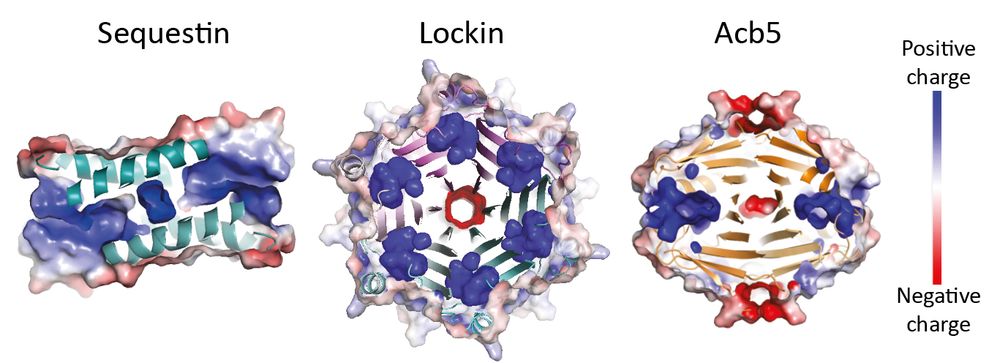
📢Preprint out!
Excited to share my final work from the @soreklab.bsky.social!
We mined phage dark matter using structural features shared by anti-defense proteins (viral tools that help phages bypass bacterial immunity) to guide discovery.
Found 3 new families targeting immune signaling!
13.07.2025 07:48 —
👍 87
🔁 45
💬 3
📌 8
Identifying phage proteins that activate the bacterial innate immune system https://www.biorxiv.org/content/10.1101/2025.07.02.662641v1
03.07.2025 03:16 —
👍 14
🔁 3
💬 0
📌 3